



Does RAM matter? Here’s the top RAM-packed Android smartphones

As device functionality develops and you begin using your smartphone for more resource intensive tasks, the age old question is beginning to rear its head as to if RAM in your smartphone really affects performance that much, and should it play a part in your purchasing decision.
That’s why we’ve listed the RAM installed in the latest Android smartphones to give you an idea of the most common RAM capacity on this years flagships.
Whilst the Samsung Galaxy Note 3 is out in front with 3GB of RAM, clearly the market is currently opting for installing 2GB of RAM into most of the flagship devices. So does a smartphone really need more than 2GB of RAM.
RAM, or Random Access Memory, is a place where data is held temporarily to present to the CPU and is constantly reading and writing to memory blocks at extremely fast rates. Resources running in RAM can be called at a far quicker rate than just from your internal or external storage. Running apps use RAM to performs their tasks so theoretically the more RAM you have the more apps you can have open right? Well, kind of. Android is a lot better at managing applications and allocated memory than it used to be but in the same breath applications are becoming significantly more resource hungry.
So despite only the Samsung Galaxy Note 3 having 3GB of RAM, the smartphone market have opted for 2GB of RAM as the optimal memory to have installed in a smartphone given the current architecture in devices. Couple this with how well Android manages available memory and 2GB is more than sufficient for current resource requirements – go ahead and check out how much RAM memory your device has available.
Whilst 2GB of RAM is sufficient now, the whole story will be different when 64-bit Android is officially rolled out. So back to the original question of if RAM matters in your purchasing decision? The answer is to an extend; it’s not so much of a case of the maximum amount of RAM matters, but more of a case of the minimum, and you should be thinking very carefully before purchasing a device with anything less than 1GB of RAM in 2014.
The post Does RAM matter? Here’s the top RAM-packed Android smartphones appeared first on AndroidGuys.

Autobirds and Deceptihogs coming soon with Rovio’s newest game

Rovio may have just launched Angry Birds Epic and announced its new series, Angry Birds Stella, but that isn’t stopping the company from teasing an upcoming game in the franchise, Angry Birds Transformers.
The company teased the game on Twitter and setup a website for the game. According to the website, all we know is that the birds and hogs are going to look like characters from Transformers, including Optimus Prime, Megatron and Bumblebee, and it’s coming to app stores soon.
Stay tuned to the Rovio’s Angry Birds Transformers website and social media accounts for more information.
Angry Birds Transformers via Twitter
The post Autobirds and Deceptihogs coming soon with Rovio’s newest game appeared first on AndroidGuys.

Internet Explorer test release lets you peek at the browser’s long-term future

While Chrome and Firefox have had experimental browser releases for a while, you’ve usually had to wait for betas to try new Internet Explorer features. Starting today, however, you can be as impatient as you like: Microsoft has launched an Internet Explorer Developer Channel. So long as you’re using Windows 7 or 8.1, you can try new web rendering, interfaces and other features well before they’re part of finished products. In this first release, you can use any USB game controller (including the Xbox 360 pad) for web games that would benefit from console-quality input.
As with other super-early browsers, you’ll likely have to live with some bugs and a general lack of polish. You won’t have to toss out the regular Internet Explorer to use the developer build, though, so there’s should always be a fallback if something goes wrong. As such, you have every incentive to jump in with both feet if you’re the curious type — hit the source link to get started.
Filed under: Internet, Software, Microsoft
Source: IEBlog

Inside Game 5 of the 2014 NBA Finals

San Antonio is known for a few things: the Alamo, the River Walk and the Spurs. In 2014, as was the case last year, the NBA Finals saw the Miami Heat and San Antonio Spurs battle it out for basketball glory, though this time, the team from Texas had the benefit of home-court advantage. For Game 5, which San Antonio ultimately won, the AT&T Center was a full house (it always is, really), packed with fans and a ton of broadcasters, journalists and other members of the media from all over the world. So what’s it like behind the scenes? Let’s find out.
Filed under: Misc, Home Entertainment, HD

Supreme Court will decide when threats made on social media become criminal

We’re still waiting to see what the Supreme Court has to say about Aereo and warrantless cellphone searches, but in the meantime there are more cases to be heard! Including Anthony Elonis v. United States, which the highest court in the nation just agreed to hear. The decision will end up setting a precedent for when violent comments made online cross from protected speech to criminal threats. In 2011 Elonis was sentenced to nearly four in jail for posting status updates and self-penned lyrics on his Facebook page wishing death on his wife, the police and others.
The story really begins back in 2010, when Elonis’ wife left him, taking their two children with her. Around the same time he lost his job at an amusement park in Allentown, PA. His Facebook wall quickly filled with angry updates, some of which painted vivid pictures of the violence he hoped would befall his estranged wife and coworkers. Many of the rather dark posts took the form of raps that Elonis wrote, which he claims were therapeutic and not meant as legitimate threats. His wife however, was uncomfortable about his public professions that his son should “dress up as matricide for Halloween” She obtained a protection from abuse order against him, but this only seemed to fuel his rage.
It wasn’t long after that the FBI caught wind of Elonis’ posts. He was visited by an agent, but not arrested initially. When following that meeting he posted lyrics detailing a fantasy in which he slit his wife’s throat, the agency decided it had seen enough and took Elonis in to custody.
Now the supreme court will have to decide whether or not the Facebook postings crossed a line. The normal standard set for such cases is whether or not a “reasonable person” would feel threatened by the actions. But Elonis’ attorneys argue that isn’t appropriate given the venue for the missives. The defendant’s wife isn’t his friend on Facebook and he did not send menacing messages to her directly, instead he posted them publicly on own wall. Essentially he never meant for her to see what he wrote, and those who saw his words might misinterpret them because they didn’t know him personally. The government’s counter argument is that the law is designed to prevent not just physical violence, but the anguish that perceived threats can cause. Elonis’ conviction has been upheld twice, and regardless of how the court finds, the decision will have widespread implications for free speech, cyber bullying and the internet in general.
Filed under: Internet
Via: The Verge

Domino’s Pizza picks up voice ordering thanks to Nuance

If you thought calling in to order a pizza was an inconvenience then you might have turned to using apps or online ordering systems. Domino’s Pizza is one of many food chains that has a plethora of ways to order a meal without having to call a real person. Today they have announced one more way to get that hot pie to your door. Now you can open the app and place your order with your voice.
Domino’s Pizza teamed up with Nuance and their Nina Mobile voice speech recognition to give you the ability to launch the app and place a verbal order.
“There will be a day where typing on keyboards or with thumbs on mobile devices will come to a close; we want to be the ones who continue to advance the technology experience – hand-in-hand with our customers,” said Patrick Doyle, Domino’s Pizza president and CEO. “Our mobile app users who are a part of this launch are truly helping set the foundation for the innovations of today, that will soon enough become the standards of tomorrow.”
Together, the platform delivers a human-like, conversational customer service experience that allows users to speak an order and quickly add items to their cart.
The voice enabled update is available in the Play Store, so go pick it up if you must. For me, I’ll stick to calling in my orders and talking to real people.
//<![CDATA[
ord = window.ord || Math.floor(Math.random()*1E16);
document.write('’);
//]]>
OS X Yosemite Designed for Retina Screens?
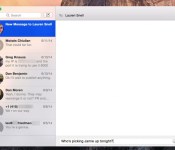
Macworld’s Jason Snell provides a nice hands-on writeup about Apple’s new OS X Yosemite. Snell focuses on the user-experience from a long term Mac user, focusing on the visual and usability changes of Mac windows. He notes the increased use of transparency and the varying implementation of title bars in many applications:

Overall, Snell feels that many of the design changes were done with Retina displays in mind:
For a while now, I’ve thought that 2014 would be the year that Retina spreads across the Mac product line. After spending time with Yosemite on both Retina and non-Retina systems, I’m more confident than ever in that guess. Yosemite’s new design feels like it was built for Retina displays: Thin Helvetica Neue replaces the long-serving but chunky Lucida Grande as the system typeface.
Apple first introduced Retina displays into the Mac line in with the Retina MacBook Pro in June, 2012. Since that time, Apple has been slow to extend Retina screens to the rest of their lineup.
The MacBook Air seems likely to be the next Mac to deliver a Retina Display. Signs point to a 12″ Retina model later this year, and there has already been early evidence in Yosemite of Retina iMacs in testing.

Samsung May Acquire Nuance, the Company That Powers Siri
 Speech-recognition company Nuance, which is responsible for the technology that powers Siri, Apple’s virtual assistant, is in talks with Samsung Electronics about a possible acquisition, reports The Wall Street Journal. The company has spoken about a possible sale with Samsung and other private-equity firms, but it is unclear if a deal has been reached.
The Burlington, Mass., company has recently spoken about a possible sale of the company with Samsung Electronics Co. and private-equity firms, some of the people said. It isn’t clear where sale talks, some of which happened earlier this year, currently stand or if they will lead to a deal.
Nuance is well known for its speech recognition and dictation recognition software, which includes Dragon NaturallySpeaking. It has also formed partnerships with multiple companies, such as Amazon, and released an API for developers. Nuance’s best known partnership is with Apple, however, as its speech and dictation recognition algorithms are the backbone of Siri.
The exact nature of the partnership between Nuance and Apple was unknown for many years as the deal between the two companies was kept secret, but in 2013, Nuance CEO Paul Ricci confirmed that Nuance’s technology powers Siri’s voice recognition capabilities. “We’re a fundamental provider for Apple,” he said at the time.
It is unclear what impact a possible Nuance acquisition would have on Apple’s relationship with the company. Apple may be forced to find another solution for Siri’s voice recognition abilities, but it’s important to note that many of Siri’s functionalities beyond voice recognition come from integration with other companies like Yelp, OpenTable, and Wolfram Alpha.
Back in 2013, a report suggested that Apple may already be working to move Siri development in-house, stepping away from longtime partner Nuance. Apple has a dedicated Siri team in Boston that may be working on a voice recognition solution in the event that Apple is forced to end its partnership with Nuance. Nuance’s talks with Samsung and other parties remain in the early stages, however, as noted above.
iOS 8 brings several enhancements to Siri, including real-time feedback, Shazam integration, hands-free voice activation, and the ability to open the App Store for the first time.

Skybox Can Predict iPhone Launch Using Satellite Imagery

The Wall Street Journal profiles one of Google’s recent acquisitions which has implications on mapping, competitive intelligence and even privacy. Skybox Imaging is an intelligence company that by the year 2018 will be able to take satellite imaging to the next level:
By the time its entire fleet of 24 satellites has launched in 2018, Skybox will be imaging the entire Earth at a resolution sufficient to capture, for example, real-time video of cars driving down the highway. And it will be doing it three times a day.
The ability to take such frequent imaging will certainly aid Google’s Maps product, but it also opens up a market for competitive intelligence. Skybox says they are already looking at Foxconn every week and are able to pinpoint the next iPhone release based on the density of trucks outside their manufacturing facilities.
Google plans on initially using the technology to improve their Maps product, potentially providing more up-to-date satellite images, but Skybox executives have long term plans for offering their data to outside developers for a fee.

Kyocera Hydro XTRM (T-Mobile Business) Review

At First Glance
The Kyocera Hydro XTRM is a 4G LTE capable Android powered handset with an IP57 Rating against water and dust. This device is available in the United States (see: U.S. Cellular), on the T-Mobile Business and MetroPCS networks. Maybe it’s just me but I feel the Samsung Galaxy S5 Active borrows a few design cues from the Kyocera Hydro XTRM; however, stylistically this is pretty standard with durable devices these days.
Design and Hardware
The XTRM features a standard dark panel around the display with average bezels around the sides. The top and bottom, however, have quite a bit more bezel, providing less of a screen-to-device ratio than we would have preferred.
Around the sides, there is a thick border trim that almost feels like a bit of a metal border. On the rear of the device, you’ll have a removable “micro diamond-cut” plastic battery door with an O-ring seal to protect against water.
There’s a 2000mAh removable battery packed in, with microSIM and microSD card support. The dual-core Qualcomm Snapdragon S4 Plus SoC (MSM8960) powered at 1.2GHz runs the device with 1GB RAM, and allows for basic/standard smartphone. It, of course, also comes with your basic GPS, WiFi, Bluetooth, etc. Memory will be 4GB, with only 1GB user available, however storage can be expanded via a MicroSD card up to 32GB.
Display
With a color plastic overlaid TFT LCD display and 480 x 800 resolution, the 4-inch display isn’t wonderful but gets the job done without looking bad or vastly hindering visibility. It’s worth noting that this unit feels much smaller in hand as compared to other smartphones on the market.
Durability

The Hydro XTRM can sit under water (~1m deep) for up to 30 minutes and is dust and shock resistant. In other words, you’ll be better protected against accidental damage than with most other devices. To be extra safe, it is always best to ensure that the battery door with the water-seal is fully and securely tight and sealed before getting this phone anywhere near water. This smartphone does not have any of those potentially annoying MicroUSB or headset port covers, yet manages to be water resistant.
We’ve dunked this phone in water, dropped it here and there, ran water directly over the device and much more; the Hydro XTRM was not phased by any of our bad behavior. It’s able to take life’s spills without problems, but do remember the phone should not be used regularly underwater and should be dried immediately after getting wet of course.
Sound Quality
Audio quality was surprisingly pleasing with this device. Our test calls proved to be loud and crisp, which we expected as many users will be using this phone around construction or loud noise areas. The area where we were most impressed by was the speaker/speakerphone volume which was loud but not as quite crisp as the earpiece.
Software and Battery Life
This smartphone runs Android 4.1.2 Jelly Bean out of the box. While certainly not the latest, it definitely runs just fine and is compatible with most everything found on the Google Play Store. There is, of course, a small downside to not having Android 4.4 KitKat. Specifically, we’re referring to usage of resources and security improvements. Hopefully we’ll see an update at some point for this model.
Kyocera has a bit of a funky skin running over 4.1; frankly, it reminds me of Android 2.3 manufacturer overlays (with a 4.1 hybrid style). Simplicity was kept in mind, while keeping the best features of Jelly Bean.
Battery Life is tricky with this phone, averaging at around 5-6hrs with light usage with data on. Strangely, on some days with heavier usage we received around 10-14hours, or the polar opposite of 3-6hrs. Sadly, it was pretty inconsistent in our testing. It is worth mentioning that the coverage area during testing was being upgraded on T-Mobile which may have contributed to the fluctuation in consistency. The phone does features a Battery ‘MaxiMZR’ similar to other Power Saving modes with other devices, something we have yet to see in stock Android in even the latest versions as of the publish of this article.
Camera
There is a 5-megapixel camera on the rear of the phone with a 1.3-mgapixel front-facing shooter. Both are pretty basic in terms of quality with no standout features to share here. Note there is an LED flash included on the rear of the phone.Overview & Cost
This device did take a bit of getting used to as a daily driver during our testing period as we came from a higher powered smartphone. Indeed, we noticed the differences after using something more robust. Average, and first time buyers, though, may not see any visible lag or under-performance. Kyocera sticks to what’s important for industrial users and the more accident prone customer. If you are looking for the latest and greatest (with or without element resisting features), this device is most certainly not for you.
The Hydro XTRM is a great choice for those needing a basic and durable Android smartphone that can handle the elements. Summarily, it’s a decent 4G LTE handset with essential functions and few extra gimmicks.
Whether you need this as a basic device, backup, or nearly weatherproof phone, check out the XTRM. U.S. Cellular has recently discontinued this model however you can find the Kyocera Hydro XTRM at T-Mobile Business (pricing varies) and for $79.99 at MetroPCS.
The post Kyocera Hydro XTRM (T-Mobile Business) Review appeared first on AndroidGuys.
 AIVAnet