


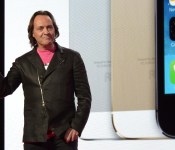
T-Mobile Test Drive lets you borrow an iPhone 5s for a week

T-Mobile clearly wants you to become a customer — the company’s “UnCarrier 5.0” move will get you an iPhone 5s to try out for a full seven days. At an event in Seattle today, the carrier introduced Test Drive, a service that will help customers avoid “buying blind,” giving you an opportunity to experience LTE at home before you commit to making a purchase. The service launches this Sunday and lets you borrow Apple’s latest handset for a week, at which point you’ll need to return the device to any T-Mobile store, even if you plan on signing up and purchasing a device.
After you sign up on T-Mobile’s website, the carrier will place a hold on your credit card in the amount of $700. Your loaner device (typically a refurb unit) will arrive with two-day shipping, and the clock starts ticking the moment you sign for the package. You’ll have free unlimited access to talk, text and data within the US (T-Mobile doesn’t want Test Drive to become an international loaner phone service, so this device is for domestic use only). A T-Mo rep will call you on day two to see how the test is going, and you’ll get a few reminders as the big day draws near.
If you return the phone with a cracked screen, water damage or entirely non-functional, you’ll be charged a $100 fee. The same penalty applies if you lose the iPhone — if you simply keep the device (which you’re absolutely not supposed to do), you’ll be responsible for the full $700. It’s available only once per household, so no, you can’t simply sign up again each week and avoid paying for a phone altogether. T-Mobile isn’t the first carrier to run such a program — Verizon’s own “test drive” ran from 2007 through 2009 — but reps appear to be committed to the initiative, with Test Drive set to continue indefinitely.
Filed under: Cellphones, Mobile, Apple, T-Mobile
Source: T-Mobile

On T-Mobile, you can now stream music without hurting your data plan

Streaming music on your phone would be fantastic — if it weren’t for all those pesky data caps. T-Mobile’s latest UnCarrier move addresses this particular pain point: Starting today, you’ll be able to listen to all of your favorite jams on popular streaming music services without it counting against your data plan. The catch? It’s limited to a few of the most popular offerings, such as Pandora, Spotify, iTunes Radio, iHeartRadio, Slacker, Rhapsody and Samsung’s Milk Music. T-Mobile exec Andrew Sherrard explained that the aforementioned services encompass 85 percent of what users listen to, so the list covers the vast majority of the carrier’s consumers. That said, Sherrard said that the company plans to reach out for feedback via a social media campaign, so make your voice heard if you’re interested in getting services like Rdio or Google Play Music added to the list. If your favorite program is included, feel free to start filling up those playlists to your heart’s content.

The offering sounds great, and it may be a well-intentioned feature meant to shake up the industry, but not all of it is made of puppies and happy unicorns. Net neutrality advocates aren’t going to love this announcement, as it gives preferential treatment to different types of data. The fact that customers can download as much data as they want — as long as it’s one of a pre-selected group of streaming music services — flies in the face of treating all data equally. It’s a small move, indeed, but if it becomes popular with consumers, it may give those who campaign against net neutrality more leverage to add to the fight with other providers.
This move is part of what T-Mobile is referring to as UnCarrier 6.0. (Test Drive, announced earlier, was part of UnCarrier 5.0. Confused yet?) But that isn’t everything the company announced tonight: A feature called UnRadio is bundled in as well. The feature is essentially a T-Mobile-branded radio station which is the result of a partnership with Rhapsody. If you’re on the Simple Choice rate plan, you’ll get access to Rhapsody’s entire music library for free. You won’t have to worry about advertisements or limits on how many skips you get, and UnRadio will also offer a large number of terrestrial radio stations. And just as with T-Mobile’s other music-related announcement, data plan will remain unaffected. If you’re not on the Simple Choice plan, you can fork out $4 a month to enjoy the service.
Filed under: Cellphones, Wireless, Mobile, T-Mobile

Austin: Engadget Live is this Friday!

If you’re going to be in Austin, TX this Friday, June 20th, join us as we kick off our Engadget Live series at the famed Austin Music Hall, 7PM sharp! Come join your fellow Austin gadget lovers and the brands that excite them for an incredible night.
One of the brands you’ll get to interact with is Austin’s own Chaotic Moon. The production studio will be showing off the untitled follow-up to Shark Punch (which taught us what the ocean’s greatest predators looked like inside-out). One player will put on an Oculus Rift and drive a virtual Jeep, while a second uses an iPad to drop bombs on the other’s vehicle. Insane, right?
Some more brands you can expect to interact with at Engadget Live include: Atlas Wearables, Charmed Labs, Huawei, Optical Cables by Corning, Plum, Re3D, Snakable, Techjango, TiVo, Vapshot and Zero Motorcycles.
So if you’re still trying to figure out what to do this Friday night, let us just solve that for you right now. Go get your tickets for Engadget Live and join us for an insanely good time.
Filed under: Announcements
Source: Engadget Live (Austin)

You can preload all your new PS4 games starting next week

One of the roadblocks to really enjoying an all-digital game collection is that it’s a lot faster to drive to the store and buy a new PlayStation 4 release at midnight than it is to snag it off of the PSN Store. Sony’s been prepping a fix for this for awhile now, but we thought it wouldn’t be starting until this fall. That changes today, with a post on the PlayStation Blog stating that any purchases made on or after May 20th this year will take advantage of the games automatically downloading and installing in advance, and the first big title to do so is next week’s Transformers: Rise of the Dark Spark. Next up after that is the DLC pack for Infamous: Second Son, dubbed First Light, and then holiday season heavy hitters like LittleBigPlanet 3 and Dragon Age: Inquisition. Curiously missing, however, is the remastered version of The Last of Us due out next month. This feature is coming to digital preorders made on the PS3 too, in case you haven’t upgraded just yet, too. Pretty handy, right?
Filed under: Gaming, Home Entertainment, HD, Sony
Source: PlayStation Blog
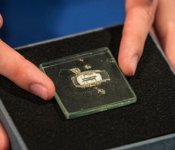
A 56-year-old prototype of the first microchip going up for auction

Without the integrated circuit (IC) basically none of the things you take for granted in your life would exist. And it’s not just your smartphone, tablet or laptop. Your TV, microwave even your car is loaded with microchips. Auction house Christie’s will be selling-off an early prototype of the integrated circuit built by Jack Kilby in 1958 while he was working at Texas Instruments. That was the year that he, along with Robert Noyce, first demonstrated a functioning IC which combines multiple electronic functions on a single slab. Most often that is silicon, but in the late 50s Kilby turned to germanium. Now you have a chance own a piece of computer history, which Kilby and his team eventually one a Nobel Prize for in 2000. Of course, you’ll need to come up with the estimated $1 to $2 million the chip is expected to fetch at Thursday’s auction.
Filed under: Misc
Via: Live Mint
Source: Christie’s

Reuters: YouTube to debut paid music service

With recent criticism that YouTube’s current free video website might block music videos from labels that do not agree to its terms, the Google subsidiary said Tuesday that it plans to launch a paid streaming music service.
YouTube did not comment on the matter, except for stating the service would provide new revenue for the music industry.
“We’re adding subscription-based features for music on YouTube with this in mind – to bring our music partners new revenue streams in addition to the hundreds of millions of dollars YouTube already generates for them each year.”
According to Reuters, who confirmed the long-running rumors, YouTube has partnered with “hundreds of major and independent” music labels for the new service. This news comes after some music trade groups have criticized YouTube’s plans to potentially block the content of certain labels from appearing on YouTube’s “free, ad-supported” website unless they sign deals to participate in the new, subscription streaming music service.
Expected to launch sometime at the end of the summer, the service is said to allow users to listen to music without adds, listen to music offline, listen to an artist’s entire album instead of just individual songs and work in conjunction with the Google Play Music service.
Via: Reuters
The post Reuters: YouTube to debut paid music service appeared first on AndroidGuys.
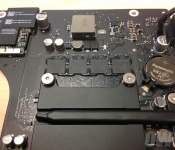
Memory in New $1099 iMac is Soldered and Not Upgradable
The 8GB of memory in the new, cheaper 21.5-inch iMac introduced earlier today is permanently soldered to the motherboard and is not upgradable, according to a teardown of the new machine by Other World Computing.
The $1,099 machine includes a 1.4GHz Dual-Core i5 processor from the MacBook Air, but users are permanently locked to 8GB of RAM. There is no build-to-order option to increase it and it cannot be increased later.

Now that we’ve had time to teardown the new iMac, unlike the $1,299 iMac, we found this iMac has the memory is soldered to the motherboard removing any possibility of adding additional memory. Users will be permanently locked in to the 8GB of memory, as there is no Apple factory upgrade option.
The other 21.5″ iMacs, launched last fall, can be upgraded through the Apple Online Store from 8GB to 16GB. RAM can also be added after purchase, but it requires removal of the screen and is an extremely difficult upgrade.
The current 27″ iMac, on the other hand, has a easily accessed door on the rear of the machine that allows for simple RAM upgrades.

Engadget HD Podcast 402 – 6.18.14

A short time ago, your hosts Ben Drawbaugh and Richard Lawler celebrated the 400th episode of the Engadget HD Podcast and it was a milestone achievement. After this week, however, the show will be on hiatus as we re-envision the future of how we deliver HD and other news beyond the website proper. That doesn’t mean we haven’t packed in a ton of info into this week’s episode, however. The FCC has decided to step in to offer support for municipal broadband and to review the situation between Netflix and ISPs like Comcast and Verizon. A new Slingbox is hitting the market and Comcast’s Xfinity router seems to have developed WiFi capabilities. Of course, it wouldn’t be a podcast without your hosts quibbling about the merits of Michael Bay or Ben giving us some info about either the Lego Movie or the brand’s latest game. If you chose to watch last night’s episode of Fargo instead of listening to the podcast live, we forgive you. But please join us for this week’s edition of the Engadget HD Podcast at the streaming links below. At least for now, we’ll all have a bit more time for HDTV!
Hosts: Richard Lawler, Ben Drawbaugh
Producer: Jon Turi
Hear the podcast:
15:12 – FCC demands that states get out of the way of municipal broadband
17:10 – The FCC is looking into Netflix’s issues with Comcast and Verizon
18:58 – Clarification: Does Xbox One have 10% more horsepower without Kinect?
22:22 – Qplay’s video streaming service is now on Chromecast
31:11 – Netflix is shutting down its API, but helpers like InstantWatcher aren’t going away
39:55 – Netflix’s website is suddenly sporting a fresh logo and brighter background
41:23 – This is the next Slingbox, with WiFi in a smaller (and probably cheaper) box
45:51 – Like it or not, your Comcast Xfinity router may now be a WiFi hotspot
52:48 – IMAX shows why its 4K camera could get you watching 3D movies again
54:40 – A look at how ‘Jurassic Park’ and its CGI dinosaurs changed cinema
59:21 – Amazon stops taking movie pre-orders in pricing battle with Warner Bros.
54:40 – Amazon lines up a drama from writers behind Braveheart and Lost
59:21 – ‘Breaking Bad’ hits Netflix in 4K today
54:40 – What’s on your HDTV this week: World Cup, ‘Fargo’ finale, ‘True Blood’ premiere
Get the podcast:
[iTunes] Subscribe to the Podcast directly in iTunes (MP3).
[RSS – AAC] Enhanced feed, subscribe to this with iTunes.
[RSS – MP3] Add the Engadget HD Podcast feed to your RSS aggregator.
Contact the podcast:

Sharp flaunts Free-Form displays for funky-shaped devices

When Motorola unveiled its snappy Moto 360 smartwatch, the first thing we thought was “how do you make a round display?” Sharp has one answer with its new IGZO-based “Free-Form” LCD prototype that can be sculpted into any shape. The company’s current IGZO tech only works with rectangular displays, where the circuits that drive the LCD live on the perimeter of the screen. Sharp managed to bake those chips into the display itself, allowing for not only a shrunken bezel but nearly any display format you might want. That’ll let designers create much more compact car dashboards, new digital signage, unusually shaped monitors and yes, wearables like smartwatches. That likely won’t include the Moto 360, though, since it’s rumored to have an OLED display. Also, Sharp says that the Free-Form display is nearly ready for mass production, but isn’t quite there yet.
Filed under: Displays
Via: TNW
Source: Sharp

Amazon’s Fire phone has average looks and high aspirations (hands-on)

It was only a matter of time before Amazon launched a smartphone. In the past 10 years, the company’s extended its reach from the online realm into physical hardware, and after the addition of the Fire TV recently, the smartphone was the last major device genre it hadn’t explored. Amazon’s filled that void with the Fire phone, an AT&T-exclusive smartphone that ships in late July for just under $200. CEO Jeff Bezos spent over an hour on stage discussing the new phone’s litany of features and how its uniqueness gives it an advantage over most other handsets the Fire phone will compete with. It’s true: No other devices have six cameras and quick access to tech support, and features like Firefly and Dynamic Perspective help give the device a flavor of its own.
In a crowded smartphone industry, differentiation is critical. Devices that don’t have any stand-out features won’t get noticed amidst the rest of the noise. Fortunately, Amazon’s got nothing to worry about here, but a fancy onstage presentation doesn’t always translate into actual user experience. Let’s take a closer look at the Fire phone to see if our initial impressions match what we saw at today’s announcement.
Excepting the five cameras on the front, the Fire phone looks like an average device. In many ways, the build reminds me of the Nexus 4: Gorilla Glass adorns the front and rear, and the plastic sides reach slightly around the back. With a 4.7-inch display, I had no problem handling the phone — Bezos was adamant that this size is optimal for one-handed use, and although I prefer slightly larger devices, Amazon believes that this size is the “sweet spot” for its users; not too large, but not too small. Its 8.9mm thickness doesn’t make it too bulky, and the back is narrower than the front, so my hand wrapped around it pretty easily.
About those five cameras? Being accustomed to a single front-facing lens on the vast majority of smartphones, a lens for each corner gives the phone a weird look. If you already feel like Big Brother is watching you, the fact that five eyes are looking at you when you use the phone probably won’t ease your worries. Of course, they’re there for a reason: One of Amazon’s unique offerings is its 3D-like Dynamic Perspective feature. The cameras take on a Kinect-like role by looking at where your face is positioned, and how far away it is from the phone. Even though it only technically requires two cameras to do this job, Amazon opted for four just in case some part of your body obstructs one or two of the lenses.
It works as advertised. A lock screen showed a balloon with mountains in the background, and as I moved my head from one side of the phone to the next, I felt like I was peeking around that balloon. This will also come in handy for games: There was a game where I was a snowboarder, and my body moved in the direction that my head moved. I could also lift my head up to make my character do a jump. This could be a fun idea in theory, but it’ll take me a lot of getting used to; each time I moved my head, my hand naturally moved the phone with me, which defeated the whole purpose.

Users with motion sickness will not like the Dynamic Perspective option. It reminds me of the parallax motion on iOS 7, a feature that frustrated a fair number of iPhone and iPad users. Fortunately, Amazon will let you turn this feature off, but execs believe it’s an essential part of the experience. Rob Williams, VP of software, said that customers should be able to do what they want with their phones, but it’s such an important feature that he doesn’t know why anyone would want to use the phone if that feature is turned off.
Firefly is another critical selling point for Amazon. It’s not unlike most QR code readers out there, but it can read several types of information and give you relevant details about that info — and it ultimately stands to be Amazon’s cash cow, since many of the products you scan will give you a prompt to buy it through the retailer’s service. As Bezos claimed in his presentation, Firefly indeed does a great job of overcoming glare; I successfully scanned a CD even though the cover had so much glare that my human eyes couldn’t even figure out what it said. It also does a good job picking up movies, TV shows and music, but I was disappointed to find out that it wasn’t able to understand a song when I sang it.

Another area in which Amazon is trying to be different is its use of gestures to navigate through its three-panel design. Flick the phone to the right to pull up a list of Amazon’s services and features; flick it to the left to get something reminiscent of a notifications panel, which offers upcoming appointments, messages and other relevant information. Slight tilts in either direction trigger what Amazon calls “peek,” which lets you take a quick look at the date, time, battery life and signal. A swivel-motion gesture brings up a fast-access screen that can get you into settings and other basic tools. Granted, you can use your fingers to pull all of these menus up, but it’s handy when you absolutely have to hold the phone one-handed.
The software is Fire OS 3.5, which is a forked version of Android 4.2 Jelly Bean (or the AOSP, at least). However, Williams insists that there’s very little relation between the two, primarily because Amazon has made so many adjustments of its own that it has plenty of different features and new user interface elements on top. As could be expected, Google Play Services won’t be offered on the Fire phone, but there should be a way to sideload APKs. A press of the home button will let you switch back and forth between the app grid and the carousel. The carousel gives you the ability to look at frequently (and recently) opened apps, and each app can list off some recent notifications — for instance, the USA Today app shows breaking news stories; the email app shows recent emails; and the calendar app offers up your next appointments. As for the app grid itself, you can put apps in whatever order you want, as well as add extra content like books, websites and other specific items.

Oddly, the Fire phone won’t launch with Bluetooth LE, though Williams confirms that the hardware does support it. This likely means the phone will get updated with software support for the spec eventually, but Amazon couldn’t give me any official confirmation on when this will take place. And this is going to be a huge negative for anyone who owns (or is thinking about buying) wearables, since many of them rely on Bluetooth LE to connect to the phone. For a flagship product launching in 2014, this was a bit of a surprise.
Spec-wise, it isn’t the most impressive phone, despite commanding a $199 price tag on-contract ($650 off-contract). But it’s not horrible either — it’s simply what you’d expect from an average phone. Of course, Amazon’s focus is on what makes it unique; the gestures, imaging prowess, Dynamic Perspective and Amazon services are differentiating factors that it can boast over other smartphones. Its exclusivity with AT&T limits the number of people who will want to buy the phone, unfortunately, and Amazon isn’t interested in selling it as a WiFi-only device. “Using a phone as anything other than a phone isn’t realistic in today’s world,” Williams said. That said, he also emphasized that this is just the beginning: While he wouldn’t confirm any future products, he said that Amazon didn’t invest multiple years into these features for just one device.
Zach Honig contributed to this report.
Amazon’s Fire Phone. Will you get one?
Filed under: Cellphones, Mobile, Google, Amazon
 AIVAnet