


Hidden ‘City Tours’ Flyover Feature for iOS 8 Maps Discovered in Beta 2
One of the many new features coming in iOS 8 that Apple did not directly address during its Worldwide Developers Conference is “Flyover city tours”. The feature is not currently available by default to those running iOS 8 betas, but developer Pierre Blazquez has discovered how to unlock Flyover city tours and partnered with Mac4Ever [Google Translate] to publish a video showing the feature in action for Paris.
At the moment, only the cities of Rome, Stockholm, Barcelona, New York, Paris, Glasgow, Cape Town, Perth, Bordeaux and the San Francisco Bay are available. One imagines that the visit was carefully prepared manually, and the list is therefore extend gradually over time.
Apple’s Maps app received significant criticism following the shift from a Google-powered app to an in-house version for iOS 6. But over the past two years Apple has continued to improve existing features and build out new ones to better compete with Google Maps. The Flyover feature showing 3D perspectives of buildings and physical features has been a particular emphasis for Apple, and the company has been working steadily to extend it to new areas of the world and improve the quality of its renderings.
Still, Apple’s Maps team is said to be struggling with internal politics that have resulted in the departure of several key employees. While improvements such as transit information for Maps have been expected for iOS 8, the company mostly glossed over mapping issues with the exception of some new indoor mapping initiatives at WWDC. As a result, it is unclear just how many of the Maps improvements will make their appearance in time for the public launch and how many might be folded into later updates.
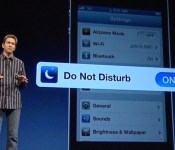
Apple Looks at Using Wearable Sensors to Auto-Adjust iPhone Notifications and Alarms
The U.S. Patent and Trademark Office today published several patent applications describing an iPhone-based system to collect and analyze data from wearable and other types of accessory sensors, reports AppleInsider. Under the system, the iPhone could then track the owner’s activity and respond with appropriate notifications and changes in the device settings.
One patent application, “Method and apparatus for automatically setting alarms and notifications,” describes a method of associating motion data with a set of alarms. In this described invention, the iPhone could detect whether a user is sleeping or awake and adjust the settings for features such as “Do Not Disturb,” for example. These motion data points may be collected from a device that is worn by the user.

In a second patent application, “Method and apparatus for automatically repeating alarms and notifications in response to device motion”, Apple proposes methods to control the timing of notifications that are delivered to an iPhone owner. In this invention, the iPhone can use sensor data to determine when a user is napping and can turn off all notifications until the owner is awake and moving again.
A final patent application, “Method and Apparatus For Personal Characterization Data Collection Using Sensors,” describes how an iPhone-driven system could detect a user’s activity level from “motion sensors, location sensors, ambient light sensors, and the like.” This sensor-based data may be used to create a “personal scorecard” that compares your activity level to others in a group.
A processor-based personal electronic device (such as a smartphone) is programmed to automatically collect data sent by various sensors from which the user’s activity may be inferred. One or more of the sensors may be worn by the user and remote from the device. A wireless communication link may be used by the device to obtain remote sensor data. In certain embodiments, data from on-board sensors in the device–such as motion sensors, location sensors, ambient light sensors, and the like–may also be used to deduce the user’s current activity. In yet other embodiments, user data (such as calendar entries) may also be used to characterize the user’s activty.
As with many patent applications, these inventions may or may not be incorporated into consumer-level products. In this case though, these methods align with Apple’s rumored iWatch device, which is expected to ship with a variety of sensors to measure basic health and fitness parameters. Apple also recently announced a new Health app and HealthKit API that allows for the aggregation of health and fitness data from apps and wearable devices into a central repository that can provide an overview of a user’s relative health.

Google’s Made with Code encourages girls to embrace computer science

Less than one percent of high school girls are interested in computer science, but Google wants to alter that script with a new initiative called Made with Code. Created in conjunction with heavy hitters like the MIT Media Lab, Chelsea Clinton and the Girl Scouts of the USA, the campaign connects girls with coding resources, inspirational videos and more. The effort sprung from Google’s own research showing that kids are more likely to get excited about computer science if they try it at an early age and are shown how it can benefit their careers. It hopes the effort will help girls to not just consume technology, but also use it as a creation tool in whichever profession they choose.
One project will have girls designing 3D-printed Shapeways bracelets using Blockly visual coding and creating animated GIFs or music beats. Meanwhile, The Girl Scouts will introduce its network to Made with Code and encourage them to complete their first coding experience. There are also videos featuring high-achieving women who use programming to fight cancer, create 3D animations and design dance sets, to name a few. Google has also created resources for parents and put aside $50 million over three years to encourage female students to get into computer science. The event will kick off tonight in New York with 100 local teenage girls, who’ll try some coding first-hand and see it used by women like Danielle Feinberg from Pixar. Overall, Google’s message to girls is that coding isn’t just for engineers, but is rather a “tool that lets you write your story with technology.” Naturally, we couldn’t agree more.
Source: Google

Intel launches messaging app that lets you speak through video avatars

It’s easy to think of Intel as a hardware company, the sort of chip-making giant that helps build wearables, cable-free laptops, smart baby onesies. Today, though, the company is showing off software, for a change. The chip maker just unveiled Pocket Avatars, a mobile messaging app that lets you send video messages to friends. Actually, “video messages” doesn’t really describe it. These aren’t so much videos as 3D avatars that happen to speak in your voice. In particular, the app makes use of facial recognition — a pet project of Intel’s — to mimic gestures like nodding, blinking, sticking out your tongue, and raising your eyebrows. All told, it’s a lot of real-time processing, which means the messages are going to be fairly short: You’ve got 15 seconds to say what you want to say.
The app, available today for iOS and Android, includes an avatar store of sorts, where you can download 45 avatars, either for free or 99 cents. Of the bunch, you’ll find some familiar characters, including those from the Lego series, Gumby, Care Bear and The Jim Henson Company (gotta give Intel credit for being thorough in its avatar-making deals, we suppose). In addition to sending to folks in your contact list, you can also post your clips to the usual services — Facebook, Twitter, et cetera. That doesn’t mean you should (we might unfollow you), but hey, at least it sounds less annoying than Slingshot.

NASA wants to explore Saturn’s biggest moon with drones

Despite brisk temperatures of -290 degrees F, Saturn’s giant Titan moon is of great interest to scientists, thanks to Earth-like geography, hydrocarbon “lakes” and even possible life. Though NASA’s Cassini-Huygens probe visited Titan some time ago, the space agency would like to return at some point — this time with a quadrotor. Using the latest drone and sensor tech, it would weigh less than 10kg (22 pounds), deploy from a recharging nuclear “mothership” balloon and acquire high-res images from close to the surface. With the benefit of that reconnaissance, it could land at promising spots, take microscopic photos and scoop up samples to be analyzed later by the mothership. NASA plans to develop the mission concepts further and design the drone in collaboration with AeroVironment — so we might one day see if Titan matches the insane artist concepts.
Via: Sploid
Source: NASA
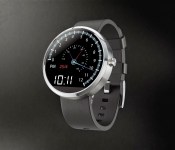
Motorola showcases 10 best Moto 360 designs in Face-Off contest

Motorola today announced it has trimmed its Moto 360 Face-Off submissions down to the top 10. After kicking off in mid-May, the hardware maker received more than 1,300 entries which run the gamut of simple and clean to outright busy and cluttered. A post on Google+ today tells us that now it’s up to us, the fans,… Read more »
The post Motorola showcases 10 best Moto 360 designs in Face-Off contest appeared first on SmarterWatching.
Read the rest at the source, SmarterWatching.com
The post Motorola showcases 10 best Moto 360 designs in Face-Off contest appeared first on AndroidGuys.

Divemachine’s 3D audio tech adds motion-tracking sound to VR headsets

You slave over trying to match the 3D visuals of the Oculus Rift with its audio equivalent, and then what do you do for a promotional image? Someone in an Oculus rift and earphones, and a pair of rendered speakers. Job done. Fortunately, Divemachine is making good progress with its immersive audio system. While VR headsets continue to get better at movement detection and the whole visual-realization-of-a-3D-space thing, audio’s not had so much attention lavished on it. Genetec’s Divemachine platform involves collaboration with environmental sound designers, and connects Oculus Rift headset movements to audio, creating what it’s calling full 3D sound.
Our jungle-based demo wouldn’t make sense to show you on video — it involved us moving around with animal noises and other environmental sounds coming from various directions. Importantly, they matched our head movements too, combining audio output with (in this example) the Oculus Rift’s motion detection. Admittedly, the effect is subtler than the optical side, but we were able to venture towards a thundering waterfall, despite not being able to see it through the trees and undergrowth.
There’s been other 3D audio headsets, like this one which connects to smartphones, but the trick here is matching the visuals with the sound — and you’re (hopefully)already getting a relatively immersive experience from the headset. The company plans to bring a developmental platform to multiple VR headsets in 2015 (it’s not exclusive to Oculus), with the 3D sound talents aiming at more accurate replications of locations. Genetec plans to offer up dedicated contents globally in 2015 — it might want to wait for the consumer products to go on sale for a while.
Filed under: Displays, Wearables
Source: Genetec (Japanese)
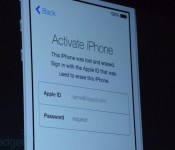
Police say Apple’s anti-theft switches have dramatically reduced iPhone thefts

When mobile sales are booming, smartphone thefts are almost certain to rise. That’s something San Francisco and New York prosecutors George Gascón and Eric Schneiderman have been telling smartphone makers for over a year, but now they’re finally making some headway. After pressuring Apple to implement a “kill switch” inside its devices, the New York Times reports that police officers in London and San Francisco saw iPhone robberies in the cities fall by 24 percent and 38 percent respectively in the six months before and after the company implemented its Activation Lock feature inside iOS 7. Over in New York, robberies were down by 19 percent and those involving grand larcenies dropped 29 percent when the police compared data in the first five months of 2014 with the same period from 2013.
It’s clear to see those small changes are making a difference, and lawmakers have rightly commended smartphone makers for implementing tougher security measures. However, things will move forward significantly from July 2015, when all smartphones sold in the United States will come with an anti-theft tool set as standard. Apple and Samsung are on board, as are Google, HTC, Huawei, Microsoft (and Nokia), Motorola and the country’s biggest wireless carriers. It could save collective total of $2.5 billion a year in replacement costs and insurance fees, and some major headaches too.
Filed under: Cellphones, Mobile, Apple, Samsung
Source: New York Times

‘Games of Thrones’ Season 4 hits Google Play and Amazon just days after the TV finale

The fourth series of Game of Thrones came to its conclusion just a few days ago, but HBO isn’t leaving anything to chance. Knowing that single episodes are smashing piracy records on Bittorrent, the company has quickly made the whole season available to download on both Google Play and Amazon. As it stands, Amazon is the best place to get your Lannister fix, pricing the full season at £16.99 for a standard definition copy and £23.99 for an HD download. Google, on the other hand, has it up for £18.49 and £24.49 respectively. If you’re after individual episodes, prices start at £1.89 on both services, letting you witness some of the biggest battles (like the one pictured above) the seven kingdoms have ever seen.
Update: Tesco is hitting the launch hard too, offering Game of Thrones Season 4 for £17.99 in SD and £23.99 in HD. However, it’s also throwing in 1,000 Tesco Clubcard points and a free 10″ Finest pizza with every purchase.
Filed under: Home Entertainment, Internet, Google, Amazon
Via: Pocket-lint
Source: Game of Thrones Season 4 (Google Play), (Amazon), (Blinkbox)

FCC report checks if your internet speed lives up to the ads, and why that’s not fast enough

Since 2011 the FCC has collected data on the wired (there’s a separate report for wireless) broadband speeds US residents are actually receiving to release in its Measuring Broadband America report, and now the most recent one is here. First, the good news — based on its data (collected from “Whitebox” devices sent to around 10,000 participants that performed automated tests during September 2013), most ISPs were meeting or exceeding their advertised speeds even during peak hours. Four that couldn’t deliver 90 percent or more of their advertised rate during peak hours included Verizon, Frontier, Qwest and Windstream — all of which can expect a letter from the FCC asking why not, for whatever good that will do. So if ISPs are delivering 101 percent of advertised speeds, why are users still seeing buffering notifications and experiencing slowdowns?
[Image credit: Bloomberg via Getty Images]

There are a few reasons (not including the shameful state of U.S. broadband former commissioner Mike Copps called out in recent comments), and one that it looked closely at is consistency. The way the FCC’s report measures that, is by showing how many of the service’s customers get a certain percentage of the advertised speed, a certain percentage of the time. With the bar placed at 80 percent of the customers, 80 percent of the time, the only services pushing higher-than-advertised download speeds were Verizon FiOS and Cablevision. Another issue is that DSL lagged behind cable, fiber and even satellite in being able to meet its advertised speeds — averaging 91 percent of the promised download speeds during peak periods, as compared to 102 percent for cable.

Of course, as everyone has recently become familiar with, another issue is apparent slowdowns at “certain interconnection points” during the test period. The FCC didn’t include that info in this report, but says it will have new tests ready to measure the impact of network congestion by the testing period planned for later this year. It’s working with services like Netflix, YouTube and Hulu to analyze the data, and previously announced it was looking into the interconnection deals between Netflix and Comcast/Verizon. In a separate blog post, the FCC specifically called out drops in broadband performance during times when internet middleman Cogent was having its disputes, and says it will release the raw data it collected.
Also, data on interconnection congestion will be made public, & @FCC will work w. Netflix, Hulu & others 2 further analyze.
– Gigi Sohn (@GigiBSohnFCC) June 18, 2014
The million dollar question(s) however, are how this report will play into the commission’s actions on net neutrality, peering agreements and proposed mergers by communications giants. If DSL doesn’t measure up as a competitor to cable, does this mean the Time Warner Cable / Comcast deal shouldn’t go through, but maybe AT&T / DirecTV should? And who exactly is telling the truth between Netflix and the ISPs? The FCC is receiving more scrutiny than ever about its handling of all of the above — if you need some supporting info for your comments, just hit this link.
Filed under: Home Entertainment, Internet, HD, Verizon, AT&T
Source: Measuring Broadband America 2014, Internet Traffic Exchange, FCC (1), (2) (PDF)
 AIVAnet