


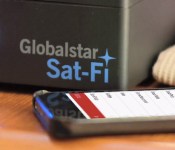
Globalstar Sat-Fi satellite hotspot available now for $999

Globalstar, the company behind the affordable Spot satellite phone, has a new device on the market that can turn any smartphone into a globally connected handset. Sat-Fi is not a WiFi hotspot in the traditional sense — you can’t simply connect and expect limitless web browsing and media streaming — but it can support email, SMS and voice calls for up to eight connected devices simultaneously. Transfer rates are capped at a paltry 9.6 Kbps, so you’re really limited to text applications, and data is billed by the minute, just like a voice call.
Like other satellite devices, you also need a line-of-sight connection between Sat-Fi’s external antenna and the big bird hundreds of miles above in order to make and receive calls, but assuming you’re able to meet that requirement you should be good to go in remote areas all around the world. The device is reasonably priced, at $999, and per-minute rates top out at $1. There are plenty of monthly plans to choose from, too, ranging from $40 for 40 minutes to $150 for unlimited service. Sat-Fi is available now.
Filed under: Cellphones, Wireless
Source: Globalstar

Apple Hiring Siri Engineers for Additional Language Support
Ahead of iOS 8 and the release of several new products later this year that will likely take advantage of Siri, Apple may be planning to bolster the virtual assistant with a range of new and improved languages.
Apple has posted several different job listings for Siri Language Engineers that are “highly motivated and an “expert in foreign languages with strong software development skills.” According to the listings, posted largely between June 10 and June 19, Apple is seeking engineers fluent in Japanese, Norwegian, Turkish, Danish, Australian English, Arabic, Brazilian Portuguese, Swedish, Dutch, Thai, Russian, British English, and Cantonese. Emphasized languages above are not currently supported by Siri.
Come and join the team that teaches Siri how to understand and speak new languages. We are an extremely diverse and passionate group dedicated to bringing the future of intelligent assistants to the world.
Each position’s responsibilities include tasks like developing natural language processing code specific to each language, providing suggestions towards new product features tailored to home markets, and daily interactions with other teams at Apple. Along with fluency in the target language, applicants are expected to have a proven track record delivering product-quality code as well as iOS or OS X development skills and proficiency with Java, perl, and shell scripting.
Apple has previously made several language related hires for its Siri team, recruiting a number of Cloud Services Engineering Interns fluent in a range of languages back in 2012 to work on support for additional languages for the service.

At the current time, Siri understands and speaks English (US, UK, Australia, Canada), Spanish (US, Spain, Mexico), Chinese (China-Mandarin, Hong Kong-Cantonese, Taiwan-Mandarin), French (France, Canada, Switzerland), German (Germany, Switzerland), Japanese (Japan), Italian (Italy, Switzerland), and Korean (Korea).
While the current version of iOS 8 available to developers does not add any additional language capabilities to Siri, it is possible that a Siri expansion is on the horizon for a later version of iOS 8, perhaps iOS 8.1, or iOS 9.
iOS 8, to be released to the public in the fall, does, however, feature a number of other Siri improvements including hands-free “Hey Siri” voice activation, Shazam integration, streaming voice recognition, and the ability to open the App Store.

Withings Debuts ‘Activité’ Fitness Tracker With Traditional Watch Design [iOS Blog]
Withings today unveiled a stylish new fitness tracker, the Activité, which bundles activity tracking capabilities into a traditional-style watch. Unlike smart watch and fitness band offerings from companies like Samsung, Pebble, Nike, and more, the new Activité features a round, analog watch face protected by sapphire glass and attached to a leather band.
Inside, the watch includes sensors that track steps taken and sleep quality, also helping users to calculate calories burned. An included secondary dial tracks a user defined metric, such as distance walked or calories burned. The Activité connects wirelessly to the accompanying Withings Health Mate app.

In an interview with WIRED, Withings chief marketing officer Julien De Preaumont said the company’s mission with the Activité was to have an impact on health with a design people like.
“Our mission is to have an impact on health,” Julien De Preaumont, CMO at Withings, tells WIRED. “That requires devices that we’ll use in the long term.” The Activité is so pared down, the design borders on obvious: “Let’s use the design of a classic watch that we know people like,” De Preaumont says.
Because of its simple design and its limited tracking abilities, the Activité is powered by a traditional watch battery with a charge that lasts up to a year, a far more impressive battery life than many of its competitors.
Withings has an existing fitness tracker, the Pulse 02, along with several other health and fitness related products, including its line of smart scales, a baby monitor, a blood pressure monitor, and an upcoming sleep tracking system, the Aura.
Available in two separate color varieties, black and silver, the Withings Activité will ship this fall for $390.

Cruise aims to make a self-driving car out of one you already own

We’re plummeting headlong into a future of cars that move without us, and you may not have to buy a brand new ride to be a part of it. You see, a startup called Cruise has been showing off a working prototype of its aftermarket RP-1 kit, and it aims to bring self-driving smarts to the car you already have.
Cruise’s system is an awfully neat one: it combines a roof-mounted sensor array with a series of actuators that manipulate the wheel and pedals. Meanwhile, a computer lodged in your trunk sort of sits between the two, chewing on all that road data and issuing commands to the control system. Of course, all of that is invisible to the person in the driver’s seat — one touch on a button installed in the dash toggles the whole shebang on and off. Calling it a full-fledged autonomous driving system is a bit too generous, though. At this point, it’s best to think of it as cruise control plus — Cruise will maintain a set speed and steer to avoid obstacles, but you shouldn’t plan on taking any naps in the back seat.
If all that sounds just a little too good to be true, well, you may be right. Neat as the startup’s tech is, it’s only set up to work on Bay Area freeways and with Audi’s recent A4s and S4s… for now, anyway. Tackling the former is an especially tricky issue since Cruise does all of that road mapping itself; scaling beyond a few locales would likely require loads of time and devotion. Cruise’s tech will set you back a pretty penny, too — it’ll cost you $10,000 to trick out your Audi with the requisite slew of sensors and silicon. That’s hardly the most accessible proposition we’ve ever heard, but if the Cruise team keeps the improvements coming, this just might give Google and its rivals a run for their money.
Filed under: Transportation
Via: re/code
Source: Cruise

Aviate’s ever-changing Android home screen is now available to everyone

Just several months after it first surfaced, Aviate’s self-organizing Android home screen is now available to everyone, with no invitation required. The finished launcher remains focused on presenting just the apps and info you need at the time you need them. You may get news when you’re at home in the morning, navigation apps during your commute or restaurant reviews when out at night. It also categorizes apps to help you find them a little sooner, and plugging in your headphones will both show relevant apps as well as online content related to the tracks you’re playing.
However, it’s clear that Aviate has received more than just new branding since Yahoo took the reins. You can now reach favorite contacts with a swipe up from the home screen, and you can track your sleeping habits. Multiple day-to-day tasks are also just a bit easier; you’ll get commute time estimates based on weather, single-step conference calls and alerts for big changes in weather. I’ve given Aviate a quick spin, and it still isn’t going to satisfy power users who want to fine-tune every last aspect of their Android home screen. However, its simplicity and context-savvy presentation are still appealing — it’s easy to use, and saves a bit of time when checking for headlines or trying to find that new camera app. Provided you like that hands-off approach to managing your phone, you can try Aviate for yourself at the source links.
Filed under: Cellphones, Mobile
Source: Google Play, Yahoo Aviate (Tumblr)

Google wants to sell you your next domain name

Right now, it’s possible to buy a domain name using Google services. You can start the process on Google’s own pages, process the transaction through Google Wallet and manage that domain through Google Apps — but you didn’t actually buy that domain from Google. That’s about to change. Today the search giant announced that it’s testing Google Domains, a registration service that will shift the company away from its dependence on companies like GoDaddy and eNom.
Google says it wants to enable a simple and transparent experience, but it’s not quite ready for a full launch just yet — at present the service is only available to a limited group. When it does launch, however, Google says it will have partnerships with several website building partners, including Shopify, Weebly, Squarespace and Wix. Have an idea for a new website? Check out Google Domains at the source link below and request a registration code.
Via: 9to5 Google
Source: Google Domains

I was shafted by Verizon with my Chromebook Pixel, too

If you follow the tech space closely, chances are good you might have heard about the data problem that some Chromebook Pixel owners have run into. If not, here’s a quick and dirty rundown of what’s happening:
LTE versions of the Chromebook Pixels are supposed to come with two years of 4G LTE through Verizon. Users are/were allotted 100MB of data to use each month. Should a user want or need more data they can purchase a day pass or a big bucket without worrying about a contractual obligation. In other words, it’s not much free data, but it’s perfect in a pinch.
Fast forward to today and we’re hearing that Verizon is no longer honoring the deal. Instead, users are just given options to purchase 4G LTE data. Meanwhile, over on the Google front, the support page for the Chromebook Pixel no longer references the 100MB monthly data. Someone, somewhere decided to stop providing the data and a few users, myself included, are getting pissed off.
Here’s how I was shafted.
As a member of the press I received a Chromebook Pixel at Google I/O 2013. It was the 4G LTE version that’s still available today and the same model that was supposed to come with data. I, too, was to receive my own 100MB of data to use over the course of a month…for two years.
Seeing as how much of my day is spent in a home office with Wi-Fi, I don’t need to rely on data all that much. I tend to spend much of my time in this room, plugging away on a Chromebox.
After about two months of using the Pixel in the house I decided to take the show on the road and work from outside of the house and test out Verizon’s speeds and connections. I bought a 1GB monthly pass for $20 and used a few hundred megabytes of data back in August. Come September I went back to the 100MB bucket for the next few months.
At some point in February I realized I was nearing the 100MB threshold on my Pixel so I tried to purchase the 1GB bucket. Somehow or other I was able to log in with my account but was unable to purchase the data. I did the standard troubleshooting stuff and waited until the next day to try again. Same thing. So, I called Verizon and talked to a rep who said they’d fix the issue and get me onto the right amount of data within 72 hours. Guess what? I waited. Nothing. Not only was I unable to access that data but now I was unable to log into my account. I later learned that my SIM was disabled.
I make another series of calls to Verizon over the next two weeks and try to get back into my account and where things were working properly. I’m told that the first rep I spoke to did not leave correct notes on the account and that they took the wrongs steps. Duh. Without boring you with the details, my SIM card was deactivated and all traces of my history and usage was wiped.
Lo and behold, I ultimate get a guy who gets my SIM running again and I am able to log back into my account. Only problem now is that my 100MB of data is gone. The rep kindly advises that he cannot add the feature to my account and that his supervisor would do it. Once his superior does he will call me to confirm. Another week goes by and still no call.
Weeks after this started I finally get into a representative to tells me that it’s impossible to add that to a SIM card and there’s no way to include it. Instead, I am offered 1GB of data for the remainder of this month (March) plus 1GB of data for the next month (April). The way he saw it, it’s worth far more on paper than the 100MB I was going to get. According to him, he was giving 2GB of data for my troubles. The catch? I had to use it before May.
Great theory, Einstein, but come May I am out of data altogether. If I want any amount of data whatsoever I am forced to purchase it. The part that chaps my ass the most is that this will be the case going forward and at no point will I ever receive 100MB of data. I don’t know about you but I would much rather have 100MB of emergency data to fall back over another 18 months than 2GB that was only good for around 45 days.
It’s the principle, stupid
Did I use all of my 100MB each month? No. Did I foresee using it every month going forward? No. But, what bothers me most is that I will not have even 50MB to use to pull down emails while on the road some day a few months from now. In fact, if I don’t use data on a semi-consistent base with that SIM card I run the risk of it being cancelled on me. In other words, the very day I need to use it for an emergency I might find the SIM is invalid and my account not registering.
I have a very hard time understanding how nobody at Verizon could honor the agreement set forth with the device. I didn’t even get a full year into it and I’m out of luck. Nobody there has the ability to provide that same deal to the SIM card? Fine… what about another one? What about those new Pixels rolling out the door that are supposed to come with it? No one at Verizon thought to offer up one of those SIM cards.
I know, I know. First world problems, right? I should have much worse things to complain about than a free 4G LTE laptop with at least a few months of data. I really haven’t voiced my issues publicly thus far but felt compelled to jump in when I read JR Raphael’s post. It’s related, yet not exactly the same stuff, but something I still felt needs shared.
The post I was shafted by Verizon with my Chromebook Pixel, too appeared first on AndroidGuys.

Three NYC filmmakers are creating a ‘TV series’ exclusively for Instagram

Maybe cord-cutting has gone too far: three New York City filmmakers are publishing their new series exclusively on Instagram. On July 1st, seven 15 second episodes of “Artistically Challenged” will appear on the trio’s Instagram account, with 25 additional updates landing every day after July 7th. After 32 episodes (and 8 minutes of footage) the story will be over — but it’s not the only narrative Instagram video has to tell. Earlier this year Adult Swim split an episode of Rick and Morty into 109 bite size chunks and says its building an entire “micro-network” for smartphone audiences.
Artistically Challenged may be making its public debut on Instagram, but it wasn’t shot on a smartphone. Early production stills show the project’s crew working with DSLRs and proper lighting rigs. The series is being shot professionally — with a crew of more than 25 NYU alumni and students — but is being formatted for the small screen in post-production. It’s certainly a novel idea, but this probably isn’t the future of cinema. Even so, you can catch the series on July 1st right here.
Filed under: Cellphones, HD, Facebook
Source: Instagram, ACtheSeries

San Francisco bans apps that let you buy and sell public parking spots

Anyone who’s ever driven in San Francisco knows that parking in the city can be a nightmare — garages are often expensive and street spaces are almost impossible to find, especially during peak hours. Several parking apps have cropped up to resolve that issue, a few by allowing folks to auction or sell their spots to others. Sounds like a neat way to make money, right? Well, there’s a very important snag: buying and selling public parking spaces like that is illegal. San Francisco City Attorney Dennis Herrera has just issued a cease-and-desist demand today to Monkey Parking, an iOS app that lets users bid for other people’s parking spaces. The letter cites San Francisco Police Code section 63(c) that states: “It shall be unlawful for any person, firm or corporation to enter into a lease, rental agreement or contract of any kind, written or oral, with or without compensation, for the use of any street or sidewalk.”
Individual drivers who violate the law can face up to $300 per violation, and as Monkey Parking’s entire business is based on an illegal premise, the city is requesting that the Rome, Italy-based company end operations in San Francisco altogether. The firm has until July 11th to do so before further legal action is taken — it could be sued for up to $2,500 per infraction under California’s Unfair Competition Law. The city also sent warnings to two other parking apps — Sweetch and Parkmodo — both of which also let you buy and sell parking spots. Sweetch users can pay $5 for a spot from another user and get paid $4 if they help them park and Parkmodo, which has yet to launch, has been offering people $13 an hour to occupy parking spots that they’ll then get to sell. While disruptive services like Uber and Airbnb have run up against city law and survived, the fact that these parking apps charge for already-public spaces likely mean they’re dead in the water.
[Image credit: Getty Images]
Source: SF City Attorney, WSJ

OnePlus One explains why full production is delayed

The OnePlus One showed up on the scene as one of the most anticipated Android devices of the new year. But, due to its low costs and high specs its popularity quickly decreased due to their invite system. This has caused outrage from the public and many former followers of OnePlus have turned against the newly formed company and ridicule its use of contests and invite system. Their slogan “Never Settle” has been turned against them to “Never Selling”. In response to this, OnePlus staff member Carl has posted in their forums addressing the lack of units ready for sale.

In Carl’s own words, “As a startup, survival is a big concern. Sitting with excess inventory is something that can quickly kill us.” To prevent a quick death to the new company, they underestimated the appeal their device would have to the general public and ordered only a small amount of components for building the actual device.
It takes three months to obtain the pieces needed just for the display and touch sensors which are a vital part to any smart phone today. OnePlus wishes to assure everyone that they are doing their best to increase production and get as many OnePlus Ones out there for the public to purchase.
Production is expected to pick up next week just as they had said before, but the production and availability of the OnePlus One is not matching the increase the rise of demand being seen by OnePlus.
The post OnePlus One explains why full production is delayed appeared first on AndroidGuys.
 AIVAnet