



University library starts ‘drone loan’ program for students

There’s good news if you’re a broke University of South Florida student who’d like to take an $1,195 DJI Phantom 2 Vision UAV for a spin: you can now sign one out from the library. Before you start preparing some kind of water balloon-dropping scheme, however, there are a few caveats. First off, all use will be supervised by library staff and you’ll have to take a course in drone operation before you can borrow one of the two available. Secondly, you’ll need a good reason to use it — one approved usage cited by a library supervisor was aerial surveying by architecture students to learn about building layouts. Educational projects aside, however, with the Phantom 2 Vision’s stabilized footage we imagine there’ll also be a lot of sweet aerial mixer videos.
Filed under: Robots
Via: The Verge
Source: University of South Florida
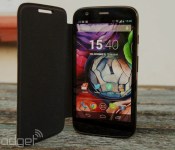
Moto G with LTE and expandable storage is now available for £160

The Moto G is a fantastic smartphone for the price, but Motorola knew it could make the handset even better with just a few small tweaks. Thus, the Moto G with LTE and expandable storage (thanks to a microSD slot) was born, and today it’s become available in the UK after launching in the US last week. Phones 4u has declared first dibs on the device, and is offering the phone free from £19 per month on contracts, for £150 on pay-as-you-go, or £160 unlocked — the retailer is also claiming exclusivity on the new white model until the end of July. A number of other sites are expecting stock sometime this week, at which point we hope to see a repeat of the discounted pricing war that was fought over the Moto G shortly after launch. Hold off a week or two, and we imagine you’ll be throwing £20-£30 less at your screen. Bargain.
Filed under: Cellphones
Apple Rejects Catcher’s 4.7-Inch iPhone 6 Casings Over Defects [iOS Blog]
In April, it was reported that Catcher Technology would be supplying Apple with metal casings for the iPhone 6. Now, China’s Economic Daily News (via Digitimes) reports that Apple has rejected Catcher’s iPhone 6 chassis, instead choosing to place short term orders with longtime supply partners Jabil and Foxconn.
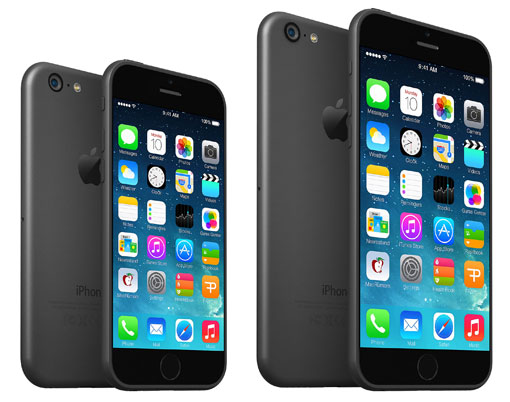
Apple reportedly had issues with defects found in the connecting areas between the plastic and metal parts within the casings, which was caused by Catcher’s anodizing process. The issues with the casings may take 2-3 months to fix, which may require Apple to rely on other supply partners.
Apple’s 4.7-inch iPhone 6 is expected to go into mass production last month for a launch this fall. Reports have also suggested that Apple will also launch a larger, 5.5-inch version of the iPhone 6 at some point, with Bloomberg noting yesterday that Apple may launch both sizes of the device at the same time. In addition to a larger screen, the iPhone 6 is expected to include a thinner design, a faster A8 processor, an improved camera, and more.

Nestle’s working on a kitchen appliance that creates custom vitamin cocktails

If Nestlé’s new “Iron Man” project ends up a success, your morning routine could go like this: 1.) Take a shower. 2.) Eat breakfast. 3.) Brew your very own vitamin supplements. According to Bloomberg, the Nestlé Institute of Health Sciences is developing a device (possibly like its Nespresso coffee-making machines) that can make supplements on the spot based on your body’s needs. Since each dose — which might come in powder or capsule form — is tailored for you, NIHS director Ed Baetge says it’s going to be more effective than anything on the market. Then again, it’s worth remembering that there are many scientists who question the health benefits of vitamin supplements in the first place. Plus, there could be some very high costs involved in Nestlé’s vision: For the vitamin-mixing machine to work properly you’ll have to input your nutrient profile and, according to University of Minnesota researchers, knowing that profile won’t be cheap. It’ll cost at least $50 to analyze the level of each nutrient, and it could cost more than $1,000 for a complete analysis.
We’re in the dark when it comes to how Nestlé plans to analyze user’s bodies since the project’s still in its very early stages, but the company’s just begun talking to a Massachusetts-based scientific equipment manufacturer. As you can imagine, developing a personal supplement maker won’t be as easy as making a coffee maker, so it’ll take Nestlé many years to conjure up a final product. Baetge believes that if he and his colleagues do it right, the machine could be “the next microwave in your kitchen.”
Filed under: Misc
Source: Bloomberg
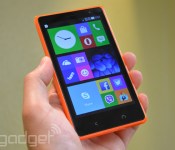
Nokia’s fourth Android phone does dual-SIM for just €99

After the Nokia X, X+ and XL, the Microsoft Devices team is back with its fourth Android-based budget smartphone dubbed the X2 Dual SIM, and the best part about it its €99 (about $135) off-contract price. That’s very attractive given the range’s pretty “inner glow” design, and the specs are also decent for what it is. We’re looking at a 4.3-inch WVGA ClearBlack LCD screen, a dual-core 1.2GHz Snapdragon 200 chip, 1GB of RAM, 4GB of storage, microSD expansion of up to 32GB (plus 15GB of free OneDrive cloud storage), 5MP/VGA cameras and a removable 1,800mAh battery. If this sounds like your kind of phone then look out for it as it goes global in July.
With its 4.3-inch screen, the X2 sits between the X and XL in terms of size, and it feels just right in my hand with a secure grip — the latter courtesy of the straight sides that subtly round off to the curved backside. The unit we got to play with is orange, but you can also get it in green, yellow, dark gray and white. With the exception of the matt dark gray version, these colors come with the series’ signature glossy, translucent plastic casing — which is, by the way, removable to access the Micro SIM slots, the microSD slot and the battery.

As before, Nokia doesn’t emphasize the fact that the X series runs on a heavily skinned Android. The X2 runs on a new version called the “Nokia X Software Platform 2.0,” which looks very similar to its predecessor. Users will find the three similar home screens welcoming you, with the main one featuring a Windows Phone-like tile UI, and you swipe right for the Fastlane for the recent apps, and swipe left for the new apps list that’s basically a carbon copy of the one from Windows Phone. The software felt slick during our brief hands-on, and the 5-megapixel AF camera was similarly responsive. Not a bad package overall.
Filed under: Cellphones, Mobile, Nokia
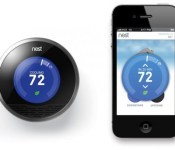
Nest Announces Developer API, Integrates With Mercedes, Google, IFTTT and More [iOS Blog]
Nest Labs today announced the “Works with Nest” developer program, which allows its Nest Thermostat and Nest Protect products to connect to a number of services from the likes of Google, Mercedes Benz, Whirlpool, LIFX and more for enhanced smart-home functionalities.

For example, Nest integration with Jawbone’s UP24 band allows the smart thermostat to begin heating and cooling when a user wakes up, while the Nest Protect can connect with LIFX’s bulbs to warn users of smoke or carbon monoxide. The new program will also allow users to create custom situations with popular service IFTTT, connecting the products to over 100 other products and services.
The Wall Street Journal also notes the Nest Thermostat’s specific integration with Google’s services, which comes after Google bought Nest earlier this year:
The integration will allow those users to set the temperature of their homes with voice commands to a Google mobile app. It will also allow Google’s personal digital assistant, Google Now, to set the temperature automatically when it detects, using a smartphone’s location-tracking abilities, that a user is returning home.
Nest also stated that it will allow developers of garage door openers and similar automated appliances to access and utilize user information. However, Nest co-founder Matt Rogers noted users will have to opt in for their information to be shared with Google, making it a point to emphasize user privacy:
Most of the data that Nest will share – with Google and others – will focus on whether users are at home or not, as detected by sensors on the thermostat. When people link a home device and related account with Nest, the company will not share their email address, name or home address with other companies, Rogers said.
“We’re not becoming part of the greater Google machine,” he said.
The news comes as a number of developers are working on products under Apple’s new HomeKit initiative, which allows home automation devices and their apps to work with iOS services using a single, secure protocol. Companies currently lined up with Apple for HomeKit include iHome, Honeywell, Haier, Philips, Schlage, and Withings.
Last week, Nest Labs announced that it would be acquiring video-monitoring and security startup Dropcam for $555 million to further its smart home initiative. The company also restarted sales of its Nest protect app-enabled smoke detector last week after it was pulled from shelves over safety concerns.
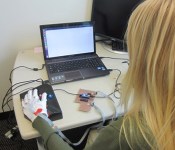
High-tech gloves can teach you Braille even if you’re distracted

It looks like a team of Georgia Tech researchers is in the business of making wondrous, high-tech gloves — their most recent one, for instance, can teach you Braille even if you’re doing something else. Similar to the piano-teaching glove they designed years ago, this new pair has vibrating motors on each knuckle that buzz in different patterns to correspond with preset Braille phrases. To test how well the gloves work, they asked volunteers during an experiment to play a game for 30 minutes while the motors buzz along with audio cues. When the subjects typed the phrases after half an hour, the researchers found their answers to be mostly accurate, with some even getting perfect scores.
Even better, the subjects, who’ve supposedly never studied Braille before, could not only type random phrases after the test, but also read and recognize some Braille letters. As with any new technology, the researchers are still conducting more tests, but the gloves have a huge potential to help with teaching more blind people the language. The wearable might also make it easier to learn Braille (something that’ll take years to master) for those who lose their sight later in life.
Filed under: Wearables
Via: Medgadget
Source: Georgia Tech

Scientists simulate time travel using light particles

We may never see practical time travel in our lifetimes, if it’s possible at all. However, a team at the University of Queensland has given the Doc Browns of the world a faint glimmer of hope by simulating time travel on a very, very small scale. Their study used individual photons to replicate a quantum particle traveling through a space-time loop (like the one you see above) to arrive where and when it began. Since these particles are inherently uncertain, there wasn’t room for the paradoxes that normally thwart this sort of research. The particle couldn’t destroy itself before it went on its journey, for example.
As you might have gathered from the “simulation” term, sci-fi isn’t about to become reality just yet. The scientists haven’t actually warped through time — they’ve only shown how it can work. It could take a long time before there’s proof that whole atoms and objects can make the leap, let alone a real-world demonstration. Should you ever step into a time machine, though, you’ll know where it all started… and ended.
Filed under: Science
Via: Phys.org, IFLScience
Source: Nature Communications
Supposed Screenshot from ‘Android L’ Lands on the Internet
The name of the next version of Android is still very much up in the air, but I think we have narrowed it down to a few names. Lollipop, Lemonhead, and Licorice, seem to be the top of the list of names floating around out there. Well it seems that a screenshot got posted on […]
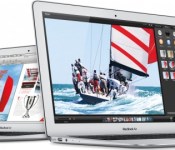
12-Inch MacBook Air to Begin Production in 3rd Quarter 2014
Digitimes reports that Apple’s new 12″ MacBook Air will enter mass production in the 3rd quarter of 2014. Quanta Computer is reportedly responsible for the assembly of the new machine which falls in between the 11″ and 13″ MacBook Air lines. Their sources have not heard of any changes to the existing 11″ and 13″ MacBook Air models.

Digitimes’ sources were able to confirm some small internal changes to the machine, but the new MacBook Air is said to look similar to the existing models:
The 12-inch MacBook Air features some design changes such as the battery and the internal layout, while its industrial design will be similar to its existing counterparts using an unibody aluminum chassis, the sources detailed. Some market watchers expect the machine to feature a Retina display.
First word of a 12″ MacBook Air came from analyst Ming Kuo in October, 2013. Kuo described the new machine as thinner than the existing MacBook Air and that it would incorporate a Retina Display. A Chinese forum post from a user who had previously leaked accurate information added that the 12″ MacBook Air would feature a “new trackpad design” and would have no fan.
Previous rumors have predicted that the 12″ MacBook Air will be announced between Q3 and Q4 2014, so approximately September/October of this year.
 AIVAnet