


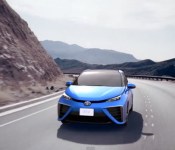
Toyota’s first hydrogen car is priced to go head-to-head with Tesla

Sure, Elon Musk is giving away Tesla patents, but don’t be surprised if more established manufacturers politely decline his offer. Instead of batteries and electric charging stations, players like General Motors, Mercedes, Honda and Toyota are focusing their efforts on a very different sort of fuel system: hydrogen. Toyota has just revealed that its first commercial hydrogen fuel cell car, a sedan modelled on the earlier FCV concept, will be ready for launch in the US and Europe in the summer of next year, priced at seven million yen (around $69,000, although exact international pricing has yet to be determined). By that time, the hydrogen car and its refueling network may lag significantly behind Tesla’s all-electric offerings, which currently start at less than $60,000 for the base model Tesla S with lifetime fuel costs included, but Toyota and other hydrogen pioneers believe that they’ll eventually gain the upper hand, thanks to their technology’s promise of greater range and quicker refueling.
Whereas most Tesla Superchargers take more than an hour to deliver enough charge for a range of 300 miles, hydrogen fuel stations could pump hydrogen gas into a car’s tank in as little as five minutes. This gas is then gradually mixed with oxygen inside the car, producing an electro-chemical reaction that offers comparable cruising range to a tank of gas — around 430 miles, Toyota claims — with no waste products other than water vapor. If there’s a downside to hydrogen, it’s the complexity and cost of gathering, storing and delivering hydrogen at high pressure. Toyota says that it’ll only sell its new car in areas that have some level of hydrogen refueling infrastructure already. However, with Tesla’s Superchargers being so cheap to build and maintain (especially ones that are solar powered), Toyota may find that launching a commercial hydrogen fuel cell car turns out to be the easy part, compared to the daunting task of ensuring that its customers are always near a fuel station.
Filed under: Transportation
Via: CNET
Source: Toyota

Israel is building a futuristic ‘hover-monorail’ that could come to the US

“Ehh, it’s not for you, Tel Aviv — it’s more of a Shelbyville idea.” We doubt a company called skyTran used Lyle Lanley’s pitch, but it just announced that a futuristic train test loop will be built at the Israel Aerospace Industry (IAI) campus in Lod, Israel. SkyTran’s so-called personal rapid transit is a magnetic levitation (maglev) system that’ll propel two-person pods along a monorail-type track. In theory, you’d order a car by smartphone, get picked up at a station and be whisked to your destination. The IAI trial will run at about 45 mph, but future trains will be much faster. If all goes well, the first commercial system will be built at Tel Aviv for $80 million and tracks are also planned for France, India and California. If all this smells of hucksterism, skyTrans is located on NASA’s campus and is a Space Act Agreement partner — it’s not Leonard Nimoy, but it’s something.
Filed under: Transportation
Via: BBC
Source: skyTran
Researchers crack iPad PINs by tracking the fingers that enter them

What’s the easiest way to find out someone’s password? Watch them enter it, of course, using the simple hacking technique known as shoulder surfing. Cameras and software have successfully been used by researchers to automate and improve the accuracy of snooping on smartphone users with such observational methods, but they require a direct line-of-sight to work. Now, as Wired reports, a group at the University of Massachusetts Lowell has developed a way to capture iPad passcodes without needing any kind of on-screen cue. A camera is still required, but because the position of the lockscreen keypad is static, their software references finger movement against tablet orientation to estimate the PIN by the way it’s entered.
Using Google Glass to emphasize how this could done quite inconspicuously, researchers found video from the wearable could capture a four-digit PIN from three meters away (nearly ten feet) 83 percent of the time (or over 90 percent with a little human help). Figures were similar using one of Samsung’s camera-equipped smartwatches, and at the same distance, video from an iPhone 5 increased the success rate to 100 percent. Better cameras unsurprisingly produced better results, and at 44 meters (around 144 feet), a $700 camcorder and a little elevation also scored 100 percent on the test. Understanding that some might be genuinely worried about this kind of carry on, the same researchers are currently developing an Android app that randomizes the layout of the PIN-entry keypad, which they plan to release at the same time they present their work at the Black Hat USA conference in August.
Filed under: Cellphones, Cameras, Tablets, Wearables, Software, Mobile
Source: Wired
iPhone 6 Said to Launch on Friday, September 19 in 32 GB and 64 GB Variants
Apple will look to launch the 4.7-inch iPhone 6 on Friday, September 19, according to a new report from Chinese web portal Tencent (Google Translate, via GforGames) citing inside sources. The news comes after German carrier Deutsche Telekom was reported to be informing customers of a similar release date for the device.
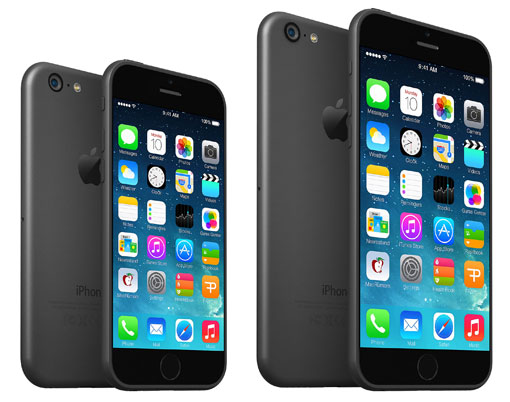
The report also notes that Apple will launch 32GB and 64GB capacities of the phone for 5,288 yuan ($846) and 6,288 yuan ($1008), indicating that Apple may launch the iPhone 6 without a 16GB model. Notably, 5,288 yuan is the current price for the 16GB iPhone 5s in China, while the 32GB iPhone 5s is listed at 6,088 yuan.
A September launch would be consistent with the past two iPhone launches, as Apple also typically launches new products on a Friday. A report from Bloomberg earlier this week also claimed that Apple may launch the larger 5.5-inch version of the iPhone 6 and the 4.7-inch version simultaneously, with previous reports indicating that issues with battery and display technology would hold up the larger device’s launch.
In addition to a larger display, the iPhone 6 is expected to feature a thinner design, a faster A8 processor, and more. The iPhone 6 is also expected to feature an improved camera, with the larger 5.5-inch version exclusively utilizing optical image stabilization and the smaller device featuring an advanced lens module.
Samsung Galaxy Note 4 rumoured to launch after IFA 2014, ready for mass Production
While the Android world’s collective gaze has turned to San Francisco for Google I/O 2014, the rumour mill continues to turn in the background. The latest rumour comes from Korea and says that Samsung is all geared up to mass produce its phablet offering for this year, the Samsung Galaxy Note 4. The report goes […]
Next version of Android apparently confirmed as Android 5.0 Lollipop by Insider
One of the things that is expected to be shown at Google I/O 2014 in just a few hours is a preview of the next version of Android. While we suspect that Google has been subtly hinting that the version number will be a nice round 5.0, we don’t quite know what the name of […]

Curiosity celebrates its first action-packed Martian year

Curiosity feted its first Martian year on the red planet (687 earth days) with a stiched-up selfie while NASA reflected on the Mars rover’s triumphs and setbacks. So far, it has achieved most of its mission goals, particularly its quest for evidence that Mars could have supported life. Drilling samples revealed traces of all the elements needed for life, and it spotted a streambed that once had “vigorous” water flow. The rover also found that moisture could be drilled from its soil, and that the radiation levels were safe for humans — all important details for planned space travel. Unfortunately, due to sharper-than-expected rocks, Curiosity now has a gaping hole in its wheel, which forced the team to change its driving methods and routes. It’s not expected to have much impact on the mission, though — after grabbing samples at a site called Windjana, Curiosity’s now headed to Mount Sharp, some 2.4 miles away. With its main goals accomplished, any new science is gravy — see the video below for more.
Filed under: Robots, Transportation, Science, Alt
Via: The Verge
Source: NASA
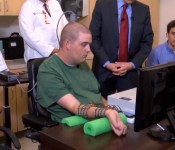
Brain implant restores control of paralyzed muscles

The quadriplegia that comes as a result of a serious spinal cord injury cuts off the lines of communication between a person’s brain and their limbs. The condition is often irreparable, and those who suffer it do so for the rest of their lives, but surgeons at Ohio State University and researchers at Battelle might have just struck back at the condition. Using a technology called Neurobridge, the pair have been able to offer Ian Burkhart, a 23-year-old who was paralyzed after a diving accident, the ability to move his hand with his own thoughts for the first time in four years.
Neurobridge works thanks to a chip that’s been implanted into the patient’s motor center, which relays those signals, via a muscle stimulation sleeve, directly to the subject’s muscles. That way, the technology bypasses the damaged nerves, essentially cutting out the middle man and restoring direct muscular control to the brain. The transmissions take less than a tenth of a second to be processed and sent, so while it won’t be as fast as the biological process, could still help people live relatively normal lives. Naturally, this first test isn’t going to mean an instant cure for people with spinal cord injuries, but the first moment of Burkhart twitching his fingers after four years, available in the video below, is a huge breakthrough.
Filed under: Science
Via: Sky News

Amazon now lets Londoners pick up packages from Tube station lockers

If work commitments mean you’re constantly trudging to the Post Office to collect a missed Prime delivery, Amazon’s hoping to make things easier for you, if you’re a Londoner that is. As of Monday, the company will open click-and-collect lockers in Finchley Central and Newbury Park Tube stations, where you can have packages delivered instead of an address. They come seven months after the retailer was rumoured to have begun talks with Transport for London with a view to installing the lockers inside unused ticket offices. However, Amazon has placed them inside the stations’ car parks instead, meaning you might have to take a small Oyster hit for the privilege. Amazon won’t be alone in offering collections on the Underground, though, as major supermarket chains including Tesco, Asda, Waitrose and Sainsbury’s are installing lockers of their own to limit the hassle of shopping around work.
[Image source: Transport for London, Flickr]
Filed under: Transportation, Internet, Amazon
Source: Retail Week
Not there in person? Watch the Google I/O 2014 keynote livestream Here
In just a few hours, the most anticipated and important keynote for the Android community will be delivered; many of you, us included, won’t be able to attend tomorrow’s very important keynote speech at Google I/O 2014. Thankfully though, Google has put up a livestream that will stream the keynote live in just over six hours, […]
 AIVAnet