Google I/O 2014: Android Auto announced, SDK releasing later Today
Google took the wraps of the Android Auto UI for your car. Integration is through your device, and it is not independent in the car. Meaning, that Android Auto will pop up on your compatible in dash touch screen system once you plug your phone in. That leaves all updates to compatible apps handled through […]
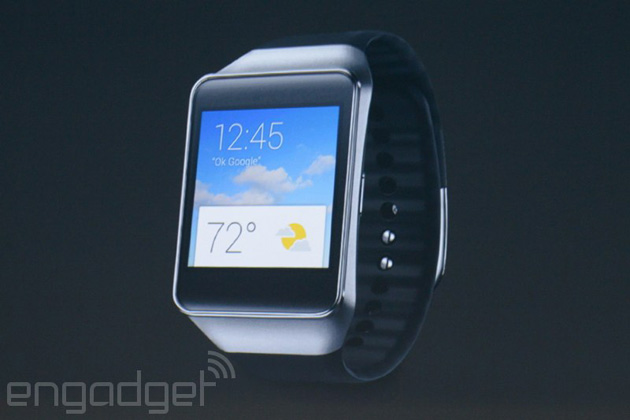
Samsung Gear Live, LG G Watch, Moto 360 availability announced

Hopefully you’ve all been watching Google I/O! If not, Google have updated us on the availability of some of the upcoming Android Wear devices.
The LG G Watch, if you haven’t yet preordered it, will be available on Google Play later today. They’ve also announced the Samsung Gear Live, Samsung’s take on a watch running Android Wear. There are no specifications released for the watches quite yet, but we’ll definitely have some more info later in the day.
And now for the Moto 360. Unfortunately, this is the only Wear watch that we know of that isn’t available today. The only info we have about it is that it will launch “later this Summer.”
Pricing is yet to be released for any of the watches, so we’ll update you as we get the information.
Image: Engadget
The post Samsung Gear Live, LG G Watch, Moto 360 availability announced appeared first on AndroidGuys.
Google I/O 2014: Emerging Markets with AndroidOne
Quick snippet about a new program, AndroidOne. Targeting emerging markets like India to reach the other 4 billion users in the world. Set of reference hardware platforms. Quality parts that are affordable. The software on AndroidOne is by Google. Full automatic update from Google. MicroMax partnerAndroid One under $100. Launching in India, Micromax, Karbonn and […]
By the numbers: Google boasts Android explosive growth

Not that this is exactly new to many of you but Android is big and it’s getting bigger by the moment. Google today announced that there are now 1 billion active (within last 30 days) Android users. And, with the upcoming Android One, Android TV, Android Wear, and Android Fit stuff we should expect that figure to shoot even higher.
- 30-day active users grown to more than 1 billion
- 20 billion texts every day
- 93 million selfies every day
- 1.5 trillion steps per day
- 100 billion times per day to check our phones
- Android tablets account for 64 percent of global market share – does not count Kindle and other branded experiences
- App installs are up 236% year over year
The post By the numbers: Google boasts Android explosive growth appeared first on AndroidGuys.
Google announces Android One

Google has just announced that they will release Android One for developing nations. Android One devices will be updated directly from Google just like Nexus devices. The first Android one device is coming from Micromax and will feature a 4.5 screen, FM radio, dual sim, and a SD card port. The device will also be under $100. Well have more on Android One and the un-named device from Micromax as more news is revealed

The post Google announces Android One appeared first on AndroidGuys.

EU Regulators Expected to Decide on Apple’s Acquisition of Beats By July 30
Apple’s proposed acquisition of Beats Electronics is facing its first regulatory hurdle after the Cupertino company announced the deal last month. As reported by Reuters, European Union’s Antitrust Commission is expected to make a decision on the purchase by July 30.
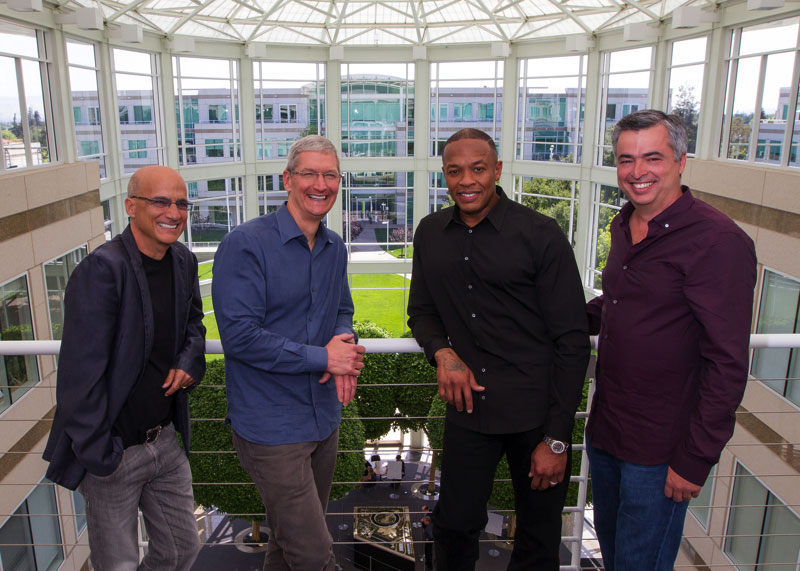
The EU regulators can approve the deal unconditionally, demand concessions if they have anti-competitive concerns or order a full investigation if they need more convincing that the acquisition will be a benefit and not a detriment to competition.
The pending $3 billion deal includes both Beats Electronics, which offers headphones and speakers, and Beats Music, a streaming music subscription service. Under the deal, Beats executives Jimmy Iovine and Dr. Dre will join Apple, giving the company a significant boost to its music industry connections.
Besides the EU, regulators in the United States also must examine the deal and determine whether there are any concerns with competition. Barring any unforeseen regulatory issues, Apple expects the transaction to close sometime next quarter.
Ford and Intel want to make cars that respond to your face and gestures

Where do anthropology students go when they leave college? Apparently, instead of travelling the Andaman Islands investigating the social impact of cousin marriage like they’re supposed to, they’ve been earning big bucks working for Ford and Intel on something called “Project Mobii.” The name stands for Mobile Interior Imaging, and we’re told that it involves a collaboration between “ethnographers, anthropologists and engineers” who are looking for ways to deliver a “more personalized and seamless interaction between driver and vehicle.”
In practice, that could mean connected cameras that allow a car-owner to check up on their vehicle remotely, just to make sure it isn’t being ransacked or joyridden. Alternatively, gestures might be able to activate the sunroof, or facial recognition software could be used to identify the proper owner, while also allowing various permissions and settings to be programmed for other family members. Alas, Ford and Intel have made it clear that Mobii is all just research and exploration for now, with nothing concrete to show for it. But hey, that’s anthropology for ya.
[Image credit: Tabercil]
Filed under: Cameras, Transportation, Intel
Android still the dominant mobile OS with 1 billion active users

Free-falling product demos and Rube Goldberg multimedia installations aside, there’s always a level of predictability to an opening day keynote. And Google I/O 2014 is no exception. Like clockwork, SVP Sundar Pichai took to the stage in San Francisco this morning to tick off the company’s latest accomplishments. He started off by touting one of the company’s biggest strengths: Android. According to Pichai, Google now has over 1 billion active users (that’s as of the last 30 days) on the OS.
Developing …
Google’s apparently opted to track 30-day usage as opposed to year-over-year numbers as in the past. That said, last year, the company boasted 900 million Android activations, up from 400 million the year before. We likely won’t get a direct comparison due to the change in tracking, but even with the numbers we have, it’s clear Android is still the dominant mobile platform. During its WWDC 2014 keynote earlier this month, Apple’s Tim Cook announced the company had reached 800 million iOS devices to date, fewer than Google’s Android activation numbers from the year prior.
Continuing the theme of unconventional stat tracking, Pichai championed the strength of the platform saying Android users send 20 billion text messages each day and 93 million selfies. What’s more, those self-absorbed phone holders apparently take 1.5 trillion steps each day, and check their handsets a total of 100 billion times every 24 hours.
Filed under: Cellphones, Tablets, Wearables, Internet, Software, Mobile, Google
Google’s next version of Android ‘L-release’ has a new look, deeper ties to the web

KitKat may have only found its way on to roughly 15 percent of phones at this point, but that won’t stop Google from looking to the future. The new version, teased by Sundar Pichai is simply being referred to as the “L-release” right now. As previous leaks have indicated, this will be the most dramatic UI overhaul the OS has enjoyed since Ice Cream Sandwich debuted back in 2011. The heart of this overhaul is called Material Design — a flatter look, with rounder elements and softer edges that will extend beyond tablets and phones to Chrome OS and Google’s various web services. You can see some of the new design philosophy at work already in the latest version of the Google+ app on Android. But it goes beyond that. Shapes are simplified and there are smooth transition animations across the UI. Developers can also add the illusion of depth by adding “elevation” which automatically stacks visual elements appropriately and adds drop shadows.
Developing…
Of course, if all that was new with Android was a facelift, it wouldn’t be all that exciting. But there are also plenty of new features. Not that there was anything wrong with notifications in KitKat, but there’s always room for improvement. In L you’ll be able to interact with notifications right from your lock screen. That can include quickly swiping them away or you can double tap on the notification to head straight into the relevant app. The notifications aren’t ordered simply chronologically anymore either, they’re sorted by relevance and importance, which is determined by a number of details, like the source app, etc… For truly important events, Google has introduced heads-up notifications, which pop interactive notifications over your current task. In a demo an incoming call showed up at the top of the screen while Dave Burke, director of engineering for Android, was playing a game. He could simply ignore the pop up completely, or he could tap the options to accept or dismiss the call.
One of the more intriguing changes is the deeper ties to the web and Chrome. The new recents interface will pull in not just apps you’ve launched but tabs you’ve opened on your desktop. And, developers can make links go to apps instead a webpage. So, if you search for a restaurant on your laptop, the recent menu won’t just open up a web page, but could launch directly into the Yelp reviews.
Then there’s the ART runtime, the software library that actually makes all your pretty little apps work. ART brings a whole bunch of advantages. For one, apps should run significantly quicker, and in particular they should launch much faster. But, it should also increase battery life because Android will be wasting less processing power decompressing apps.
Filed under: Cellphones, Software, Mobile, Google
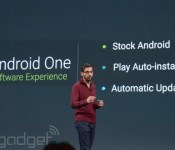
Google’s Android One program will set minimum standards for bargain-basement smartphones

For every HTC and Samsung, there’s tens of Android hardware makers who have to redesign their smartphones to hit a certain low price. This is especially true in the developing world, where keeping the cost down means a lot of effort is spent tweaking devices — something that Google feels is a waste of time. That’s why it’s launching Android One, a program where Mountain View’s engineers will design cost-conscious hardware, and other companies will simply manufacture it. There’s plenty of fringe benefits, but the biggest one is that Google will be able to dictate a minimum set of standards for forthcoming Android handsets.
Since the company is targeting the developing world, Google is initially teaming up with Indian smartphone makers like Karbonn, Cromax and Spice. In an example presented on stage, Sundar Pichai talked about a Micromax Android One device with dual-SIM and SD card slots, a 4.5-inch display and FM radio priced at just $100. As well as that, these phones will get the same preferential treatment as the Nexus and Google Play ranges when it comes to automatic software updates. Is this, then, the much-rumored Android Silver program? Possibly, but given that it’s going to be aimed toward the bottom end of the Android world, it seems like the notion that Silver would kill-off the Nexus line won’t come true today.
Filed under: Cellphones, Software, Mobile, Google
 AIVAnet