



The 7-inch Samsung Galaxy W is officially launched in Korea for 499,400 Won
 Looks like we didn’t have long to wait before Samsung announced the 7-inch Galaxy Mega device that leaked out a few days ago. That mysterious device has been launched today in Samsung’s native Korea as the Samsung Galaxy W, a 7-inch behemoth that aims to marry phone-like abilities with tablet-type functionalities. As was suspected, the Galaxy W is going to have a 1.2GHz processor, 1.5GB RAM and a 720p display resolution, however we now know that it will also come with 16GB storage, a 2MP front facing camera and a 8MP rear camera. And despite being what Android purists would say is “slightly underpowered”, the Galaxy W is going to be able to take advantage of Korea’s LTE-A networks for blistering mobile data speeds.
Probably some contentious points on the spec sheet include a 3,200mAh battery, which could struggle to give decent battery life when coupled with LTE-A access and that 7-inch display. Possibly also disappointing is the fact that the Galaxy W apparently only comes with Android 4.3, especially considering that Samsung devices are already starting to get Android 4.4. So far, only availability in Korea has been announced for 499,400 won (or $488 USD), however the device has already received FCC approval so it’s only a matter of time before we see the device as the Samsung Galaxy Mega elsewhere.
It’s definitely an intriguing idea as Samsung clearly wants to differentiate this device as a smartphone device rather than a tablet. Would you consider the Samsung Galaxy W when it comes to your region? Let us know what you think in the comments.
Source: SammyHub via SamMobile
//<![CDATA[
ord = window.ord || Math.floor(Math.random()*1E16);
document.write('’);
//]]>

This is what brain synapses look like in 3D

Many know that brains are inherently complex things; there are trillions of synapses converting chemical and electrical signals in a human mind. However, did you know that even those synapses are very complex? If not, it should be perfectly clear now. German scientists have used a mix of extremely high-resolution microscopes (both electron and fluorescent), mass spectrometry and protein detection to create a super-detailed 3D map of a synapse in a rat’s brain. It’s almost like a miniscule city — those dots you see represent 300,000 proteins, and only a tiny portion (the glowing red patch at the bottom) is transmitting chemicals.
Such 3D models aren’t just for putting on a show. While scientists are usually focused on individual protein types that could trigger conditions or lead to treatments, digital maps can help them understand how those proteins fit into a greater whole. If nothing else, this rendering is a friendly reminder that recreating the brain is a daunting task.
Via: National Geographic, Gizmodo
Source: Science, Virginia Hughes (Vimeo)
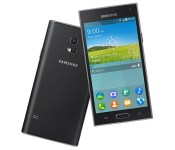
Samsung breaks from Android with its first Tizen phone

Filed under: Cellphones, Mobile, Samsung
Source: Samsung
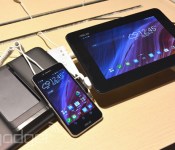
ASUS’ PadFone X goes global: still a 5-inch to 8.9-inch transformer

The ASUS PadFone X due June 6th can be considered as a slightly rugged version of the regular PadFone Infinity flagship line, but it’s only limited to AT&T customers. Luckily, for those outside the US, there will soon be a global variant dubbed the PadFone S. These two models are pretty much identical: you get the same 5-inch phone to 8.9-inch tablet transformation, and the guts include the 2.3GHz quad-core Snapdragon 800, 2GB of RAM, full HD displays, microSD slot, 13MP plus 2MP cameras on the phone (1MP front camera on the tablet) and 2,300mAh plus 4,990mAh batteries. The only differences are the 3G and 4G bands for obvious reasons, plus the wireless charging here follows the more popular Qi specifications, as opposed to PMA’s. There’s no info on pricing yet here at Computex; all we know is that it’ll arrive in select markets as early as late Q3 this year.

Also announced alongside the PadFone S are an LTE-enabled ZenFone 5 (A500KL, with a 1.2GHz quad-core Snapdragon 400) and a ZenFone 4 with a slightly newer Intel chip. Both are due some time between late Q3 and early Q4 in select markets. We’ll have more info closer to the time.
Filed under: Cellphones, Tablets, Mobile, ASUS

Samsung’s 7-inch Galaxy W blurs the line between phones and tablets

If you thought that big devices like the Galaxy Mega 6.3 were already blurring the distinctions between phones and tablets, hold on to your hat — Samsung has just erased those distinctions altogether. Its new Galaxy W (not to be confused with the 2011-era W) blends the 7-inch screen of a small tablet with a relatively compact design that lets you hold it one-handed for phone calls. This isn’t the first crossover we’ve seen by any means, but it promises to be more comfortable than truly finger-straining rivals like ASUS’ Fonepad 7 or HP’s 7-inch VoiceTab.
As with the Mega, this isn’t the flagship you might expect given the gigantic dimensions. You’ll be making do with a 720p display, a 1.2GHz quad-core processor, 16GB of expandable storage, a 8-megapixel rear camera and a 2-megapixel front cam. The W is even stuck on Android 4.3 rather than 4.4. It won’t be the cheapest device, either, as it’s selling for 499,400 won ($489) off-contract in its native Korea — Samsung is no doubt expecting customers to treat this as a two-in-one purchase. There’s no mention of an American launch, but you shouldn’t count on one when US carriers have so far been skittish about offering category-defying hardware.
[Thanks, Phil]
Filed under: Cellphones, Tablets, Mobile, Samsung
Source: Samsung (translated)
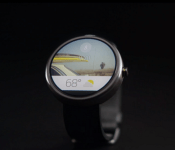
The ‘HTC One Wear’ Running Android Wear could be Out by End of Summer

The smartwatch market is going to be no doubt booming this year. Smartwatches have already grabbed the attention of consumers with various different style watches already out there for you to buy, but now we have Android Wear; the new Android-based smartwatch OS, that Google announced not too long ago. Shortly after the announcement, LG and Motorola announced their watches, the LG G-Watch and the Moto 360. Both running versions of Android Wear, but then we wondered about other OEMs utilizing the Android Wear software. OEMs such as HTC.
HTC briefly chimed in about wearable technology back at the end of 2013, and they indicated that they themselves would be diving into the smartwatch game. Now it seems that a new report coming out of TK Tech News, that claims HTC could have their new smartwatch, dubbed the “HTC One Wear”, out by late Summer. Apparently it will be HTC’s answer to the Moto 360, giving us a round display and being made to premium quality like the HTC One series.
This is all unconfirmed as per usual, but given that Samsung, LG, and Motorola, have got watches in the market, HTC should have theirs out this year if they want to be any kind of completion. Let us know your thoughts about this.
Source: Phandroid
//<![CDATA[
ord = window.ord || Math.floor(Math.random()*1E16);
document.write('’);
//]]>

Google is building 180 satellites to spread internet access worldwide

Google’s plans for satellite-based internet access just got a little more concrete. The Wall Street Journal hears that the search firm is preparing to build 180 “small, high capacity” satellites (not pictured here) that will go into low orbit and provide internet connections to underserved areas. While details aren’t forthcoming about the machines, there may be more on the way; reportedly, the company could “double” its vehicle count if all goes well. A spokeswoman didn’t confirm or deny the efforts, but did note that having an internet link “significantly improves people’s lives.”
The initiative might be very expensive, with tipsters estimating a cost between $1 billion to $3 billion. However, the satellites could eventually pay for themselves. They would really be an extension of the thinking behind the balloons from Project Loon — getting more people online increases the number of people who can see ads, improving Google’s bottom line. Any orbital internet service would most likely serve as a complement to Project Loon, providing data in far-flung, sparsely populated regions while the balloons handle places with greater demand.
[Image credit: NASA/GSFC/Landsat, Flickr]
Source: Wall Street Journal
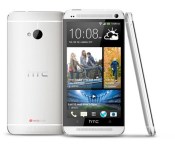
How would you change the HTC One (M7)?

Wouldn’t it have been great if we’d covered last year’s HTC One just before the replacement arrived? Clearly. Since the calendar didn’t work out like that, however, let’s instead take this moment to commence a post-mortem on one of the most critically acclaimed handsets of 2013. Garnering a 92 point Engadget store, a fantastic low-light camera and that amazing body, let’s face it — everyone was envious of this hardware. But has your experience been as flawless as that of our reviewer? Join the forums and share your feelings on the subject.
Filed under: Cellphones, Mobile, HTC
Source: Engadget Product Forums
WhatsApp returns to Windows Phone with new features in tow

Windows Phone users worried that Whatsapp’s devs might be enjoying their Facebook money too much to fix the app can now rest easy. Whatsapp is now back on the Windows Phone Store after a couple of weeks’ absence, and it even comes with new features, including chat backgrounds, better privacy settings and the ability to customize notification tones. Its devs pulled the app from the store after a lot of users reported having serious issues with update 3 for Windows Phone 8 that permanently disabled notifications or caused persistent errors. Just as Microsoft’s Windows Phone guy Joe Belfiore promised on Twitter, though, Whatsapp’s back and ready for more cross-platform messaging.
[Image credit: Luis/Flickr]
[Thanks, Manthan]
For those w Q’s on Whatsapp: they pinged us about an issue that popped on notifications, we’re working with them on a fix. More info soon
– joebelfiore (@joebelfiore) May 22, 2014
Filed under: Misc, Mobile, Microsoft
Via: Neowin
Source: Windows Phone Store

Apple to Announce More Plans for iBeacon Technology at WWDC 2014
Apple will unveil more plans for its iBeacon technology at the start of this week’s WWDC 2014, reports The Wall Street Journal. In addition to new details about the technology, the company will promote iBeacon by placing transmitters throughout the Moscone Center while offering sessions for developers on how to better implement the technology into their apps and services.
 An Estimote Beacon
It is not known what exactly Apple has in store for the technology, but it is possible that the company could announce a more prominent role for iBeacons in iOS 8, new partnerships with companies, and more. iBeacons could also see integration in Apple’s highly rumored mobile payment service.
First introduced during last year’s WWDC, iBeacons enable iOS devices to wirelessly communicate with physical beacons through Bluetooth, as the transmitters are able to deliver relevant information to apps and services when a user is physically nearby. Apple implemented a new iBeacon “Made for iPhone” specification in February, signaling a more significant role for the technology in its devices.
iBeacon technology has also been used by a number of companies in a variety of ways since the end of last year. Shopping app Shopkick and Macy’s partnered to integrate the technology into stores to assist consumers, while Major League Baseball and the National Basketball Association have used the technology to provide enhanced live experiences.
Apple has also implemented iBeacons into its own retail locations to deliver messages about picking up online orders and store events, although early experiences with the technology were mixed. The technology has also been featured in the UK, where a cafe and London’s Heathrow Airport have integration iBeacons to notify users of promotional deals.
In addition to new details about iBeacon at WWDC 2014, Apple is also expect to unveil iOS 8, OS X 10.10, a new home automation platform, and perhaps some new hardware.
Apple will be live streaming the event both on its website and on the Apple TV. MacRumors will also be providing a live blog, live tweets via the MacRumorsLive Twitter account, and a spoiler free page for those who want to watch the full keynote at a later time.
 AIVAnet