


iOS 8 to Include Support for System Wide Third-Party Keyboards [iOS Blog]
Apple today announced at its Worldwide Developers Conference that iOS 8 will support system wide third-party keyboards.
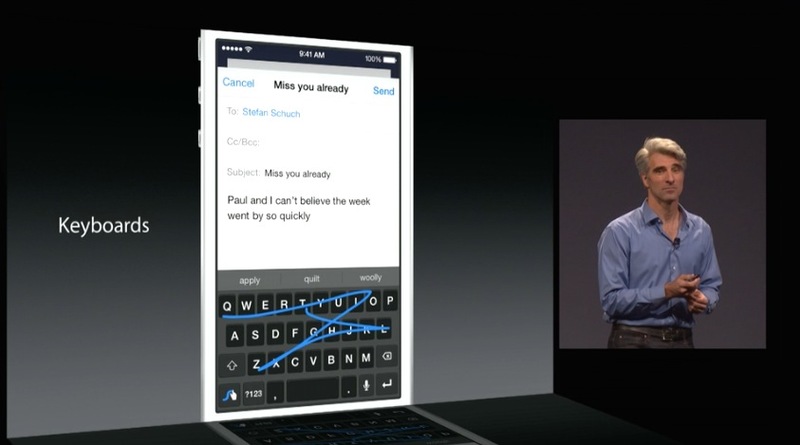
The company showed something that appeared to resemble the popular-gesture based keyboard Swype running on iOS 8, as software chief Craig Federighi noted that keyboards have the most restrictive sandbox to ensure user privacy and safety.
To this point, third-party keyboards such as SwiftKey Note and Flesky have launched for iOS, although their integration has been limited to note-taking in a separate app and allowing app developers to incorporate their keyboard, respectively. With this announcement, it is likely that both keyboards will launch for iOS with full integration at some point in the future.
Support for third-party keyboards will be included with iOS 8, with the new mobile operating system expected to launch this fall.
Apple to Enhance App Store with ‘Explore’ Tab, App Bundles, Beta Testing, and More [iOS Blog]
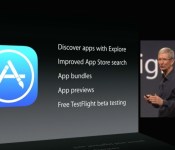
After showing off the main features for iOS 8 at its Worldwide Developers Conference today, Apple announced improvements for the App Store starting with iOS 8, including app bundles, integrated beta testing, improved search and more.

In order to improve discoverability, the App Store will soon add an “Explore” tab, allowing users to explore through categories and sub-categories easily. Search has also been improved, with the ability to see the top trending searches in the App Store and related searches.
Developers will also be able to bundle together apps, allowing users to buy multiple apps for a single discounted price. Also available to developers are previews, which allows developers to include short videos to tell users what their apps are all about.

Finally, developers can also invite users to beta test their apps in a new service called TestFlight, which allows developers to see information about their apps from right within the service. The service is free for developers, and stems from Apple’s acquisition of Burstly, which offered its own TestFlight beta management service, back in February.
Apple also announced that there are now 1.2 million apps in the App Store and nearly 300 million visitors to the App Store per week who are downloading apps. The App Store has also reached another significant milestone, passing 75 billion apps been downloaded since its 2008 debut.
Apple to Discontinue Support for iPhone 4 in iOS 8 [iOS Blog]
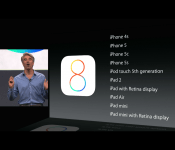
Near the end of today’s keynote at the Worldwide Developers Conference that included a first look at iOS 8 among other things, Apple revealed what iOS devices will be compatible with its new mobile operating system this fall. That list included the iPhone 4s, iPhone 5, iPhone 5c, iPhone 5s, iPod touch 5th generation, iPad 2, iPad with Retina Display, iPad Air, iPad Mini, and iPad mini with Retina Display.

Notably missing from the list is the iPhone 4, which saw compatibility with iOS 7 last year and even saw improved performance with iOS 7.1. Apple restarted iPhone 4 production for countries including Brazil, India and Indonesia earlier this year, but the device will likely be now be discontinued again in the near future.
iOS 8 will launch this fall with revamped notification features, a new QuickType keyboard that adds predictive typing suggestions, an enhanced Messages app, a new Healthkit app that aggregates health-related metrics, improvements to Siri, and many more features.
Apple Announces Significant SDK Improvements with New ‘Swift’ Programming Language, CloudKit and More [iOS Blog]
Apple devoted the last third of its keynote address at the Worldwide Developer Conference today to improvements for its Software Development Kit (SDK), launching a new programming language called Swift, and development kits for health, home automation, iCloud and inter-app operability.
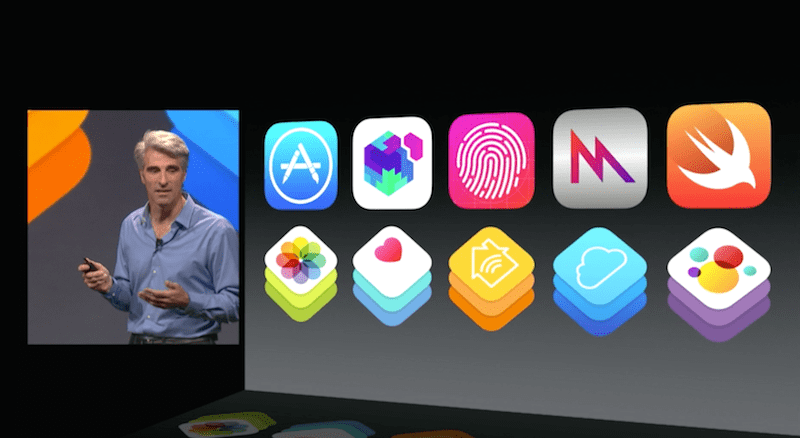
The announcement that got the biggest reaction from developers was Swift, a new programming language for Cocoa and Cocoa Touch that Apple calls modern, fast and powerful and designed for safety.
Swift is the result of the latest research on programming languages, combined with decades of experience building Apple platforms. Named parameters brought forward from Objective-C are expressed in a clean syntax that makes APIs in Swift even easier to read and maintain. Inferred types make code cleaner and less prone to mistakes, while modules eliminate headers and provide namespaces. Memory is managed automatically, and you don’t even need to type semi-colons.
Swift also includes “Playgrounds”, which allows developers to see the results of their code in a side panel in real time. The developer community appears extremely excited about Swift, with Realmac’s Nik Fletcher saying he had “no words”. Notable Apple pundit and developer John Gruber said that Swift is “huge, huge news” and the “future of all Apple development”.
iCloud has also been partly opened up for developers with a powerful new framework for developers called CloudKit. It allows developers to avoid costly and time-consuming coding the server-side of applications, with Apple providing huge amounts of cloud storage and computing power for free, albeit with extremely high limits to encourage tight coding.
Leverage the full power of iCloud and build apps with the new CloudKit framework. Now you can easily and securely store and efficiently retrieve your app data like structured data in a database or assets right from iCloud. CloudKit also enables your users to anonymously sign in to your apps with their iCloud Apple IDs without sharing their personal information.
Additionally, Apple announced lots of new APIs for developers to take further advantage of iOS. Extensibility allows apps from the App Store, which are usually isolated in sandboxes, to communicate with each other. For instance, the Pinterest app could be updated to provide a sharing option in Safari, or Bing could be updated to provide translations within Safari. Another example includes the Photos app, which can use filters from third-party apps like VSCO.
Apps from the App Store can send widgets to the Today pane in the Notification Center. For instance, ESPN’s SportsCenter could add a widget within the Today pane that allows users to easily check the latest sports scores without having to open the app. Widgets are also interactive, allowing users to, for example, bid for an item on eBay from within the Notification Center.
Other parts of iOS have been opened up to developers as well, including the ability for users to swap out the default iOS keyboard for third-party options like Swype. Touch ID has also been opened up to developers, allowing apps like Mint to use fingerprint scans instead of passwords.
Apple also announced its rumored home automation platform, called HomeKit. Previously, each home automation app used its own security protocols. Now, after working together with leaders in the home automation field, all apps can work together with a single protocol and secure pairings. This allows automated home devices, like Phillips’ Hue lights, to work with Siri. Users can now tell Siri something like “Siri, get ready for bed” to turn off the lights, close the garage and whatever other functions are automated in a users’ home.
Apple has also improved things for game developers, announcing Metal, which frees up resources for game developers to make better looking and more powerful games for iOS devices. For instance, EA would now be able to use its Frostbite engine for console games for games meant for iOS, like the upcoming Plants vs Zombies: Garden Warfare.
Xcode has been updated with live rendering, view debugging, performance testing, storyboards and more.
All of these SDK features are available for developers in the iOS 8 beta today, and will be available for consumers later this year in the fall. Much more information is available at Apple’s Developer website.
Video of Apple’s WWDC 2014 Keynote Now Available [Mac Blog]
Less than an hour after the end of the event, Apple has already posted video of today’s Worldwide Developers Conference keynote to its website. The video is also available on the “Apple Events” channel on the Apple TV.

Announcements at the event included:
– Apple Announces OS X Yosemite with Improved Cross-Device Connectivity and New User Interface
– Apple Announces iOS 8 with Interactive Notifications, QuickType, More
– Apple Announces Significant SDK Improvements with New ‘Swift’ Programming Language, CloudKit and More
Apple has also uploaded the “Apps We Can’t Live Without” video to YouTube, which played before the keynote and showcases how users view developers and the apps they build.

Dell debuts Venue 7 and 8 Android tablets

Dell has been mainly releasing Windows Phone devices along with their Chromebooks. They haven’t released an Android tablet since October last year, now they finally have something to show us in the Android department. Those devices mentioned above are Dell Venue 7 and 8 tablets. Well, today Dell released a refresh for said devices.
Dell Venue 7 is a tablet with a 7″ IPS WXGA screen 1280×800 in resolution. The device is powered by a dual-core Intel Atom (Z3460) “Merrifield” chip clocked at 1.6GHz which is paired with a 1GB of RAM. Dell Venue 8 on the other hand features a full HD 8″ screen, 1920×1200 in resolution. It has a same processor as its smaller counterpart but at a higher clock-rate, it is clocked at 2.1GHz and it also sports a 1GB of RAM.

Both tablets have 16GB of inbuilt storage (expandable via microSD card up to 64GB) and a 4550mAh battery along with a 5MP main camera. Dell Venue 7 sports a 1MP front shooter while the larger of the two has a 2MP front-facing camera. Dell Venue 7 weights 290 grams and the 8″ version is somewhat heavier at 338 grams. Both tablets will run Android 4.4 KItKat out of the box.
Both Dell Venue 7 and 8 look rather good and even though specifications aren’t exactly up to par with some of the higher end offerings we can’t complain much considering the price which is $159.99 and $199.99 respectively. The devices will be available in black and red colour options and will be available on Dell’s online store starting July 1st.
VIA: Dell
The post Dell debuts Venue 7 and 8 Android tablets appeared first on AndroidGuys.

Tip: Get the LG G3 SmartK Keyboard for any Android device

When LG unveiled their LG G3 they also showed off their Smart Keyboard which claims to improve contextual recognition and decrease the margin for input errors by 75%, as well as a ton of customisation, including the ability to adjust the keyboard height. Now, any rooted Android device can enjoy LG’s Smart Keyboard.
The guys over at XDA have managed to extract the LG Smart Keyboard from the ROM of the G3 and have made it available for all rooted Android devices running Android KitKat 4.4.
You can either flash it via recovery or install the .APK.
SOURCE: XDA
The post Tip: Get the LG G3 SmartK Keyboard for any Android device appeared first on AndroidGuys.

AT&T announces Galaxy Tab 4 10.1, Galaxy Note Pro 12.2 availability

AT&T on Monday announced the upcoming availability of the Samsung Galaxy Tab 4 10.1 and Galaxy Note Pro 12.2. Both arrive on June 6 and offer 4G LTE connectivity.
The Galaxy Tab 4 10.1 features a 10.1-inch display, 1.2GHz quad-core processor, up to 16GB storage, and a 3-megapixel rear camera. Other details include a 6800mAh battery, microSD expansion, Android 4.4 KitKat, and a host of Samsung apps and services.
Pricing for the Galaxy Tab 4 10.1 is $379.99 with a two-year service agreement. Those who prefer to purchase without a contract can do so for $24 per month over twenty months on a Next plan.
The Samsung Galaxy Note Pro 12.2 is much more powerful and features a 12.2-inch display, 2.3GHz quad-core processor, 8-megapixel rear camera, and 9500mAh battery. Additionally, this one offers S Pen support, up to 32GB internal storage, and microSD expansion.
The Galaxy Note Pro 12.2 costs $45 per month over two twenty months; alternately, customers can purchase for $799 with a two-year contract.
Both tablets will be sold as part of a limited time promotion. Pick up either of these two with a Samsung Galaxy S5 or Galaxy S5 Active and you’ll save $50 in the process. You will, naturally, have service agreements or device installments for all of your products.
The post AT&T announces Galaxy Tab 4 10.1, Galaxy Note Pro 12.2 availability appeared first on AndroidGuys.

Apple’s WWDC 2014 in numbers: 40 million on Mavericks, 800 million iOS devices and more

Charts, graphs and stats: these are the things Apple keynotes are mad of, and today’s WWDC 2014 kickoff was no different. CEO Tim Cook took to the stage this morning at the Moscone center in San Francisco armed with enough numerical ammunition to put your best boardroom PowerPoint Keynote to shame. Cook kicked things off boasting over 40 million copies of OS X Mavericks installed and more than 50 percent of the install base working on its latest OS. He went on to point out that while PC sales continued to slip (down 5 percent, according to Cook), Apple’s computer sales are growing.
Developing …
However, according to Gartner’s Q1 2014 shipment estimates, Apple failed to crack the top five in worldwide shipments, coming in at number three in the US with 10.8 percent of the market.
In the OS wars, Apple may have strong adoption for its latest, but OS X still trails Windows by a large margin. Microsoft’s Windows 8 (released in late 2012) reached 200 million licenses by February of this year. While we don’t have internal numbers on its latest update, Windows 8.1 (released in October 2013) surpassed both Apple’s OS X 10.9 Mavericks and Microsoft’s own Windows 8 with 6.35 percent of the market according to May 2014 stats from Net Applications. Meanwhile, that same report pegs Windows 7 at 50 percent of the OS market. Regardless of its growth and reach, Apple is still a distant second in the race for desktop dominance.

In the smartphone market, iOS is still second to Android. According to Strategy Analytics, Apple’s mobile OS reached 15.5 percent of the market in 2013, down from 19.4 percent the year before, with Android hitting 78.9 percent, up from 68.8 percent in 2012. Despite those numbers, Cook mocked the competing operating system’s fragmentation issues, saying 98 percent of iOS users are now on iOS 7, while only nine percent of Android users are now on its latest OS, KitKat.
According to Cook, a 97 percent customer satisfaction rating shows why its had 130 million new iOS users in the last year and half of its Chinese customers switching from Android to iPhone in the last six months. To be fair, the iPhone just reached that country’s largest carrier, China Mobile, in January. As Cook not-so-lightly put it:
“They bought an Android phone, by mistake, then sought a better experience, and life …”
Taking a step back and looking at the big picture, Cook boasted a total of 800 million iOS devices shipped. Back in June of last year, that number was 600 million, up from 500 million in January, 2013. The iPhone, which launched in 2007, has since reached 500 million units shipped. Samsung, Apple’s biggest mobile rival, meanwhile, announced it sold 200 million Galaxy S smartphones (launched in 2010) as of February. So where does the rest of that 800 million come from? Apparently, Apple’s shipped 100 million total iPod Touches and 200 million iPads.
At this rate, we wouldn’t be shocked to hear Cook boasting iOS billions some time next year. In the mean time, Apple has more than just billions in profits to gloat about. As of today, users have downloaded 75 billion apps from the App Store, with 1.2 million apps to choose from and 300 million visits to the digital storefront every week.
Filed under: Cellphones, Desktops, Laptops, Software

OS X Yosemite: Apple’s latest desktop operating system is free this fall

Apple’s just unveiled the latest update to its desktop operating system for Macs and it’s called Yosemite. While last year’s Mavericks brought the inevitable reality of iOS/OS X integration even further with the introduction of familiar apps, like Maps and iBooks, this time around Apple’s Tim Cook promises both systems are now “engineered to work seamlessly together.”
Craig Federighi, SVP of Software Engineering at Apple, explained that Apple’s focus for OS X Yosemite was on clarity, continuity and clear font type throughout the operating system. Finder window menus are now translucent, matching up with the image backgrounds on your desktop to dynamically shift for personality and color temperature. This effect has been translated to the refreshed dock which, itself, has also gotten a slight makeover with newer, flatter-looking icons and even a new trash can; something Federighi referred to as “fundamentally still Mac.” There’s even a new “dark mode,” giving users the option to eschew translucency for dark grey toolbars.
As Cook mentioned at the start of today’s WWDC kick-off, the prevailing theme of this OS X update is one of uniformity and the enhancements made to Yosemite reflect that direction. The OS now sports changes to menu navigation for Apple’s suite of desktop applications that see the nav bar moved to the left rail across all programs, like Messages or FaceTime.
Federighi went on to highlight changes to Notification Center in Yosemite, saying that users can expect to now see a full day’s worth of their schedule lumped in with regular notifications from other apps. To swap between the two, Apple’s added in tabs at the top to let users minimize the information (i.e., calender, reminders, news updates) shown at a glance. Widgets for weather, stocks and calculator have also been tossed into this new Notification Center for easy access.
One of the more glaring changes to OS Yosemite, is the addition of Spotlight search as a front and center service throughout the system. A search bar, akin to Google’s search bar across Android devices, will appear in the midst of the desktop so users can quickly index and surface apps, docs and other items of interest without having to go all the way to the icon on the upper right of the menu bar. This new Spotlight can even be used to bring up full contacts info and any related information — be it a shared document or scheduled appointment — attached to a specific contact search.
The change to Spotlight here, as we mentioned previously, really seems to be going after the preemptive search of Google Now. Federighi showed off how the feature can now make recommendations for movie times, nearby restaurants and even offer measurement conversions. Apple’s even worked Spotlight into the address bar of the revamped Safari browser, again, to give users a one-stop shop for search across the web and local files.
As for Safari, that browser has predictably been updated for continuity, Federighi’s favorite buzz term for this WWDC. The browser’s window carries over the translucency seen in other areas of the operating system, but also sports changes to some familiar functions. Favorites are now hidden by default, but users can access these by clicking on the address bar. Sharing out links to social networks has been simplified with a one-click process and RSS feeds will populate in the browser’s sidebar.
AirDrop in Yosemite now works with iOS, so iPhone owners can easily transfer files to the Mac and back. Another example of “continuity” is Hand-off, OS X Yosemite’s ability to recognize work being done on iOS that a user might want to continue on the desktop. The feature works very simply: Once an action is detected on iOS, Yosemite will create an icon on the desktop to remind the user to complete the task. This sensing ability also extends to creating a tethered connection, as a user’s iPhone will now appear as a connection option in the WiFi dropdown.
Gmail users have long enjoyed the ability to make and receive calls from their laptop and now Apple’s giving users of its ecosystem that same perk. Once connected to your iPhone, Yosemite will prompt users with notifications to answer or ignore incoming calls (both audio and video); a feature Federighi demoed by ignoring his Mother’s call and then calling new Apple employee, Dr. Dre. The OS will even allow users to click on a number within a website (say from a restaurant page) to dial it directly.
Since WWDC is a developer-focused conference, Apple is making OS X Yosemite available to them to download beginning today, with a non-dev beta to be released this summer. But, as it was with OS X Mavericks, today’s Yosemite reveal is only a teaser for the Apple user public-at-large and that full retail release won’t be available until sometime this Fall. Though, when Apple does unleash OS Yosemite later this year, users will be able to download it for free.
 AIVAnet