


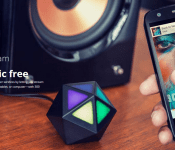
Moto Stream, a New Audio Streaming Device, Released by Motorola for $50
Motorola has announced and released a new little device called the Moto Stream. The icosahedron sided orb, which reminds me of the Nexus Q with a slight design change, gives you a quick connect to your home theater or speaker system. In the video you see that you simply plug it in to the power source and connect the 3.5mm audio jack and you are done.
 Motorola incorporated NFC into the Moto Stream to make it super easy for all your friends to connect to the device without having to individually pair every device. Nothing is more annoying than holding a button for pairing mode in hopes they can connect the first time. Once connected you can have free range of up to 300 feet, when connected with a class 1 Bluetooth phone, to control all the tunes while you mingle. The video, below, and the Motorola accessory page for it doesn’t make any mention of a specific application needed. All the imagery depicts Google Play Music. Naturally we assume since it is just Bluetooth that once you connect your given devices the Moto Stream will take action when one of those devices issues a command.
Heist Mode allows up to five devices to control any speaker. There’s no setup and it’s universally compatible with all Bluetooth® devices, so anyone can jump in and drop a track. And if you don’t like what’s playing, heist it.
It is a pretty interesting little device for just $50. The streaming audio market is getting pretty heavily saturated and competitive. This single room, single speaker set up isn’t anything new. While the NFC quick connect, design and lights are a nice touch there are plenty of other options out there, like the Rocki which goes over Wi-Fi for the same $49 or the more expensive Phorus PR1 that also runs over Wi-Fi and allows you multi room controls.
If you want more detailed information, or just want to order one, then head over to Motorola’s site.
Source: Motorola Via: 9to5Google
//<![CDATA[
ord = window.ord || Math.floor(Math.random()*1E16);
document.write('’);
//]]>

Chromecast Picks Up WatchESPN, MLS Matchday and Google+ Photo/Videos Support
The $35 Google Chromecast is certainly picking up steam since it was launched. When it came out with a handful of apps, people were excited. Then came the big providers and some of our favorites, like Plex. Since then we have seen home screen changes, games, and more ways to cast from our devices then we really need. Option are good though, it is what makes the Chromecast a must have device, at least in our book.
The Google Chrome Blog has announced today another new partner in the race to be the best value media stick in history. As of today, WatchESPN is now Chromecast supported. That would be the Android app as well as from the browser, if I am not mistaken. As with all major players in the game, the Chrome cast support will only work for you if you have ESPN networks as part of your cable or satellite package.
Another addition to today’s streaming services is MSL Matchday. This one is for all you Football fans out there. No, not pigskin football. Soccer. Again, you need to fork over some cash on a MSL Live subscription to catch all the live games. Cost wise you are looking at $49.99 for access to the whole 2014 season, or you can shell out $15.99 a month.
Finally, we have Google+ photos and videos integration. Just look for the little cast icon in the photos view on your device. Sadly, I don’t see it on any of my devices yet and the Play Store isn’t showing a G+ update either.
Source: Google Chrome Blog
//<![CDATA[
ord = window.ord || Math.floor(Math.random()*1E16);
document.write('’);
//]]>

Scientists can create and erase memories ‘at will’

A person is the sum of their memories, so what happens when our personal histories can be deleted at will? That’s the ethical dilemma facing researchers over at the University of California, San Diego, who have found that it’s possible to delete and recover memories created in the minds of genetically engineered rats in the same way MIT scientists did with mice last year. In a slightly gruesome series of experiments, the rodents were given electric shocks while their neurons were bombarded by light pulses delivered by an optical fiber implanted into their brains. After a while, the shocks stopped, but whenever their brains were stimulated, the rats continued to feel fear, since they were drawing on memories.
Subsequently, the team weakened the rats synapses and found that they could break the link between the feelings of fear and the optical stimulation. Then, to cap the process off, resumed the original series of pulses and reactivated the feelings of fear and apprehension without any additional electric shocks. The head of the project, Professor Robert Malinow, said that “We can form a memory, erase that memory and we can reactivate it, at will,” but don’t worry, he’s not got any plans for world domination just yet. Instead, he’s hoping that his findings will help to counteract the symptoms of Alzheimer’s disease — although we’re going to keep a tinfoil hat on standby, just in case.
Filed under: Science
Via: IFL Science
Source: UC San Diego, Nature

Forget training wheels: This bike balances itself

Training wheels are great for getting kids rolling, but they don’t really develop the balance required for real riding. Jyrobike takes a different approach to the learning process, providing a more authentic cycling experience while still offering the stability new starters need. That’s because it’s self-balancing, and though that sounds too good to be true, the technology that makes it possible is actually quite simple. Contained within the front wheel is a weighted, motor-driven disk that gets up to several thousand revolutions per minute (RPMs). This spinning disk, which emits a dull hum when at full speed, exerts a gyroscopic force that pushes against the turn and lean of the front wheel. As the rider tilts towards the point of no return, the front wheel corrects and as a result, nudges the child into a balanced body position. Watching someone ride a Jyrobike doesn’t give you a good idea of how stable the thing really is, but we were incredibly impressed by a live demo. With just a small amount of forward momentum, the prototype easily shrugged off sideways slaps with only a slight waver.
Jyrobike has three levels of stabilization, meaning you can gradually tone down how much help it’s giving the rider as they progress (lower RPMs produce a lesser corrective effect). There’s even an optional remote control parents can use to sneakily change the wheel’s balance setting on the fly, if a child is struggling or needs challenging. If you don’t have the remote, though, the Control Hub (aka front wheel) has buttons and LEDs for adjusting balance settings and displaying remaining charge. The wheel can also play bugle, siren and dinosaur sounds from its internal speaker to keep kids entertained while riding. A micro-USB port allows you to recharge the wheel (and update its firmware), which currently runs for around three hours per charge. When a child no longer needs aid, you can easily get into the Control Hub and remove the weighted disk so it becomes more or less a normal front wheel. Jyrobike isn’t just about teaching, though, as it allows some children with prohibitive disabilities and disorders to cycle like everyone else.

If the idea of Jyrobike sounds familiar, it started as a college graduate project before several early prototype runs. Now, the team behind it is looking to raise $100,000 through Kickstarter to turn it into a fully fledged product. A pledge of $249 will be you a full bike with 12-inch rims, while $299 will buy the larger, 16-inch model. As the technology is contained solely within the front wheel, you can always buy just a 12- or 16-inch Control Hub for retrofitting at $129 and $149, respectively.
Right now, Jyrobike is meant for kids. As you can probably imagine, bigger people, bikes and wheels have a massive impact on the physics at play. A Jyrobike for adults needs much re-engineering, but once the team has delivered everything they promised in its Kickstarter campaign, that’s the plan. Some preliminary work on an adult model has already been conducted, and it’s expected to be much more sophisticated, with a handlebar-mounted control system and smart features that dynamically adjust the level of stabilization. While it’ll obviously be helpful for late learners, the main use case for an adult version would be to give disabled or otherwise impaired cyclists a two-wheeler of their own.
Filed under: Transportation, Science
Source: Jyrobike (Kickstarter)

ASUS introduces us to the ‘world’s largest’ curved LED monitor

ASUS announced a slew of high-profile devices at its press conference yesterday, but the company’s booth at Computex still turned up a few gems today. Among them: a prototype of a 32-inch curved LED monitor, which ASUS says is the largest of its kind.
At least in its current incarnation, the monitor’s curve is very slight — the company’s experimenting with the ideal amount of bend in the display, and a rep said the subtle curve currently in place helps avoid any image warping. The 2,560 x 1,440 (WQHD) panel itself looks pretty crisp, though because of the display’s large size, you can clearly make out individual pixels. ASUS chose VA (vertical alignment) technology for the screen, which combines the best features of TN and IPS panels to offer wide viewing angles and accurate colors. Thanks to the combination of display tech, the slight curve and a glare-deflecting matte finish, the LED monitor can comfortably accommodate a family of four watching a movie. Entertainment is clearly the main focus here, and a DisplayPort connection is on board for grabbing content from your laptop.
As a prototype, the 32-inch curved monitor doesn’t have a set price tag or a launch date at this point. ASUS did say that it will cost more than its $800 models but less than its 4K monitors, which is admittedly a pretty big range. For now, though, you can check out a few photos in our hands-on gallery above.
Zach Honig contributed to this report.
Filed under: Displays, Home Entertainment, ASUS

FDA makes it easy for apps to give you public health data

Want to know if it’s safe to buy an unknown foodstuff or medicine when you’re already at the store? You’ll have that option soon. In step with the White House’s open data efforts, the FDA has launched OpenFDA, a platform that makes it easy for apps to fetch public health data. Developers only need to implement some search code to pull up information; before this, they had to sift through reports or make special requests. OpenFDA only provides data on adverse drug reactions and medication mistakes right now, but it should expand to recalls and labeling after the current trial phase. You’ll have to wait for the first FDA-savvy apps to roll out. Still, it shouldn’t be too long before you can walk up to the drugstore counter with confidence.
[Image credit: AP Photo/Kevork Djansezian]
Filed under: Cellphones, Internet
Source: FDA

Instagram Receives Major Update With New Image Manipulation Tools [iOS Blog]
Instagram received a significant update today, adding 10 new creative tools to the app to put it on par with more robust image editing apps. Users will now be able to manipulate and adjust brightness, contrast, warmth, saturation, highlights, and shadows.
When you go to select a filter, you’ll now see a new wrench icon. Tap it and you’ll find a tray of photo editing tools ready for you to explore. You can also now adjust how much of a filter you apply to a photo by double tapping the filter icon.
There’s also a new adjustment tool for cropping and straightening photos at the same time, as well as a vignetting tool for darkening the edges of a photo. Sharpen is designed to make photos clearer, while each filter will now be adjustable by strength to produce a range of new looks for pictures.
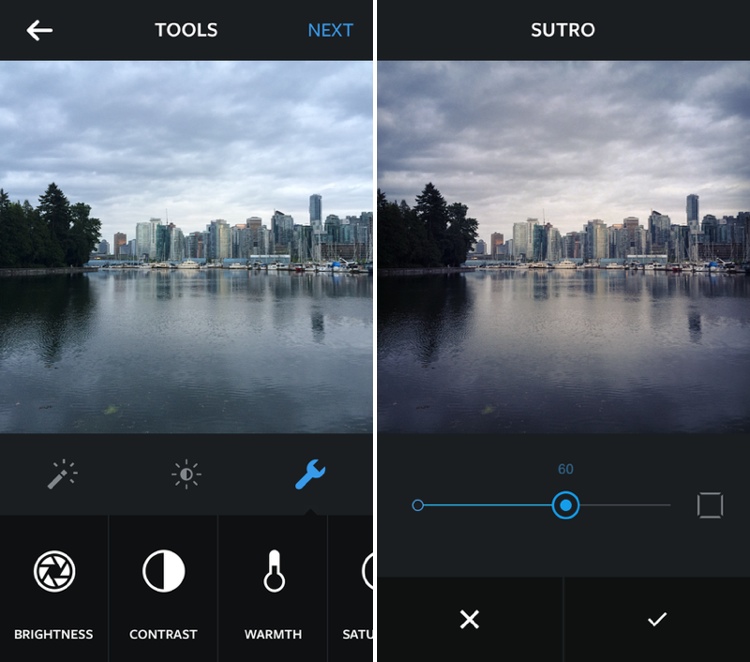
Here’s a full rundown of the new tools:
– Adjust: Crops and straightens at the same time.
– Brightness: Lightens or darkens a photo.
– Contrast: Brightens light areas, darkens dark areas further.
– Highlights: Lightens or darkens the lighter areas of the image.
– Shadows: Lightens or darkens the darker areas of the image.
– Sharpen: Subtly enhances the crispness of an image to make it clearer.
– Saturation: Increases the color intensity of an image.
– Warmth: A slider that allows for adjustments towards warm orange tones or cool blue tones.
– Vignette: Darkens the edges of a photo to highlight the center of the image.
– Filter Strength: Sliders that adjust how strong each filter will appear (includes Borders).
According to Instagram co-founder Kevin Systrom, who spoke to Re/code, the goal isn’t to complicate Instagram, but to improve image editing tools without removing focus from the main product.
“We are aiming to make the core better, creating more of an ecosystem,” he said “Everyone can build a photo app, but not everyone can build a community.”
Instagram‘s new tools, particularly the ability that allows images to be adjusted by filter strength, will allow for a whole new photo editing experience for users. The update is available immediately from the App Store.
Instagram can be downloaded from the App Store for free. [Direct Link]

Beats Acquisition Boosting Apple’s ‘Coolness’ Factor Among Young Consumers
 Last week, Apple confirmed its plans to acquire Beats Electronics and Beats Music in a $3 billion deal that would bring a successful headphone business and a fledgling streaming music service under Apple’s umbrella. While many have pointed to Jimmy Iovine as the acquisition target, Apple may also be using the deal to boost its “coolness” factor among younger users, as suggested in a survey by education technology company Chegg (via Re/code).
Chegg asked 10,000 students about their experience with Beats and their knowledge of the Apple-Beats merger. While most of the students surveyed were familiar with the Beats brand, only 15 percent had purchased Beats products and a mere three percent had subscribed to the Beats Music service. More than half of the students (60 percent) were aware of the deal with one quarter claiming the deal will make Apple more “cool” and fifty percent believing the acquisition will increase Apple’s popularity among students.
This is largely good, albeit unsurprising, news for Apple, which has long dominated the college market. In most college lecture halls across the country, you’ll see rows and rows of MacBooks — many of which were purchased using Apple’s educational discount or in Apple-affiliated campus stores. Still, more and more young people are streaming music using services other than iTunes. Spotify has more than 40 million subscribers, and 40 percent of its American users are between the ages of 18-24.
Beats is often criticized as being a bass-heavy fashion accessory and not a true audiophile product, but sales figures reveal that the typically younger consumers who buy Beats are more interested in appearance than audio quality. According to marketing research company NPD, Beats accounts for 27 percent of the $1.8 billion headphone market and more than half (57 percent) of the premium market for headphones with a starting price tag of $100 or more.

iOS 8 Offers Quick Access to Apps Based on Location
Apple outlined several of iOS 8′s major features during yesterday’s WWDC keynote, but with the operating system now in the hands of developers, details on several lesser known features have been leaking out.
One new feature sees the iPhone displaying apps on the lock screen based on location. For example, MacRumors readers have seen relevant app icons pop up while at or near brick and mortar locations like Starbucks and the Apple Store. While at a Starbucks, for example, the Starbucks app icon is displayed in the lower left corner of the iPhone’s lock screen, which allows a Starbucks Passbook card to be easily accessed.

This feature isn’t limited to Apple’s own stores or to major retailers, either, as one Twitter user has also seen an app for a train station on the lock screen while at that particular location.
Displaying location-based apps on the lock screen is particularly useful at Starbucks and the Apple Store as both locations allow users to make purchases using their iOS devices. In fact, a common theme between the apps that have demonstrated this functionality is a specific on-site function like the ability to make a purchase or display a ticket.
It is not clear how this feature works, or which apps are compatible at this point, but the iOS 8 release notes mention the location based apps as a facet of Location Services. “When Location Services is turned on, the device’s current location is used to recommend relevant apps on the lock screen.” Based on the description of the feature, it appears to work through both the App Store and physical location and will eventually be able to be turned off by turning off location services for the App Store.
As we approach the public release of iOS 8, it’s likely we’ll hear more about this new location-based alert feature. iOS 8 is expected to be available to the public in the fall, following a developer-oriented beta testing period.
(Thanks, Kyle!)

BRAVEN Announces the New Water-Resistant ‘Mira’ Bluetooth Speaker
Summer is right around the corner, for many it is already here. When I think warm weather and sunshine, I think rivers, lakes and pools. I also think music. BRAVEN has announces the availability of their latest Bluetooth speaker, the Mira.
 The Mira is a small hockey puck style Bluetooth speaker that has quite a bit to offer. Inside there is a 1200 mAh battery that is rated for 10 hours of audio playback. The battery is charged with a micro USB plug that is located under a rubber stopper. Under the plug you also find a aux port and a reset button. The Mira also has a multi function kickstand that also flips around to make a hook to hand the speaker on things, like the shower head. Externally on the front they have the power button, play/pause and volume up/down that also doubles as track forward and back. This gives you full control over your tunes while keeping your device at a safe, water free, distance.
 The Mira also has a mic allowing you to use it as a speaker phone while lounging in the pool with your drink. I did say it was water-resistant as well. The little speaker offers up a IPX5 rating.
“Mira has the power to fill a room with outstanding sound, a design that makes it multifunctional, and an understated look that complements your decor,” stated Andy Fathollahi, Chief Executive. “In simple terms, Mira embodies versatility and functionality.“
The new BRAVEN Mira is currently available in black or silver today for $99.99. BRAVEN will be releasing a light blue, light pink and a primary color combo in coming weeks. If you have ever owned a BRAVEN speaker, you know the sound is always stellar along with the build quality and battery life. We have reviewed a number of their speakers over he years and they just keep getting better.
You can get a better look and place an order for one over at Braven.com
//<![CDATA[
ord = window.ord || Math.floor(Math.random()*1E16);
document.write('’);
//]]>
 AIVAnet