


China’s state media wants Apple and Google to be ‘severely punished’ for NSA spying

Today has seen a sudden spike in anti-American sentiment in Chinese state-owned media, with Apple, Google, Microsoft and Facebook all being described as “pawns” of the US government (aka the “high-level hooligan”). Articles in the China Daily and People’s Daily call for these companies to be “severely punished” for their alleged roles in the PRISM scandal, but there’s no obvious trigger to explain the timing of their publication. One possible factor is today’s date: June 4th marks the bloody end of the Tiananmen Square protest of 1989, when government forces killed hundreds of pro-democracy activists in the streets of Beijing. Google and other sources of international news are being subjected to extra censorship in order to control discussion of the Tiananmen anniversary within China, which implies that these outlets are currently even more irksome to the Communist Party than they usually are.
An excerpt from the People’s Daily:
“U.S. companies including Apple, Microsoft, Google, Facebook, etc. are all coordinating with the PRISM program to monitor China… To resist the naked Internet hegemony, we will draw up international regulations, and strengthen technology safeguards, but we will also severely punish the pawns of the villain.”
Another possible explanation for the blanket attack is that fresh evidence of privacy abuses has come to light in China, perhaps involving the NSA and its (unhealthy) relationship with commercial web services. However, no new allegations have been detailed, and Apple and other companies continue to deny that the NSA has backdoor access to their data centers. Alternatively, the wave of press coverage could simply be a response to America’s recent scolding of a Chinese military cyber-espionage unit, or part of a wider governmental push for the use of homegrown rather than US-made technology.
Filed under: Misc, Internet, Mobile, Apple, Google
Source: Reuters

MIT’s robotic limbs pave the way for real-life Doc Ock (video)

Two groups of MIT scientists are working on robotic limbs, which when worn together can make you look like one famous comic book villain: Doctor Octopus. Unlike prosthetic limbs developed to replace real ones, the teams’ (from MIT’s d’Arbeloff Laboratory) Supernumerary Robotic Limbs (SRLs) are designed to supplement your existing arms. One team showcased its latest shoulder-mounted SRL prototype at the IEEE International Conference on Robotics and Automation in Hong Kong, where members showed how it can take over tasks when your real arms are too busy. These particular SRLs take data collected by the accelerometer and gyro embedded in the base of the shoulder mount, as well as their accompanying wrist monitors. The limbs then move on their own based on your actions — for instance, they move up when you raise your real arms, and in the future, they could open doors when you’re carrying something.
The second team, on the other hand, is working on waist-mounted SRLs. Since the project was mostly sponsored by Boeing for its aging employees, the mechanical limbs are designed to be used either as arms or legs, in order to help with airplane construction by bracing or supporting workers’ weights. Sadly, neither machine has mind-control capability, so you’ve got a lot of work to do to fulfill your Doc Ock dreams.

Filed under: Robots
Via: The Verge

Bitcoin rival rewards you for archiving history instead of doing useless math

Other than generating lucre, Bitcoin mining does nothing but waste of time and energy. That’s why researchers from Microsoft and the University of Maryland have developed “Permacoins” which reward you for actually doing something useful: backing up important data to your hard drives. For instance, you could earn crypto-coins by helping store, say, the 200TB US Library of Congress to your own disks. You wouldn’t be able to cheat and use Dropbox or Google Drive thanks to an encrypted key, and data would be validated using a “proof of reliability” check. With enough participation, it would provide a safe, distributed backup and enable data to be accessed during outages — like when the Library of Congress went offline during last year’s shutdown. It’s just a prototype for now, but researchers reckon a 100 Petabyte data pool could be created if users spent the same on storage that they have on pricy mining rigs.
Filed under: Science, Internet, Microsoft
Via: The Register
Source: UMD, Microsoft Research

Relish drops the landline to offer ‘fibre-fast’ broadband without the hassle

UK broadband is in a state of flux. Fixed-line providers like BT and Virgin are expanding their services to deliver super-fast broadband into homes. Elsewhere, operators including EE, Vodafone and Three are cementing their mobile backbone to meet the UK public’s insatiable thirst for data over the airwaves instead. A small number of companies have tried to find the middle ground, the space where broadband and mobile networks meet, but none have ultimately succeeded. A new service called Relish wants to change that, and it believes it has the credentials to win where others haven’t.
Relish is a mobile provider with a difference. Its primary goal is to serve Londoners with fast broadband “without the wires.” As you might have guessed, it’s relying on 4G connections to deliver internet to customers, but unlike rivals EE or Three, it places no restrictions on the amount of data you can consume. Because it’s a mobile provider, there’s no need for a landline, meaning you won’t have to wait for an engineer to install routing kit and activate your connections. It also means you don’t have to pay monthly line rental or sign up for lengthy contracts.
Unlike rivals EE or Three, it places no restrictions on the amount of data you can consume
How does it work? Relish, which launches today in select London postcodes (we’re told it spans from Kensington in the west to Canary Wharf in the east), lets you call or order online and have a custom-couriered (on a colourful motorbike) welcome pack delivered to you the very next day. Plug the Huawei-suppied TD-LTE router in and you’re immediately online. The home service runs completely on Relish’s own spectrum (owned by UK Broadband), delivering what the company calls “fibre-fast” broadband. That connection is said to average 30Mbps, which isn’t as fast as many true fibre services, but Relish says those speeds won’t be affected by data limits or evening slowdowns, which heavily-contested fixed-line providers regularly employ.

Make no mistake, the service is not for everyone. Relish itself says it’s aiming for specific segments that “haven’t had enough choice to buy broadband to suit their lifestyle.” London’s young professionals, renters and people who want more flexibility are the Relish’s key demographics. Because all the service needs is a power connection, customers can take their box wherever they go (depending on Relish’s coverage). Monthly contract’s start at £20, but you will have to buy the router for £50. Sign up for a 12-month contract and the router is thrown in free of charge.
Monthly contracts start at £20, but you will have to buy the router for £50
The home service is just one of four packages that Relish offers. There’s also a mobile broadband package which operates similarly to a MiFi from Three. Depending on the package you buy, you will be supplied with a Huawei-supplied mobile router called the Pocket Hub (which normally costs £35) which works nationwide. While it will take advantage of Relish’s own networks in the city, the company is using Three’s HSPA+ 3G networks as a fallback, letting you obtain connectivity anywhere in the UK. Prices start at £10 for 1GB and you’ll receive a £5 discount if you already own the home product. However, any data you don’t use in a 30-day period will be wiped off your allowance.

Relish is targeting businesses too. Its standard business offering is designed to cater for 20 employees, mainly in companies that are on the move. Startups, pop-up shops, coffee shops and companies moving offices are what Relish wants to cater for, by offering a number of additional services that aren’t normally reserved for regular customers (like static IPs). Bigger companies with very high data requirements can apply for the company’s dedicated business service, which offers speeds up to 1Gbps and is installed within 10 days. Relish didn’t say much about this package, suggesting it wants to scale for consumers and smaller businesses first.
Relish is targeting businesses too. Startups, pop-up shops, coffee shops and companies moving offices…
It’s very easy for Relish to overstep the mark and oversell a service that is limited to specific regions in London, so it’s employing a number of checks to ensure customers aren’t dissapointed with the service they receive. The company is using high-frequency bands (Bands 42/43, or 3.5-3.8GHz if you’re interested) to deliver high speeds in densely-populated areas. Because it runs a pure data service and doesn’t lay voice transmission on top, you’ll only get the service that it’s specifically designed to offer. If you enter your postcode on the Relish website and you fall outside of the supported areas, it simply won’t sell broadband to you.
Relish says that it’s only using 1/6th of the spectrum it owns in London, allowing it to expand its service city-wide in the future. There’s no date for an expansion to other cities, so if you live outside London, you’ll only be able to sign-up to Relish’s roaming offering. If the company’s postcode checker says you’ll get service, but you live in a basement or somewhere normally outside of the reach of mobile signal, Relish will let you test its service as part of a 14-day trial and send it back if you’re not happy.
Filed under: Internet
Source: Relish

Watch strap batteries could double the life of your wearable

Smartwatches are starting to look a whole lot better, but they’re still liable to run out of juice in mere days. A flexible-battery manufacturer here at Computex reckons its thin, flexible lithium-ceramic cells, shaped into wristbands, could offer as much as 500mAh of extra power, with existing models already offering an extra 300mAh. According to ProLogium, that would effectively double the battery of Pebble’s smartwatch and, well, on-paper specifications suggest that it could more than double the capacity.
The lithium-ceramic batteries used are solid-state, meaning they avoid the volatility of other lithium-powered power sources. Other safety boons include non-flammable materials and the fact that it won’t explode or set fire if cut into pieces — always good to know. (We saw a demo cell cut apart, and it was still able to power a strip of LED lights). These three- to five-cell layers are also only roughly 1.5mm thick, meaning wearables seem an ideal place for them, from smartglass headsets to light-up clothing, heating elements and, yes, smartwatches.

The company is already making the bands, and while we were handling the one-piece design, it also offers a more typical strap-like, two-piece design that connects at the ends of a watch face, and a “chin” design that would connect and overlap an existing strap. The (admittedly not working) sample was plenty flexible to substitute in for a watch strap, but we reckon the biggest test will be the aesthetic one.

NASA readies Mars ‘flying saucer’ for risky hypersonic flight test

The wispy atmosphere of Mars is 99 percent thinner than Earth’s — not great for slowing down space ships or metorites. NASA’s testing a way to make it work, however, using a helium balloon, rockets and a Low Density Supersonic Decelerator (LDSD) vehicle, which looks suspiciously like a UFO. The plan is to launch the LDSD to 120,000 feet using the balloon, then push it to the edge of space (180,000 feet) with the powerful solid-fueled rocket. At that point it’ll be traveling hypersonically at Mach 4 in the stratosphere, simulating a Mars arrival. A second, donut-like balloon called the “supersonic inflatable aerodynamic decelerator” will then deploy, increasing the craft’s surface area and slowing it to about Mach 2.5. Finally, the largest supersonic parachute ever tested will pop, allowing the vehicle to eventually touch down in the ocean. If the complex plan goes awry, NASA will learn from the data it gathers and try again in order to meet its ambitious Mars exploration schedule. Either way, it’ll be fun to watch — the launch is set for tomorrow in Hawaii between 2:00 and 3:30 PM ET.
Filed under: Transportation, Science, Alt
Via: HobbySpace
Source: NASA

An up close look at the giant gaming PC that’s also a desk

Lian Li usually deals in computer towers, but it occasionally dabbles in incredible (or mad) desks built specifically to house desktop PCs. We even got to see one of these monstrosities in person, the top-end model above, spotted right in the epicenter of Computex, Asia’s biggest tech show. Given the trend toward tablets, phones and wearables this year, it could well be the most… Computex thing here. We just wish there was some kind of award for that.

Filed under: Desktops

ITV channels come to Sky Go in time for the World Cup

It’s hard to sniff at Sky Go, the service that lets you watch live TV on computers and mobile devices when out of set-top box range. Free to Sky subscribers, its main weakness is a limited channel selection, which is slowly but surely being addressed through new agreements. Today, one such deal adds all of ITV’s channels to Sky Go, just shy of a year after Virgin Media brought the same selection to its equivalent TV Anywhere service. The new Sky-exclusive channel ITV Encore will also serve up both live TV and on-demand content through Go when it launches in early June. E!, Home and Lifetime are also set to be added to the service over the summer. Considering ITV will be broadcasting 34 World Cup games, the new channels have landed on Sky Go at an opportune time. If you don’t have Sky, though, remember you can still catch all that footy while out and about on ITV Player.
Filed under: Home Entertainment, Internet
Source: Sky
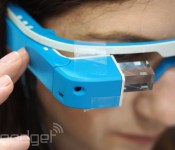
SiME Google Glass knock-off is held together with Scotch Tape

It’s not exactly a good sign when your product’s being held together with Scotch Tape. But that’s actually one of the main points of distinction between the SiME Smart Glass and Google’s version of the wearable — that and a much lower price point, of course. Taiwanese company ChipSip hopes to sell its Google Glass knock-off for $500, and though that seems palatable compared to $1,500, it’s still not cheap. That price is even harder to swallow when you see just how complicated it is to use, as we discovered on the Computex show floor.
The heads-up display runs Android 4.2.2, and the touchpad on the right side of the device makes for a very finicky user experience. Selecting apps and moving the cursor around takes a ton of effort. There’s no voice functionality, either, so you can’t say “Okay, SiME” to make things easier (how would you pronounce that, anyway?). As for the display itself, the 720p screen looked decent, but the frame was too big for my head, which made it hard to get a steady image.
Unlike Glass, which has its own custom interface, SiME uses stock Android, which was more than a bit clunky to navigate. You have a standard app tray and all of the apps you’d expect to find on a smartphone — where they’re actually meant to be used. Externally, the display looks nearly identical to Google’s equivalent, but the projected image wasn’t easy to see, effectively making this iteration unusable. Ultimately, we’re not confident that this wearable will ever be a perfect fit, but either way, ChipSip has a long way to go before SiME’s ready for consumers.
Zach Honig contributed to this report.

This $295 battery-powered unicycle could replace your Segway

Ah, the sweet memory of learning to ride a bike with training wheels! My hands are sweaty, and my ego a bit damaged after spending a half-hour learning to ride a battery-powered unicycle called the Pinwheel. This $295 gadget is one of the more interesting finds here at Computex 2014 — if you’ve been looking to ditch that Segway for a more portable mode of transport, this may be it. It’s made by Shenzhen-based company TOPJOY, and it really is a thrill to ride.
Luckily, there was a model with training wheels and a balance strap on hand, because it takes a bit of time to get the hang of it. As you’d expect, it’s all about balance — stand straight to stop, lean forward to move forward, back for reverse and so on. You can travel at up to 22 kilometers per hour (about 14MPH) on this guy, but you better know what you’re doing before you attempt to move that fast. Turning’s a bit difficult, too, especially if your parallel-parking skills are a bit iffy. Luckily, the Pinwheel’s design is resilient enough to withstand a few bumps and bruises as you learn how to ride it, though you might not be so lucky, so be sure to wear a helmet.
The Pinwheel’s real appeal is its portability; it weighs about 20 pounds, and could easily be tucked away after your morning commute — it even has a handle for easy carrying. The replaceable battery pack, which even sports a USB port for charging up smartphones and tablets, yields about four hours of use, and you can choose from six different color options. The Pinwheel is being shopped around to potential buyers here at the show, so depending on demand, it could end up in a variety of markets. And now for the best part: a video of me making a fool of myself riding the unicycle on the Computex expo floor.
Zach Honig contributed to this report.
Filed under: Transportation
 AIVAnet