


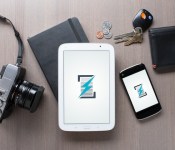
Rezence wireless charging standard now supports laptops and tablets

Wireless charging is a technology often reserved for smaller devices — smartphones, watches and electronic toothbrushes — but that’s about to change. The Alliance for Wireless Power (A4WP) just updated its Rezence charging standard to support laptops, tablets and devices requiring up to 50 watts. The Alliance only just made this change official, but it’s been coming for awhile: when Dell joined the group back in February, the A4WP promised to introduce a higher-power specification that would enable Ultrabooks to charge untethered.
It’s a good step forward in charging technology, and could make it easier to keep your devices topped off on the go. That said, manufactures still have to pick from three disparate charging standards before shipping a device, leaving any product without specific internals to brave a fragmented landscape. A4WP member Lenovo seems optimistic, at least, stating that the new Rezence standard the solution that “best meets [their] customers’ needs.”
Source: Rezence

The Amazon Phone Looks to be Set for a June 18th Announcement in Seattle
Speculation and rumors surrounding an apparent Amazon phone have popped up a number of times over the last two years or so. There have been leaked images that depict an Amazon centric and branded device along with various supply chains confirming its existence. The last few Amazon events were speculated to include an announcement of said device, but have all come up short with just some new tablet announcements.
It would appear that that is all about to change though. Amazon is having an event on June 18th in Seattle.
 See. There is clearly a device in the image with the Amazon branding on what we would assume is the rear of the device. You could claim it is another tablet, but the video they offer up will show you something different. Take a look for yourself.
Did you see the lady at the 41 second marker? Right at the very bottom of the screen, you can see she is looking at a small form factor, much smaller than a 7-inch tablet, device. Pretty certain at this point that it is the Amazon phone that has eluded the world for so long. Aaron Kasten snagged the perfect still of what I am referring to.

Now, what is all the head twisting and turning about? Well, the previous chatter indicated that the device would bring a total of 6 camera sensors that will enable the device to offer a 3D interface when you are looking at it. Pretty nifty idea really. Rounding out the leaks the device was said to offer a 4.7-inch 720p screen, a Qualcomm processor, 2GB of RAM and a 13MP rear camera. There has also been a fair amount of talk about it launching with certain Prime Data plans and that it will be an AT&T covered device. However, memory serves me that June 18th is also the date that T-Mobile is set to announce the Uncarrier 5.0 information. I am wondering if it will come right along side the Amazon phone as well.
Sadly all of this is rumor and speculation until June 18th gets here. It is pretty obvious that Amazon is announcing the Amazon phone though.
Via Aaron Kasten
//<![CDATA[
ord = window.ord || Math.floor(Math.random()*1E16);
document.write('’);
//]]>

HTC One Remix leaked with Verizon branding

It seems that Verizon is gearing up to release the HTC One Remix. Folks over at @evleaks leaked an image of a HTC smartphone with Verizon branding on it. The phone is said to be the Verizon’s version of the HTC One Mini 2, and the only difference is that the Remix comes with a smooth metal back. It’s a beautiful device and we will hopefully see it at Verizon soon.
 The device will come with 4.5″ 720p LCD display, Snapdragon 400 quad-core processor, 16GB of storage (plus microSD slot), a 13MP rear non-UltraPixel camera, 2100mAh battery, and Android 4.4 atop which sits HTC’s Sense 6 UI layer.
Are you planning to grab one? Let us know in the comment box below.
Source: @evleaks

The post HTC One Remix leaked with Verizon branding appeared first on AndroidGuys.
‘Swift’ Programming Language Been in Development for Four Years, “Major Focus” Since 2013
 The Swift programming language was as close to a “One More Thing” as there was at the WWDC Keynote this week, debuting to significant cheers from the developers in the audience. Immediate reaction after the keynote suggested Swift was “huge news” and the future of development on Apple products.
Apple says Swift code is “concise yet expressive”, interactive and fun. For coders, the introduction to Swift is available on the iBooks Store but Chris Lattner, head of Apple’s Developer Tools department, shared additional information on Swift on his personal webpage (via TechCrunch).
Now that Swift is public, Lattner revealed that he began working on Swift in mid-2010, with a team of coders “contributing in earnest” late in 2011. Last July, Swift finally became the major focus of Lattner’s Developer Tools Group.
The Swift language is the product of tireless effort from a team of language experts, documentation gurus, compiler optimization ninjas, and an incredibly important internal dogfooding group who provided feedback to help refine and battle-test ideas. Of course, it also greatly benefited from the experiences hard-won by many other languages in the field, drawing ideas from Objective-C, Rust, Haskell, Ruby, Python, C#, CLU, and far too many others to list.
The Xcode Playgrounds feature and REPL were a personal passion of mine, to make programming more interactive and approachable. The Xcode and LLDB teams have done a phenomenal job turning crazy ideas into something truly great. Playgrounds were heavily influenced by Bret Victor’s ideas, by Light Table and by many other interactive systems.
Lattner says that he hopes to make programming “more approachable and fun” with Swift, getting rid of extraneous materials to make programming easier to learn.
“We’ll appeal to the next generation of programmers and to help redefine how Computer Science is taught,” Lattner writes.

Watch this: Robot arm composes intricate 3D light paintings

What happens when you outfit a robot arm used for manufacturing with RGB LEDs? Well, lots of things we’d surmise, but super detailed 3D light paintings are but some of the possibilities. A pair of human/computer interaction students at Carnegie Mellon have done just that, producing much more detailed results than previous efforts. Using a Kinect to capture the subject(s), a collection of 5,000 points are plotted over the course of about half and hour with various software applications handling the plotting, color, 3D modeling and more. To log the work in its entirety, DSLRs snap long exposure stills as the arm does its work. Perhaps that ABB IRB 6640 can moonlight as a portrait artist between construction projects.
Filed under: Misc
Source: The Creator’s Project (Vice)

Virtual reality training for rescuers may save your life in a crisis

While some soldiers have virtual reality training to familiarize themselves with the battlefield, paramedics and other rescuers are out of luck; their first crisis is frequently all too real. Intelligent Decisions isn’t happy with that lack of preparation, so it’s developing a VR system that gives first responders a taste of what it’s like to handle major emergencies. Its upcoming Medical Simulation thrusts trainees into chaotic situations like natural disasters and terrorist attacks, teaching these people to maintain focus and treat those who need the most help. The hardware can incorporate actors and mannequins into computer-generated scenes, and it will have sensors for blood pressure, heart rate and gaze to verify that crews are staying cool under pressure.
While Medical Simulation is built with civilian rescuers in mind, it should also be useful for military medics that have to get used to the heat of combat. It might also be used to treat patients far removed from immediate danger’ Intelligent Decisions believes it could help with complicated surgery or veterans coping with post-traumatic stress. It will take about two years for Medical Simulation to enter service, but it could be cheap enough that even clinics can ready themselves for worst-case scenarios — if calamity strikes, you may owe your life to someone who’s had some VR practice.
[Image credit: Miguel Rojo/AFP/Getty Images]
Filed under: Displays, Wearables
Source: The Verge
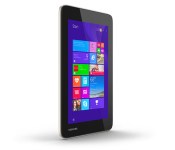
Toshiba stuffs Windows into a 7-inch tablet, whether you want it or not

There’s no shortage of 8-inch Windows tablets on the market right now, but Microsoft and its partners are pushing ahead with plans to shrink the OS even further. A Redmond executive at Computex has just shown off the Toshiba Encore 7: a 7-inch tablet running full Windows 8.1. If you’re thinking that the Windows desktop will be mighty fiddly at this screen-size, then you’re right — it’s only going to be useful as a Plan B when there’s no other way to get into a legacy application, or when you’re hooked up to a keyboard, mouse and bigger display. For regular use, you’d be reliant on the more thumb-friendly Metro UI and apps.
The Encore 7 isn’t actually the first such device we’ve seen (Panasonic has a 7-inch Toughpad, and some smaller brands have had a go too), but it’s likely to be one of the first to go mainstream, especially if it can score a budget price tag. There’s no official pricing or availability yet, but judging from the use of a standard Bay Trail Atom processor, paired with a reported 1GB of RAM and a 1,024 x 600 display resolution, there’s nothing to stop the Encore 7 coming in at well under $200. We’re hoping to get hands-on with the device shortly, but in the meantime our review of the Encore 8 should give you a flavor of what this thing is like.
Filed under: Tablets, Microsoft, Intel
Source: Microsoft News, Tech2.hu
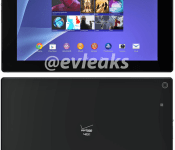
Verizon Looking Like Likely Carrier for the Xperia Z2 Tablet
I am a huge fan of Sony products. Ever since my switch from Samsung to the Sony Xperia Z on T-Mobile, I have no desire to return to the dark side. A new leak suggests that Verizon will be getting back on board with Sony after years of denial. The last Sony phone I can remember was clear back when it was still Sony Ericsson and they had the Xperia Play. While the leak, courtesy of @Evleaks, doesn’t show us a Xperia Z3 phone, it does show us a Verizon branded Xperia Z2 Tablet. Just as good and if not better to many.
 The Xperia Z2 Tablet was only recently announced in February. The tablet brings in a 10.1-inch 1200 x 1920 resolution display with Sony’s Triluminos and X-Reality engine. It packs in a Qualcomm Snapdragon 801 quad-core processor at 2.3GHz along with 3GB or RAM. The battery life is rated for 10 hours, it is a 6,000 mAh battery, and the whole thing is water-proof (IP55 and IP58) / dust resistant (IP55). It is really hard to not want one of these bad boys.
We will have to wait and see what Verizon has planned for this one. We suspect it will be released soon, but probably carry a hefty price tag for access to the 4G LTE services. Nothing new there.
Via: @Evleaks G+
//<![CDATA[
ord = window.ord || Math.floor(Math.random()*1E16);
document.write('’);
//]]>

LG Exec: LG G3 almost had even smaller bezels

The LG G3 is renowned for its slim bezels and is an engineering marvel when it comes to design, but the company were constantly pushing for even slimmer bezels.
According to Chul Bae Lee, the VP of LG Mobile’s design lab, the executive team were constantly urging the engineers to decrease the width of the LG G3′s bezel even more, but were only stopped by technical restrictions.
In order to accommodate this large screen, the bezel has to be very slim, that’s a given condition. I kept squeezing my engineers to make it slimmer and slimmer. They are all my friends but they didn’t meet my expectations and this is the best we can do as of today. It is still one of the best in the market and it is all related to the technology development as well.
Any slimmer and the device would have been simply unstable and wouldn’t have passed LG’s quality control test, notably the four-feet drop test. Another option would have been to use thicker glass for the display, which again wouldn’t be an option in order to retain the thinness of the device.
LG feel that they got the perfect balance between bezel size and robustness of the device. What do you guys think?
SOURCE: TrustedReviews
The post LG Exec: LG G3 almost had even smaller bezels appeared first on AndroidGuys.
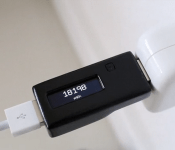
You might soon be able to charge your battery up to 92% faster

We all know battery life is one of the main fields that should be improved when it comes to smartphones. We have all this power in such a small body but battery life often annoys us. There aren’t many solutions other than portable chargers and/or replaceable batteries (for some devices), but there might be way to soften the blow.
A company named PLX Devices Inc is working on a way to offer you up to 92% faster charge of your device’s battery. The device which should help you do that is called Legion Meter and is on Kickstarter as we speak. Legion Meter should be a usb dongle in which you should plug-in your device via usb cable. There are tons of information Legion Meter will give you on its display but the main feature is of course faster charge times, they say up to 92%. Kickstarter goal was $10,000 and they’ve currently raised over $355,000, this actually says something about smartphone batteries these days. If you want to pledge your donation or want to know more visit the link below.
Would you buy something like this? Does your smartphone take way too long to charge?
SOURCE: Kickstarter
The post You might soon be able to charge your battery up to 92% faster appeared first on AndroidGuys.
 AIVAnet