



Germany’s green energy boom is leaving a ‘trail of blood’ on coal companies

Ever since it started, the commercial growth of renewable energy has been a laborious, often painful matter of government pushes, tax incentives and campaigning for greater awareness. In Germany, however, the energy market is on the cusp of evolving to the next step: An era in which the sun and the wind replace fossil fuels through the sheer, unstoppable force of the market.
The country is currently experiencing a glut of energy, thanks to the recent openings of new coal power stations (which were commissioned back when electricity was in short supply) as well as record levels of renewable generation — especially solar. On sunny and windy days, the excess of electricity (which on average stands at 117 percent of peak demand) gets so big that energy prices are pushed downwards and traditional power stations are forced to cut down their running hours. A decade ago, fossil companies enjoyed a 15 percent margin on their sales, but today they make just five percent. An energy trader has informed Bloomberg that he believes that the latest coal stations to come online will make “much less money than originally thought” and “won’t cover their costs.”
Regulation is still at the heart of Germany’s predicament, because green generators have preferential access to the grid on days when there’s an overload. In other words, they’re allowed to run and run, while coal-fired stations have to switch themselves off in response to the excess. However, the consequence — which we’re already seeing — is to sap investors’ interest in financing the coal industry. In turn, this means that when the country’s older coal stations reach their end of life over the next decade, there’s a much greater chance that they’ll be replaced by green sources. Renewable energy’s contribution to the grid is on target to rise to 45 percent by 2025, while coal companies are left with what one chief financial officer described as a “trail of blood” on their balance sheets. In the US, meanwhile, the birth of solar on an industrial scale is only just getting started.
Filed under: Misc
Source: Bloomberg
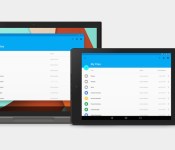
Did Google show us HTC Nexus 9 render on Google I/O?

There were plenty of rumors suggesting that HTC is working on a new Nexus tablet, dubbed Nexus 9. We’ve even had a detailed leak regarding the device which included not only a render of the device but its specifications as well. Well, something interesting happened on Google I/O which might suggest that the leak was true, to some extent at least.
If you look at the picture Google used at this year’s I/O, you’ll notice a weird look tablet in the middle which is not the Nexus 7 (2013) (it is not Samsung’s Nexus 10 either, you can tell that on a first glance). I’ll tell you why:
- The camera is on the middle of the tablet (from portrait perspective), while the one on the Nexus 7 is on the right side of it, not completely, but still, it’s not centered.
- You’ll notice the front facing speaker on the render, next to a front facing camera. Well, Nexus 7 doesn’t have a front facing speaker. On the other hand the leaked HTC Volantis doesn’t either, as far as we can tell by the render linked above at least.
- The tablet on this render is in landscape while the Nexus 5 (on the right) is in portrait. You can see that the tablet is taller in landscape than Nexus 5 is in portrait, which also doesn’t match up to Nexus 7′s proportions. Nexus 5 is 137.9mm tall while the Nexus 7 (2013) is 114mm wide.
This really doesn’t have to mean anything, maybe Google is playing with us. Be it as it may, we do think this is for real and that Google wanted to tease us a bit, in other words we don’t think it’s their way of trolling us or that it was an accident. What do you think?
Source: Google
The post Did Google show us HTC Nexus 9 render on Google I/O? appeared first on AndroidGuys.

Google released a promo video showing off Android “L” on various devices and situation as a part of Google I/O

Google really had lots to say at this year’s Google I/O. We definitely expected a promo video for it and Google delivered.
Video runtime is around 2 minutes and it shows most of what Google has been talking about, or better, presenting at Google I/O this year. This promo video is tracking a guy and his dog in different situations, from waking up and running to a dog show and chillin’ in the living room. Throughout the video you can see Google’s new Android Wear in action on a LG G Watch and Android “L” on a Nexus 5 and Nexus 7, they even included Android TV and Android Auto in the story. Oh well, see it for yourself:
Source: Google (YouTube)
The post Google released a promo video showing off Android “L” on various devices and situation as a part of Google I/O appeared first on AndroidGuys.

Download all the new Android L wallpapers

Now the new Android L Developer Preview is available, the guys over at XDA have extracted the wallpapers used on the latest version of Android, so not only can you now enjoy the main homescreen demonstrated at Google I/O, but you can now have them all.
If you want to download all the Android L wallpapers in one hit, then you can do so using this link.


The post Download all the new Android L wallpapers appeared first on AndroidGuys.

Nissan’s ‘Gran Turismo 6’ concept car crosses over into reality

Nissan has just revealed that its 2020 supercar design of the GT-R created for Gran Turismo 6 has now become an actual, full-sized 2+2 car. The virtual game car was introduced last week, and the actual glass-and-steel model drew admiring gapes when it was revealed at Goodwood, England today (see the video below). That’s no doubt because of the radical styling, which includes a four-wheel drive chassis, active suspension, ventilated hood and that carbon fiber front splitter. We’re not sure if the real McCoy is even driveable, but you’ll be able to get behind the wheel of the game car on Gran Turismo 6 sometime next month.
Filed under: Gaming, Transportation
Via: Engadget.jp

Facebook now lets UK users choose from over 70 gender options

Four months after it did so in the US, Facebook is now letting UK users choose new gender options. After working with two UK organisations, Press For Change and Gendered Intelligence, the social network added over 70 new terms, allowing you to select one of the new custom genders or add your own. Users can also choose a preferred pronoun: male (he/his), female (she/her) or neutral (they/their), which is reflected in birthday notifications and suchlike. As with all profile information, Facebook lets you hide anything you’re not comfortable with sharing and says it will not disclose gender selections to advertisers. To update your profile, click the ‘About’ tab, then hit “Edit” next to the “Gender” option in the “Contact and Basic Information” section.

[Image credit: Facebook]
Filed under: Internet, Facebook
Source: The Independent

Google will pay for coding lessons for thousands of female tech workers

We know the stats by now, and they’re grim: women hold just a quarter of IT jobs, and they make up a mere 18 percent of recent computer science graduates. At this year’s I/O, Google has announced a new program that, it hopes, will do something to correct this imbalance. It’s going to pay for “thousands” of female tech workers to discover basic coding through self-learning courses, presumably in the hope that this will advance their careers and turn them into better mentors and role models for youngsters.
A cynical view might be that Google is simply throwing cash at the problem, because this isn’t really a long-term solution: The company is actually just handing out voucher codes so that women can enrol for three months of free online classes at the Code School. However, Google is also running deeper projects to tackle female underrepresentation in education and employment as part of its Made w/ Code program. And besides, it probably deserves credit for taking the unusual step of highlighting just how bad its own diversity problem is, rather than hiding behind the tech industry as a whole.
Google is offering the Code School vouchers directly to female I/O attendees and others “inside the tech community,” but if you’re interested and don’t want to be overlooked, then you can put yourself forward here.
Filed under: Misc, Internet, Google
Via: CNET
Source: Code School, Google Women TechMakers

Sony to stream two World Cup matches in 4K at a London cinema

Sporting events are often used as a testbed for new broadcast technologies, and this year’s World Cup is no different. The BBC is already piloting 4K transmissions (albeit internally) from Brazil, but Sony has dreams of hitting the big screen. The official World Cup sponsor announced today that it’s teaming up with Vue Cinemas to deliver a quarter final match and the final in Ultra High Definition (UHD) live via satellite to Westfield’s Vue Multiplex, which’ll host events on the 4th and 13th of July. Sony says tickets will be limited, by which it probably means the audience will be full of corporate types, but intends to offer a few to some “lucky fans.” We’ve contacted a representative and will share exactly what we know in due course.
Update: Sony has responded, confirming that the quarter final match is for guests only. However, the Final will be opened to the general public, with tickets available via Vue directly.
[Image credit: Daniel Incandela, Flickr]
Filed under: Home Entertainment, HD
Source: Sony Europe
Android 4.4.4 for the Sony Xperia Z1 Compact makes a surprising Appearance
If you had to guess which device after the Nexus, Motorola and Google Play edition devices would be getting the Android 4.4.4 update next, I’m willing to bet that the Sony Xperia Z1 Compact wouldn’t be the first thing you blurt out. As fate would have it, however, Android 4.4.4 for the Sony Xperia Z1 Compact has indeed been […]

ReWalk’s rehab exoskeleton now approved for home use

The ReWalk exoskeleton has been helping paraplegics walk in US rehab centers for years, but now that it got certified by the FDA, almost anyone who can afford it can finally get one. Unlike the one-size-fits-all version for rehab facilities, the personal system that got the agency’s approval is customized for each user and is designed for use in various indoor and outdoor environments. Still, the two share the same design: they both have metal braces that support the body, motors that provide movement and a backpack that supplies energy. They also have a wrist remote control, where users can issue the sit, stand or walk commands. So, what did ReWalk have to go through in order to get the agency’s sweet A-OK, anyway?
Well, the exoskeleton was subjected to a clinical trial involving 30 participants, which tested its ability to walk on various surfaces and determined the time it’ll take a user to traverse certain distances. These tests helped the FDA figure out who can buy and use a ReWalk, because it won’t be easy maneuvering a seven-pound exoskeleton. Apparently, you can’t get the machine unless you can already stand with assistance and use crutches. Also, you can’t have other neurological injuries (other than the ones on your spinal cord), unhealed fractures, infection, circulatory conditions and heart and lung diseases, among others. ReWalk hasn’t revealed its pricing for the US yet, but in Europe, one unit costs a whopping €52,500 ($72,000).
[Image credit: Getty Images]
Filed under: Misc
 AIVAnet