


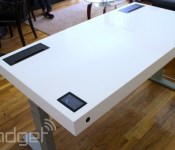
Stir’s ‘smart desk’ now works with Fitbit, shows how many calories you’ve burned while standing

Remember the Stir Kinetic, that $3,890 “smart desk” we showed you last fall? You know, the sleek-looking one made by someone who used to work on Apple’s iPod team? Yep, that’s the one. In any case, it’s about to get a few more features to help justify that insane price tag. Stir just announced that the desk will now integrate with Fitbit’s fitness-tracking platform, allowing you to tally up all the calories you’ve burned while standing.
What’s cool is that the exchange of information is actually a two-way affair: The desk uses its WiFi connection to pull in information from Fitbit (think: steps taken) and then display that on the table’s built-in touchscreen. Meanwhile, of course, the desk knows when you’re nearby, as it has motion sensors built in (obviously, too, it can tell, based on the height of the desk, whether you’re standing or seated). Using this information, Fitbit can calculate how many calories you’ve burned while working. This is especially nice because Fitbit’s fitness trackers couldn’t otherwise tell how many calories you’ve burned while standing still; they only know how many steps you’ve taken. So, if you’re trying to weigh your Fitbit activity against your daily food intake, you might be pleased by all the “bonus” calories you burn as a result of merely standing around.
If you happen to be one of the few who bought a Kinetic desk during its first production run, you’ll receive these latest features via a software update (again, the built-in WiFi comes in handy for this sort of thing). And if you didn’t, well, plenty of other fitness trackers can estimate your daily calorie burn as well — and for a fraction of the price.
Filed under: Household
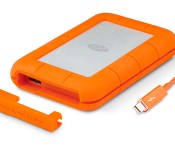
LaCie’s popular portable drive adds more convenience and durability

Who hasn’t misplaced an accessory cable at one time or another. We’ve all been there. Well, to combat that issue with it’s popular orange-draped Rugged portable drive, LaCie has built it right in. A Thunderbolt cable is now attached to the mobile storage unit, wrapping around the edge of the device for safe keeping. What’s more, there’s a cap that protects the jack and an additional USB 3.0 port with IP54-rated dust and water protection. This means that not only are the drives capable of taking a fall of up to 2 meters (just over 6.5 feet), it can also keep debris and moisture our whilst in the field.
In terms of speed, the Rugged clocks in at up to 387MB/s and can handle 100GB in less than five minutes. If you’re itching to grab one, you’ll have to wait until July, but 1TB and 2TB capacities in addition to 250GB and 500GB SSD options will range in price from $220 on up to $500.
Filed under: Storage

Asia’s biggest tech show is ASUS’ show

While covering Computex 2014 this year, we saw ASUS Chairman Jonney Shih take to the stage no-less than three times. Granted, two were to showcase his company’s seemingly limitless product launches, but he also snuck on stage at Intel’s keynote — arguably the only other company that makes an impact at the Taipei. ASUS is a Taiwanese company and when Shih appears, several lines of journalists pop up (as do their flashes), and the light show pretty much continues until he leaves — the home crowd like him. It also helps that the chairman comes across as super enthused whenever he talks up the products — we can recall a particularly cheerful “ubiquitous cloud computing” exclamation at last year’s showcase).
There’s also the fact that ASUS exceeds even Samsung when it comes to producing previously unseen form factors. From phone tablets to tablet phones, hybrids, and this year, a ‘five-in-one’ PC with a built-in smartphone. After a relentless flurry of announcements, journalists, analysts and bloggers are then unleashed into smallish demo area, where, if you’re lucky, there’s two of the new flashy devices to share around a room of hundreds. Apple events might carry a higher degree of pressure, but the chaos of an ASUS press launch at Computex, remains… unique. Here’s how ASUS made this Taipei tech event its own:
Filed under: Cellphones, Laptops, Tablets, ASUS
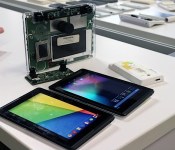
Google’s secretive 3D-mapping project now has a tablet: here it is

Comprehending the world around us is something we humans take for granted, but it’s not so easy for our technology. Sure, autonomous robots and military-grade research labs have hardware that can approximate the same visual acuity of human eyes, but Google’s Advanced Technologies and Projects (ATAP) division started Project Tango to bring that sort of tech to the masses. Its mission is to make mobile devices capable of using depth sensors and high-spec cameras to craft three-dimensional maps more cheaply and easily than other current efforts. ATAP announced its first piece of hardware in February, a prototype smartphone equipped with Kinect-like 3D sensors and other components, but the team is now expanding the project to a new form factor: a seven-inch tablet that’s packed with a lot more power.
The prototype tablet has a 1080p display and runs a stock version of Android 4.4 KitKat, but what’s most important is the oomph under the hood: NVIDIA’s quad-core Tegra K1 chip alongside 4GB of RAM and 128GB internal storage (microSD cards are not supported). That’s in addition to USB 3.0, micro-HDMI, Bluetooth LE and LTE (availability will depend on carrier, but Google isn’t announcing which frequencies are supported just yet) — and if that all sounds like overkill for a tablet, it’s because the team wanted to make it extremely difficult to hit a ceiling in terms of computing power.

The Tango tablet sees the world through the two cameras and a depth sensor on the back. One camera has a 4MP sensor and comes with (relatively) huge two-micron pixels that offer high light sensitivity and faster speeds than most standard options (similar to the UltraPixel sensor in HTC’s One), while the other camera tracks motion more broadly with a 170-degree wide-angle fisheye lens.
If that all sounds like overkill for a tablet, it’s because the team wanted to make it extremely difficult to hit a ceiling in terms of computing power.
The smartphone is a bit chunky and unsightly, from an industrial design standpoint, but the tablet actually looks like it could pass as a consumer device. It’s neither as thick as I expected, nor does it appear hastily put together. Even though device aesthetics don’t really matter in a tablet aimed squarely at developers, the ATAP team has put a lot of effort into the design to ensure its slate is best equipped to do its job. For example, the cameras are mounted at a 13-degree angle to give them the view needed to gather accurate data, while allowing any meatbag holding it to do so in a natural way — instead of awkwardly holding the tablet directly in front of their faces when mapping a room.

Through Tango, the ATAP team wants to give mobile devices a sense of human scale and an understanding of space and motion — it wants your phone or tablet to mimic the way we see the world. Should Tango succeed, the phone in your pocket will be able to map out a three-dimensional mockup of your office building or home, as well as measure the distance between objects within them (walls, counters, couches and so on).
The NVIDIA chip inside uses desktop GPU architecture, making it easier for companies to port over complex programs that they’ve already spent years developing on PCs.
The benefits of these spatial talents are broader than you’d think. If you’re wandering aimlessly through a Home Depot to find a small trinket, you could install an app that guides you through the store, like an indoor version of in-car GPS. Or, instead of imagining how that Swedish sofa would look in your living room, another app might deftly show you if the furniture will fit where you want it to go, no tape measures or imagination required. Virtual real estate tours could become much more realistic for buyers, while three-dimensional maps would be especially handy for visually impaired users. “If you walk around the office building, [a device with Tango tech] could read the names of each conference room out loud as you pass them,” says Johnny Lee, Tango’s technical program lead.
The project’s already getting plenty of support from the graphics community, with renowned game engine builders Unity and Epic among the many companies working with Tango; even Autodesk (the makers of AutoCAD) has several projects in the works. That corporate support, which began with Qualcomm’s Adreno GPU inside the Tango smartphone, should continue to grow stronger on the tablet because of the K1 chip involved. The NVIDIA chip uses desktop GPU architecture, making it easier for companies to port over complex programs that they’ve already spent years developing on PCs.
“If the device can understand your environment, you could turn your living room into a dungeon.”
Then there’s games: Lee showed us an impressive game demo that let us explore a fantasy world by walking around in real space, making the tablet a virtual window into a completely different place or time. “If the device can understand your environment,” said Lee, “you could turn your living room into a dungeon.” This type of environment also seems ripe for a good game of virtual hide-and-seek, with characters hiding behind real objects in your house.

This 3D mapping technology is still considered bleeding-edge, but Lee envisions a day in which the enhanced sensing capabilities are expected in a device, much like Bluetooth is a fundamental feature in phones today. To get Project Tango where it is today, ATAP collaborated with a number of manufacturers and component suppliers to produce the necessary hardware, while universities and research labs contributed much of the software. Work in the 3D mapping space has been ongoing for the last twenty years, but the challenge Tango tackles is condensing all that technology into a small enough device that consumers will want to carry around.
We’ve outlined a few examples of what Tango could bring to the table, but none of it would be possible without the creative input of developers. Back in March, the team distributed 200 phones to third-party devs, but in the next six months Lee plans to ship out these high-powered tablets on a far wider scale; beginning today, developers can sign up to get notified when they’re available. The tablet’s expected to go on pre-order later this month, but Google is hesitant to lock down a specific date for release. Whenever it shows up, however, it’ll cost $1,024 to get your hands on one — if you get whitelisted for an invite. (Like Google Glass before it, there are criteria one must meet to be deemed worthy.) Regardless, the team hopes to showcase the device at I/O if it’s ready.
Like Google’s continued experiment in wearable computing, this isn’t a consumer product yet. The tablet’s loaded with top of the line components throughout to give devs what they need, while retaining a realistic price tag. For their money, developers won’t be getting capabilities different from the phone released in Feburary, but the larger form factor does provide an upgrade in ergonomics. According to Lee, when holding the slate you’re less likely to block the cameras with your fingers. Plus, a bigger device can house a much larger battery (ATAP isn’t giving an official size yet, but it’s likely quite generous, if the phone was any indication). More space between the cameras and sensors also allows for more accurate 3D measurements, and there’s more room for heat to dissipate, which means these bigger devices can handle more computing power.
Eighteen months into the 24-month project, Lee and his team see a bright future, but Tango’s ambitions don’t stop with phones and tablets; the Program Lead believes that Tango could eventually extend to wearables as well. “[Tango] is a camera-based system … and in a wearable we can explore [always-on] cameras that constantly track positions everywhere.”
Filed under: Cellphones, Wireless, Mobile, Google

Tech CEOs push US Senate for stronger surveillance reform

The CEOs of AOL, Apple, Dropbox, Facebook, Google, LinkedIn, Microsoft, Twitter and Yahoo! all agree: more needs to be done to reform the government’s snooping capabilities. That’s the thrust of a letter that appeared online yesterday, anyway. Though the list of signatories contains a handful of rivals, all of them agree that the version of the USA Freedom Act that recently passed through the US House of Representatives still sucks and that the US Senate needs to fix it.
Why? Well, it was originally meant to stop the NSA’s bulk collection of metadata (like who emailed you or when you called someone) outright, but some (including the nine companies who issued the letter) believe the version of the act that passed was watered down to the point where it could easily be exploited. Naturally, there’s still a raging debate on just how valuable and safe that bulk collection actually is. The undersigned nine also call for greater transparency when it comes to user data requests it receives from the government, though that’s not a surprise considering how frequently they already bring up the issue. Just take a peek at, say, Facebook’s most recent transparency report — you’ll find that the social giant received between 0 and 999 national security requests for data. Painting in strokes that broad is unsatisfying at best and obscurantist at worse, which is why companies like Twitter are weighing legal options to push for more specificity.
Source: Reform Government Surveillance

Watch NASA launch its hypersonic LDSD this afternoon

In preparation for a potential trek to Mars, NASA’s launching its UFO-like low density supersonic decelerator into the stratosphere to simulate an arrival on the red planet. The best part? You can tune in live via the organization’s website today from 1:45-3PM ET.
Filed under: Misc

Amazon’s smartphone expected at June 18 event

The long-rumored Amazon smartphone may finally be unveiled in just two weeks. The company is currently teasing a new product, which will be unveiled by CEO Jeff Bezos during an event June 18 in Seattle.
In the teaser video, which you can see below, it shows people’s reactions to a new product, but doesn’t show the device itself. Many of the reactions are that it’s something they’ve never seen before, and one person notes, “It moved with me,” suggesting a 3D experience. It has been rumored for some time now that Amazon has been developing a smartphone with a 3D display.
Some of the other rumors we’ve covered in the past include that it will feature a 4.7-inch display, run a heavily customized version of Android just like Amazon’s Kindle range, will feature four low-powered infrared cameras on the face of the device which will be used to track the users facial position in relation to the device, enabling users to navigate through apps and integrate with the device in a way which has never been seen before, as well as will be an AT&T exclusive and carry a feature called “Prime Data,” essentially giving the user free data while using sanctioned apps, and will not effect their monthly data allotment. It is speculated that the “free” data will cover Amazon’s portfolio of apps including Amazon MP3 and quite possibly a Prime Instant Video app.
Although Amazon isn’t revealing the device yet in the video, it is teasing it even more with a photo of the corner of the supposed device seen at the top of this post.
Something interesting about this unveiling is that Amazon is allowing anyone to request an invitation, you just need to request one, but space is limited.
It’s been rumored that while the device is going to be unveiled in June, it won’t ship until September, but we don’t have too much longer now to wait and see.
Via The Verge

The post Amazon’s smartphone expected at June 18 event appeared first on AndroidGuys.

NVIDIA Shield successor spied at FCC

A successor to the NVIDIA Shield could soon find its way into the hands of gamers and multimedia entertainment lovers, according to new findings. A filing from the FCC for a very Shield-like device known as the P2570 has been spotted, leading many to assume the second-gen portable console is looming on the horizon. Considering the newly discovered drawings and that first device bears a P2450 model number we’re totally on board with the rumors.
It’s likely that the next model keeps the design language and form factor of the original; the refresh could come in a bigger, higher resolution display and/or faster Tegra K1 chipset. Whatever it is, we’re interested.
The NVIDIA Shield is one of our favorite Android devices of the last year and gets better with each software update. One area where we’d like to see some changes is the price tag. Debut at the $300-$350 again and it could be a slow adoption. We’re in love with the $200 sticker we’ve seen lately and think it’s about what consumers expect in a portable device.
The post NVIDIA Shield successor spied at FCC appeared first on AndroidGuys.

Barnes & Noble turns to Samsung for latest NOOK

Barnes & Noble has turned to Samsung for its latest version of the Nook experience, reports the two companies. Arriving in August, the Samsung Galaxy Tab 4 Nook will be a 7-inch device which will be sold online and at the nearly 700 stores across the country.
“Partnering with Samsung brings our customers great new products and evidences our commitment to our Nook customers and growing our digital content business” – Barnes & Noble Chief Executive Michael Huseby
It’s not immediately clear what Samsung gets out of the deal nor how it will differ from the standard Galaxy Tab 4 (7-inch). As some may recall, Nook tablets already have access to Google Play Store.
Will this be branded as a B&N product with pre-selected apps, games, and content? What about pricing? We’ll find out more as we get closer to the release date.
The post Barnes & Noble turns to Samsung for latest NOOK appeared first on AndroidGuys.

Jony Ive and Bono to Appear at Cannes Lions Festival to Discuss (RED) Partnership
The organizers of the Cannes Lions International Festival of Creativity today announced that they will be honoring Bono with the first ever LionHeart Award later this month at the 61st annual festival. The award is being given for Bono’s work with the (RED) campaign to raise funds for the fight against AIDS.

Alongside the honor, Bono and Apple design chief Jonathan Ive will participate in an on-stage interview to discuss their collaboration on the campaign, which has seen contributions from the purchase of (PRODUCT)RED Apple products reach $70 million. Ive last year also partnered with friend and designer Marc Newson to auction off a number of one-of-a-kind items, including a unique red Mac Pro and rose gold-plated EarPods, to benefit the (RED) campaign.
In an exclusive seminar for Cannes Lions delegates, Bono will join Jonathan Ive, Apple Inc’s Senior Vice President of Design, in a discussion moderated by Shane Smith, CEO and Founder of VICE Media, and introduced by Anne Finucane, Global Strategy and Marketing Officer of (RED) partner, Bank of America. Bono and Jonathan Ive will discuss the success of (RED) and [its] unique collaboration with global partners – including Apple, (RED)’s largest corporate contributor to the AIDS fight – and the record-breaking (RED) Design Auction curated by Jonathan Ive and Marc Newson. The auction resulted in $44 million for the Global Fund on World AIDS Day last year.
The 45-minute interview, which will represent a relatively rare public appearance for Ive, will take place on June 21. It is unclear whether video of the interview will be made available after the event, but we have contacted festival organizers to inquire about the possibility.
(Thanks, Joe!)
 AIVAnet