



Apple, Other Tech Companies Give $2 Million Each to Cover Taxpayer Costs of Super Bowl 50 [Mac Blog]
 Apple, along with fellow tech companies Intel, Yahoo, and Google, has given $2 million in cash and other services to offset taxpayer costs of hosting Super Bowl 50 in the Bay Area, reports the San Jose Mercury News (via AppleInsider). In exchange for their donations, each company will receive their own private Super Bowl suite and publicity around the time of the game in 2016.
In total, the Bay Area Super Bowl Host Committee announced that it had raised $40 million for Super Bowl 50. The game will be held in the newly constructed Levi’s Stadium, which be the home of the San Francisco 49ers this year after taking two years and $1.3 billion to build. The stadium is also just 13 miles away from Apple’s headquarters at 1 Infinite Loop in Cupertino, California.
It is unknown exactly how Apple will plan to use its Super Bowl publicity, but the company has had quite the history running Super Bowl advertisements in the past and could choose to run one in 2016. Apple’s “1984″ television ad for the Macintosh was among the most iconic in TV advertising history, as the company ran its last dedicated Super Bowl commercial in 1999.
Since then, a number of rumors throughout the years have pointed to Apple running more commercials alongside the Super Bowl, although the company has not done so. Apple was rumored to be working on a commercial for this past year’s Super Bowl, but instead chose to partner with U2 and Bank of America for a Product (RED) promotion.
Yahoo to strip Facebook and Google logins from Flickr starting June 30th

Yahoo’s slowly been closing off third-party logins for its web services, but it’s now turning its attention to one of its most-established communities: Flickr. The Next Web reports that the company has emailed users telling them that Facebook and Google account logins will be removed from the photo-sharing site starting June 30th. Yahoo previously said the change would allow it to offer “the best personalized experience to everyone,” but given its desire to reinvent itself, ridding its services of rival logins keeps users inside its walled garden and helps boost its own userbase. If your desired login option will cease to exist come June 30th, Yahoo asks that you log into the site one last time using your Facebook or Google details. You’ll be required to create a new Yahoo account, which will then be linked with the account you’ve used previously.
[Image credit: Murilo Cardoso, Flickr]
Filed under: Internet
Via: The Next Web
Source: Yahoo

Live-tweets narrate the D-Day landings exactly as they happened

To mark the anniversary of the Allied invasion of Western Europe on June 6, 1944, one Twitter account is sharing the events exactly as they happened exactly 70 years ago. The UK’s National Archives has thrown open official army war diaries, RAF squadron records, government cabinet papers and messages sent to Prime Minister Winston Churchill to describe D-Day events in real time. Tweets laden with photos and snapshots of documents provide additional detail, giving us a valuable insight into the decision-making processes and endeavours of British and Commonwealth forces over the course the Normandy landings. Google is also honoring the event by launching a new collection on its Cultural Institute website, which features 470 documents and images from Operation Overlord. Some messages are hard to read, but others provide a little light in what was otherwise a dark time for Allied servicemen and women.
1/Queen’s Own Royal Rifles of Canada: A cafe just off the beach is opened up and selling wine to all and sundry http://t.co/chgJ8JuKHj
– War Cabinet (@ukwarcabinet) June 6, 2014
[Image credit: Downing Street, Flickr]
Filed under: Internet
Via: Pocket-lint
Source: War Cabinet (Twitter), National Archive Cabinet Papers
TechCrunch: Amazon’s first phone uses ‘Okao Vision’ for 3D effects

Amazon’s June 18th event is still mostly shrouded in mystery, but general consensus is that the e-commerce giant is releasing a phone of its own with an interactive 3D interface. Now, TechCrunch claims to have identified the technology behind that feature, and it’s supposedly Omron’s Okao Vision face-sensing system. The Amazon team reportedly customized the Japanese company’s creation so that it can be used to show 3D effects on an ordinary LCD screen without special glasses. Instead of relying on accessories, the software depends on four front cameras embedded on the device’s corners to track the user’s face, as well as on the phone’s accelerometer and gyroscope. For instance, if you tilt your face to one side, the interface shows you a hidden panel you wouldn’t see if you look at the screen from another angle.
Besides being able to track faces, Okao Vision (or “Face Vision” in Japanese) can also recognize facial features and determine the user’s gender and ethnicity, though we’ve yet to find out whether Amazon has also integrated those features. We’ve reached out to both Omron and Amazon for confirmation, but in case we never hear back, you can always just start counting down the days until the 18th.
Filed under: Cellphones, Mobile, Amazon
Source: TechCrunch

Cable companies are reportedly funding fake consumer groups to attack net neutrality

The public wants net neutrality so badly that it broke the FCC’s website. But can the weighty voice of the people combat well-funded astroturfing? VICE believes that the nation’s cable companies are funding groups that pretend to represent consumers, but are actually just parroting their own stance to shout down the general public. For instance, the outlet has learned that Broadband for America, which describes itself as a coalition involving “independent consumer advocacy groups,” and which counts senator John Sununu amongst its members, is actually funded by the NCTA — big cable’s lobbyists. It’s the same situation with the American Consumer Institute, another anti-net neutrality voice of the people, which just happens to receive the bulk of its funding from the CTIA, which represents the US wireless industry. Now, what was the thing our grandma told us about astroturfing? Oh right: if you have to invent spokespeople to represent the other side in the debate, you’re probably not the good guys.
Filed under: Internet
Source: VICE

Samsung wearables may boast fingerprint sensors

Fingerprint sensors seem to be the next big thing when it comes to mobile devices, but have you ever thought about having them in your smartwatch?
The company behind the fingerprint sensor on the Galaxy S5, Synaptics, has revealed that next year the same technology could find its way onto Samsung’s smartwatches.
Whilst there are no plans yet as to what use the sensor may have on a smartwatch, or if it will even extend past just unlocking the device, it seems Synaptics are confident companies will begin to adapt their technology to wearables, and Samsung will be the first to do so.
The post Samsung wearables may boast fingerprint sensors appeared first on SmarterWatching.

Read the rest at the source, SmarterWatching.com
The post Samsung wearables may boast fingerprint sensors appeared first on AndroidGuys.
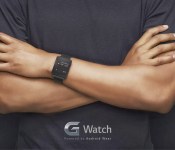
LG G Watch to be powered by a Snapdragon 400 chip?

We know little about Android Wear smartwatches, such as the LG G Watch and Moto 360, besides seeing some photos and video of them in action, but one thing we know even less about is what’s under the hood.
Thanks to some leaked source code rumored to come from the LG G Watch, we have a tip that the device will be powered by a msm8226 processor, also known as the Qualcomm Snapdragon 400 processor. The processor is common in some of today’s smartphones including the Moto G.
With smartwatches like Samsung’s Galaxy Gear having less than stellar battery life, it will be interesting to see how LG and Google tackle this issue.
The post LG G Watch to be powered by a Snapdragon 400 chip? appeared first on SmarterWatching.
Read the rest at the source, SmarterWatching.com
The post LG G Watch to be powered by a Snapdragon 400 chip? appeared first on AndroidGuys.
Living With Google: Gmail

In the world of Google apps, Gmail is one of the most important tools in the Android world. Your Gmail account is attached to everything Google. From the very first Android device you pick up you set up a Gmail account for the play store and other Google services. Gmail is not only a E-mail client it is your Google account that stores your contacts and Google settings.
Setting up a Gmail is very straight forward. Choose your name, password, and recovery Email if you have one. Your account and profile is your name and password for everything Google like YouTube and Maps. You will receive an initial email welcoming you to Gmail and it has links to show all the features and tips for using your account. There is also a Privacy agreement allowing Google servers to scan you Email for advertising and for information to help personalize your other Google services like Google Now.
Gmail is fast, secure, and easy to use. Very efficient at blocking spam and malicious files that may harm your device. Most people agree Gmail is the safest email client available online today for the common user. Using the mail client Google automatically sorts your mail in three groups primary, social, and promotions. You can customize what mail goes in what tab but Google has made it very efficient in sorting by itself with no user input. Primary mail is your common mail between your contacts and business dealings. Social mail is your Facebook, Youtube, Twitter, Google+, and other social networks. Promotions are like the spam and promotion email you want to see like Groupon and Google Play.
In my personal experience I have always used Gmail for its reliability and ease of use I have to primary Email accounts and one AOL of all things from the old days. In general most all my mail is sorted in it proper folders. When setting up a new phone or computer I sign in and immediately my contacts and mail is restored along with my Google settings. I have a few other tabs I have created for work and business contacts and only once in a blue moon does anything seem out of place. Google has really made an email client what it should be smart, easy and safe.
The post Living With Google: Gmail appeared first on AndroidGuys.

Apple Australia Reaches New Four Year Contract with Retail Employees [Mac Blog]
Apple Retail Store employees in Australia have reached an agreement with the company on a new four-year contract, bringing the base pay for entry-level employees up to $22.45 ($20.95 USD) and allowing for 2% annual pay increases, reports ifoAppleStore.
The contract (PDF link), which was approved by 90% of the country’s retail employees and certified by the Australian government, will go into effect on November 1 and also reclassifies the hierarchy of retail employees to define specific responsibilities.
 The Apple Store in Sydney, Australia
For instance, Level 1 employees include those responsible for store aspects such as assisting customers and doing repairs, which correspond to Apple Specialist and Genius positions, while Level 2 employees are defined as those who work at a “higher level” than Level 1 employees and/or supervise as designated area of the store. Meanwhile, Level 3 employees perform full managerial duties, and correspond to Apple Business Leader, Store Leader, and Market Leader positions.
When the agreement becomes effective this November 1st, starting pay for full-time Level 1 employees will be $20.95 per hour (all rates in U.S. dollars), and Level 2 will start at $25.26. Casual employees will receive 25 percent more per hour to offset fewer benefits. Level 3 employees are management, and will receive a base annual pay of $72,779. The Level 1 base pay represents a 25 percent premium over the current $16.69 Australian minimum wage. However, the annual pay increases are less than the FWC’s 2.6 percent increase in the 2013 minimum wage.
Also included in the new contract are terms on grievance procedures and general working conditions. Notably, workers can receive multiple weeks of “redundancy” pay if Apple determines that a job being performed is no longer required, with compensation depending on age and years of continuous service. Additionally, workers who have a first-aid qualification are paid an extra $29.56 every two weeks, and all workers are also permitted to take two hours off from work to donate blood up to four times a year.
Finally, the agreement touches on the subject of ‘Bag Check’ inspections, which was the subject of a class action lawsuit last year. Apple Australia states that employees will be required to participate and fully-co operate with the bag and locker inspections, as they “may happen at any time.”

Connected car model gives us a glimpse of the automobiles of the future

Your dream car is (choose one):
A.) A bumper-to-bumper candy-color paint-job, ostrich seats and 22-inch chrome rims.
B.) One with everything connected cars can offer, such as in-car 4G LTE and WiFi.
If you chose B, then you have to see the Automotive Parts Manufacturers Association’s connected car demo. In addition to having an internet connection, it also features wireless charging capability, 360-degree proximity sensors, as well as (we’re saving the best for last here) gesture control and anti-drunk driving technology. We assume the car has an onboard breathalyzer of some sort, as you wouldn’t even be able to start it if you’ve had one too many.
If you do get to start it up, you can use gestures to control the radio and other components of the car — similar to that gesture-based car control patent Google filed in 2013 — but you can’t exactly wave your hands around to drive. Also, it’s loaded with sensors that monitor your body to determine if you’re falling asleep, and it warns you to get out of the way if it senses rushing ambulance or police cars driving behind. APMA’s fantasy car, which is actually a tricked out Lexus powered by QNX’s Car Platform 2.0, was recently showcased at the association’s annual conference in Windsor, Canada. Since it’s just a demo, we’ll most likely never get to see it on the road, but we wouldn’t be surprised if a huge company launches something similar in the future.

Filed under: Transportation
Via: SlashGear
Source: VentureBeat, APMA
 AIVAnet