


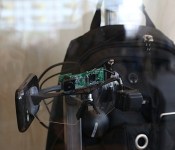
These early Google Glass prototypes looked (even more) awkward

Whether you believe Google Glass looks hideous or fashionable — and hey, we’re not here to judge — the current model looks a heckuva lot better than its first few prototypes. The first models arrived on the scene in 2010, and they looked more like the mess Jason Jones slapped together for the Daily Show than an actual consumer product. Three of the earliest prototypes, spanning two years, were on display at I/O this week.
The very first Glass prototype, which wasn’t shown off, was essentially just a big screen twice as big as a human face; it featured a coat hanger and a pico projector. Not a practical solution, of course, and definitely not a portable one. So the Google X team came up with the Pack (seen above), which only looked slightly less ridiculous. This handy model used a backpack with a laptop, GPS and mobile keyboard, and it came with a webcam, earbuds and Samsung smartphone, which was solely used as an early version of the Glass trackpad. Yes, this meant that testers walked around in 2010 with a phone attached to their cheek and a pack strapped to their back.
Fortunately, most prototypes actually improve as time progresses, and that’s exactly what happened with Glass. The Cat model, which came out the following year, shed the backpack and smartphone. Instead, the 3D-printed frame had Nexus 5 guts grafted onto the right side along with an awkwardly placed battery on the left. Curiously, the optical display sat underneath eye level. Cat was heavy, but it was at least the first truly portable version of the wearable.
Finally, the Emu model came later in 2011. Once again, it was a significant improvement in looks, weight and portability: It was cleaner, the circuitry wasn’t as rudimentary as older models, the optical display was positioned above the eye and it came with a bone conduction speaker that hung out on the back of the head.
I/O didn’t provide us with any new details about the consumer-facing future of Glass, but at least we got to know a bit more about its past.

Germany drops Verizon internet contract over NSA spying fears

Germany is irked that the NSA spied on its officials (including its Chancellor), and today it responded by hitting the US where it really hurts: the pocketbook. The German Ministry of the Interior has decided against renewing a Verizon internet service contract that expires in 2015, in no small part due to worries that the carrier must sometimes hand over foreign data to the NSA. The country has to reject companies that collaborate with the American intelligence agency if it’s going to meet the “particularly high demands” of a critical communication infrastructure, according to the Ministry.
The nation had already been second-guessing the contract, so Edward Snowden’s NSA surveillance leaks were really just the straws that broke the camel’s back. However, the cancellation still validates US tech firms’ worst fears — they’re losing business in countries which no longer feel they can trust American outfits with sensitive info. It’s too soon to know whether this trend will continue, but it’s clear that even close US allies aren’t afraid to cut corporate ties if they believe their data is at risk.
[Image credit: AFP Photo/Jewel Samad]
Filed under: Networking, Internet, Verizon
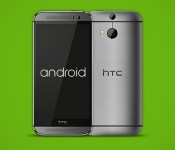
HTC commits to Android L for One series
This year Google I/O was probably the best so far, and also a lot happened this year. Google introduced their latest version of Android, known as the Android L. The new OS is coming this fall, and HTC is making sure that their customers are not having second thoughts about it. They said on their official blog that:
We are committed to updating our flagship HTC One family as fast as possible and will begin rolling out updates to the HTC One (M8) and HTC One (M7) in regions worldwide within 90 days of receiving final software from Google, followed shortly by other select HTC devices.
 HTC is trying their best to be the first one to release Android L update for the One series. That’s definitely a good news for all HTC One (M7) users because they might have thought that HTC is only focusing on the flagship smartphone right now.
Android L is still the codename, and it might be known as Lemoncake when it is officially released. Though we personally like Lemonheads as well, you should share your thoughts with us too.
Are you happy to hear this One-users?
Source: HTC
The post HTC commits to Android L for One series appeared first on AndroidGuys.

1.7 million people watched the USA vs. Germany match on ESPN’s app at the same time

If Ann Coulter is correct, that following soccer is un-American, unmanly and unworthy of a species with opposable thumbs, then clearly, you’re all a bunch of girly men. At some point during the USA vs. Germany match that aired earlier today, 1.7 million visitors were watching the game at the same time through ESPN’s site and its WatchESPN app. And that’s not even counting folks who watched on television or through other means. As TechCrunch notes, that 1.7-million figure is even more than the 1.1 million concurrent viewers who tuned into the Super Bowl earlier this year (to be fair, of course, more people had to watch this match at work because it aired at 12PM Eastern, not on a Sunday night). Even more impressive is the fact that ESPN managed to rack up all these simultaneous visitors despite having technical difficulties that left some viewers unable to log on during the first half. “We did investigate some limited issues due to unprecedented demand during the first half,” an ESPN rep told TechCrunch. See, there ya go: Americans like soccer, after all (especially when Americans are playing). How you like them apples, Ann?
Image credit: Getty
Filed under: Internet
Source: TechCrunch, Kristie Chong Adler (Twitter)
You can buy an ‘unofficial’ Google Cardboard VR kit for 20 bucks

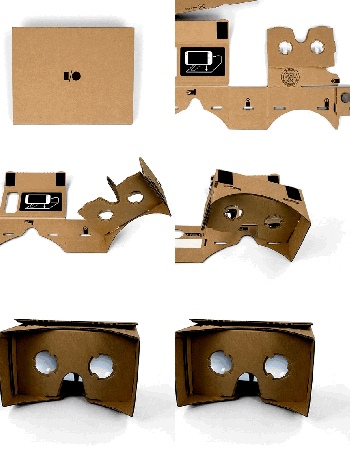
At the end of Google’s keynote yesterday, Sundar Pichai announced that all I/O attendees would receive either an LG or Samsung Android Wear device, along with Moto 360 when it becomes available later this summer. But he also offered up an unexpected gift… the slide read #cardboard (yes, with the hashtag) and Pichai held up a small brown square, barely large enough to accommodate a thin book for shipping purposes — but Google had something else in mind. Once assembled, #cardboard serves as a head-mounted 3D viewer, using your own smartphone and a pair of integrated lenses to create the effect.
Functionally, it’s virtually identical to the PhoneStation we saw earlier this month at Computex, but unlike that yet-unreleased device, Cardboard is available now for I/O attendees. The rest of us can pick up a similar version from San Francisco-based DODOcase, which is making the kit available for $20, or $25 with an optional NFC tag, plus 4 bucks for shipping. The set, which ships within 4-6 weeks, will net you pre-cut cardboard, lenses, a magnet, a rubber band and velcro, which you can assemble together in five minutes. Just add your smartphone.
Filed under: Displays, Home Entertainment, Wearables, Google
Source: DODOcase

Android Wear brings Google to life

How many times have you checked your phone today? If Google’s data is correct, your answer is somewhere between zero and 125. This proclivity to check our phone is the foundation upon which Android Wear, the company’s wearables platform, is built. Wear isn’t about replacing your smartphone though; it’s about extending Android beyond your pocket and into the world around you. Yesterday’s I/O keynote revealed a lot about Google’s vision for the future — and Wear is the thread that could tie it all together.
On stage, Director of Engineering for Android, David Singleton, explained that everything in Android L is contextually aware, and has voice recognition enabled. Wear isn’t a separate entity; it’s an extension of Android L. An interface that bridges your experience of the world to the phone in your pocket (and vice versa). No more unlocking your phone and digging for restaurant recommendations. Wear knows your location and preferences; it’s already giving you step-by-step directions to a ramen joint around the corner. Or so the theory goes.
Wear isn’t a separate entity; it’s an extension of Android L.
Singleton’s demonstration of how Wear dances with, rather than marches beside, your phone was to order a pizza through his watch in under 20 seconds. A party trick to please the mostly developer audience, sure, but that demo showed Wear’s potential in a way that people understand: a useful interaction that solves a (hunger) problem. That’s something you can easily do from your phone, of course; the smartwatch skeptics are going to be harder to impress.

Singleton’s second onstage demo showed Wear working with a tablet, displaying a recipe from Allthecooks. The tablet is the main screen in this scenario, but Wear is listening; it’s a servant to more than one device. The tablet feeds Wear each stage of a recipe one by one. Swipe for the next instruction on the watch, and this is reflected back on the tablet. The same is true for all interactions on all apps across all your Android L devices. No more dismissing notifications twice. This same symbiosis will be present across Android, Wear and Chrome OS — Google’s making the most determined push for unity yet, and Wear is a big part of it.
Great, we can order pizza and make recipes a little less likely to fail. But Google has a much broader ecosystem now. Android will be in cars, TVs and your home. It knows what you like to eat, where you go on weekends and how badly you suck at Tappy Chicken. All of this information is united by your phone, and (the idea being) effortlessly enhanced by Wear. The feel-good promo videos might ham it up a little, but Google Now’s cards are getting smarter, and could find a natural home on your wrist. Having a wearable that controls (and is controlled by) all the technology in your life is, perhaps, the only logical case for a smartwatch — and that’s what Google is going for.
Google wants Wear to be the key that unlocks the Android experiences around you right now.
Earlier on in the I/O keynote, Director of Engineering at Google, Dave Burke, showed off a new feature within Android L — trusted environments. If you have a “Bluetooth watch” (this was before Wear was discussed), your phone knows you’re near, and removes the need for a password to access it. This might work for all Bluetooth devices, but it’s further evidence of the neat shape Google has cut out for Wear in Android’s future. Google wants Wear to be the key that unlocks the Android experiences around you right now.
If you’re thinking Wear is just a fancy example of the internet of things, that’s because it is. This isn’t even the first wrist-worn gadget to be used for controlling other smart devices. Jawbone and SmartThings may spring to mind. The difference here is potential scale. Having a fitness tracker feed into your home automation is great. A platform that can set your thermostat, get driving directions (or score a lift), tell you about your surroundings and quickly reply to a friend’s message is better.
Your phone is still the brain, the identifier, the hardware that knows you. Wear listens, interfaces, serves. Much like Android itself, or Google Now, Wear is a platform that, if grown with care and attention, could usher in the era of the smart-world. A world where technology is used to lower, not create barriers between discovery and social interaction. That’s the marketing dream at least, and surely one we’re all invested in. On a more practical level, if Google is working on a unified ecosystem (as it appears to be), it’s about time for something like Android Wear.
Is my Android smartphone compatible with Android Wear?

So you’ve heard the news, seen the pictures, and are already thinking about buying an Android Wear smartwatch. The only hangup, as you see it, is knowing whether your smartphone is compatible with the new software experience. Thankfully, finding out is as easy as visiting a website from your phone. Simply navigate your browser to… Read more »
The post Is my Android smartphone compatible with Android Wear? appeared first on SmarterWatching.
Read the rest at the source, SmarterWatching.com
The post Is my Android smartphone compatible with Android Wear? appeared first on AndroidGuys.
 AIVAnet