


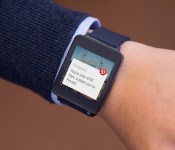
Pinterest comes to Android Wear, alerts you to nearby pins

Earlier today, Google announced that it’s releasing an SDK for its new Android Wear platform, allowing developers to make apps for Android smartwatches. It looks like Pinterest got a head start, though: The wedding planning bookmarking app is about to update its Android app to work with Android wearables. In particular, if you’re near a place you’ve pinned, you’ll get an alert on either your Android phone, tablet or smartwatch. From there, you can get directions too, if you’re lost (even though in theory you’re already close by). The update — version 3.0, to be exact — will hit the Play Store sometime tomorrow. So be ready for that, even though we suspect most of you were not lucky enough to get a free watch at Google I/O today.
Filed under: Wearables, Google
Source: Pinterest

Google gives us a simulated ride with Android Auto

Meet Google’s answer to Apple’s CarPlay: Android Auto. It’s a new platform announced today at the annual orgy of software and hardware development known as Google I/O, and it puts the (almost) full power of Android in your car. Why almost? Well, despite the fact that the system leverages your smartphone to power your car’s infotainment system, you don’t get access to all your apps. It has a limited selection that are suitable for use on the road and optimized for an in-dash interface, and I got to see several of them in action in an Audi S3.
Getting started with Auto is easy: you just plug your phone into the micro-USB cable wired into your car. For now, wired is the only option, but Product Manager Dylan Thomas said that the Android Auto team is in the process of evaluating wireless solutions. Regardless, once your phone’s connected, your car is endowed with the powers of Android. In the Audi, we got to see how the system works without a touchscreen, though other manufacturers, like Hyundai, are using such an interface. The Android Auto framework is built to function with either, according to Thomas, and it’s up to the individual manufacturer to decide what’s best for its customers. Whether you’re using a button and knob solution or a touchscreen, voice control is universally available to control things, too. And the voice control worked really well in the Audi. When asked whether Google had best practices recommendations for in-car microphone setups, Thomas informed me that his team is working with the manufacturers to do so.
In practice, navigating through the apps in the Audi was easy, whether the hardware or voice controls were used. On screen, users get a consistent look no matter the app, and a universal nav bar that persists beneath all apps that gives you direct access to the voice dialer, navigation, and music apps, along with your app tray. Despite the consistent layout, each app can be customized with different colors and icons to suit varying features and tastes.
For example, the Google Play Music app gets orange accents, while Spotify is swathed in green, but both have play/pause and track controls in a row at the bottom with album art filling the top 2/3 of the screen. A vertical ellipses icon located to the right of those controls grants access to an overflow menu filled with the custom iconography (and features) for each app. By using the same template for each app, Google is making the interface easier to navigate, which helps avoid confusion behind the wheel (a very good thing). Similarly, Google Maps sports a simpler interface that has fewer, larger location labels than its desktop or mobile implementations — again, to make it more car-friendly.
In summation, our brief time with Android Auto was a positive one. Voice controls worked well, apps look good, and navigating the system was relatively easy and intuitive as a result.
Filed under: Cellphones, Transportation, Mobile, Google

Living in a Google world: Why Android L means you’ll never have to disconnect

The biggest news to come out of Google’s developer-focused I/O conference isn’t Android TV or even the several new Android Wear smartwatches; it’s that Android is about to become much more than a mobile operating system. It’s about to consume your life.
With the introduction of the Android L platform (as the next version of that operating system’s tentatively being called), Google wants to be a part of everything you do — with technology, at least. Whether it’s swiping through Google Now on your smartphone, dismissing notifications on your smartwatch, using voice search to find a movie on Android TV or searching for a cafe on your in-car display, Android will follow you everywhere. And while features like universal sync across devices and voice commands will likely make your life easier, Google’s getting something pretty significant in return: access to nonstop streams of your personal data and search history. In short, it’s pretty clear that the “L” stands for “Life.”
Android L is a functional overhaul of Google’s ecosystem disguised as an aesthetic face-lift.
Android L, which will soon make its way into developers’ hands, is a functional overhaul of Google’s ecosystem disguised as an aesthetic face-lift. The new OS gets a makeover courtesy of Material Design; a new look that incorporates floating elements and transition animations for a more engaging experience across Android, Chrome OS and the web. Along with that glossy new façade, though, comes the true innovation at the core of Android L’s master plan: features that unite your life across your phone, smartwatch, desktop and more. Here’s a taste of how L will streamline things: Android notifications, such as calls and text messages or even low-battery alerts, will show up on your Chromebook when your smartphone is nearby. (Incidentally, Apple announced similar functionality for OS X Yosemite at WWDC earlier this month.)

Sundar Pichai shares Google’s vision for taking Android L beyond mobile.
Early on during the Google I/O keynote, SVP Sundar Pichai laid out what’s essentially the company’s new mission statement: “We worked together — Android, Chrome and across all of Google — to craft one consistent vision for mobile, desktop and beyond.” So instead of getting windows into Google’s world via Android on your smartphone and services such as Google Docs, everything will fall under the omnipresent umbrella of L. Your search history and contextual info from Google Now will follow you virtually everywhere — even to the living room and your car if Google has its way — and truthfully the unified system offers plenty of perks. Beyond syncing settings and notifications, you’ll even be able to unlock your phone just by wearing your Android Wear watch — no PIN or lock screen pattern required.
The convenience factor here is nice, but it’s also just plain neat to see Google-powered devices acknowledging each other in new, interesting ways. A few years down the line, this feature could evolve into unlocking your front door with Android@Home, or even auto-resuming a playlist from your smartphone in your Android-ready car.
It’s a case of digital convenience intentionally breeding laziness.
If you’re already using Google services, Android L’s deeper cross-device ties likely won’t scare you away. After all, the company already knows quite a bit about anyone with a Google account and search history. But even if we’re okay with this omnipresence in our personal lives, Google’s step into the enterprise space blurs the lines uncomfortably. Baked into Android L is Android for Work, a BlackBerry Balance-style technology that keeps your work and personal accounts separate and secure on the same device. Google really doesn’t want you using a separate, non-Android phone for work, and by protecting sensitive enterprise data it hopes to keep you from leaving its search-lined world.

A slide from the I/O conference highlighting Google’s Android everywhere philosophy.
Android L’s clearly a bid to make Google into a way of life, but we shouldn’t be too surprised by that. This is Google operating as usual; this is a search company making a very public play for our data, albeit under the guise of efficiency for the end user. Effectively, it’s a case of digital convenience intentionally breeding laziness. And, really, when the walls between mobile, desktop and wearable no longer exist — when it’s one uninterrupted Google ecosystem, who would ever want to leave?
Google Play Services 5.0 brings in all the goodies from Google I/O, and more [APK Download]
This morning’s keynote at Google I/O 2014 was as exciting as any in recent memory with plenty of emerging and new technology that will only strengthen Android’s foothold in the technology industry. All of these new features, however, need to be tied into the Android OS somehow, and that’s where Google Play Services 5.0 comes in. […]
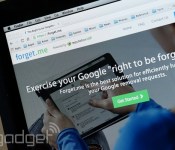
Forget.me makes it slightly easier to wipe yourself from Google’s memory

Now that Google must obey Europeans’ right to be forgotten, companies are rushing to capitalize on your (presumed) desire to erase yourself from online searches. Take Reputation VIP’s new Forget.me, for example: the free service promises both a simpler, step-by-step alternative to Google’s existing removal form as well as notifications should the internet giant accept your request and start yanking content. That’s potentially quite handy, especially if you’re not technically inclined.
However, there’s a real question as to whether or not this help is really necessary. While Forget.me may formulate your claim in a way that Google is more likely to accept, the official form isn’t that hard to fill out. Unless you have a lot of links to pull or are genuinely worried that Google won’t honor your wishes, you’re likely better off doing the work yourself.
Via: TechCrunch
Source: Forget.me

Real FX lets you race against robot toy cars, no mobile app required

Sure, Anki Drive put robotic toy cars on the map, but it’s not ideal — not everyone can justify giving their kids iOS devices just to steer plastic vehicles. You won’t have that issue if Wow Labs gets its Real FX kit on to store shelves. The system blends conventional RC handsets with smart, optically guided cars; all you do to play against artificial intelligence is switch a racer’s handset to “pace car.” You don’t have to settle for fixed course designs, either, since you can build them piece-by-piece.
If you want to give Real FX a whirl when it ships in October, you’ll have to make a pledge to its Kickstarter campaign. Pitching in at least £80 ($136) gets you a starter set with two cars and 12 track pieces, while a pro set with 39 track pieces will cost you £150 ($255). Only the basic equipment is clearly cheaper than Anki’s, but either bundle may represent a much, much larger bargain if you don’t already have iOS gadgets hanging around.
Filed under: Gaming, Household
Via: Autoblog
Source: Kickstarter

The Big Picture: Exploring Mexico’s abandoned railways in a homemade ‘spaceship’

When artists Ivan Puig and Andrés Padilla Domene decided to explore Mexico’s abandoned railways, they wanted one vehicle that could ride on road and track. The result is the Sonda de Exploración Ferroviaria Tripulada, aka SEFT-1 (above). The vehicle allows Puig and Padilla to travel on between, and on the tracks while taking pictures, recording video and interviewing locals. The goal of the project is to highlight the impact that the failed railway between Mexico City and the Atlantic had on local communities, many of which are now extremely isolated. SEFT-1 will be presented at an exhibition in London until July 27th. Much of the media and journeys are also documented on a the project’s website.


[Image credits: Puig, Padilla, The Arts Catalyst and Furtherfield]
Filed under: Transportation
Source: SEFT1
LG G Watch makes it’s debut in the Play Store Today
At the Google I/O keynote this morning Google announced that the LG G Watch would be making its appearance in the Play Store later today. That moment is now. The G Watch is one of the first of two devices sporting Android Wear to make their way public, the other being the Samsung Galaxy Gear […]
Samsung Gear Live, the Android Wear Smartwatch, now live in the Play Store
The LG G Watch wasn’t the only Android Wear device that was slated to hit the Play Store today. The Samsung Gear Live was also said to be going live. Loks like Google followed through and put both devices in at the same time. Interestingly enough, the Gear Live is $30 less than the LG […]
Google I/O 2014 Keynote now available on YouTube for all that missed It
If you happened to have one of those day job things that prevented you from watching the Google I/O 2014 Keynote, then you are in luck. The entire 3 hour event this morning is now up on YouTube for your viewing pleasure. Well, 2.5 hours, although you might want to poke through the first 27 […]
 AIVAnet