


Next version of Android apparently confirmed as Android 5.0 Lollipop by Insider
One of the things that is expected to be shown at Google I/O 2014 in just a few hours is a preview of the next version of Android. While we suspect that Google has been subtly hinting that the version number will be a nice round 5.0, we don’t quite know what the name of […]
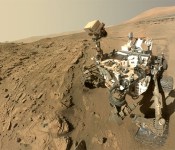
Curiosity celebrates its first action-packed Martian year

Curiosity feted its first Martian year on the red planet (687 earth days) with a stiched-up selfie while NASA reflected on the Mars rover’s triumphs and setbacks. So far, it has achieved most of its mission goals, particularly its quest for evidence that Mars could have supported life. Drilling samples revealed traces of all the elements needed for life, and it spotted a streambed that once had “vigorous” water flow. The rover also found that moisture could be drilled from its soil, and that the radiation levels were safe for humans — all important details for planned space travel. Unfortunately, due to sharper-than-expected rocks, Curiosity now has a gaping hole in its wheel, which forced the team to change its driving methods and routes. It’s not expected to have much impact on the mission, though — after grabbing samples at a site called Windjana, Curiosity’s now headed to Mount Sharp, some 2.4 miles away. With its main goals accomplished, any new science is gravy — see the video below for more.
Filed under: Robots, Transportation, Science, Alt
Via: The Verge
Source: NASA
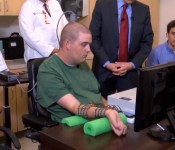
Brain implant restores control of paralyzed muscles

The quadriplegia that comes as a result of a serious spinal cord injury cuts off the lines of communication between a person’s brain and their limbs. The condition is often irreparable, and those who suffer it do so for the rest of their lives, but surgeons at Ohio State University and researchers at Battelle might have just struck back at the condition. Using a technology called Neurobridge, the pair have been able to offer Ian Burkhart, a 23-year-old who was paralyzed after a diving accident, the ability to move his hand with his own thoughts for the first time in four years.
Neurobridge works thanks to a chip that’s been implanted into the patient’s motor center, which relays those signals, via a muscle stimulation sleeve, directly to the subject’s muscles. That way, the technology bypasses the damaged nerves, essentially cutting out the middle man and restoring direct muscular control to the brain. The transmissions take less than a tenth of a second to be processed and sent, so while it won’t be as fast as the biological process, could still help people live relatively normal lives. Naturally, this first test isn’t going to mean an instant cure for people with spinal cord injuries, but the first moment of Burkhart twitching his fingers after four years, available in the video below, is a huge breakthrough.
Filed under: Science
Via: Sky News

Amazon now lets Londoners pick up packages from Tube station lockers

If work commitments mean you’re constantly trudging to the Post Office to collect a missed Prime delivery, Amazon’s hoping to make things easier for you, if you’re a Londoner that is. As of Monday, the company will open click-and-collect lockers in Finchley Central and Newbury Park Tube stations, where you can have packages delivered instead of an address. They come seven months after the retailer was rumoured to have begun talks with Transport for London with a view to installing the lockers inside unused ticket offices. However, Amazon has placed them inside the stations’ car parks instead, meaning you might have to take a small Oyster hit for the privilege. Amazon won’t be alone in offering collections on the Underground, though, as major supermarket chains including Tesco, Asda, Waitrose and Sainsbury’s are installing lockers of their own to limit the hassle of shopping around work.
[Image source: Transport for London, Flickr]
Filed under: Transportation, Internet, Amazon
Source: Retail Week
Not there in person? Watch the Google I/O 2014 keynote livestream Here
In just a few hours, the most anticipated and important keynote for the Android community will be delivered; many of you, us included, won’t be able to attend tomorrow’s very important keynote speech at Google I/O 2014. Thankfully though, Google has put up a livestream that will stream the keynote live in just over six hours, […]

Meet the multilingual robot newscaster with a very human face

Pepper the robot looks like a robot, thanks to an almost-anime design. What then, of Kodomoroid (above, center) and Otonaroid (right)? Both androids have found employment at Japan’s National Museum of Emerging Science and Innovation, as part of its new ‘Android: What is human?’ exhibit. Kodomodroid (‘child android’) can recite news (and weather) reports from around the world in a variety of voices and languages. Meanwhile, Otonaroid (‘adult android’) is steered by a human nearby and will work as a guide for the exhibition. Museum visitors will be able talk with the adult robot (as well as take control themselves), but will they be able to look either android in the eye?
This exhibit is right in the center of the Uncanny Valley: the dip in comfort we feel when robot (or anything) becomes something almost human. These androids look human, but they’re certainly not and it’s an odd feeling when you’re stood right in front of you. When your eyes meet, it’s weird and probably why I got flustered trying to talk to the robots. But it’s that very sensation and the bigger questions that robots pose which form the backbone of this exhibition. What is human? How far do androids have to go to become indistinguishable from humans? Do we even want that? To help frame the question, the museum’s collaborated with ATR Hiroshi Ishiguro Laboratories — you might recall Ishiguro’s Geminoids series, and there’s a similar attention to detail, if not more, on these animated mannequins.

Each one is made down to the detail, with plaster casts of their muse as well as special kind of silicone to better replicate the appearance of human skin and muscle. We managed to get up close to the adult model and touched her hand in what we hoped was the least creepy way. The surface is understandably cold, but it really does feel like skin: there’s a texture and a give to it… and that feels odd too. We talk a little in English, more in Japanese and lip sync isn’t exact, more of an estimate, although the Otonadroid will mimic its human controller’s head and even eye movement. The arms can also move, but this is more for the overall effect than any particular function: these androids are getting closer to the human aesthetic, even if there’s still a few tells — they’re not meant for mechanical tasks.

The child robot remains half-hidden behind its desk, but the adult one is on full show: her hands fidget, she blinks, looks around, even bows when she needs too. Both robots are utilizing information from outside their own remit. With the newscaster, she’s parsing existing news, even if the pronunciation is pretty spot-on, and we’re told that in the near-future she’ll do it in multiple voices — and languages. She’s setting up her broadcast residence within the Miraikan, and will give visitors news reports and weather forecasts throughout the day. Between the two humanoid robots, the Miraikan has added Ishiguro’s Telenoid to the exhibition.

Admittedly, Telenoid is a veteran android. It’s been around for a few years and is another remotely-controlled robot, coated in a similarly silicone skin, although this one’s certainly less humanoid. Then again, that face probably gave it away. The face is intentionally minimal, however: the robot was designed so that whoever ‘steers’ it will project their personality to it. It’s meant to be gender- and age-neutral. When we got to talk to it, the oddest part was lifting it up to our lap, as suggested by the museum staff. When you pick up a kid or a baby, there’s typically a degree of squirming, but Telenoid is more passive — only its neck and facial features move. The controller is positioned only a few meters away, and visitors will be able to talk and control Telenoid, which is monitored through an overhead camera and mics hidden behind the robot.

The exhibition is a rare chance to get up close with these high-end (and presumably expensive) robots and includes several other bots — even the world-famous Asimo. But what’s next? For Kodomoroid, it’s her (pre-programmed) dream to have her own TV show. She also wants to branch out into gourmet reporting — even though she doesn’t eat.
The exhibition opens today at the Miraikan, Tokyo.
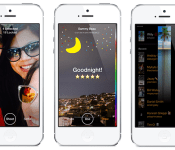
Facebook’s Snapchat rival Slingshot now available worldwide

Facebook launched its not-so-subtle Snapchat competitor Slingshot last week, but only for a US audience. That period of exclusivity has turned out to be quite short-lived, however, as today the new way to socially network is available worldwide. So, to give it a go, all you need is an iOS or Android device, and some friends to “sling” stuff at.
Filed under: Cellphones, Software, Mobile, Facebook
Via: Engadget Spanish
Source: Slingshot

PlayStation Now will start streaming PS3 games to Sony TVs next week

Sony has been testing its PlayStation Now cloud streaming game service for months, with a select group of players testing it out on the PS3 and PS4 (all PS4 owners can try it out at the end of next month). On Monday, that group will expand to include owners of some of Sony’s 2014 TVs, including all 4K Ultra HD sets and some of the 1080p models. As a part of the PlayStation Pilot Service, that means that if they live in the continental US, they can play PS3 games with just an internet-connected TV and a DualShock 3 controller plugged in via USB.
Trying games out that way might not save a ton of dough however — prices for renting a title can range between $3 and $20 — but it does mean one fewer box is needed in the entertainment center. Of course, Sony also mentions that its family of funky wedge-shaped Bravias are available in its Best Buy in-store experiences along with its 4K Ultra HD Media Player — necessary if you want to watch Breaking Bad in the highest quality possible. So is this the end of the dedicated console? Not yet, but between this and its (coming soon) streaming TV service Sony is eventually going to make sure that the only cord plugged into its TVs is the one for power.
Sony:
We are supporting nearly all 2014 models of BRAVIA TVs.
- XBR-X950B series
- XBR-X900B series
- XBR-X800B series
- KDL-W950B series
- KDL-W850B series
- KDL-W800B series
- KDL-W700B series
- KDL-W600B series
Filed under: Home Entertainment, HD, Sony
Source: Sony Blog
‘Android L’ Spotted?! Galaxy Note 4 Benchmarks Impress! – ManDroid Quickie
Google I/O is almost here, and there will hopefully about numerous things to nerd out on tomorrow. Right now though, we can talk about other Android news. Android L made the rounds this week, and apparently the next version of Android will make an appearance tomorrow. We will see what happens and try to cover […]

Planetary Resources wants your help spotting asteroids

Eager to help Planetary Resources look for asteroids and bring humanity that much closer to space mining? Well, it’s time to get cracking. The company has launched Asteroid Zoo, a site that relies on crowdsourcing (i.e. you) to both find rocks in the void and train computers to do the same. It’s pretty straightforward — all you do is look at image sets from the Catalina Sky Survey and mark any asteroids or artifacts.
Be prepared to spend a lot of time sifting through pictures before you hit the motherlode. As Planetary Resources explains in the clip below, there are “hundreds of thousands” of previously unseen images; you’ll probably be staring at quite a few unidentifiable blobs. You may not want to spend hours at a time on Android Zoo as a result, but it may be worth a quick trip during your lunch break. And hey, you may get lucky. You might just spot a mineral-rich asteroid, or even help NASA make an important discovery.
[Image credit: NASA/JPL-Caltech]
Filed under: Science, Internet
Source: Asteroid Zoo, Planetary Resources
 AIVAnet