



EU Regulators Expected to Decide on Apple’s Acquisition of Beats By July 30
Apple’s proposed acquisition of Beats Electronics is facing its first regulatory hurdle after the Cupertino company announced the deal last month. As reported by Reuters, European Union’s Antitrust Commission is expected to make a decision on the purchase by July 30.
The EU regulators can approve the deal unconditionally, demand concessions if they have anti-competitive concerns or order a full investigation if they need more convincing that the acquisition will be a benefit and not a detriment to competition.
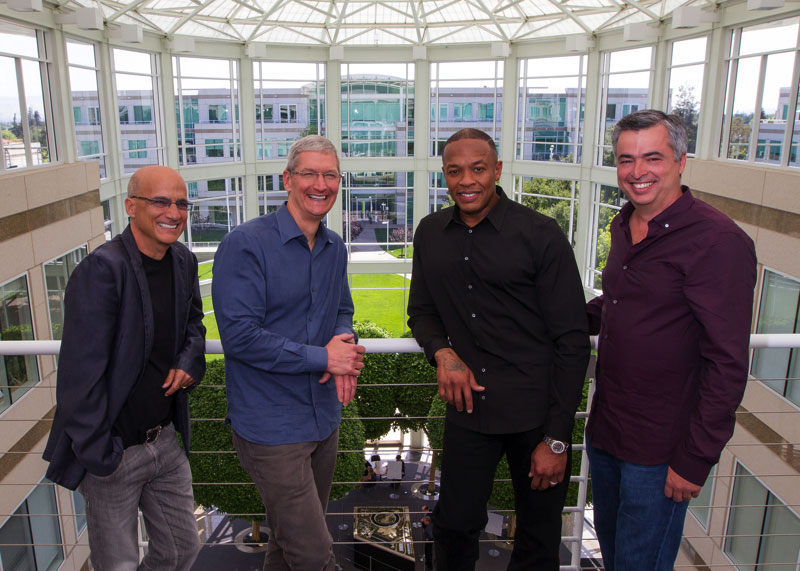
The pending $3 billion deal includes both Beats Electronics, which offers headphones and speakers, and Beats Music, a streaming music subscription service. Under the deal, Beats executives Jimmy Iovine and Dr. Dre will join Apple, giving the company a significant boost to its music industry connections.
Besides the EU, regulators in the United States also must examine the deal and determine whether there are any concerns with competition. Barring any unforeseen regulatory issues, Apple expects the transaction to close sometime next quarter.

Ford and Intel want to make cars that respond to your face and gestures

Where do anthropology students go when they leave college? Apparently, instead of travelling the Andaman Islands investigating the social impact of cousin marriage like they’re supposed to, they’ve been earning big bucks working for Ford and Intel on something called “Project Mobii.” The name stands for Mobile Interior Imaging, and we’re told that it involves a collaboration between “ethnographers, anthropologists and engineers” who are looking for ways to deliver a “more personalized and seamless interaction between driver and vehicle.”
In practice, that could mean connected cameras that allow a car-owner to check up on their vehicle remotely, just to make sure it isn’t being ransacked or joyridden. Alternatively, gestures might be able to activate the sunroof, or facial recognition software could be used to identify the proper owner, while also allowing various permissions and settings to be programmed for other family members. Alas, Ford and Intel have made it clear that Mobii is all just research and exploration for now, with nothing concrete to show for it. But hey, that’s anthropology for ya.
[Image credit: Tabercil]
Filed under: Cameras, Transportation, Intel
Android still the dominant mobile OS with 1 billion active users

Free-falling product demos and Rube Goldberg multimedia installations aside, there’s always a level of predictability to an opening day keynote. And Google I/O 2014 is no exception. Like clockwork, SVP Sundar Pichai took to the stage in San Francisco this morning to tick off the company’s latest accomplishments. He started off by touting one of the company’s biggest strengths: Android. According to Pichai, Google now has over 1 billion active users (that’s as of the last 30 days) on the OS.
Developing …
Google’s apparently opted to track 30-day usage as opposed to year-over-year numbers as in the past. That said, last year, the company boasted 900 million Android activations, up from 400 million the year before. We likely won’t get a direct comparison due to the change in tracking, but even with the numbers we have, it’s clear Android is still the dominant mobile platform. During its WWDC 2014 keynote earlier this month, Apple’s Tim Cook announced the company had reached 800 million iOS devices to date, fewer than Google’s Android activation numbers from the year prior.
Continuing the theme of unconventional stat tracking, Pichai championed the strength of the platform saying Android users send 20 billion text messages each day and 93 million selfies. What’s more, those self-absorbed phone holders apparently take 1.5 trillion steps each day, and check their handsets a total of 100 billion times every 24 hours.
Filed under: Cellphones, Tablets, Wearables, Internet, Software, Mobile, Google
Google’s next version of Android ‘L-release’ has a new look, deeper ties to the web

KitKat may have only found its way on to roughly 15 percent of phones at this point, but that won’t stop Google from looking to the future. The new version, teased by Sundar Pichai is simply being referred to as the “L-release” right now. As previous leaks have indicated, this will be the most dramatic UI overhaul the OS has enjoyed since Ice Cream Sandwich debuted back in 2011. The heart of this overhaul is called Material Design — a flatter look, with rounder elements and softer edges that will extend beyond tablets and phones to Chrome OS and Google’s various web services. You can see some of the new design philosophy at work already in the latest version of the Google+ app on Android. But it goes beyond that. Shapes are simplified and there are smooth transition animations across the UI. Developers can also add the illusion of depth by adding “elevation” which automatically stacks visual elements appropriately and adds drop shadows.
Developing…
Of course, if all that was new with Android was a facelift, it wouldn’t be all that exciting. But there are also plenty of new features. Not that there was anything wrong with notifications in KitKat, but there’s always room for improvement. In L you’ll be able to interact with notifications right from your lock screen. That can include quickly swiping them away or you can double tap on the notification to head straight into the relevant app. The notifications aren’t ordered simply chronologically anymore either, they’re sorted by relevance and importance, which is determined by a number of details, like the source app, etc… For truly important events, Google has introduced heads-up notifications, which pop interactive notifications over your current task. In a demo an incoming call showed up at the top of the screen while Dave Burke, director of engineering for Android, was playing a game. He could simply ignore the pop up completely, or he could tap the options to accept or dismiss the call.
One of the more intriguing changes is the deeper ties to the web and Chrome. The new recents interface will pull in not just apps you’ve launched but tabs you’ve opened on your desktop. And, developers can make links go to apps instead a webpage. So, if you search for a restaurant on your laptop, the recent menu won’t just open up a web page, but could launch directly into the Yelp reviews.
Then there’s the ART runtime, the software library that actually makes all your pretty little apps work. ART brings a whole bunch of advantages. For one, apps should run significantly quicker, and in particular they should launch much faster. But, it should also increase battery life because Android will be wasting less processing power decompressing apps.
Filed under: Cellphones, Software, Mobile, Google
Google’s Android One program will set minimum standards for bargain-basement smartphones

For every HTC and Samsung, there’s tens of Android hardware makers who have to redesign their smartphones to hit a certain low price. This is especially true in the developing world, where keeping the cost down means a lot of effort is spent tweaking devices — something that Google feels is a waste of time. That’s why it’s launching Android One, a program where Mountain View’s engineers will design cost-conscious hardware, and other companies will simply manufacture it. There’s plenty of fringe benefits, but the biggest one is that Google will be able to dictate a minimum set of standards for forthcoming Android handsets.
Since the company is targeting the developing world, Google is initially teaming up with Indian smartphone makers like Karbonn, Cromax and Spice. In an example presented on stage, Sundar Pichai talked about a Micromax Android One device with dual-SIM and SD card slots, a 4.5-inch display and FM radio priced at just $100. As well as that, these phones will get the same preferential treatment as the Nexus and Google Play ranges when it comes to automatic software updates. Is this, then, the much-rumored Android Silver program? Possibly, but given that it’s going to be aimed toward the bottom end of the Android world, it seems like the notion that Silver would kill-off the Nexus line won’t come true today.
Filed under: Cellphones, Software, Mobile, Google

Google’s new ‘Material Design’ UI coming to Android, Chrome OS and the web

Google’s annual I/O developer keynote has only just begun, but already we’re being treated to some of its announcements. In a bid to create a new “visual language” for users, Google is taking the design of Android, Chrome OS, and web properties back to basics with its new “Material Design.” According to Google, Material Design organizes interactions and makes better use of space, serving different views of the same content when viewed on a smartphone, tablet or desktop. Google’s Android apps will be updated to reflect this change, and you may have seen it in early Gmail and Calendar app leaks.
The new design language is more than just a visual refresh, though. In its on-stage demo, Google showed new animations that are designed to present the maximum amount of content while ensuring that scrolling remains smooth. It’s inviting developers to make use of improved typography, grids and more color to improve the layout of apps and services, making user interaction more seamless.
Developing…
Filed under: Cellphones, Mobile, Google
Source: Material Design Guidelines (PDF)

Android personal unlocking will bypass security in ‘trusted environments’

Google wants to make it faster to unlock your Android device in trusted environments with a new feature called “personal unlocking.” For instance, if your Bluetooth watch is connected and nearby, you’ll be able to swipe open your home screen without an unlock code. If the watch is off, however, you’ll need to punch in the code. It also won’t challenge you for a code under certain conditions like your locations, and even by sound of your voice. That’s part of the new Material Design UI coming up for future versions of Android which you’ll see in the upcoming versions.
Filed under: Cellphones, Mobile, Google

Supreme Court says cops can’t search your phones without a warrant

The Supreme Court’s Aereo decision may not have it earned many techie fans, but its decision on two other cases — Riley v. California and U.S. v. Wurie — may change that. The highest court in the land has just unanimously ruled that the police “generally” cannot search your cellphones without a warrant. As always, there’s room left for extenuating circumstances, but you won’t have to worry about the police rifling through the contents of your mobile devices if you get pulled over for speeding.
These two cases were rooted on opposite sides of the country, but in both instances the police used information obtained from the plantiffs’ phones to tie them to acts of wrongdoing. In David Leon Riley’s case, a slew of curiously worded text messages prompted police to investigate a connection to a San Diego-based members of the Bloods, while an entry in Brima Wurie’s call log led police officers in Boston straight to his apartment (and his stash of drugs) after he was already arrested. We live in an age of instantaneous communication — good or bad — but the high court seems to have right idea when it comes to how the legal system should look at the gobs of photos, data and communiqués we carry around with us everywhere. Here’s what Chief Justice John Roberts had to say in his written opinion:
Modern cell phones are not just another technological convenience. With all they contain and all they may reveal, they hold for many Americans “the privacies of life,” Boyd, supra, at 630. The fact that technology now allows an individual to carry such information in his hand does not make the information any less worthy of the protection for which the Founders fought. Our answer to the question of what police must do before searching a cell phone seized incident to an arrest is accordingly simple- get a warrant.
Via: SCOTUSBlog
Source: Supreme Court

Sky goes it alone for its latest fibre broadband trial

Currently at the mercy of BT, Sky has indicated that it wants to build its own fibre-optic broadband network for some time. Having partnered with providers to deliver TV broadcasts over cables and teamed up with TalkTalk to supply gigabit (1000 Mbps) broadband to select customers in York, the company has decided to go it alone for its latest fibre trial. In Basingstoke, Sky’s building its own fibre-to-the-premises (FTTP) network that’s capable of delivering speeds of up to 950 Mbps over an ethernet connection (150 Mbps over WiFi), far outstripping those offered by rivals BT and Virgin Media (which currently top out at 300 Mbps).
To do so, it’s using overhead poles to bring fibre optic cables directly to subscribers’ homes instead of relying on a local (often BT-operated) exchange, bypassing the limitations of traditional copper wires that feed the majority of Britain’s homes. In return for testing the new fibre network (under Sky’s Love Digital brand), lucky residents enjoy Sky’s superfast broadband free-of-charge for one year, as well as a £10.75 monthly saving on their TV bill. While Sky is still conducting early tests, it suggests the company may soon be ready to invest in its own fibre network and go direct to customers. That’ll intensify competition, giving consumers more choice and likely incentivise lower prices in the process.
Filed under: Household, Internet
Via: TechWeekEurope
Source: Love Digital

Watch Google’s opening keynote at I/O 2014 here!

Although we’ll be liveblogging the opening keynote of Google’s annual developer conference in just about an hour, we don’t want to dismiss the fact that many of you like to follow along when a livestream is available. Google’s got you covered: keep a tab open at this page for live video footage of the keynote. We expect a lot of news this morning at San Francisco’s Moscone Center, and we’ll keep you posted on all of the latest announcements and developments as it happens.
[Image credit: Getty Images]
Filed under: Announcements, Google
Source: Google
 AIVAnet
