


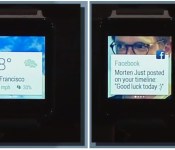
Google Launches First Android Wear Devices, Featuring Always-On Displays and Card-Based Interface
At today’s Google I/O event in San Francisco, Google demoed its Android Wear platform and announced availability of the first Android Wear devices. First announced in March, Android Wear is designed to bring the Android platform to a range of wearable devices from several of Google’s manufacturing partners.

As described on stage, Google has designed Android Wear with many of the features and functions that rumors have suggested Apple’s own iWatch might include. Android Wear supports screens of multiple sizes and styles, including both square and circular. With its always-on display and card-based UI, it displays information like notifications and location-based reminders.
Largely controlled by voice via Google Now integration, Android Wear also supports contextual apps that display information at a glance and it also integrates with several sensors, such as those that monitor steps taken and even heart rate on supported devices. It includes Google Maps support, offering turn-by-turn directions on the wrist and it can be used to control other devices, such as speakers.
Android Wear devices are reliant on a connected smartphone, much like the iWatch is expected to be reliant on the iPhone. Apps that are downloaded from the Google Play Store are able to include a wearable portion, which is automatically installed on a compatible Android Wear device when downloaded on a smartphone, extending available app functionality to the wrist.
On stage, demonstrations of Android Wear gave a clear idea of what we might expect from other wearables in the future, including the iWatch. A Lyft car was ordered via a simple voice command, with the watch automatically detecting a location. Ordering the car, payment, and update notifications on the driver’s location were all displayed directly on wrist, without the need to access a smartphone.
 Samsung Gear Live
Google announced the release of the full Android Wear SDK, along with the launch of the first devices supporting Android Wear. The LG G Watch is available for order today, as is the Samsung Gear Live, a new Samsung watch that supports Android. The platform’s first circular watch taking advantage of the round UI, the Moto 360, will be available later this summer, and additional devices are in development by various partners.
By focusing on a platform rather than a device of its own, Google has managed to get Android onto wrists several months ahead of Apple. According to the most recent rumors, Apple’s much-rumored smart watch won’t launch until later this year, possibly at an October event. The iWatch expected to have a strong focus on health and fitness, with more than ten sensors to collect various types of data.
Google Announces ‘Android Auto’ CarPlay Competitor
At its Google I/O developer’s conference in San Francisco, Google today announced Android Auto, its answer to Apple’s CarPlay. Much like CarPlay, Android Auto is designed to bring the Android experience to a car’s in-dash infotainment system.
As described by Google, Android Auto is contextually aware and puts the apps that users need front and center on the car’s dashboard. Google stressed that Android Auto is “completely voice enabled,” relying on Google Now much the way CarPlay relies on Siri for voice commands. Google also noted that it’s able to offer a completely personalized experience that is mobile, working with any Android Auto compatible car as it is reliant on an Android phone.
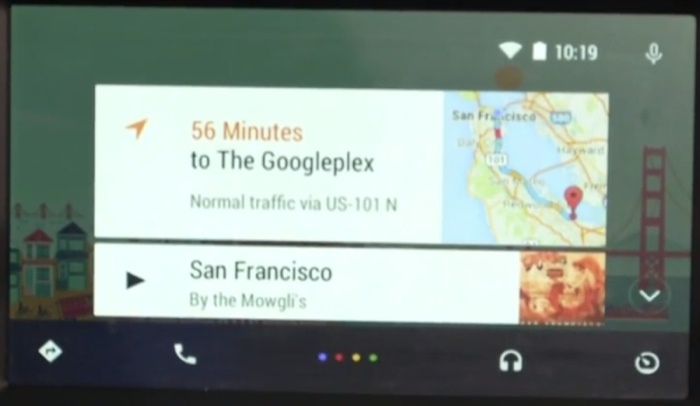
Android Auto integrates deeply with Google Maps, providing drivers with access to all Google Maps features like local search, personalized suggestions, live traffic information, and turn-by-turn navigation.
On stage, Android Auto was demoed planning a trip to the DeYoung Museum in San Francisco. Android Auto was first asked how late the museum was open, providing a response, before it was ordered to navigate to the location, where it offered turn-by-turn directions. It was also demoed composing and sending messages entirely via voice.
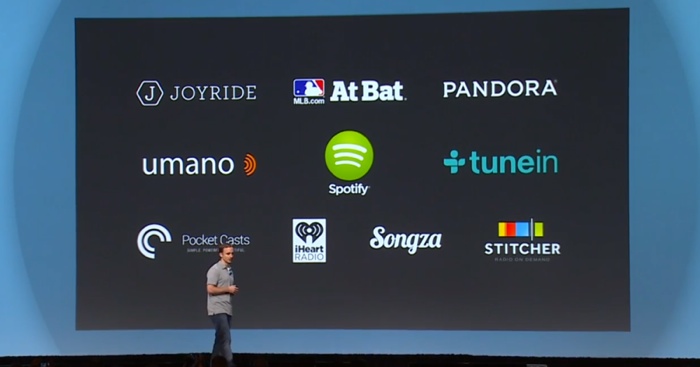
Like CarPlay, Android Auto integrates with several different app partners to provide music and other audio, such as MLB at Bat, Pandora, Spotify, Songza, Stitcher, iHeart Radio, and more.
Google also announced 40 new partners for its Open Automotive Alliance, which is a group of “technology and auto industry leaders” that are committed to bringing Android to cars in 2014. The goal of the alliance is to make “technology in the car safer, more seamless, and more intuitive for everyone.”
According to Google, Android Auto will be available in 25 different car brands, with the first cars rolling off dealer lots before the end of the year. Google is also releasing an Android Auto SDK in the coming weeks so developers can create apps for the platform. Apple’s CarPlay is also expected to be available in several different cars before the end of the year.
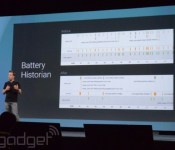
Android L can squeeze out 90 extra minutes of battery life with a new mode

Even as smartphones are getting bigger and better, battery life is often an issue. Google announced today at I/O that it’s upcoming version of Android includes “Project Volta” to take the problem head-on. A “battery historian” gives more info on exactly what’s draining energy, while a battery saver mode lets users squeeze up to an extra 90 minutes out of each charge by doing things like lowering the screen refresh rate. Following Project Butter to make the OS more responsive and Project Svelte to optimize it for cheaper phones, Volta could quickly have a very tangible effect on how we use our smartphones (and other Android devices). Developers can make their apps much smarter about battery usage, by avoiding updates or holding off on energy intensive tasks when energy is running out. If you want ot try out the new modes immediately, keep an eye out for the L Developer Preview arriving tomorow for the Nexus 5 and Nexus 7.
Filed under: Cellphones, Mobile, Google
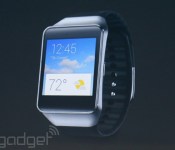
Samsung unveils Gear Live, its first smartwatch using Android Wear

So the rumors were true: Samsung has revealed its first Android Wear-powered smartwatch, the Gear Live. The device mates a familiar, squared-off design (much like the Tizen-powered Gear 2) with Google’s wrist-worn interface. It includes the Gear 2′s 1.63-inch Super AMOLED screen, 300mAh battery and 4GB of storage; fitness gurus will be glad to hear that the heart rate monitor has also carried over. You’ll get to pre-order both Gear Live and its LG-made counterpart, the G Watch, later today; Samsung’s hardware will sell for $200 and ship on July 7th through Amazon, Best Buy and Google Play.
Filed under: Wearables, Samsung, Google
Source: Samsung
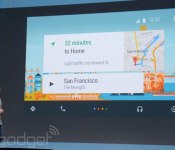
Google boosts in-car connectivity with Android Auto

The Open Automotive Alliance finally shows a product at Google I/O after its launch in January this year: Android Auto. Members including Google, Audi, Honda, GM, Hyundai, and chipmaker Nvidia have been collaborating to bring Android safely to the car in 2014. Rather than the more traditional model that sees smarts baked-into the car’s headunit, your phone will project its OS and the app in play onto the car’s screen — much like AppRadio does now. The big benefit here is as your phone updates, your car’s center stack gets better without you needing to fiddle with it.
Android Auto is a completely voice-enabled contextually based system, so speaking to your car will allow it to pass along info on opening and closing times of places near you, restaurant listings, send messages, play music and make calls. The info is then displayed on screen on cards much like you’re used to seeing in Google Now. Apps like Spotify, Songza, MLB.com at Bat are on-hand at launch though we expect that list will grow. In the on-stage demo, the phone was tethered to the car with a cable — likely HDMI — though we expect that it may well use Bluetooth for audio as well. The APIs used in Android Auto are shared by Android Wear, so devs will have the ability to easily port between watch and car or even integrate them. 25 car brands have signed up so far bringing the total member count to 40 including the technology partners that have jumped on board thus far. Car makers like Acura, Alfa Romeo, Audi, Bentley, Chevy, Chrysler, Dodge, Honda Hyundai, VW, Subaru, Maserati and Volvo will have models rolling off the assembly line this year. The SDK isn’t available just yet but will be available soon.
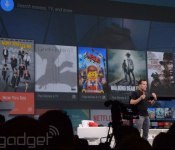
Google targets Amazon and Apple’s set-top boxes with Android TV platform

Google’s already well acquainted with the living room, having launched its Google TV platform at the I/O conference four years ago. It’s safe to say the set-top box software has fallen out of favor (with all but Sony, anyway), and Google’s been experiencing more success of late with its simpler Chromecast dongle. Well, today the search giant’s revealing its next play in home entertainment with Android TV, a brand new platform that’s part of Android L, and it’s bringing Google’s OS back to the big screen.
Much like on Apple’s set-top box or Amazon’s Fire TV, Google’s platform is a convenient front-end for it to plug video content from its own collection, in this case the Play store. It runs apps from other content providers like Netflix, of course, and allows you to pump live TV through the interface as well. Anything running Android TV will have the same functionality as a Chromecast, so you’ll be able to push content from your other devices to the TV exactly as you do with the dongle. Google Cast itself is being updated with direct screen mirroring, among other things.
Even closer to Amazon’s effort, Google intends Android TV not to be just for passive media consumption, but gaming as well. Different Android devices can be connected to your TV simultaneously to act as controllers. If your watching rather than gaming, then any Android phone, or smartwatch running the Wear platform, can be used as a remote.
Android TV features a simple and familiar card-based UI that naturally focuses on visual information (displaying movie posters, for example). The home screen floats on top of the content you’re currently playing, bringing that feeling of depth that’s key to Google’s new Material Design language. Google’s services and personalized recommendations are prominent, and voice search and navigation is included to make finding consumables, or anything else, as easy as saying it from the sofa. Apps and content can organize themselves across your home screen dynamically, based on your recent usage patterns.
With a special Play store experience just for the big screen, Android TV will be launching later this year alongside the Android L release, and various hardware partners are already on board. Next year’s smart TV ranges from the likes of Sharp and Sony, among others, will have the Android TV platform built-in. And, if you don’t fancy buying a whole new set, Razer, ASUS and others will be making set-top boxes-slash-consoles. Google’s also got a dev kit for those eager to get working with the SDK right away, which in Android L is the same one for tablet and smartphone form factors, too.
Filed under: Home Entertainment, Software, HD, Google
Source: Google Android TV
Here’s what Google’s Android Wear can do

Google says that we glance at our smartphones 125 times per day, but wants Android Wear devices to take on much of that burden. During an I/O 2014 demo, it showed how smartwatches like LG’s G Watch — paired with Android 4.3 or higher phones — will display the most important info to you at any given time. That includes info like flights, the weather, your commute, appointments, reminders, Keep notes and messages. Since all Wear devices will have touchscreens, you can swipe up on the watch face, Google Now-style, to see more cards. Swiping sideways will then bring up additional info from a given card. Disposing of a card on the watch makes it disappear on your handset too.
You’ve also got voice commands, activated by — you guessed it — “Okay, Google.” You can use it to set a reminder or take voice notes that are automatically saved to Google Keep. You can also pose questions to the watch and get the answer in card form on both your wearable and phone screen. Swiping down from the top of the screen mutes or unmutes the sound on your watch and lets you peek at settings like the battery life.

You can also control music with touch or voice controls, (which will turn the song’s album art into your watch’s background screen, by the way). It’ll also function as a sportsband by measuring the steps you’ve taken and your heart rate on supported devices. Google will give you daily summaries of those stats, and those stats will also be fully available to developers via API functions.
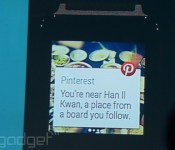
All of that comes with stock Android Wear, but developers will get access to those functions too. For instance, any phone notification from say, Twitter or Facebook, can also be available on your wrist, along with voice replies and notification pages as we saw in an earlier preview. Another sample third-party app flaunted by Mountain View was Pinterest, which will notify you when you’re near a pal’s location, letting you swipe to see a map and step-by-step directions. All that’s powered by Google Maps, which, of course, is baked into Android Wear.

Google showed off a few other third-party demos by ordering a pizza from the Moto 360 in about 20 seconds and displaying a step-by-step recipe on its watch face from the Allthecooks app. It also used voice-recognition to order a car with the upcoming Lyft wearable app. (It also noted in an aside that all Android Wear devices will be water-resistant.)
Google saved the best news for last: the Android Wear SDK is now available for developers with most of the API features included. If you’re champing at the bit to buy one, there’s another payoff too. LG’s G Watch is now available to order on the Play Store and Samsung’s newly announced watch, the Gear Live, is also up for pre-order. The much anticipated round-faced Moto 360, however, won’t be coming until later this summer.
For more, check our Google’s new Android Wear page and our I/O 2014 event hub right here.
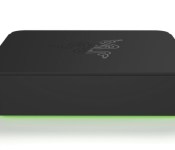
Razer’s making a gaming ‘micro-console’ with Android TV, available this fall

The company behind crazy devices like the Razer Edge and Project Christine is getting into game console creation as well. Razer’s employing Google’s Android TV initiative to create a game-focused “micro-console” and it’s arriving this fall. So, what does it do? Razer’s only offering a teensy bit of details, but what we know thus far sounds impressive. The micro-console can “stream movies, music and other apps for large-screen entertainment,” says Razer, “with an emphasis on gaming.” Sounds a lot like Amazon’s Fire TV, no? The difference here is that Razer’s also promising “hardcore” gaming, though we’re not hearing exactly how it will pull that off just yet (we asked!).
The same goes for what’s inside the Razer micro-console in terms of horsepower and connectivity — we’ve got no idea just yet. Internal storage? No idea. Price? Same situation. Actually, what Razer’s saying is, “In keeping with the spirit of Google I/O, we will not be discussing specific product details at this time.” Pretty funny you guys!
Anyway, in terms of gaming-specific applications, we also don’t know how you’ll control games on the device. Bluetooth game controllers? A custom controller? While we expect it’ll support Bluetooth, Razer’s not saying just yet. As for interface navigation, that’ll be handled by the Android TV app you heard about earlier today. There’s also some form of voice control, which we expect depends on your phone’s mic (though it’s always possible one’s built into a custom gamepad — we’ve got a lot of questions!).
Razer’s not offering hands-on opps today, and the image you see above is actually a render. As a result, it’ll be a few before we can offer more details on Razer’s first console experiment. For now…well, it sounds neat, right? Razer makes nice hardware and knows how to cater to gamers. Consider us cautiously excited.

Android TV will be in Sony, Sharp and Philips TVs next year

Google isn’t giving up on TVs yet. While its new Android TV flavor of Android L will hit the streets in set-top boxes aimed at game consoles and media streamers, it announced that next year smart TVs from Sony (all of its 4K and smart TVs), Sharp and TP Vision / Philips will ship with the OS. It’s also working with some familiar TV providers overseas like LG U+ in Korea (not LG Electronics TVs, which are moving to webOS) and SFR in France, as well as the chipmakers that build the components for smart TVs and boxes as seen in the slide above. The difference from the original Google TV approach is that the company isn’t treating Android TV as an entirely separate platform from mobile, and everything needed to handle video from HDMI,TV tuners or IPTV receivers is now natively included in Android L. We’ll probably have to wait until CES 2015 to find out if it’s having any success convincing more TV manufacturers to join in (again), but these are a start.
Android TV: Google Cast, voice search and tailored content. Visit http://t.co/H3lQNHUvcn for a preview and look for devices this fall.
– Android (@Android) June 25, 2014
Filed under: Home Entertainment, HD, Sony
Source: Android TV
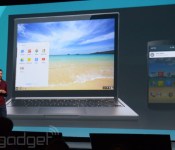
Google bringing Android apps to Chromebooks

Google I/O wasn’t all about Android and wearables. The Mountain View company unveiled more information about Chrome OS, that other Google operating system, as well. The big news? Google is finally bringing Android apps to the Chromebook. Sundar Pichai, Google’s Senior VP of Android, Chrome and apps, showed off the Vine Android app on a Chromebook Pixel on stage. It seems as if you can mirror the screen from the phone, with a phone-sized screen showing up on the Chromebook display. The apps can access local hardware so you can record a Vine from your Chromebook’s camera if you wish. Additionally, when connected, a notification will pop up on your Chromebook letting you know if your phone battery is low plus incoming calls and text messages too. At last, it seems Google is working to bring Chrome and Android together in a unified experience.
Filed under: Google
 AIVAnet