


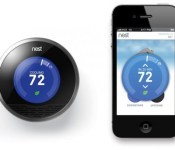
Nest Announces Developer API, Integrates With Mercedes, Google, IFTTT and More [iOS Blog]
Nest Labs today announced the “Works with Nest” developer program, which allows its Nest Thermostat and Nest Protect products to connect to a number of services from the likes of Google, Mercedes Benz, Whirlpool, LIFX and more for enhanced smart-home functionalities.

For example, Nest integration with Jawbone’s UP24 band allows the smart thermostat to begin heating and cooling when a user wakes up, while the Nest Protect can connect with LIFX’s bulbs to warn users of smoke or carbon monoxide. The new program will also allow users to create custom situations with popular service IFTTT, connecting the products to over 100 other products and services.
The Wall Street Journal also notes the Nest Thermostat’s specific integration with Google’s services, which comes after Google bought Nest earlier this year:
The integration will allow those users to set the temperature of their homes with voice commands to a Google mobile app. It will also allow Google’s personal digital assistant, Google Now, to set the temperature automatically when it detects, using a smartphone’s location-tracking abilities, that a user is returning home.
Nest also stated that it will allow developers of garage door openers and similar automated appliances to access and utilize user information. However, Nest co-founder Matt Rogers noted users will have to opt in for their information to be shared with Google, making it a point to emphasize user privacy:
Most of the data that Nest will share – with Google and others – will focus on whether users are at home or not, as detected by sensors on the thermostat. When people link a home device and related account with Nest, the company will not share their email address, name or home address with other companies, Rogers said.
“We’re not becoming part of the greater Google machine,” he said.
The news comes as a number of developers are working on products under Apple’s new HomeKit initiative, which allows home automation devices and their apps to work with iOS services using a single, secure protocol. Companies currently lined up with Apple for HomeKit include iHome, Honeywell, Haier, Philips, Schlage, and Withings.
Last week, Nest Labs announced that it would be acquiring video-monitoring and security startup Dropcam for $555 million to further its smart home initiative. The company also restarted sales of its Nest protect app-enabled smoke detector last week after it was pulled from shelves over safety concerns.
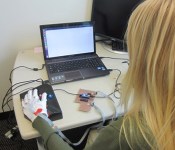
High-tech gloves can teach you Braille even if you’re distracted

It looks like a team of Georgia Tech researchers is in the business of making wondrous, high-tech gloves — their most recent one, for instance, can teach you Braille even if you’re doing something else. Similar to the piano-teaching glove they designed years ago, this new pair has vibrating motors on each knuckle that buzz in different patterns to correspond with preset Braille phrases. To test how well the gloves work, they asked volunteers during an experiment to play a game for 30 minutes while the motors buzz along with audio cues. When the subjects typed the phrases after half an hour, the researchers found their answers to be mostly accurate, with some even getting perfect scores.
Even better, the subjects, who’ve supposedly never studied Braille before, could not only type random phrases after the test, but also read and recognize some Braille letters. As with any new technology, the researchers are still conducting more tests, but the gloves have a huge potential to help with teaching more blind people the language. The wearable might also make it easier to learn Braille (something that’ll take years to master) for those who lose their sight later in life.
Filed under: Wearables
Via: Medgadget
Source: Georgia Tech

Scientists simulate time travel using light particles

We may never see practical time travel in our lifetimes, if it’s possible at all. However, a team at the University of Queensland has given the Doc Browns of the world a faint glimmer of hope by simulating time travel on a very, very small scale. Their study used individual photons to replicate a quantum particle traveling through a space-time loop (like the one you see above) to arrive where and when it began. Since these particles are inherently uncertain, there wasn’t room for the paradoxes that normally thwart this sort of research. The particle couldn’t destroy itself before it went on its journey, for example.
As you might have gathered from the “simulation” term, sci-fi isn’t about to become reality just yet. The scientists haven’t actually warped through time — they’ve only shown how it can work. It could take a long time before there’s proof that whole atoms and objects can make the leap, let alone a real-world demonstration. Should you ever step into a time machine, though, you’ll know where it all started… and ended.
Filed under: Science
Via: Phys.org, IFLScience
Source: Nature Communications
Supposed Screenshot from ‘Android L’ Lands on the Internet
The name of the next version of Android is still very much up in the air, but I think we have narrowed it down to a few names. Lollipop, Lemonhead, and Licorice, seem to be the top of the list of names floating around out there. Well it seems that a screenshot got posted on […]

12-Inch MacBook Air to Begin Production in 3rd Quarter 2014
Digitimes reports that Apple’s new 12″ MacBook Air will enter mass production in the 3rd quarter of 2014. Quanta Computer is reportedly responsible for the assembly of the new machine which falls in between the 11″ and 13″ MacBook Air lines. Their sources have not heard of any changes to the existing 11″ and 13″ MacBook Air models.

Digitimes’ sources were able to confirm some small internal changes to the machine, but the new MacBook Air is said to look similar to the existing models:
The 12-inch MacBook Air features some design changes such as the battery and the internal layout, while its industrial design will be similar to its existing counterparts using an unibody aluminum chassis, the sources detailed. Some market watchers expect the machine to feature a Retina display.
First word of a 12″ MacBook Air came from analyst Ming Kuo in October, 2013. Kuo described the new machine as thinner than the existing MacBook Air and that it would incorporate a Retina Display. A Chinese forum post from a user who had previously leaked accurate information added that the 12″ MacBook Air would feature a “new trackpad design” and would have no fan.
Previous rumors have predicted that the 12″ MacBook Air will be announced between Q3 and Q4 2014, so approximately September/October of this year.
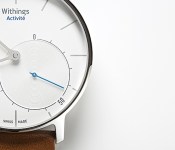
Withings Activité is a fitness tracker disguised as a designer Swiss watch

Most fitness trackers look like they belong in the gym or on the race track, which is fine if you’re working out, but not so great if you want to look your best at the board meeting or that fancy cocktail party. The Withings Activité, however, changes the notion of the fitness tracker entirely with an elegant design that’s more reminiscent of a Rolex or a Hublot. That’s because the Activité was actually created by a team of Parisian designers and Swiss watch-makers. Available in either black or silver, it’s made out of stainless steel 316L and an “unbreakable” sapphire glass that also functions as a touch screen — you can tap it to switch between modes. Included is a leather strap that’s apparently sourced from a famous tannery in France, though you can swap it out with a plastic strap if you prefer. Outfitted with a classic round face and a traditional analog watch display, the Activité has two dials — the primary one tells the time, while a smaller sub dial keeps track of your activity targets.
Yep, while it may not look like it, the Activité really is an actual fitness tracker — after all, it’s made by the company that brought us that WiFi enabled scale and other, more serious fitness gadgets. It’s able to monitor your steps, calories burned, distance traveled plus sleep patterns via an accelerometer and other internal sensors. Smart enough to know when you’re awake or asleep, it can even wake you up with a vibrating alarm. Like a classic Swiss watch, the Activité has a special Connected Movement time mechanism that’s designed for long-term accuracy, and it comes with regular ol’ watch batteries that never need to be recharged (though they only last a year). It communicates with iOS devices via Bluetooth LE, working in concert with a handy Withings Health Mate app that lets you create custom activity plans and track your progress towards your fitness goals. Oh, and you’re free to take the Activité to the pool as well, as it’s water resistant for up to 50 meters.
If this sounds like the activity tracker of your dreams, well, you’ll have to pay a hefty sum for it: the Activité will retail for $390 later this fall. But considering it’s perhaps the best-looking fitness tracker — maybe even one of the better watches — we’ve ever seen, it may be well worth it.
Filed under: Wearables
Source: Withings Activite
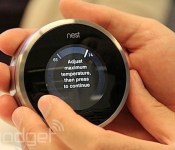
Nest devices start talking to Google, washing machines and your car

Nest’s Learning Thermostat and Protect smoke detector are now part of a much, much larger universe. The company has just launched a developer program that lets third-party apps and devices talk to Nest hardware, making it do things that aren’t possible through official software. The initiative is kicking off with a whole host of partnerships in place, in many cases with feature updates either available now or due in the near future. Chamberlain’s garage doors can now tell your Nest thermostat when you’re home, while Mercedes-Benz lets you check the temperature on the road; Logitech’s Harmony Ultimate remote can lower the heat in mid-movie, and Jawbone’s Up24 fitness tracker can tell Nest when you wake up.
This isn’t strictly one-way interaction, either — Nest gear can control other gadgets under the right conditions. If a Protect discovers smoke, it can tell LIFX light bulbs to flash red and have IFTTT’s phone app text the neighbors. Whirlpool, meanwhile, is going the distance by linking the equipment to its washers and dryers. Nest’s thermostat can not only have Whirlpool machines keep your clothes fresh until you get home, but delay the start of a given cycle to avoid a peak energy consumption period and save money, if you’re using the right power provider.
And yes, the program will eventually include support from Nest’s parent company, Google. Come the fall, Google voice commands will let you set the temperature on your thermostat; Google Now, in turn, will optionally heat or cool your home as soon as you set off on your commute. It’s ironic that Nest’s owner will be late to the home automation party, but the first wave of developers should give you plenty to do while you’re waiting.
Filed under: Household, Google
Source: Nest

Amazon and Warner Bros. reach truce over movie pricing

Well, that didn’t last long. A couple of weeks after Amazon stopped taking pre-orders for Warner Bros. Blu-ray and DVD movies to extract a better pricing arrangement, the Wall Street Journal is reporting that the two sides have reached a truce. Swing by Amazon and you’ll once again find pre-orders for disc-based versions of The Lego Movie, Transcendence and other upcoming releases. The exact nature of the deal is hush-hush, but it wouldn’t be shocking if Amazon got the upper hand — movies are just a small part of the online retail giant’s business, while Warner Bros. would lose an important source of revenue. Whether or not you approve of Amazon’s tactics, this is good news if you prefer hard copies of movies over downloads and streams. Now if Amazon and Hachette could only negotiate their own peace regarding books…
Filed under: Home Entertainment, Internet, HD, Amazon
Source: Wall Street Journal
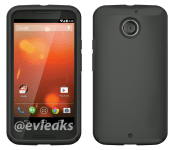
Moto X+1 render leaks, case included

Motorola’s Moto X was a positive surprise last year. It didn’t have cutting edge specs, but it worked like a charm carrying some useful features along with it. All that packed in a relatively small body considering a 4.7″ screen. Due to this fact we now expect more from Moto X+1 than we did with the Moto X.
After the phone got confirmed by accident and its details and launch date leaked we got even more interested in it. Thanks to @evleaks we now have a render of the phone itself, unfortunately there’s a case on it though. Despite the case, which covers up parts of the device, those bezels look thicker than they should be. We could be more certain of this if that case wasn’t on it, but it sure looks like those bezels shouldn’t be that thick. even the ones on the top and bottom of the phone.
What do you think, do you like it or are you in the same boat as we are?
Source: @evleaks
The post Moto X+1 render leaks, case included appeared first on AndroidGuys.
Global launch of the LG G3 to start June 27th in Asia, Europe and Middle East
The LG G3 was announced to much fanfare just over one month ago, however its presence has so far only been felt in LG‘s native country of South Korea. Despite this, The LG G3 managed to post some very impressive sales figures, even outselling the peak rate of sales for the Samsung Galaxy S5. Luckily […]
 AIVAnet