



Lego Fusion lets you build virtual playgrounds with real-world bricks

If your child is constantly glued to a tablet swiping away at birds or fruit, you’re probably wistfully wishing for the days when kids liked playing with actual toys. Well, Lego just might have the perfect solution for you and your offspring. Today, the maker of the beloved construction bricks announced Lego Fusion, a system that combines the flexibility and fun of app-based games with the good ol’ fashioned activity of creative Lego building.
Developed by Lego’s Future Lab, Fusion was invented as a way to marry digital and analog play. Ditte Bruun Pedersen, a senior design manager of the Lab, tells us that during its research, the Lego team discovered that children don’t really differentiate physical play from digital. “To them, it’s not two separate worlds. It’s one world that blends together. It’s all just play.” However, games on tablets and phones remain popular with kids because of how immersive they are, so the trick is to put the two worlds together.
The Lego folks identified three sorts of games that kids typically like: Tycooning, which involves building and managing, tower defense style games and racing. And so they’ve come up with four different Lego Fusion games to fit those categories. Lego Fusion Town Master lets you create a miniature Lego city, Lego Fusion Battle Towers puts you in a medieval battle where you’ll need the best castle and fighters, and Lego Fusion Create & Race has you creating a customized car for either a time-based race or a demolition derby. The fourth game, Lego Fusion Resort Designer, is very similar to Town Master except that it lets you decorate the interior of buildings as well.
Each Lego Fusion set consists of 200 bricks along with a special “capture” brick building plate that’s meant to be paired with a corresponding app. To play the Town Master game, for example, you would build a two-dimensional facade on the base plate, say the front of a house with a door, two windows and a roof (buildings can be up to 16 bricks high and 16 bricks wide). You’d then launch the app’s camera function to focus on the printed pattern, which is used as an identification tag. This essentially lets the app figure out exactly the size and colors of the Lego bricks you’ve built on the plate, enabling it to import and translate that physical creation into the digital realm. The app is then intelligent enough to transform the two-dimensional front of a house into a three-dimensional virtual building to be placed in the game. Lego tells us it uses Qualcomm’s Vuforia mobile vision platform for this process.

“For most kids, if you simply give them a pile of bricks and tell them to build something, they go blank,” says Pedersen. By pairing a game objective with the bricks, it gives them a prompt to actually get something started. “The games are used to facilitate creativity,” she says.
All the apps are free to download and experience for free so kids (and their parents, of course) can familiarize themselves with the game’s mechanics and requirements before committing to it. However, all of these apps do actually require the physical Lego set to progress. You can’t build a building in the game without those physical bricks.
Additionally, the Lego Fusion games are designed to encourage kids to keep on building beyond the initial steps. With Town Master, you’re constantly given missions to appease the townspeople and run the city. In Battle Towers, you’ll have to upgrade your castle with defenses depending on the kinds of enemies the game pits against you. As for the racing game, well, you can’t beat your last time or destroy your competition without making your car sleeker and meaner. “It drives kids back and forth from the tablet to brick building,” explains Pedersen.
Further, since all the creations are stored digitally in the Lego world — you can save them to the cloud with a Lego ID — children are able to carry on with the game even after they’ve put their bricks away for the day. If the parents allow it, kids can connect with their friends using their Lego credentials too. They can visit each other’s towns, see how the other person’s tower looks like and even race those cars against each other. It also presents the opportunity for the child to learn from what their friends have made, and perhaps improve upon their creations.
Each of the Lego Fusion sets cost $34.99 and will be available at Toys R Us, Lego stores and Legoland locations in the US and online. The Town Master, Battle Towers and Create & Race kits will be ready in August, while the Resort Designer game will be in stores in September. The age range for these Lego Fusion games are 7 and up. Though the system doesn’t look quite as cool as Mindstorms, at least it encourages kids to build something real rather than poking at pixels all day.
Filed under: Misc

iOS 7’s Activation Lock Feature Helping Reduce iPhone Theft in Three Major Cities
New York Attorney General Eric Schneiderman announced today that Apple’s Activation Lock feature in iOS 7 has led to a “significant” reduction of iPhone-related theft in New York, London, and San Francisco, reports The New York Times.

Measuring crime after Apple introduced Activation Lock alongside iOS 7 last Fall, police officers in San Francisco said that iPhone robberies in the city fell 38 percent, with London experiencing a 24 percent drop. Meanwhile, the New York Police Department said that iPhone robberies dropped 19 percent, while grand larcenies including the device dropped 29 percent in the first five months of 2014 compared to the same time period last year.
“The introduction of kill switches has clearly had an effect on the conduct of smartphone thieves,” Mr. Schneiderman said in an interview. “If these can be canceled like the equivalent of canceling a credit card, these are going to be the equivalent of stealing a paperweight.”
Apple’s Activation Lock feature, which prevents stolen phones from being reactivated without an iCloud password, has received praise from various groups since its inclusion in iOS 7. Schneiderman, along with San Francisco attorney George Gascón, spearheaded smartphone anti-theft efforts last year and called Apple’s Activation Lock the “world’s first attempt to implement a technological solution to the global smartphone theft epidemic.”
Apple also entered a voluntary agreement with a number of other smartphone makers in April to include anti-theft technology on all smartphones going on sale after July 2015. Under that agreement, every phone sold would have capabilities allowing users to remotely wipe data and to prevent reactivation without the owner’s permission. It is likely that Apple’s Activation Lock and Find My iPhone features already satisfy the requirements of the agreement.
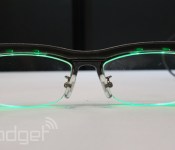
Ambient glasses put smartphone notifications right in front of your eyes

Still not sold on smartwatches, but want to know what’s going on with your phone without taking it out of your pocket? Maybe Matilde’s Fun-iki glasses, spotted at CNET Japan’s Live 2014 event, will do the trick. Connecting to smartphones through WiFi, a trio of LEDs above each lens will glow (or pulse) when there’s a notification, or simply to add a little, er, color to your complexion. The lights cycle through various shades of red, green and blue, and you’re able to assign specific colors to specific notifications: these frames aren’t limited to just phone calls and email pings and adding further third-party apps’ notifications is apparently easy.
There’s speakers within the arms, while it charges through the micro-USB port on the left side — we’re told it’ll typically blink and glow for around two days. It’s a pretty simple pair of glasses: notifications are pretty much it — there’s no interactive component or camera within the hardware itself, but you can setup the notifications, color cycles and pulse rates through a companion app. There’s also three different light-up modes: ‘disco’ and ‘party’ make the LEDs go a little crazy (just think of the Tinder applications), while ‘relax’ mode takes gentler hues and fades them in and out. Oh and there’s a morse code mode, where you can flash out a specified message. Because anachronisms.

The company says that it expects them to go on sale later this year, for a pricey 15,000 yen (around $147). Interestingly, the initial product could open up different styles: there’s not much stopping Matilde adding prescription lenses, or even adding some water protection. (It’s working with Paris Miki, an established Japanese glasses-maker, on the project). The company said that work is already underway on sports activity apps for the hardware. Given the squash goggle styling of the hardware, we reckon there’s some potential there.

Filed under: Wearables
Source: Fun-iki glasses

Sony Action Cams are ready to stream live internet video

Sony Action Cam owners: if you’re eager to share your sporting adventures with the world, your moment has come. The company has just rolled out a firmware update for the AS100V (installable on Macs or Windows) that lets you broadcast live video on Ustream, complete with social network alerts when you’re on the air. The higher-end camera also gets a new Motion Shot Mode that composites several photos into one, while burst shooting and self-timer modes are useful for both action-packed images and self-portraits.
You won’t get live streaming or high-speed photography if you’re using the more modest AS30V cam, but you’re not out of luck. It’s getting its own upgrade (available on Macs and Windows) that delivers multi-camera control through an optional remote, better automatic exposure and the use of WiFi without a memory card. Hit the source links if you’re ready to expand your cinematic repertoire.
Source: AS100V update (Mac), (Windows)

Future phones will have security measures built into the glass

The glass on your smartphone screen doesn’t do a lot right now: it lets pictures and touch input get through, and that’s about it. It may pick up a few extra talents in the future, though. Researchers at Polytechnique Montreal have developed sensors that can sit under the surface of the scratch-resistant Gorilla Glass used in many mobile devices. Their approach etches optical waveguides into the display, letting it track changes in light. As a result, the screen can do things that would normally require either wiring or dedicated sensors. Your phone could check its temperature using light, and the manufacturer could even embed a unique optical pattern into the glass that lets the phone identify itself; it might get much harder to clone a device (and, presumably, its information).
There are some subtler advantages, too. Since there’s nothing but photons passing through the waveguides, they’d be invisible. You could even stack multiple guides (and potentially multiple sensors) without obscuring the picture. In the long run, this could be key to transparent electronics that need many functions hidden from sight.
Despite the involvement of a Corning scientist, there aren’t any official plans to include these light sensors into Gorilla Glass. However, Polytechnique Montreal is fully bent on getting its technology into real, shipping gadgets. The invention should be production-ready within about a year, and the team is seeking out companies that could put the sensors into finished hardware. Provided the group finds some takers, you could soon see phones whose displays are as smart as the electronics underneath.
Filed under: Cellphones, Science, Mobile
Via: PCWorld
Source: Optics InfoBase

Stock Email Android App Makes its Way into the Play Store [APK Download]

Google continues to place their stock apps into the Play Store, and we can now add the stock email app to the list. Some of the features added to the app include, extra security for Gmail accounts, printing to the app, improved account setup, and of course, bug fixes.
Sadly the app can’t be placed on all devices out there. As of now, Nexus devices are compatible with the update and that is about it. This is just one more app to add to the list that Google has pulled from the base Android OS to better support consumers without having to mass release a device update to solve an Email issue. We have the apk download for you below, so like everything you download and place on your device, install at your own risk. Let us know how it runs.
//<![CDATA[
ord = window.ord || Math.floor(Math.random()*1E16);
document.write('’);
//]]>

Google Play Movies & TV Updated to v3.2.25 Adding Wishlist to Watch Now [APK Download]

App update Wednesday has one more update for you, and that is Google Play Movies & TV. The app gets an update bringing it to version 3.2.25, and adds wishlist content to “Watch Now”. Other than that, here is a list of other changes.
- Precise seeking. To rewind or fast-forward a few seconds, drag your finger across the video image. Drag and hold at the edge of the screen to continue seeking.
- 10 second rewind. Swipe your finger across the video image to jump back 10 seconds.
- Thumbnails. Images appear above the timeline to make seeking easier.
- Captions. More options to customize captions.
- Navigation menu. Easier switching between accounts and added Settings.
So if you feel like getting the latest Google Play Movies & TV, hit the link below to grab the apk. If you find anything else that has changed with the update, please let us know.
Download Google Play Movies & TV Here
//<![CDATA[
ord = window.ord || Math.floor(Math.random()*1E16);
document.write('’);
//]]>

Confiscated data must be returned or deleted if it’s not covered by a warrant

Picture a scenario where the government’s accused you of a crime. During its investigation, law enforcement copies your computer’s hard drive to look for evidence of your misdeeds (pursuant to a warrant, of course). Until today, it was unclear if law enforcement could hold onto copies of your data forever. A new Federal Court decision, however, has crystallized things for us all: the government can no longer keep that data indefinitely. United States v. Ganias is the name of the case in question, and the court held that indefinite retention of our digital files is an illegal seizure under the 4th Amendment to the US Constitution.
So now, when law enforcement obtains, searches, and finds the data it’s looking for pursuant to a warrant, it’s got to either return the other files it copied or delete them. Unfortunately, the Appeals court didn’t say just how long the government can keep that other data before disposing of it — meaning someone else gets to figure that little detail out. Gotta keep those lower courts busy, right?
Filed under: Misc
Via: Washington Post

Hate drones? This system tells you when to duck and cover

While drones can be fun and tremendously useful for huge industries like film and farming, in the wrong hands and with the right payload, they still have the capacity to invade privacy. That’s why a new Kickstarter project is offering a system that can detect drones (small, personal ones, not military-grade machines) within 50 feet. The technology, officially called the Personal Drone Detection System, consists of two sensors, a command and a control module. It’s connected to the internet via WiFi, and if it does sense a moving transmitter that could be a drone, it sounds an alarm or sends your phone or tablet a message if you’re out.
We say “could,” because the developers launched this crowdfunding campaign in order to find a group of Alpha testers who can help them improve the system. So, while the software’s designed to minimize false triggers, users might go through a few false alarms (say, from people using their phones or other electronics near their homes) until the proper software updates have been issued. Anyone interested in being an Alpha tester will have to pledge at least $499 to get a unit, which is expected to ship in November. But take note that detection’s all the system can do at the moment — it’s not exactly equipped with lasers that can blow up flying peeping toms.
Filed under: Robots
Via: The Verge
Source: Kickstarter

T-Mobile launches Un-Carrier 6.0, unRadio sets music free starting June 23

While announcing its latest “Un-Carrier” moves Wednesday night, T-Mobile launched Un-Carrier 6.0 and introduced some initiatives to “un-leash” music.
The first of the initiatives, unRadio, was announced in conjunction with Rhapsody and is a new service that aims to eliminate all issues associated with current Internet radio. T-Mobile said that unRadio is ad-free, offers unlimited skips and a catalog of over 20 million songs. It will be available starting June 23 to all T-Mobile customers with unlimited 4G LTE, while other T-Mobile customers can get it for $4 per month.
Our competitors want you to believe that Internet radio is still free on their networks — but it’s not,” said Mike Sievert, chief marketing officer for T-Mobile. “On AT&T and Verizon, you’re paying for every note of every song you stream. You even pay for the ads. Our goal with Music Freedom is different. We want people to enjoy their music worry-free — the way it’s meant to be.”
unRadio wasn’t the only thing up its sleeves as T-Mobile also announced that its Simple Choice customers will now be able to stream all the music they want from their favorite streaming services having to worry about using their data. These streaming services include Pandora, Rhapsody, iHeartRadio, iTunes Radio, Slacker, and Spotify, as well as Samsung’s Milk Music and the forthcoming Beatport music app from SFX.
Via: T-Mobile
The post T-Mobile launches Un-Carrier 6.0, unRadio sets music free starting June 23 appeared first on AndroidGuys.
 AIVAnet