


Apple TV May Gain Deeper Integration With iOS and Macs via Continuity
Developers who have installed the newest iOS 8 beta, the latest version of OS X Yosemite, and the current Apple TV beta, all released yesterday, have noticed a new pop up notification suggesting the Apple TV will gain some of the Continuity features Apple introduced during its Worldwide Developers Conference.

As noted by 9to5Mac, the notifications are being received on Macs running on the same local WiFi network as Apple TVs that also have the newest software, suggesting at the least, that with Yosemite, Macs will be able to interact with the Apple TV in new ways.
It is unclear how Yosemite and the Apple TV might interact as any Continuity features between the two are not yet functional, but it is possible that a feature like Handoff could be used in conjunction with AirPlay, allowing a movie, TV show, or music to be seamlessly transferred from one device to another.
It’s also possible the Apple TV could display notifications when a phone call is incoming to an iPhone, much like the Mac and the iPad are able to do. Call notifications and on-screen caller ID are not far-fetched, as some telecommunications providers that offer TV, Internet, and phone access are able to display caller information on screen.
Continuity features like Handoff appear to require Bluetooth 4.0, a feature that is only available in the third-generation Apple TV. Yesterday’s update was only available for third-generation Apple TVs, providing more evidence that the device is likely to gain some Continuity features.
OS X Yosemite, the new Apple TV software, and iOS 8 are all expected to be released to the public in the fall after an extended beta testing period. Apple is also said to be working on an upgraded Apple TV set top box with new capabilities, which could also take advantage of Continuity features.
Evidence of iPhone 6 Atmospheric Pressure Sensor Found in iOS 8
Apple may add an atmospheric pressure sensor to the iPhone 6, according to a report by 9to5Mac. This follows on a rumor from March that suggested the iPhone 6 could include humidity, temperature and pressure sensors when it comes out this fall.
A barometer is used to measure atmospheric pressure, giving indications on current and future weather trends as well as altitude data. The report says new APIs in iOS 8 reference altitude data, including one called “isRelativeAltitudeAvailable” that tells apps if a device “supports reporting relative altitude changes”. For an iPhone 5s, the API returns “no”.

According to sources at Apple, the Cupertino-company has been working on an updated version of the Compass application that includes altitude tracking, so perhaps that application, which was originally added in 2009 alongside the iPhone 3GS, is what customers will utilize to track their altitude.
iOS 8 is expected to be launched this fall alongside new, larger iPhones. The altitude and pressure sensors could make an appearance in the phone as well as new iPads that are expected later this fall.

The man who defined net neutrality is running for office in New York

Many will tell you to run for office if you really want to change the political status quo. Tim Wu, the professor who defined the term “net neutrality,” has clearly taken that advice to heart — he’s now running for lieutenant governor in New York state. As he explains to the Washington Post, he sees this as a chance for state governments to get more of a say in both net neutrality issues and telecom mergers. People aren’t happy with “concentration in the media industries and tech industry into political strength,” Wu says.
He’d particularly like to pressure New York regulators into challenging Comcast’s proposed acquisition of Time Warner Cable. While federal law might let the takeover go ahead, the state isn’t beholden to those rules; it might just stymie the entire deal if it decides that the merger hurts consumers. Wu notes that New Yorkers are sensitive to both never-ending price hikes and telecoms that act with seeming impunity. They’ve been especially upset with Verizon, which both limited its FiOS deployment in the state and refused to reinstall some landline phone service in the wake of Hurricane Sandy.
Wu is aware that he and the gubernatorial candidate he’s running with in the Democratic primary, Zephyr Teachout, are “underdogs” compared to incumbent Andrew Cuomo. All the same, he believes that there’s at least some chance of victory. He also sees Teachout as a good match — she’s interested in a company-independent approach to supporting the state economy, so it only makes sense that she gets help from a net neutrality advocate that won’t play favorites. Whether or not the two beat the odds, they may at least draw more attention to telecom policies that are frequently relegated to the sidelines in political debates.
[Image credit: Stanford Center for Internet and Society, Flickr]
Filed under: Home Entertainment, Internet, HD
Via: Ars Technica
Source: Washington Post

Scientists use lasers to understand how water stays liquid below its freezing point

We only remember a few things from science 101, but we’re reasonably certain that water boils at 212 degrees (Fahrenheit) and freezes at 32. Scientists at Stanford’s SLAC National Accelerator Laboratory, armed with a Linac Coherent Light Source X-Ray Laser, however, have shown us otherwise. Should you be armed with such a device, the normal rules of physics no longer apply, and — for the first time — it becomes possible to observe water right down to its molecular level, even while it is supercooled as a liquid to minus 52 degrees Fahrenheit.
Although supercooling water has long been possible, it’s been mostly impossible to observe and understand what happens during this process. One of the key things that the SLAC team has discovered, by using the X-Ray laser, is that water is able to, for want of a better word, “sweat.” As they sent chilled droplets down a vacuum chamber into the eye of the laser, they observed that some droplets rapidly evaporated, allowing the rest of the water to enter its supercooled state. What’s the point in all of this? The atmosphere absorbs different levels of solar radiation depending on if the water is in a crystalline or liquid state. Being able to understand how much of each is floating around the earth at any one time is key to being able to predict levels of climate change — and, hopefully, finding a way to prevent it.
[Image credit: Greg Stewart / SLAC]
Filed under: Science

Twitter now lets you share gifs on the web, Android and iPhone

And there was much rejoicing.
Starting today, you can share and view animated GIFs on http://t.co/wJD8Fp317i, Android and iPhone. http://t.co/XBrAbOm4Ya
– Twitter Support (@Support) June 18, 2014
Filed under: Internet
Source: Twitter Support (Twitter)

Apple discounts the books Amazon refuses to stock

If you head over to iTunes and look for book pre-orders at $9.99 or less, you may notice something strange: they’re all Hachette titles. That’s no coincidence — Amazon is delaying shipment on Hachette books right now, a negotiating tactic it calls an “essential business practice.” Authors and publishers think otherwise, with one referring to it as “extortion” that’s “illegal when the Mafia does it.” As Re/Code pointed out, however, it’s ironic that Apple is offering cut rates on Hachette books, considering it was found guilty of conspiring with the publisher to raise prices. Apple has since settled class-action suits that resulted from that judgement, though it won’t have to pay if it wins its appeal against the DoJ. Either way, Apple is set to profit by selling buzzy new titles like J.K. Rowling’s well-reviewed Silkworm, since Amazon has essentially kneecapped itself. Let’s face it though — Apple also likely enjoys razzing the book industry’s 800 pound gorilla.
Filed under: Internet, Apple, Amazon
Via: Forbes
Source: iTunes

Live from Amazon’s phone announcement in Seattle!

Look, Amazon didn’t exactly hide the fact that today’s mystery product announcement would be its long-rumored 3D phone. But with the exception of the occasional picture, the company did a decent job of keeping its new handheld device out of the public eye. Now Amazon’s ready to show off the new Kindle Fire phone (or whatever it ends up being called), and we’re here to bring you the news as it happens. Enjoy!


Filed under: Cellphones, Wireless, Mobile, Google, Amazon
Amazon announces the Fire Phone

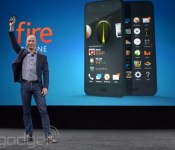
Yep, it’s a phone alright. Amazon officially unveiled the Fire Phone today at a special press event held in Seattle. Consistent with the rumors, Amazon’s first ever phone has a 4.7-inch Gorilla Glass display with a HD resolution screen (we’re assuming it’s 720p).
Developing…
Filed under: Cellphones, Mobile, Amazon

BlackBerry turns to Amazon for apps

BlackBerry on Wednesday announced a new licensing agreement with Amazon which sees the hardware maker employing the Appstore for its handsets. Once realized, smartphones which run the forthcoming BBOS 10.3 will be able to tap into the Amazon Appstore and its more than 200,000 applications. Yes, this means the same Android apps available to Kindle Fire, Fire TV, and Android devices already running the Appstore. Due in September, the software update will give BlackBerry smartphones access to apps outside of the World store.
The post BlackBerry turns to Amazon for apps appeared first on AndroidGuys.
Living with Google: Google Music

In short, Google Music is one app I have found I simply can’t live without. Google Music is free for your own uploaded music (up to 20,000 songs) but to really utilize the service you want to sign up for All Access.
All Access allows you to listen to everything available on Google Music – millions of songs. Google has a vast library of music you can listen to on Android devices, iOS, and through the web page Music.Google.com. Initially there is not much going on in your library; it’s when you start to explore Google Music All Access that the app starts to become an everyday music experience.
Google Music allows you to create playlist and radio stations of what you want to listen to. Just about any type of music is available at all times as long as you have a good connection. If you know you are going to be in an area with no connection you have the option of pinning your music on your device. Users can pin anything from single songs to entire albums and playlists.
 Need a bit of inspiration? Google also has a recommend listening feature that comes in handy if you don’t know what to listen to. Suffice it to say, there’s a smart algorithm at work here and it’s able to recommend new releases, suggest music you’ll enjoy, or just play a random selection of stuff that you’re likely to love.
To get Google Music you have to download the app on the device your using as well as any computer you use. Most new Android phones come native with the music app. The application on the computer will ask to search for music to add to you library automatically. When you have downloaded the app there will be an option to turn on All Access for a monthly fee which is well worth it. You can’t keep the music and share it for obvious reasons but you can store it on device so if you have no service or internet connection you can still listen to it uninterrupted.
There are options available like listen now which takes you to music that’s on device or music that you regularly listen to. My library which is whats only on device sorted by genres, artist, albums, and songs. Playlist which are your playlist you have created. Radio which is a list or radio stations you have created and Explore which gives you a top songs list and suggested songs and artist bases on what you listen to. There is only one strong suggestion for this app if you can organize your library on a computer do it, the app has fewer capabilities than the web application.
LIVING WITH GOOGLE is an ongoing series of articles dedicated to highlighting the many ways in which Google can help better our lives. With innumerable apps and services to choose from, our aim is to educate readers on the ways in which we use them.
See Also Living With Google: Google Now , Living With Google: Gmail
The post Living with Google: Google Music appeared first on AndroidGuys.
 AIVAnet