


Automatic Gains Redesigned App, New Data on Fuel Level [iOS Blog]
Automatic today announced a major update for its Automatic app and connected driving platform, introducing a significant app overhaul with a revamped UI designed to be “lighter, faster, and more modern.”
Along with a new look, the Automatic app now provides data on fuel level and gives low fuel warnings. In supported cars, fuel level will be displayed directly in the iPhone app, along with an estimate of the miles left in the tank based on driving habits. Users are able to set an alert to be warned when they’re low on gas.
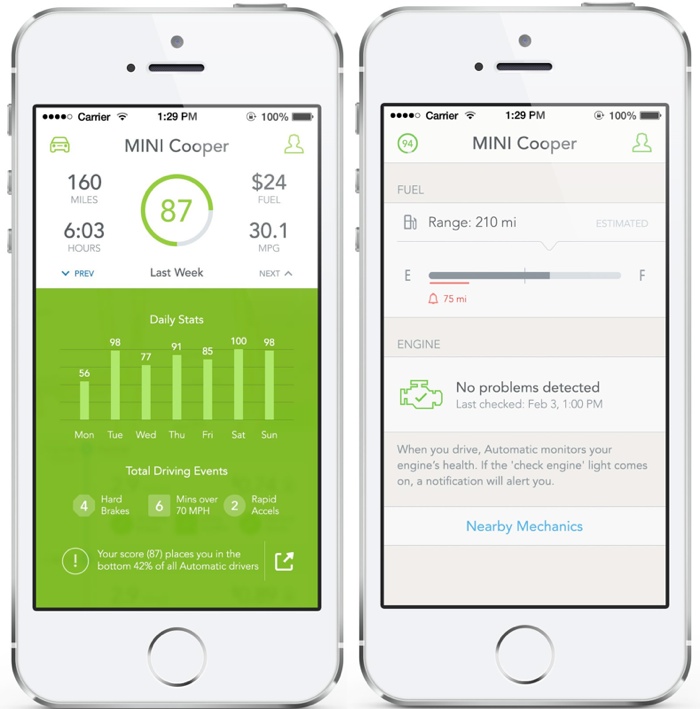
Automatic’s new fuel data is only available to approximately half of cars using the Automatic system, as many cars do not report their fuel level through the diagnostic port. Automatic recommends checking whether a car supports fuel data on its website.
With the new app update, consumers will also be able to change the speed at which Automatic delivers alerts for driving too fast. Previously set at 70 MPH, users will now be able to choose a custom speed, which is useful for states with higher or lower speed limits. Along with customizable speed thresholds, Automatic is also improving how customers are warned when driving too fast, cutting down on the number of warning chirps.
Now, consumers will only hear the chirp once when you cross the threshold. The chirp won’t repeat for the rest of the trip unless a person dips below the threshold and crosses it again.
The Automatic Link, which plugs into a car’s data port, can be purchased from the Automatic website for $99.95. The Automatic app can be downloaded from the App Store for free. [Direct Link]

Garmin Launches ‘Viago’ Navigation App for iOS with Speed Limits, Lane Assist, and More [iOS Blog]
Longtime GPS navigation leader Garmin is expanding its app portfolio with its newly-announced navigation title, Viago. The maps company hopes to compete with free navigation apps such as Apple Maps by offering Viago with an affordable price tag and a robust set of core navigation features.

Viago sets itself apart from the competition with a set of standard navigation features that are not usually available in free apps, such as lane assist, speed limit display, weather information, photo-realistic junction views and more. Customers who want more than these base features can opt to purchase advanced options a la carte via in-app purchases. Additional paid features include real-time traffic with automatic rerouting, urban navigation with public transportation, downloadable maps and more.
“Garmin víago offers the best navigation technology available from Garmin, helping drivers to reduce stress and save time on the road,” said Joern Watzke, vice president world-wide mobile business at Garmin Wuerzburg GmbH. ”The comprehensive feature set goes far beyond simple turn-by-turn directions and assists drivers like no other navigation app. Premium in app purchase options allow users to fully customize their navigation experience and only choose the features they want.“
The app also features Garmin Real Directions (in-app purchase), which allows the driver to receive descriptive driving directions that include notable landmarks, traffic signs and traffic light status that make it easier to drive an unfamiliar route. Viago also is compatible with Garmin HUD, a standalone Bluetooth device that projects driving directions into the driver’s line of sight using a transparent film on the car windshield or an attached reflector lens.
Garmin Viago [Direct Link] is available now at a launch price of $0.99 (normally $1.99) until July 13, 2014. In-app purchase packages range from $4.99 to $19.99 with Maps to Go and Traffic Live now discounted 50 percent during this promotional period.

What you need to know about laser-cut clothing

You know the intricate, elegant, classic pattern found on your grandma’s doilies? Imagine that design as an item of clothing. That is laser-cut design.
Laser cutting used to be reserved for haute couture designs. But as consumers began lusting for the technique, and the technology was made more readily available to manufacturers, it’s become commonplace to see laser-cut silk and leather in ready-to-wear runway collections. Where the runway goes, affordable fashion typically follows: You can now find laser-cut clothing sold by fast fashion retailers like Topshop and ASOS. And that’s just for starters.
WHAT IS IT?
Laser cutting is a method of manufacturing that (surprise, surprise) uses a laser to cut materials. All of the advantages — extreme accuracy, clean cuts and sealed fabric edges to prevent fraying — make this method of design very popular in the fashion industry. Another benefit is that one method can be used to cut many different materials, like silk, nylon, leather, neoprene, polyester and cotton. Also, the cuts are made without any pressure on the fabric, meaning no part of the cutting process requires anything other than the laser to touch a garment. There are no unintended marks left on the fabric, which is particularly beneficial for delicate fabrics like silk and lace.
For example, Marc Jacobs used laser cutting to create delicate, ethereal lace and silk pieces for LV’s Spring/Summer 2012 ready-to-wear collection (seen above). Similarly, Georgina Chapman and Keren Craig of Marchesa frequently send exquisite gowns down the runway with the most intricate laser-cut patterns. An example: the soft pink gown with layers and layers of laser cut fabric in Marchesa’s Spring/Summer 2011 ready-to-wear collection.
HOW DOES IT WORK?
This is where things get technical. There are three main types of lasers used for laser cutting: the CO2 laser, the neodymium (Nd) laser and the neodymium yttrium-aluminum-garnet (Nd-YAG) laser. For the most part, the CO2 laser is the method of choice when it comes to cutting wearable fabrics. This particular process involves firing a high-energy laser that cuts by melting, burning or vaporizing material.
To accomplish the precise cut, a laser travels through a tube-like device while being reflected by several mirrors. The beam eventually reaches a focal lens, which targets the laser to a single spot on the chosen material for cutting. Adjustments can be made to vary the amount of material that is cut by the laser.

The CO2 laser, the Nd laser and the Nd-YAG laser all generate a concentrated beam of light. That said, differences in these types of lasers make each ideal for certain tasks. The CO2 laser is a gas laser that produces an infrared light. CO2 lasers are easily absorbed by organic material, making it the first choice when it comes to cutting fabrics like leather. Nd and Nd-YAG lasers, on the other hand, are solid-state lasers that rely on a crystal to create the light beam. These high-powered methods are well-suited for engraving, welding, cutting and drilling metals; not exactly haute couture.
WHY SHOULD I CARE?
Because you appreciate attention to detail and precise cuts in fabric, you fashionista, you. Cutting fabric with a laser allows for extremely accurate cuts without ever touching the fabric, which means that a garment comes out as untainted by a manufacturing process as possible. Laser cutting offers the kind of precision that you’d get if a design were done by hand, but at a much faster pace, making it more practical and also allowing for lower price points.

There’s also the argument that designers who utilize this manufacturing method are less likely to be copied. Why? Well, the intricate designs are hard to reproduce in an exact way. Of course, those who copy can aim to recreate an original pattern or might be inspired by specific cuts, but utilizing laser cuts makes it that much harder for the competition to create an identical pattern.
WHAT’S THE ARGUMENT?
It’s easy to forget, now that laser-cut designs are found all over, that the technology wasn’t always as widely available as it is today. It used to be that the only way to get your hands on a laser-cut garment was to shell out a lot of cash; these days, you can get a laser-cut vest from Topshop for less than $100, and a faux-leather top from Forever 21 for under $30. Or, if you’re more highbrow than fast fashion, not to worry — you don’t necessarily have to break the bank to get your hands on a laser-cut piece of clothing. Bloomingdale’s, for example, has several offerings for under $300.

There isn’t a persuasive argument against this manufacturing technique. If you want beautiful, detailed clothing, laser cut is the way to go. There may be an argument in that you might not really care to have impeccably cut clothing. But then why did you read this far?
WANT TO KNOW MORE?
It’s only natural that you do! Cut Laser Cut and Laser Cut Fabric are two companies you can turn to if you’d like to start cutting your own designs, if you want to see what else laser cutting can do when it comes to fabric or if you feel the need to know more. And EDITD offers a deeper look at how the laser-cutting trend has grown from a technique used solely for haute couture collections to now something that is used by hundreds of brands — from both ends of the cost spectrum and everything in-between.
[Image credit: Karl Prouse/Catwalking/Getty Images (lead image); Maximilian Stock Ltd. (laser); Catwalking/Getty Images (skirt); Chris Moore/Catwalking/Getty Images (full dress)]

The world’s largest video game collection sold for $750,250

Remember the story of Michael Thomasson, who was forced to sell his collection of video games? The Guinness world record-holding haul was eventually snapped up for a whopping $750,250. The unnamed bidder, now short three quarters of a million dollars, will take ownership of one of the largest video game libraries in private ownership, including some more avant-garde pieces of hardware including NUON and the Tapwave Zodiac. Assuming that you weren’t the lucky bidder, it’s probably time to start hunting through the bins at the back of Gamestop to start your own from scratch.
[Image credit: Techspot]
Filed under: Gaming
Source: GameGavel

The Ekocycle Cube 3D-prints recycled plastic, is backed by will.i.am

Who isn’t making 3D printers these days? We’ve seen countless models hit the market, but the new Ekocycle Cube from 3D Systems may be the first to boast backing from both a beverage maker and a celebrity. Coca-Cola and will.i.am have been collaborating on the sustainability initiative dubbed Ekocycle since 2011, and at CES this year the artist shared his passion for 3D printing and other emerging tech. As the latest announcement in the eco-friendly campaign, the new printer uses post-consumer plastic to create a variety of designs. It’s not the first attempt at make 3D-printing a bit greener, but with some star power and the clout of 3D Systems behind it, the Ekocycle Cube definitely looks to be the highest-profile one to date.
The design is based on the Cube 3 from 3D Systems, with touchscreen controls and the same boxy look, but the Ekocycle sports a flashier red shade on the inside — and, most importantly, the new product will only print filament that’s partially comprised of recycled plastic. The cartridges aren’t made exclusively from recycled plastics, though; each one contains about 25 percent of post-consumer PET plastic bottles.
Each cartridge gives you about three plastic water bottles’ worth of material, and the printer ships with designs for rings, guitar picks and phone cases, among other things. The Ekocycle Cube can print materials up to 6 inches cubed in size with a 70-micron resolution, and users can buy filament in black, red, white and “natural” colors. It’s unclear how much individual cartridges will cost, but the Cube itself is expected to retail for $1,200 when it launches later this year.
Filed under: Peripherals
Via: Electronista
Source: Ekocycle Cube (Cubify)

Automatic’s updated iOS app tells you how much gas you’ve got left

Automatic brought its driving companion app (which, if you’ll recall, pairs with a dongle in your car to deliver real-time driving feedback) to Android earlier this month, but it hasn’t left iOS users out in the cold. The team just pulled back the curtain on version 2.0 for roadwarriors who have pledged allegiance to Apple, and that update has brought some nifty new tricks into the fold.
The iOS app underwent a touch of plastic surgery, but the real meat comes in the form of two new features for the lead-footed among you. In the early days, your Link dongle would bing at you once you tip-toed over the 70 mph threshold, but you can now tweak that speed limit to your like. More importantly, owners of certain cars will be able to see their current fuel level (along with a estimate of remaining range) on their phones, which sounds much better than trying to guess how much is left in the tank when the fuel light comes on. Yeah, yeah, some of this will sound passé if you tool around in a ride from the past few years, but there’s a staggering chunk of people who could stand to smarten up their cars without breaking the bank.
Source: Automatic

UK spies using foreign loopholes to monitor Google, Facebook and Twitter users

GCHQ, the UK’s intelligence agency, has yet to confirm whether it taps undersea network cables to gather content from ISPs, but we now know how it would justify access if it did. Charles Farr, the Director General of the Office for Security and Counter Terrorism, revealed that spies could intercept British users’ Google searches, Facebook updates and Twitter posts when servers are located outside of the country. The information came to light after Privacy International, Liberty, Amnesty International and a number of civil liberties organizations issued a legal challenge against GCHQ in an attempt to unravel the secrets of agency’s Tempora data-tapping program, which were revealed as part of Edward Snowden’s NSA document leaks.
British law states that agencies do not have the right to spy on internal communications. However, the same restrictions are not applicable for foreign transmissions. Farr argues that if a Briton was to perform a Google search on a server that is located outside of the UK, it would be classed as an “external communication.” Facebook updates and Twitter posts would likely fall under the same classification, although direct communications like emails may be protected, as the sender and the recipient both reside in the UK.
Worryingly, if content is deemed to be an external communication, UK law states that it can be searched, read and eavesdropped upon, regardless of whether the people involved were suspected of any wrongdoing. Farr’s statement notes that the UK has for “many years faced a serious threat from terrorism,” and that the sharing of data has led to the prevention of terrorist attacks and other serious crimes. Microsoft has already begun blocking US government requests to access European data, and now that intelligence agencies are slowly starting to reveal their data access strategies, more companies could follow suit or begin locally hosting servers.
[Image credit: UK Ministry of Defense, Flickr]
Filed under: Internet, Google, Facebook
Source: Charles Farr Witness Statement (PDF), Privacy International

iOS 8’s Variable Touch Sizing Bringing ‘Surface Pressure’ to FiftyThree’s ‘Pencil’ Stylus
FiftyThree announced today (via TechCrunch) that its “Pencil” iPad stylus will be updated with a new Surface Pressure feature when iOS 8 debuts later this year. This feature allows users to change the thickness of the lines they create by controlling how much of the pencil tip comes in contact with the iPad screen.

Pencil’s tapered tip was inspired by the expressive richness of real pencil points, which allow creators to change the character of the line with the angle of the tip. With Surface Pressure you’ll be able to control the lines you create based on how much of Pencil’s tip or eraser is in contact with your iPad. Use the point for fine details or the angled edge for broad strokes. Surface Pressure unlocks new capabilities for each of Paper’s tools—fill faster as you draw, shade as you sketch, or carve away in varying widths as you erase.
This Surface Pressure option is made possible by iOS 8′s variable touch sizing, which lets developers interpret touch along a range of point sizes that vary from a single point to a broad circle. The ability to adjust line thickness on the fly is a significant advantage over the current version of the stylus, which delivers a single line whose thickness is controlled via an in-app setting that is changed manually.
FiftyThree released the Bluetooth Pencil stylus last November as a companion to its popular Paper drawing app. It is available in either a brushed aluminum (US$50) or walnut ($60) option for consumers who live in the US or Canada. Surface Pressure will be included in a free Pencil software update, which will be released this fall following iOS 8.

Amazon’s upcoming smartphone will be exclusive to AT&T

Due to be unveiled at an event in Seattle tomorrow, the Wall Street Journal have reported that the upcoming Amazon smartphone will be exclusive to AT&T.
Amazon are expected to continue their partnership with AT&T for which they offer their cellular versions of Kindle tablets with their smartphones, which makes sense. It could also indicate the introduction of a long rumoured Prime Data service which would offer reimbursed data rates for localised content from various companies.
With four front-facing cameras, the Amazon smartphone is expected to offer a 3D user experience without the need for glasses to indulge the user in contextual menus which adapt to the orientation of the device.
One thing is for sure, we won’t have to wait long until we see what Amazon has in store for us.
The post Amazon’s upcoming smartphone will be exclusive to AT&T appeared first on AndroidGuys.

Cyanogen Theme Showcase launches on the Google Play Store

If you like to theme your device then the new Cyanogen Theme Showcase app may be of interest to you as it’s now launched in the Google Play Store.
The app acts as a portal to access Cyanogemod themes on Google Play to the theme switcher included in the CM ROM.
Developers are being encouraged to submit their creations into the app and it supports a variety of icon packs from Nova, LauncherPro, Trebuchet, ADW, and Go Launcher.
Check it out on Google Play for free.
The post Cyanogen Theme Showcase launches on the Google Play Store appeared first on AndroidGuys.
 AIVAnet