


Crowd-control drones reveal the technology’s dark side

The treatment of South African miners has been a troublesome issue ever since black laborers were forced into the mines in 1894. It’s led to a series of bloody strikes and protests, starting in 1946 and continuing through apartheid right up until today. A new type of crowd suppression drone from a local defense contractor isn’t going to help matters, especially given the fact that the country is in the grip of a 21-week miners’ strike in which some protestors have already been killed. The Skunk, built by Desert Wolf, is designed to “control unruly crowds without endangering the lives of security staff,” and is reportedly already being adopted by mine owners.
Equipped with a 4,000-strong clip and four paintball gun barrels, the Skunk can fire up to 80 projectiles in a single second. It can carry dye markers, pepper spray bullets or even solid plastic balls, which somewhat stretches the definition of “non lethal.” The hardware also carries strobe lights and on-board speakers to disorientate and warn the crowd, as well as a FLIR thermal camera for night vision operations. According to defenceWeb, unnamed mine operators have already placed orders for 25 Skunks, which could be deployed as early as next month. Good luck, then, to anyone trying to protest for safer working conditions beyond that date.
Filed under: Misc
Via: PrivacySOS
Source: defenceWeb, Desert Wolf

Honeywell thermostat lets you set the temperature using your Pebble smartwatch

Honeywell may now be looking to take on Nest with a new sleek and stylish thermostat, but it’s still making sure that users of its other connected systems enjoy updates too. In a bid to make things a little easier for owners of it evohome smart zoning thermostat, the company has extended support to the Pebble smartwatch, offering up room-by-room heating control from the comfort of your wrist. Honeywell’s new smart bundle allows you to set the temperature of in each zone (or room) in your home and turn the heating on or off with the push of a button. The app can also immediately enable or disable any of the preset evohome quick actions, which is especially helpful if you’ve forgotten to shut off the heating before you fly off on holiday. If you’ve installed Honeywell’s zoning thermostat and also own a Pebble, you can grab the new app and watchface from Pebble’s app store using either your iOS or Android device.
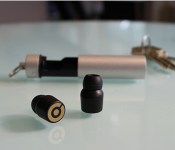
Earin’s tiny wireless earphones recharge while they’re in your pocket

Bluetooth earbuds like Dre’s new Powerbeats aren’t actually “cordless.” They still have a cable running from one bud to the other, which puts a limit on just how tidy and inconspicuous they can be. A group of former Sony Ericsson and Nokia engineers reckon they can go a step further: losing the connecting cable and headset mic in order to create two miniscule, music-dedicated buds with independent batteries and AptX-compatible wireless receivers.
Known collectively as “Earin” — though it’s hard not to think of them as “Earins” — the buds promise three hours on a charge. Admittedly, that sort of battery life isn’t great, especially if it’s an ideal spec rather than the dependable minimum, but the engineers have a solution for this too: When not in use, you place the Earins in a small tube that both protects and re-charges them, using its own battery. The overall effect actually looks quite practical, which probably explains why the project is already halfway to its £180,000 ($300,000) funding target. A £99 ($170) contribution from you at the Kickstarter page will nudge things along and, if the target is met, secure you a pair sometime in January 2015.
Filed under: Cellphones, Portable Audio/Video, Wireless, HD, Mobile
Via: Gizmag
Source: Kickstarter

Tokyo Toy Show 2014: Robot pets, maglev toys and more!

It’s our first year touring Japan’s premier toy show, and we’d be happy to do it again. Among traditional wooden blocks, tricycles, action figures and card games (so many card games!) there’s a number of toys with a high level of technology — like maglev toy trains. Japanese toymakers continue to produce robot toys, hoping for either AIBO-like moment of fame, or at least a hit for the holidays. Several companies were also trying to convince not-quite-teens to get their parents to pay out for (admittedly cheaper) smartphone-like gadgets. One LINE-branded gadget even lets tweens play games, send stickers and messages once it’s either within range of a friend’s (actual) smartphone or through WiFi — it uses a low-fi, simpler version of the messaging app. Surprisingly, for a trade show, nearly every product on show here already had a price and a launch date — at least for this side of the Pacific. Many, many more toys, after the break.
MiP: the controllable toy robot waiter

MiP is a two-wheeled robot that keeps itself upright Segway-style, and generally hurls itself around without bumping into things… most of the time. By rotating the wheel, the robot cycles through seven modes, with a dance, balance (for carrying things around), running, controller, free running and study modes. With sensors built into the front, you can can either rebuff his advances, or gently steer him by gesturing to the left or right of the robot’s eyes. With a smartphone, you can draw a route with your finger, battle other MiPs or just get it to dance along with your music collection.
We were most impressed with it’s ability to carry around small objects (our drinks), although it looks like you’ll have to place the drink on MiP’s tray before ordering it somewhere, which defeats the purpose of it, namely our own laziness. The robot is being pitched as a toy for both kids and adults, and it’s an undercurrent of the entire show. A decreasing population and low birthrate has meant that Japan’s toymakers are casting their net wider than normal: if adults are interested, then there’s simply a better chance of it being to a top-selling toy. MiP will launch this week for 15,000 yen.
Pet robot cats! (And dogs. And chicks)
Dream Cat Celeb is here. That’s a direct translation of this furry, carry-able (weighs as much as a cat?) robot with touch sensors along its head, chest, back and tail. Just like the real thing, it doesn’t like it when you touch its tail. The facial expressions are pretty good, although robotic whirring and squeaking needed to accomplish that ruins the effect a bit. This new model is set to arrive in Japan next onto, priced at 12,000 yen ($117) but Hasbro says the cat is still in development, so this may not be the very final model. We’d like the fur to be a bit more natural. It has a plastic, artificial feel to it, but it remains a luxury version of Hasbro’s Furreal toy range from a few years back.

A more portable, cheaper, pet than the cat, this chick will also arrive next month, priced at around 2700 yen ($26), and it packs a single sensor on the top of its head. Pet it properly, and its tiny wings will flutter. If you’re into neon-colored chicks, the company also had blue, mint green and pink versions, although theses were currently only for show.

Primed to capitalize on that meme, the bigger (and heavier), Shiba-chan can run on its battery, or while being plugged in. It reacts to voice commands, (the makers say it has 85 different behaviors) although the current developmental model had some issues hearing through the noise and general mayhem of a toy show. In Japanese, it was able to shake hands, sit up and beg, while petting it right will make Shiba-chan wag its tale and “make happy noises”. There’s even the obligatory toy bone that it’ll hold onto if you offer it up to his mouth. Man’s best robot friend won’t be cheap: when it launches this November, it’ll be priced at 40,000 yen ($392) .
Toy smartphones

That smartphone boom? Toymakers want to get young-’uns hooked early with substantially cheaper (and let’s not kid ourselves) less advanced communication devices. They run the full gamut of functionality: some were running Android (with app store access), while others had their own UI that looked like Android but were actually pretty bare-bones — they did connect to purikura photo booths — they’re very big in Japan. The LINE “My Touch Smart” mentioned in the intro runs everything from a LINE-styled portal, although the admittedly chunky device did have a camera, over 300 stickers built-in and a micro-SD slot for music playback. The other phone toys are heavily bejeweled, and you can any color as long as it’s pink (and possibly powder blue.) Prices for these hover around the $100 mark, however, making it a whole cheaper than an iPod touch.
More coverage from the Tokyo Toy Show 2014:
High-speed maglev toys are coming in 2015
This remote-controlled car moves on land, air and sea
Filed under: Cellphones, Gaming, Peripherals, Robots, Transportation
A Complete Guide to Virtual Desktops for Business
Introduction:
A major issue for modern businesses is trying to keep up with the constant increasing prices of desktop computer upgrades. Many businesses cannot afford these regular upgrades and have a found a new solution. Virtual desktops which can run server hardware, application software and operating systems inside a virtual machine are the solution to this issue. The reason that virtual desktops are such a good solution is that they allow employees to access their work from devices all over the world. You can assign a user permission to access the virtual desktop and provided they have a connection to the internet this can be done anywhere. This article will discuss how a virtual desktop can be used in business.
Allows your business to be flexible:
With the modern technology at our disposal work can now be done on far more devices than just a desktop or laptop computer. If a business uses a virtual desktop then this will allow employees to work on a wide range of devices such as desktop computers, laptops, tablets and even smartphones. By having access to work on portable devices like smartphones this can allow your employees to work on the move. Virtual desktops allow for wider flexibility in a business as it means employees do not have to be in the office to do all their work.

Data will no longer have to be stored locally.
Image source: https://farm6.staticflickr.com/5258/5537403064_1e3b3f7f0d.jpg
Less expensive:
A virtual desktop solution can help your business reduce its costs greatly. With virtual desktops there is far less of a need for desktop management and support. Virtual desktops remove the need for the massive cost of buying expensive equipment and software that would eventually need upgrading anyway. Also hardware and software has to be maintained properly to work. Virtual desktop maintenance can be done by your provider saving you a lot of hassle and time.
A greener way to work:
Businesses that do their part to help the environment are respected so it is important your business is seen as doing their fair share to help our planet. As said previously virtual desktops allow for much more versatility in your workforce. You can use virtual desktops to decrease the need for all employees to be working in a central office. This means employees will not have to travel to work and pollute the air with their vehicles. Also by not having to maintain more expensive equipment and having a smaller office space you will save on electricity bills. Customers will be attracted to the fact your business is trying to be greener.
Simple:
When changing how your business work you will want to ensure that it can be done with as little stress as possible. Virtual desktops offer almost identical experiences as a traditional desktop would. This means training costs will be kept to a minimum as the majority of staff will be able to adjust to the change of using virtual desktops with no help at all.
When new software updates come out and you work traditionally this will mean you have to update them all manually. Backing up your data and scanning for viruses also has to be done manually traditionally. These processes are all very time consuming. When using a virtual desktop these processes can be done all at once for every computer you use making for a far more efficient system.
Security:
One of the big differences with virtual desktops to traditional desktops is in how they save their data. A virtual desktop will save its data to a data storage centre rather than locally. This will increase security as employees will not have any sensitive information saved to their computer. When dealing with important data businesses have to meet certain requirements as part of the law. Virtual desktops can help your business in achieving this.

Virtual desktops can offer you increased security.
Image source: https://farm3.staticflickr.com/2263/2229635029_8fb790b936.jpg
Conclusion:
Virtual desktops clearly offer a wide variety of reasons to use them. Many companies are starting to adapt to using them due to the advantages they bring to computing. Whether your business is large or small the advantages are all the same. Why not move your business to a virtual desktop software solution today and see the advantages?

Europe and South Korea will share their 5G know-how

There’s a fine line between being fashionably late and arriving just as the party’s over, which is the problem Europe suffered when it came to implementing 4G mobile networks. That’s why the EU is now teaming up with South Korea to co-operate in developing 5G in the hope of getting back to the front of the line. In addition to sharing cash and know-how on developing the standard, both parties will harmonize radio spectrums to avoid the problems with roaming that were suffered in the race to implement LTE. Of course, no-one believes that a standard for 5G will be ready for at least another year, but there’s a hope that maybe Europe won’t be so far behind the US as it was last time.
Filed under: Cellphones, Wireless, Mobile
Source: Europa
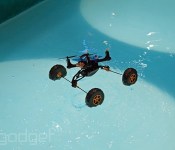
This remote-controlled car moves on land, sea and air

We probably have drones to thank. They’ve helped the price of flying vehicles plummet from the days of gasoline-powered helicopters, but what about water? Or racing on land? For those, you might want to consider Takara Tomy’s newest radio-controlled vehicle, the Earth Rider RC (or the 陸海空RC, “Land Sea Air RC”). At the Tokyo Toy show, we got to see it fly down roughly six feet to neatly land on the water, where its tires keep the car afloat — and those important electronics out of harm. The same propellers that can put it into the air can then glide the RC across the water, like like a pond skater, except for, well, the propellers, wheels and things…
You’ve probably heard of vehicles that transition between areas before, but the appeal here is how it transfers to the air (or water) without any transformation or mode change. It appears that the wheels aren’t powered, but that the force from the quad-copter blades compels it to move it somehow like a car. Also, as it’s a mere 50 grams, the toy company says it will move/fly/float for around five minutes after a 30-minute charge, while the controller itself runs on six AA batteries. This all-in-one RC launches in Japan this October for around $91 (9,250 yen), but there’s no news on whether it’ll make it across to the US — whether it can roll on water or not.
Filed under: Gaming, Transportation
Source: Takara Tomy (Japanese)

France is the first team to benefit from goal-line tech at the World Cup

Well, the above image might look pretty straightforward, but when the shot from France’s Karim Benzema bounced off the far post and deflected off the keeper into goal, in the midst of a World Cup match, there was more than a little confusion. The referee asked for clarification through the newly instituted goal-line technology, which initially (and confusingly) ruled ‘No goal’. However, that was for the initial rebound, not when it bounced off the Honduras keeper and apparently crossed the line. For anyone that considers themselves a soccer fan, see if you would’ve called the goal yourself in the Vine clip after the break — for as long as it remains up. (Even if FIFA isn’t particularly technology friendly when it comes to the beautiful game itself, the association is surprisingly fast to act on copyrighted video uploads. Funny huh?)
Source: Vine

Feedback Loop: Discussing E3, Nintendo, live streaming and more!

This week’s edition of Feedback Loop is packed with gaming goodness. We discuss all the E3 things, analyze Nintendo’s upcoming titles, share the worst games we’ve ever played and find out if watching feeds of other people gaming is any fun. You’ll find all this and more in our fabulous forums after the break.
Share your thoughts on E3!
Sony, Microsoft and Nintendo all announced a slew of new games this week. Whether you’ve got a next-gen console or not, there’s plenty of eye candy for everyone. Head over here and let us know which are the must-haves for your collection.
Breaking down Nintendo’s new games
We love Mario… and Link. There, we said it. And that’s why we loved Nintendo’s announcements at this year’s E3. Open-world Zelda game? Check. Designing your own Super Mario Bros. levels in Mario Maker? Check. Head to the forums to share in our collective joy? Check.
What is the worst game you’ve ever played?
Some people consider the Atari game E.T. to be among the worst video games of all time. With all the E3 news going on this week, playcrazy thought it would be a perfect time to talk about the most awful games that we’ve ever played. Go ahead, tell us yours. Do your worst.
Do you watch live streams of games?
Live streaming is the future, right? Twitch is all over next-gen (at least according to Microsoft and Sony). Kris ponders Nintendo’s streaming aversion and why people enjoy watching other people play games. Which kind of person are you?
That’s all this week! Want to talk about your favorite gadget or have a burning question about technology? Register for an Engadget account today, visit the Engadget forums and start a new discussion!

Airdog drone serves as your loyal action sports cameraman

The battle in the skies this week is the autonomous action-sports drone apparently. Why? Because, what if you want to be the star in your as yet un-made aerial epic? With a regular drone that’s a tricky one. You could film yourself, as you stand flying the drone, but where’s the fun in that? Airdog is a quadcopter drone that follows you, using GPS and movement tracking to keep up as you get down (the slope, or whatever). Action camera selfie videos are cool and all, but wouldn’t an epic aerial shot following you carving through fresh powder snow, or riding that killer wave, or heck, even scuba diving be so much better? Airdog promises exactly that. And more.
The first thing that makes Airdog different is the wrist-mounted controller. You simply tell Airdog when to launch, and it will take off, reach your chosen altitude, and then start following you — and you won’t need your phone, making it a true all-weather set-up. Once you’re done riding, simply tell it to land, and it will. That’s the basic operation, but Airdog’s creators want this to be the action camera drone of choice. As such it will be configured with sport-specific profiles. Imagine you’re surfing, and want to catch you riding that one big wave? The drone’s 10-15 minute battery life might all be spent by the time mother nature serves up the barrel you want. To solve that problem, Airdog can be left on the coast, and when that set finally does roll in, you can trigger it to take off and come find/follow you. Should the battery run low while you’re still in action, it’ll fly itself back to the coast and land again. There will be similarly tailored profiles for other sports.

You might be asking a very good question at this point: what about avoiding obstacles? Airdog’s creator Edgars Rozentals tells us that his team are already working on a solution for that, one that will be available as an upgrade after release. In the meantime, you can either fly where you know the path to be clear, or, use the ability to draw in a route for the drone via the app in advance (literally telling it exactly where to fly). You can even record a route with the app, then fine tune and adjust it later.
The tracking part uses a combination of GPS, accelerometers, gyroscopes and a barometer. If autonomy still makes you nervous though, there is the option to control it with a good old RC transmitter too. As for the camera part, it’s designed to carry a GoPro in its protective housing — something Airdog claims is a first (most carry just the naked camera). There is a gyro stablization gimble included too, which will give smooth footage, and the whole drone folds away for easy transporting. The only catch? It’s launching on Kickstarter so you’d better hope enough of you get onboard to make it happen. If you do, you can bag one for the early-bird price of $995 – $1,195. Retail shoppers can expect to part with $1,500 if and when it hits the shelves (all things going well, in October).
With the drone market-place clearly hotting up, the battle for the skies is on. DJI has been leading the field with ready-to-fly drones so far, but Airdog and other recent entries show that there’s an appetite to take drone videography to the next level. This is exciting for the consumer, but there will always be concerns over what this could mean for public airspace. If you haven’t already, then definitely check out out explainer on the whole topic. What we like about Airdog, though, is the smarts of the software. The custom profiles for each sport suggest that its developers really want to make this adaptable, and useful to a wide variety of pursuits. And the waterproof controller mechanism not only opens it up to the sea/water sports, but a whole host of other applications, too.
Until now, the market was either hobby/kit-based, or expensive bespoke options. DJI has done a lot to democratise the drone with its Phantom range, but that still left only a small choice. Now, with entrants like Pocketdrone, Hexo and of course Airdog, there should be something to fit all use cases and pockets. Rest assured, we’ll be putting them all to the test as and when we can.
Source: Airdog, Kickstarter
 AIVAnet