



Engadget Daily: an interview with Shuhei Yoshida, a social guide to the World Cup and more!

Today, we sit down with Shuhei Yoshida to discuss PlayStation Now, watch SwiftKey lose its price tag, go hands-on with Mario Maker and explore how to keep up with the World Cup on Facebook, Twitter and Google! Read on for Engadget’s news highlights from the last 24 hours.

PlayStation at E3 2014: an interview with Worldwide Studios head Shuhei Yoshida
Today at E3, our own Ben Gilbert sat down with Sony’s Shuhei Yoshida to discuss PlayStation Now. Launching as an open beta later this summer, the game-streaming service is just the beginning of Sony’s initiative to bring PlayStation games to many devices.

SwiftKey’s Android keyboard is now available for free
If you like SwiftKey, but couldn’t pony up $4 for predictive typing, you’re in luck. Thanks to today’s update, the popular Android keyboard app is completely free to download. And don’t worry iPhone users, SwiftKey for iOS 8 is on its way.

A quick guide to following World Cup 2014 on Google, Facebook and Twitter
It’s time to get your game faces on: The World Cup is tomorrow, and most everyone in the world will be watching. Here’s our guide to following every bit of the action on Google, Facebook and Twitter. Let the games begin!

Making your own Mario level is incredibly fun, but difficult to master
Want to build you own level of Super Mario Bros.? It might be a bit harder than you’d think. Read on as Brad Molen goes hands-on with Nintendo’s new game called Mario Maker.
You also might like:

SPACECOM will be 11 bit launchpad’s first published title, due in second half of 2014
 11 bit studios is a well known name in the gaming world, thanks to its best known franchise to date, the Anomaly series that featured its trademark ‘tower offence’ gameplay. Well, the studio is now looking at improving its portfolio and is launching a new publishing label called 11 bit launchpad, and its first published game is going to be SPACECOM, developed by Flow Combine.
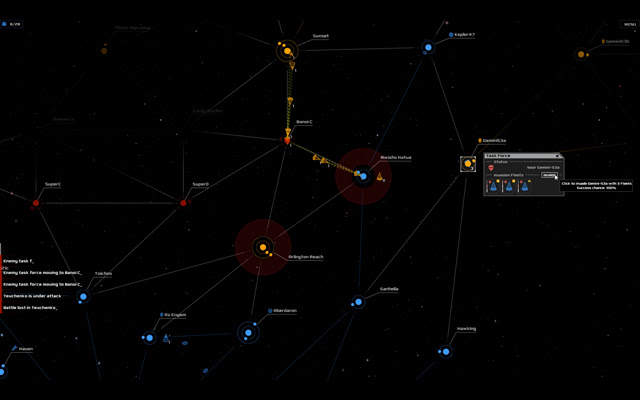
 With the talents of Marek Ziemak (former Gameplay Producer for The Witcher) on board, SPACECOM is an extremely strategic game set in space, one that is going to appeal to hardcore strategists. With up to six players per game, the game emphasizes cunning and having your plan execute to perfection in order to stand a chance at winning. With its minimalistic design, SPACECOM has already garnered plenty of attention on the Steam platform, having been greenlit for development, and will be spreading to other platforms as well, including Windows, Mac, Linux and of course, Mobile sometime in the second half of 2014.
 Who’s interested in playing a hardcore strategy game like SPACECOM? Let us know in the comments if you are.
Press Release
11 bit launchpad Unveils SPACECOM from Flow Combine and Former The Witcher Gameplay Producer, Marek Ziemak
June 6, 2014 – 11 bit launchpad, the new publishing label of 11 bit studios (Anomaly, This War of Mine), announces SPACECOM; a strategic-to-the-bone game of deception and cunning that emphasizes creative tactics over complex mechanics.
SPACECOM pushes your ability to strategize with a focus on real-time tactics and planning – not fast clicking – using a minimalist design inspired by military technology. Use proven maneuvers learned from military legends or devise your own cunning plans, and dominate your enemies in planetary systems with up to six players per campaign.
Spacecom was developed after-hours by Flow Combine and emerged as a prototype that was quickly approved by the Steam Greenlight community. Flow Combine teamed up with 11 bit launchpad in early 2014 and began working with Marek Ziemak to finish Spacecom and bring it to Steam and other digital platforms.
“SPACECOM focuses on the mental elements of hardcore, real-time strategy. It’s not about quick clicking, but rather, devising plans and properly executing them,” said Lead Designer Kuba Stokalski. “I’m happy that we found a partner that can back us financially and with the necessary experience. It’ll enable us to make the most of what SPACECOM is, and what it can be.”
Marek Ziemak (former Gameplay Producer for The Witcher) said, “We were struck by how great SPACECOM works on a strategic level, and we were not surprised that the community quickly greenlit this game on Steam. Now, we’re not so far away from the game being finished and delivered to strategy gamers.”
11 bit launchpad is the new publishing label operated by 11 bit studios. As Senior Producer, Marek Ziemak will lead the production of SPACECOM and other unannounced titles. Flow Combine is home to additional alumni from The Witcher, including Programmer Maciej Czerwonka, Audio Designer Maciej Miasik, and Graphic and Design artist Adam Kozlowski.
SPACECOM will be released on Steam, Games Republic, and other digital distributors in the second half of 2014, and will be available for Windows, Mac, Linux, and Mobile devices.
SPACECOM:
www.spacecom-game.com11 bit launchpad:
http://www.11bitlaunchpad.com/Follow SPACECOM on Twitter at @spacecomgame or on Facebook at: https://www.facebook.com/SpaceComGame
//<![CDATA[
ord = window.ord || Math.floor(Math.random()*1E16);
document.write('’);
//]]>

Court rules collecting cellphone location without a warrant violates the Fourth Amendment

Quartavious Davis was sentenced to nearly 162 years in prison, without the possibility of parole, for a string of armed robberies in the Miami area several years ago. After having his day before the Court of Appeals for the 11th circuit, much of that severe punishment stands. Davis will likely continue his battle to have his conviction overturned or his sentence reduced, but his case has already struck one victory for privacy advocates. The decision handed down by the judges today marks the first time that cell phone location data has been explicitly included as part of a reasonable expectation of privacy under the Fourth Amendment.
Part of the evidence levied against Davis and his accomplices was data from cellular providers showing they had made or received phone calls in the vicinity of the alleged targets around the time the robberies occurred. The problem is, no warrant was issued for this information, instead it was obtained via court order that doesn’t require probable cause, only “that there are reasonable grounds to believe that the … records or other information sought, are relevant and material to an ongoing criminal investigation.”
In short, we hold that cell site location information is within the subscriber’s reasonable expectation of privacy. The obtaining of that data without a warrant is a Fourth Amendment violation.
The court thought that the particular subsection of the law used to obtain the information was not appropriate. As you can see in the quote above, the judges felt that location data is within a reasonable expectation of privacy, because “Davis has not voluntarily disclosed his cell site location information to the provider.” The final verdict, warrantless mining of location data is unconstitutional. Unfortunately for the defendant, even though his constitutional rights were violated, the judges did not believe a “reversible error” had been committed by a previous court. Instead, it let the evidence stand under a “good faith” exception. So, while this may set a strong precedent for future cases, it didn’t help Davis.
Source: The United States Court of Appeals for the 11th Circuit (PDF)

Cheap, tiny robots serve as terrain scouts for expensive ones (video)

Big robots like Cheetah and Big Dog cost a lot to make, so it would be such a shame if they get put out of commission after slipping on, say, a patch of ice. To prevent that from happening, UC Berkeley and ETH Zurich researchers propose sending a team of small, expendable robots ahead of the big, expensive one to scout terrain conditions — in the event that they do get used for real missions, that is. The researchers demonstrated their idea at the IEEE robotics conference in Hong Kong, where they used UC Berkeley’s tiny cardboard robot called VelociRoACH to do recon work for ETH Zurich’s StarlETH.
They loaded the smaller machine with the ability to send back terrain data to the bigger quadruped, which, in turn, is equipped with a camera to monitor its minion’s location. Thanks to this kind of setup, the scout robot can tell the main unit if an area’s too unstable to step on, and the bigger machine can avoid that exact spot. During real missions, that’ll probably mean losing scouts along the way, but that’s the idea anyway: sacrifice cheap robots for the sake of the multi-million creation.
Filed under: Robots
Via: IEEE
Source: US Berkeley

Outlook Web App finally debuts on Android, but only for ‘small’ devices

Been looking forward to a native Outlook Web App for your Android device? You just might have to wait a little longer: the freshly launched OWA Android app is only available on ‘select devices.’ Microsoft says this pre-release version can do everything its iOS counterpart can and automatically update its address book whenever the user makes a chance to their device contacts, but it’s not ready for a full roll-out. Still, if you’re sporting a device with Android 4.4 KitKat and Google’s OS standards categorize your phone as “small” or “normal,” the app’s inaugural releases is yours for the taking. Have something else? Check out OWA’s support page: Microsoft is taking suggestions on what devices to support next.
Filed under: Cellphones, Mobile, Microsoft
Source: Google Play, Office 365
HP’s Machine technology rethinks the basics of computing

We’ve seen bits and pieces of technology that hint at the future of computing, but HP has just taken a big, big step toward bringing them all together. The company has unveiled The Machine (yes, that’s the name), a processing architecture designed to cope with the flood of data from an internet of things. It uses clusters of special-purpose cores, rather than a few generalized cores; photonics link everything instead of slow, energy-hungry copper wires; memristors give it unified memory that’s as fast as RAM yet stores data permanently, like a flash drive.
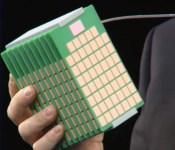
The result is a computer that can handle dramatically larger amounts of data, all the while using much less power. A Machine server could address 160 petabytes of data in 250 nanoseconds; HP says its hardware should be about six times more powerful than an existing server, even as it consume 80 times less energy. Ditching older technology like copper also encourages non-traditional, three-dimensional computing shapes (you’re looking at a concept here), since you’re not bound by the usual distance limits. The Machine shouldn’t just be for data centers and supercomputers, either — it can shrink down to laptops and phones.
To HP, the platform opens the door to large-scale computing concepts that aren’t even possible today, since devices can talk to entire networks to get things done. A doctor could compare your symptoms with that of every other patient on Earth, even while keeping everything private; smart cell towers would be aware of what’s going on across other towers and react accordingly. The shift in thinking is significant enough that HP is writing its own operating system from scratch to handle what’s possible with The Machine. It’s also creating an optimized version of Android, so there is a chance you’ll see Machine-based gadgets in your pocket.
The big obstacle at this point is simply timing. HP won’t even have samples of the necessary memory until 2015, while the first devices using The Machine are expected to ship in 2018. However, the tech firm is also attempting the kind of fundamental shift that the industry hasn’t seen in decades — this is going to take a while as a matter of course.
Filed under: Desktops, Misc, Laptops, HP
Source: HP Next

Getting sweaty with the future of Sony’s virtual reality

The private room, elevated above the crazed throngs of E3 attendees, was dark and oppressively stuffy. Inside, Conan O’Brien lay on a beanbag in front of Sony’s newest virtual reality demo for its Project Morpheus headset: Street Luge. And he was surrounded by two Nintendo booth babes — an awkward collision of rival gaming worlds that wasn’t lost on Sony PR. Conan was finishing up a shoot for a spoof segment on Morpheus and I had to wait for the celebrity fanfare to stop.
I mention Conan not to drop a bold-faced name, but because his interest and involvement in Sony’s Project Morpheus at E3 represents a visible tipping point for VR. The technology is about to go mainstream; it’s very nearly ready for prime time. Soon, non-gamers will be donning VR helmets and exploring simulated worlds. It’s the reason why Facebook purchased Oculus VR for $2 billion and also why movie studios are currently in talks with Sony to create VR experiences. A cultural shift is coming and Sony wants to be right out in front riding that wave. It just won’t be doing that in 2014.
“We’re still just at this point able to say it’s not this year,” said Richard Marks, Sony’s senior director of research and development. “We don’t have quite the number of experiences that we feel would be a good value for people to buy some special hardware for it.” That may be true, but it’s not for a lack of effort on Sony’s part. Marks said that a number of studios, both third-party and internal, are hard at work on titles or demos for Morpheus. So far, though, Sony’s only opted to show demos — the aforementioned Street Luge simulator and Castle — created by its London Studio since “they’ve been working with [Morpheus] the most.”
For E3, Sony made slight tweaks to the Castle demo it debuted alongside Morpheus at the Game Developers Conference earlier this year. Anton Mikhailov, one of the principle engineers working on Morpheus, said slight improvements to the graphics, like antialiasing, were made, along with the inclusion of a new weapon: the mace. Castle is by far the most comfortable Morpheus experience to demo as there’s not much movement required on the player’s part. The experience centers mostly on manipulating and damaging a suit of armor with your hands, a control scheme made possible by a pair of the PlayStation’s Move controllers. It’s impressive stuff, especially when a dragon pops in to tower over and terrify you. I may have even let out a small squeal in excitement when it happened.

But it was Street Luge, Sony’s new racing sim, that really drove home the physical effects Morpheus can have on players. I was sweaty and slightly nauseous when the demo had come to end; an aftereffect I found to be partly thrilling and partly alarming. But first, let me explain how I got to that point.
“We don’t have quite the number of experiences that we feel would be a good value for people to buy some special hardware for it.”
To play Street Luge, I lay down on the very same beanbag that Conan had nestled into earlier and strapped on Morpheus. Steering controls were handled only by the left and right movements of my head and nothing more. I couldn’t stop or slow my luge as it plummeted down a road through winding cliffs and tunnels and straight into oncoming traffic. And all of it was fine, really, thanks to improvements made to Morpheus’ tracking. The speed was brisk enough so that I could admire the fleeting scenery, but not quite fast enough to make me want to break contact with the virtual world. That is, until I hit a steep downhill drop that caused my stomach to lurch and that indescribable butterfly nausea to creep into my chest. It was exactly as exhilarating as plunging down an actual hill in a car or on a roller coaster, except this was VR; this wasn’t real. But as Mikhailov pointed out, it was definitely done on purpose.
Mikhailov elaborated on that particular element of the demo, saying that its inclusion and the resulting discomfort was intentional. The Morpheus team is using these E3 demos as a sort of real-world lab and the press and general public attendees as guinea pigs. Mikhailov’s aware that this kind of visceral experience could diminish over repeated playtime, especially as gamers become acclimated to VR. But what he’s most interested in is whether or not gamers want that nervous sensation to stick around with each playthrough. Does VR become less real when we can no longer physically feel it? That’s the question Mikhailov is seeking to answer with Street Luge — the question of standards. It’s something Sony plans to address not only as a cooperative effort with other VR firms, but also for its own Morpheus gaming platform.

Street Luge doesn’t require any physical controller, just the headset and PlayStation Camera. Which makes it the exact type of VR experience Sony wants to lead with when it eventually launches a consumer model of Morpheus. As Marks explained, “Actually, Street Luge is great because you just put [the headset] on and there’s no controller or anything … I don’t think it’ll be that complicated for those first experiences. But then when you really want to get fully immersed and do things with the controller, Move or two Moves — that probably won’t be the first thing you try. But Street Luge is actually a great one to be first.”
The speed was brisk enough so that I could admire the fleeting scenery, but not quite fast enough to make me want to break contact with the virtual world. That is, until I hit a steep downhill drop that caused my stomach to lurch.
The Morpheus of today likely won’t resemble the Morpheus that launches at retail. Marks said Sony’s consumer electronics division is working to refine its design and form factor for better ergonomics and weight. It’ll even ship with “very short headphones” packed in the box, although Sony wants gamers to have the option to use the headset of their choice. But one thing that’s sure to remain consistent from now until the release of the first consumer model is its wired connection. “Wireless is challenging,” Marks said. “There’s a lot of data. All of the visual data that’s being transmitted to the displays — sending that wirelessly is challenging. It’s something we’re looking at, but it’s a very tricky engineering problem.”
As for hands-free gesture input, Marks said that it’s something his team is “looking at for the long-term future,” but that teaching a gesture language presents problems for ease of use. But there’s also another issue holding up development on that end: the PlayStation Camera. “It has the ability to create a depth map and then analyze the depth map,” he said, adding that, “It’s tricky to do that at the same time as you’re tracking the colored lights because we have specialized exposure settings and things in the camera to match the lights. And so then the rest of the image gets a little bit dark.” Because of that, the Move controllers are Sony’s preferable input choice.

Right now, there’s no magic bullet for Morpheus or VR in general. “No one’s really found the killer genre yet,” said Jeff Stafford, Sony’s other lead engineer working on Morpheus. “It’s too early. There’s not enough development yet.” To that end, Stafford explained that Sony is encouraging developers to “go crazy and explore all different things” and not restricting dev time to any particular genre.
One genre that Sony is actively avoiding for Morpheus game development, though, is the first-person shooter. Stafford elaborated: “Everyone assumes the most natural genre is the first-person shooter. Actually, we find that first-person shooter, because of the TV screen and the way that they’ve evolved; you’re running around at very unnatural speeds — that’s not so great for VR.”
“No one’s really found the killer genre yet. It’s too early. There’s not enough development yet.”
Genres for VR may, mostly, be wide open for studios to experiment with, but that also goes hand in hand with the amount of time gamers spend immersed in VR. None of the current Morpheus demos extend beyond five minutes, but that’s not because Sony thinks extended sessions are harmful to gamers. In fact, Stafford, who spends countless hours hooked up to Morpheus each day, said that he “could see people playing in VR for maybe two hours” at a time, realistically.

Though Sony acknowledges Morpheus will eventually branch out beyond gaming, for now its efforts are focused squarely on the PlayStation 4. Marks said this is because the PS4 is a known quantity for developers and consumers, and also because of its rapidly growing install base. “We have a known box, which has very known graphical capabilities … We have known controllers … So that’s our focus; to have this really known experience that we can share with people. And it could be shared across all those millions of PlayStation 4s.”
Sony also has one other focus for Morpheus, or whatever it ends up calling the headset when it’s released, and that’s on approachability and ease of use. It’s the key to making VR a mainstream product and a profit driver for the company. As Marks explained, Sony’s vision for the consumer model is simple: “[You] just basically hook it up, plug it in, put it on and you’re able to get into VR. We really want to make it this an easy experience for people.”

Apple Targeted by EU Probe into Irish Tax Policies as U.S. Considers Tax Holiday for Cash Repatriation
 The European Commission today launched a formal investigation into Apple’s tax arrangements in Ireland, seeking to determine whether the company’s tax deals in the country are considered illegal state aid. The Commission is also investigating Starbucks and Fiat Finance & Trade SA.
“Special secret deals should be outlawed across the EU,” Chas Roy-Chowdhury, head of taxation at the Association of Chartered Certified Accountants, said in an e-mailed statement. “All tax breaks and reliefs should be openly available for qualifying businesses.”
Apple’s tax policies have been under scrutiny in recent years, as it utilizes multiple subsidiary companies headquartered in the Irish city of Cork to move money around the world without significant tax penalties because companies managed and controlled abroad but located in Ireland are not subject to taxes. Last year, Apple’s arrangements earned it a tax rate of 3.7 percent on non-U.S. income.
Apple has maintained that its tax policies are entirely legal, a position it echoed today in a statement to Bloomberg. An SEC investigation also found Apple’s tax policies to be legal.
“Apple pays every euro of every tax that we owe,” the company said in an e-mailed statement. “We have received no selective treatment from Irish officials. Apple is subject to the same tax laws as scores of other international companies doing business in Ireland.”
As the European Commission begins its investigation, the U.S. Senate is considering a one-time tax break to repatriate cash held overseas. Back in 2013, Apple CEO Tim Cook defended Apple’s tax practices and responded to accusations of “extensive tax-avoidance strategies” with a call for tax reform, asking for simplified corporate tax policies and lower rates for repatriation.
Apple holds more than $100 billion in cash overseas and at current tax rates, it would have to pay a 35 percent corporate income tax to bring the money back to the United States, “a very high number,” as Cook has said.
If a tax holiday is granted, the rate could be much lower. A repatriation holiday in 2004 allowed companies to bring cash to the U.S. at a rate of 5.25 percent, which could cut Apple’s tax bill down significantly if it brought money back from overseas.
Note: Due to the political nature of the discussion regarding this topic, the discussion thread is located in our Politics, Religion, Social Issues forum. All forum members and site visitors are welcome to read and follow the thread, but posting is limited to forum members with at least 100 posts.

Apple Seeds OS X Mavericks 10.9.4 Build 13E16 to Developers [Mac Blog]
 Apple today seeded build of OS X 10.9.4 to developers, approximately two weeks after releasing the first OS X 10.9.4 beta and almost a month after the public release of OS X 10.9.3, which included enhanced support for 4K displays and syncing improvements.
The beta is available through the Software Update mechanism in the Mac App Store as well as through the Mac Dev Center.
It remains unclear what improvements the 10.9.4 update will bring to Mavericks, but it is likely to include bug fixes and stability enhancements. Apple is asking developers to focus on Graphics Drivers, Bluetooth, Audio Drivers, Finder, App Store, and Safari.
Apple has also seeded Safari 6.1.5 and OS X Server 3.2 to developers.

HTC One (E8) hands-on

HTC’s betting big on its recently unveiled E8 by pricing it almost half as much as the similarly-specced M8 in China, so naturally, we had to check it out for the sake of curiosity. To our surprise, the plastic body was quite solid — more so than the Desire 816 — and felt good thanks to the ergonomic curves on the back. The design also looked better in real life than in the official renders, though only time will tell how scratch-proof that glossy body is. Slower camera and lack of TV remote feature aside, the E8 is easily a steal given the near-identical guts as the M8 (Snapdragon 801, 5-inch 1080p screen, microSD expansion and more) plus the reassuring build quality; and there’s even a hilariously large limited edition packaging that doubles as a mood light — check it out in our video after the break.
 AIVAnet