



Powerbeats2 are Beats by Dre’s first wireless earbuds

There may have been some big changes at Beats recently, but it’s still all about the headphones. The newest addition to the (ever growing) family is the Powerbeats². As the name suggests, they are a revision of the original sport-friendly buds from Beats, but this time they’re wireless — Beats’ first in-ears to cut the cord. The Powerbeats² keep the (albeit modified) hook-over-the-ear design, but liberate heads from handsets via Bluetooth 4.0. Beats says you’ll get six hours of playback from a full charge, but should they be low on juice when you fish them out of your kit bag, the company claims a 15 minute pre-gym charge will see you good for a one-hour workout. If keeping up with LeBron (who “inspired” the Powerbeats²) makes you work up a bit of a sweat, then their IPX4 water resistance should keep them in good condition.
The Powerbeats² come with one vital feature that anyone who’s used Bluetooth headphones for any amount of time will know is essential. They have an LED that tells you when power is low. There’s nothing more disheartening than having the music fade on you barely minutes in to your workout. In fact, the Powerbeats² tells you when it thinks there’s less than an hour of playtime to go, and ramps this warning up when battery life could be below 15 minutes.
We had a pair of the Powerbeats² land in the Engadget office this morning, so had a real quick chance to check them out. An accusation often levelled at Beats headphones is that they are too heavy on the bass. The first thing I noticed about the Powerbeats² is actually how prominent they are on the mid-highs, perhaps a little too prominent — if you have the volume jacked right up like I did. Set at a more reasonable level though, while listening to electronic music, I noticed synth stabs and vocals in particular seemed to cut through a lot more than the low end frequencies, and this is music with a lot of low end. This was a trend we found with the new Solo² on-ears, too. So one thing’s for sure, Beats is clearly working to move on from the bass-is-best approach of earlier models.

If you’ve never used earbuds with fastening hooks before, you might be concerned that you don’t get the fit that you may be used to with regular in-ears. It’s a legitimate worry that the hooks might prevent the buds from sitting tight in your ear, and thus not giving the full “lock” that they need to provide the best audio experience. The Powerbeats² thankfully has adjustable, bendable sections within the part that goes over your ear. This means you can set them up just right for your particular lug-holes, and get the sound piped in without that dreaded “loose” feeling.
Despite being “wireless,” there is a cable running between the two buds. This sits comfortably on the back of the neck and even has a widget to let you adjust the amount of slack. It also keep the Powerbeats² from ever parting company with each other of course. The lack of long cable does mean that the remote/control buttons sit quite high up by your left ear, but that’s something you will probably get used to with regular use. It’s certainly a small trade-off if you’re not a fan of wingtips like Beats’ Tour model, or Jaybird’s BlueBuds. You might also be wondering if there’s support for aptX, we were told there isn’t, which is a real shame given the asking price (below).
The Powerbeats² launch in Beats’ signature colors — red, white and black — but cost $199, (whichever hue you go for) when they launch later this month.

Google reportedly wants in on Virgin Galactic’s space business

Fresh from its $500 million acquisition of satellite imaging specialist Skybox, Google appears to be ready to make another space-related investment. Sky News reports that the search giant is in advanced talks to take a minority stake in Richard Branson’s Virgin Galactic business with a view to getting its internet satellite project off the ground. Google may invest around $30 million into the company, which is set to begin commercial flights to space later this year, forming a joint venture that would see Virgin Galactic offer up its technology in return. Reports suggest Larry Page and co. are already preparing to build 180 small satellites that will be placed into a low orbit to provide internet connections to remote areas of the globe. That, coupled with the acquisition of drone maker Titan Aerospace, suggests Google is steadily moving forward with its space project. Virgin Galactic could provide the thrust, so-to-speak, helping get Google’s satellites exactly where they need to be.
Filed under: Transportation, Google
Source: Sky News

Console OS will let you run Android on a Windows PC or tablet

Toggling between Windows and Android on a single device? That sounds desirable enough maybe, especially the way Intel describes it, but the quest for a practical mixture of green and blue has had its hiccups. (And that’s putting it mildly.) A new project has just arrived on Kickstarter, however, which takes a slightly different tack. It’s called Console OS, and it’s based on the premise that easy-to-use dual OS’s don’t need to be baked in at the factory. Currently under development by the same people who brought us the similarly-themed iConsole.tv, this fork of Android 4.4 is designed to run as either a secondary or standalone OS. It claims to be equally at home in touch-based or mouse n’ keyboard environments, with compatibility promised for a bunch of recent devices (including Dell’s Venue 8 Pro, Lenovo’s Miix 2 and Intel’s NUC). What’s more, since Console OS runs natively on Intel’s x86 architecture, it also promises better performance than any virtualized or emulated solution.
None of this is especially easy to swallow without hard evidence, of course. Mainstream Android devs barely pay much attention to Intel’s chips, let alone to niche Android forks, so the performance and stability of Android apps and games remains to be seen. A significant time delay in switching between OS’s could also be an issue, even though Console OS is supposed to keep the wait down to just 10 seconds. In any case, the risks of investing in this project aren’t huge: a $10 contribution will get you a copy of the Pro version of the software, which allows unlimited windowed Android apps (running inside the Console OS interface, not Windows), faster OS switching and free upgrades for life. Paying more will buy you a greater say over which devices will be supported when the finished article arrives in December. Check out the Kickstarter page for more.
Filed under: Desktops, Laptops, Tablets, Software, Intel
Source: Kickstarter

The LG G3 is so hot: LG shows the best way to advertise 4K video is in an active Volcano
 There is some pretty elaborate advertising out there these days, but this one definitely takes the cake for being the most breathtaking in recent memory. The ad was put together as part of the LG G3 4K Active Volcano Photo Shot Project, which follows the journey of photographer Jung-won Park and his life-long dream to photograph the heart of an active volcano. As part of the project, Jung-won visited Ambrym Island, took in all the local culture as well as all the sights before making his ascent to the volcano, taking pictures with his LG G3 all the while. Check out the full 5 minute ad below:
It’s a fascinating journey, and surprisingly a really good way for LG to showcase the wonderful OIS+ enhanced camera on the LG G3; whether the pictures featured in the video are actually from the LG G3 is entirely up for debate though. And even if it was a pretty expensive and extreme way of advertising the LG G3, you can’t argue with the results: a 4K video of the bubbling surface of an active volcano. If only YouTube supported 4K videos…
What do you think about Jung-won Park’s journey into a volcano with a LG G3? Let us know your thoughts on the ad in the comments.
Source: YouTube
//<![CDATA[
ord = window.ord || Math.floor(Math.random()*1E16);
document.write('’);
//]]>

Yet more candid photos of the Samsung Galaxy F show it side-by-side with the Galaxy S5
 Leaks regarding the Samsung Galaxy F, or previously known as the Samsung Galaxy S5 Prime, have significantly ramped up over the last few weeks, culminating most recently in some candid photos of the device showing its front and back. The latest leak places the Galaxy F side-by-side with the Galaxy S5 to give us a good comparison of how the devices differ. The Galaxy F is of course the device on the left, having a slightly larger screen (5.2 or 5.3-inches) and slightly more rounded corners than the Galaxy S5.
You will also notice that despite the larger, Quad HD screen, the Galaxy F actually manages to be slightly smaller than the Galaxy S5 thanks to thinner bezels. While the Galaxy F still isn’t a sure thing, this is definitely our best evidence that Samsung is developing a Quad HD device that will come in at a price point higher than the Galaxy S5. Not only with the screen and price be larger, but so will its hardware, allegedly housing a Snapdragon 805, 3GB RAM and a 16MP rear camera with OIS. Evleaks has previously suggested that the Galaxy F will be announced in September even though it almost looks ready to release now.
What do you think about how the Samsung Galaxy F looks side-by-side with the Galaxy S5? Let us know your opinion in the comments below.
Source: Phone Arena
//<![CDATA[
ord = window.ord || Math.floor(Math.random()*1E16);
document.write('’);
//]]>
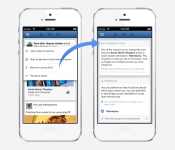
Facebook will allow users to alter their ad profiles; track your smartphone usage

Have you ever wondered why Facebook just showed you an advertisement for Star Trek toys or some other random item? Well apparently you will soon be able to find out.
Facebook is planning to announce Thursday that it will allow users to see the likes and interests it keeps on them. Not only will Facebook allow users to see it, but users will also have the ability to keep, change, or add information into those files. A nice feature that Facebook is including is if you do not like specific ads you are seeing, you will have the opportunity to tell Facebook what type of marketing messages you would rather see.
In a way, as the New York Times points out, this is actually pretty smart business for Facebook. Online advertisements are all about being directed towards your target audience. What is a better way to directly collect information to advertise to potential customers than to have them tell you what they do or do not want to see.
Facebook’s motives may be a preventive measure seeing how the Federal Trade Commission and the White House have recently called on Congress to pass legislation to protect consumers’ private data. Add that to increasing privacy concerns that companies like Google are seeing in Europe and you could see why Facebook is attempting to stay one step ahead of growing regulation.
At the current time, Facebook only uses information that it gets from interactions on Facebook, like by clicking “Like” on the AndroidGuys Facebook page (yes, that was a hint). That is changing though as the new abilities will bring about new tracking as Facebook hopes to improve it’s targeting by tapping into the data it collects from people’s smartphones and websites they visit.
Users can opt out of the extensive tracking by visiting a special ad industry website and by adjusting their mobile device settings to do so.
While other big Internet companies like Google and Yahoo let users see, change, or block some of the dossiers that they use to deliver ads, Facebook will be the first major Internet company to show how they connect the dots from your likes and interests to the ad displayed on the screen. You can do this by clicking the tiny arrow on the top right corner of any ad you see in the Facebook network.
The question remains, now that Facebook is opening the doors so you can see what is stored and how they relate that information to you personally, how does this make the you feel about the data that is being stored about you? It is probably fair to say that Facebook knows more about you than your closest friend or loved one.
Source: New York Times
The post Facebook will allow users to alter their ad profiles; track your smartphone usage appeared first on AndroidGuys.

U.S. Cellular adds ZTE Grand S Pro

U.S. Cellular and ZTE on Thursday announced the immediate availability of the Grand S Pro. Featuring a 5-inch 720p display and 13-megapixel rear camera, the smartphone is powered by a quad-core 2.3GHz Qualcomm Snapdragon processor with 2GB RAM. The handset is equipped with support for U.S. Cellular’s 4G LTE network and also offers 8GB internal storage (with microSD), Bluetooth 4.0, NFC, MHL, and a 2300mAh battery.
The ZTE Grand S Pro can be purchased for $99 with a two-year service agreement on a variety of U.S. Cellular rate plans.
The post U.S. Cellular adds ZTE Grand S Pro appeared first on AndroidGuys.

How Tim Jenison created ‘Tim’s Vermeer’

Tim Jenison may have been behind Video Toaster and LightWave, but he’ll probably be remembered as the man who proved that Vermeer used technology to help him paint. In a lengthy piece over at BoingBoing, the inventor reveals the techniques that went into recreating the camera lucida used to paint Tim’s Vermeer, as documented in the film of the same name. In addition to building an exact replica of the room depicted in The Music Lesson, Jenison wanted to only use hardware that the Dutch master himself could have used — which led him to mill his own glass lenses, which he polished by hand. Oh, and did we mention that the film is now available to buy on Blu-ray? Because it is.
[Image credit: Tim Jenison / BoingBoing]
Filed under: Misc
Via: This is Colossal
Source: BoingBoing

Microsoft expands its pledge not to sell ads against your private data

Microsoft constantly reminds us that Google scans email in order to sell ads. Now it’s adapting its policies to specifically state that it won’t engage in the same practices as its rival. Well, not all of them. In an effort to be more transparent and build trust, the company has updated its service agreement and privacy policy to make it clear that it will not access your content to sell ads. “We do not use what you say in email, chat, video calls, or voicemail to target advertising to you,” Microsoft notes. “Nor do we use your documents, photos, or other personal files to target advertising to you.” However, the policy, which covers most of Microsoft’s online services, including Bing, Outlook and OneDrive, won’t come into effect until July 31st. To be clear, however, Microsoft isn’t ignoring your data completely, and there are still a few clauses to be aware of.
While Microsoft says it won’t access your content to sell you ads, it does state that it will collect data from your account. The company says this content includes “your communications and your files,” which ranges from words in an email or documents stored on OneDrive. It’s a muddy area, but Microsoft says it does so in order to gain an insight into how you use its services. Remember when Microsoft came under fire for rifling through someone’s Hotmail account without permission? The company vowed to go through a more stringent process in future cases and has updated its policy to reflect that change. Instead of inspecting content on its own, it will now refer suspicious activity to law enforcement. All of the changes have been made available before the July 31st deadline so you can run through the new terms with a fine-toothed comb. If you want to opt out, Microsoft will kindly show you the door — you’ll need to either stop using its services or close your account.
Filed under: Internet, Microsoft
Via: Neowin

Helicopter drones are ready to drop driverless vehicles into danger zones

Helicopter drones and driverless cars have been doing their thing for a while now, but having the two work together in unison is not a simple task. Not to be put off by a challenge, researchers at Carnegie Mellon’s National Robotics Engineering Center (NREC) have teamed up with US military aircraft supplier Sikorsky to go much bigger and use the technology to help survey areas that are hazardous to humans. It’s part of an 18-month study that will see Sikorsky will supply an auto-piloted Black Hawk helicopter capable of carrying an NREC-supplied unmanned ground vehicle (UGV) to a test site in its sling. Once at the chosen area, it will drop of the UGV and head back to base, while the vehicle uses its on-board sensors to check for potential biological, nuclear or chemical contamination. Not only does it have huge military applications, law enforcement agencies could also utilize the technology, keeping soldiers and officers away from potential danger. It’s maybe something you’d expect to see in an real-time strategy war game, but Sikorsky is betting big on automated flight technology. It wants its pilotless aircraft to handle the duty of carrying soldiers to the battlefield and make supply drops during operations.
Filed under: Transportation
Via: Venturebeat
 AIVAnet