



How would you change Intel’s Next Unit of Computing?

What is Intel’s Next Unit of Computing? It’s far too bulky to be an Intel-hewn alternative to the Raspberry Pi or Arduino, nor is it powerful enough to be designed to replace a low-powered desktop. Sitting awkwardly between the two, we imagine that plenty of you bought one of these for curiosity’s sake, but have you used it? What projects did it fit into, and how easy was it to use? Share your experiences of this over at our forums, you never know, some Intel engineers might even be listening.
Source: Engadget Product Forums

Feedback Loop: must-play video games, Netflix woes and more

June is here! Let’s get this summer started with a fresh edition of Feedback Loop. Kris finds a list of video games we must play before we die; Netflix tries to shame ISPs; Tetris hits the big three-zero and we discuss whether everything announced at WWDC was innovative enough. All that and more past the break!
Must-play video games
Quick, think of a classic video game that someone needs to play at some point in their life. You probably thought of something like Super Mario Bros., Pac-Man or even Tetris. Kris recently found a fun book that listed 1,001 Video Games You Must Play Before You Die. There are some classics in there, as well as more obscure stuff. She went through the list and found she’s played 120 of them. Head over to the forums to take a gander and then share how many of the games you’ve played.
Netflix streaming woes
Net neutrality is a complex subject and sometimes it’s hard to know which side we should be rooting for. Earlier this year, Netflix signed a deal with Comcast to get more bandwidth. This week, Netflix is publicly shaming Verizon. It’s getting messy out there! Have you seen a message from Netflix pinning poorly streamed videos on your ISP?
‘Tetris’ turns 30!
Speaking of classic games, Tetris hit a crazy milestone as it celebrated its 30th birthday! Have we been meticulously organizing falling blocks that long? John talks about his earliest Tetris memories. I remember sitting in the back of class playing Tetris on my TI-82. What are yours?
Thoughts on WWDC
On Monday, Apple kicked off its World Wide Developers Conference by showing off iOS 8 and OS X Yosemite. We discussed some of the newly announced features and talked about whether or not they were interesting, innovative or uninspiring. What did you think of the announcements?
That’s all this week! Do you want to talk about your favorite gadget or have a burning question about technology? Register for an Engadget account today, visit the Engadget forums and start a new discussion!
Poet explains why he spammed Twitter with every word in the English language
zealots
– everyword (@everyword) June 2, 2014
Approximately 109,150 tweets. Spread across seven years. Posted automatically by a bot which, each time, simply grabbed a single word from an already published (and inevitably outdated) canon of the English language and threw it out onto the social network. The bot was the brainchild of a poet, Adam Parrish (aka @everyword), whose original intention was simply to the “satirize the brevity of Twitter,” but who gradually came to see the project as a “magical writing experiment.” He learned, for example, that his 95,000 followers had a penchant for words that felt like they told a story, even when they weren’t expressed as part of sentence: words like “sex,” “weed” and “vagina,” which each got around 2,000 retweets. If you read The Guardian‘s interview with @everyword, you’ll see that his other big discovery was about how people imputed meanings to words that were entirely personal or based purely on coincidences in their Twitter feeds — like how a tweet of the word “zealots” apparently became tangled up in the chatter of Apple fans in the midst of WWDC.
Via: Techmeme
Source: The Guardian

Your smart TV can be hacked over the air, but it’s not likely

It only makes sense that putting a TV online theoretically exposes it to hackers, but it’s now clear that those hacks don’t have to go through conventional internet pipelines. A team of Columbia University researchers has published details of a vulnerability in an interactive TV standard (HbbTV) that lets evildoers hijack your smart TV and other devices in your home network so long as you tune into a specific over-the-air digital channel. Attacks can run undetected in the background, and the nature of the broadcasts makes it difficult or impossible to trace the culprit. Reportedly, the only surefire remedies are to cut off broadcast-based web content altogether, monitor for unusual spikes in network activity or notify users when apps launch.
However, you shouldn’t fret about someone stealing your data just because you tuned into the Home Shopping Network. If you only watch shows over cable or satellite, this issue won’t affect you; as it stands, HbbTV hasn’t yet reached North America. It’s also difficult for would-be hackers to reach many people without signal amplifiers. Still, the security hole isn’t going to be very comforting to cord cutters who still want the benefits of an internet-connected TV set.
Filed under: Home Entertainment, HD
Via: Forbes
Source: Yossi Oren
What it’s like to drive a Tesla Model S in the UK

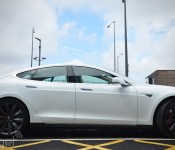
In a nutshell: more fun and more practical than you might expect, despite the high upfront cost. The right-hand drive model of the Tesla Model S has just arrived in the UK and it instantly transforms the story of electric cars in this country. Instead of being a glossy, distant, sometimes Hollywood-ised drama taking place along the West Coast of America, I find myself looking at a sleek, relatively unostentatious saloon parked up in the grey drizzle of Canning Town, East London. And I’m holding the keys.

I mess about with the pop-out doorhandles; I take photos of the double helping of front-and-back boot space; then I quickly slump into the driver’s seat before anyone asks to see the license that I forgot to bring to the test drive.
There’s a huge amount of technology in this £98K ultra-spec version, which costs twice as much as the lower-performance base model. It’s dizzying at first: a primary split-screen LCD panel in the centre of the dashboard, with a smaller section at the bottom for climate and car controls, plus another LCD dash behind the wheel that replicates some of the same information from the main unit. This includes a small-screen view of the GPS, which you can just about make out through the gap in the steering wheel.

It’s a lot to take in, so better to ignore it, at least for now. I push (or rather “click”) out of neutral using an implement that would, in a normal British car, have triggered the windscreen wipers. Then I pull out of the parking slot, keen to get out onto the stilted sequence of bus lanes and CCTV cameras that is otherwise known as a London public highway.
The hi-vis men at the gate have their backs to me and don’t hear me coming, even when my front bumper is almost nudging against their heels. Window down: “Hello gents, would you mind?” Startled, they clear the way and I press the metal for the first time.
Woah! I find myself apologising to the Tesla representative sitting next to me. “Sorry, I didn’t realise it’d be quite so…”

In a fossil fuel car, even a sporty one, it can take a couple of explosions from the transmission before you really feel the horsepower. And by then you’re half-way to the local magistrate’s court. It’s different with the Model S: The accelerative high is legal, clean and delivered in an instant-action pill with no side effects, regardless of how fast or slow you were travelling before you swallowed it.
A silent punch of g-force, then you simply level out when you hit the speed limit and act as if nothing naughty just happened. Once you’ve completed overtaking, or joined the A-road, all you can hear is tyre noise and your own breathing. It’s like abruptly losing your wanted level in Grand Theft Auto.

Aside from the acceleration, the car feels familiar and European. It’s a matter of minutes before I’m dangling my elbow out of the window and enjoying a sight-seeing tour of the postmillennial architecture around the A13. I’m told that Britain is over-represented on the team of engineers that designed this vehicle, and I can believe it.
The dash is starting to make sense by now. The upper panel has six different screens to choose from, ranging from media to the Bluetooth phone interface. The lower panel is showing a large view of the map. But then the Tesla rep switches this to a view of the car controls and finally merges the two panels into one big one. A paradise of customization.
I experiment with the “Sport” mode, which toughens up the steering, while the “Comfort” mode makes everything light and easy. The “Creep” mode mimics the gentle tug of a regular engine when you touch biting point at the traffic lights. Speed bumps feel fine with suspension on “Standard” — or at least no worse than you’d expect given the big alloys. Meanwhile, switching the regenerative braking mode from “Standard” to “Reduced” hardly feels any different — just a tad more deceleration when you lift off the power — so I keep it as it is and enjoy the feeling of creating energy instead of consuming it.
Based on five miles of driving, which was broadly representative of the stopping and starting in London, my average projected range is 316 miles on a charge. That’s a figure I only ever see on the dash of my Audi after spending £60 at the petrol station, snacks not included. With a Tesla S, an overnight charge from the mains probably costs less than a fiver (rough guess). Or it’s free for life from your nearest Supercharger. I’d probably only need to re-charge once every couple of weeks, as I’m told the car holds its energy very well when it’s parked up overnight, unlike Tesla’s old Roadster.

But then you have to think about the purchase price: £98k for the top-spec luxury model, £70k for the luxury model without extras, and £50k for the entry-level option. Even Tesla’s CEO, Elon Musk, admits that’s “more expensive than we’d like.” When I meet him, I think he looks a bit like a car salesman. I suppose that’s what he is, at this precise moment, but he also has the confident demeanour of a man who has amply proved his point. A man who has lapped Ford.
I ask him how long it’ll be before I can afford one of his cars, given that I could only stretch to £15,000 if I sell my Audi and push my credit to the max. “Three years from now,” he says. “Our third generation will cost £25,000, and when you factor in the free fuel and tax savings, your budget should cover it.”

I’m convinced he’s right. In three years I’ll be driving an EV of some sort. Many of us will. Musk is a man who delivers; and he’ll deliver a Tesla S to your house within four months if you place an order in the UK today. By which point, he says, you’ll be able to traverse the entirety of “southern England” thanks to the rapidly expanding network of Superchargers along major corridors.
For now though, I’m still in Canning Town, enjoying a taste of my future and someone else’s present. About to use my wife’s Travelcard to get home. Gotta love the Jubilee line.
Filed under: Transportation
 AIVAnet