


Tesla will open up its Supercharger patents to boost electric car adoption

Tesla’s CEO has been carefully dropping hints that he might “do something controversial” with his company’s collection of technology patents, and now we know what he’s on about. Speaking at the UK launch of the Tesla Model S yesterday, Elon Musk said that he specifically wants to open up the designs for his Supercharger system in order to create a standard technical specification that other electric car makers can adopt. As part of this, it’s possible that Tesla might need to give away some intellectual property about components within the cars themselves, but the general idea ties in with a commitment Musk made a while ago about not wanting Superchargers to become a “walled garden.” Besides, it makes a lot of sense — especially when you imagine what it’d be like today if we had to put up with manufacturer-specific gas stations.
Then again, Superchargers are more than just fancy plug-in points: they’re also a business model in which electricity is given away “free for life” for Model S owners, with all costs factored into the upfront price of the car. Musk is very clear that other EV makers would have to subscribe to this same business model if they want to partner up. They’d also have to contribute a “fair” proportion to the maintenance and running costs of the ever-expanding Supercharger network itself — costs which he insists aren’t very onerous, especially since the physical locations are often given to Tesla rent-free, and in some cases they’re powered by solar panels. Rival companies might turn their noses up, of course, and in fact they’re already battling over alternative charging standards, but it’s clear that the offer is there if they want it.
Filed under: Transportation

Motorola doubles the Moto X’s storage and lets you try one for a penny

Motorola has just released a 64GB version of its customizable Moto X handset, and is extra keen to get one in your hands. It just launched a promotion that will allow you to put a nominal $.01 deposit down on that or any Moto X model, and customize it using Moto Maker. It’ll then ship it out, and once you’ve had a look you can either pay for it (the new 64GB version is $450) or send it back, with no hard feelings or strings attached. The cynical among us may say that it’s anxious to unload stock as a result of its acquisition by Lenovo and the resulting Texas plant closure, though Motorola says otherwise. Either way, it seems sure that you won’t be able to resist a Moto X of your own design once it’s in your hands. We don’t disagree — but for that price, we’re also tempted by other options.
Filed under: Cellphones, Mobile
Via: Slashgear
Source: Motorola
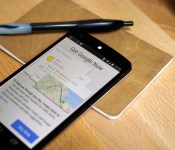
Google Now is going to make sure you don’t miss your exit, ever again

Google Now keeps on getting some nifty features that will make your life easier. The service recently got offline sync and notifications for Chrome users. This time around we have a smaller but an interesting addition to Google Now.
If you’ve ever missed your stop while riding on a train for example and ended up miles and miles away from your destination, this Google Now feature might help you in the future. Google Now will ask you if you need an alarm to let you know you’re close to a certain stop while you’re travelling via train or a bus. Interesting enough, this feature does not connect to your smartphone’s alarm functions.

This might be an interesting feature for some and quite useless for others, but it’s here. Are you going to use it? If you’re interested poking deeper in Google Now, check out our big list of Google Now commands.
VIA: PhoneArena

The post Google Now is going to make sure you don’t miss your exit, ever again appeared first on AndroidGuys.

EE could soon ditch Carphone Warehouse and Phones4U

A strategic shift by the UK’s largest mobile operator could leave a nasty taste in the mouths of Carphone Warehouse and its new partner Dixons. The Telegraph reports that just weeks after the two UK retailers confirmed plans to merge in a £3.6 billion deal, EE is deciding whether to end its relationship with Carphone Warehouse, and possibly Phones4U, as it looks to work more closely with customers. EE is expected to make an announcement “within weeks,” and could involve dropping either one of its partners, or both. If EE was to sever ties with newly-formed Dixons Carphone, it would lose direct sales from over a thousand high-street stores, which puts more pressure on its own stores to pick up the slack. However, it already counts more than 30 million customers, has a one-third share of the UK market and recently announced plans to boost its retail presence across Britain. Carphone Warehouse has prided itself on being the best place to independently compare deals, but with Three already flying solo and EE set to follow, it could seriously undermine the retailer’s claims.
Source: Telegraph

Microsoft now selling Kinectless Xbox One for $400

One way Microsoft can stimulate Xbox One sales is to drop the price to match its better-selling rival, the PlayStation 4. After it confirmed exactly that by announcing a Kinectless Xbox One last month, the company has now opened sales — hours before E3 2014 kicks off. You can pick one up for $399.99/£349.99 via Microsoft’s online store, which lets you concentrate on gaming instead of repeating that frustrating “Xbox on” command. If you decide later that you do want the sensor-packed accessory, a standalone version will be available this fall. Microsoft will also continue to sell the “premium” bundle with Kinect. Today’s launch is meant to be about gamers that “just like to play games with a controller in their hand,” because, you know, everyone else totally wanted a Kinect to begin with.
Filed under: Gaming, HD, Microsoft
Via: The Next Web
Source: Microsoft Store (US), (UK)

Lack of Maps Updates in iOS 8 Said to be Caused by ‘Internal Politics’, Developers Leaving
 Leading up to last week’s Worldwide Developers Conference keynote, various reports suggested that Apple would be significantly improving its Maps application in iOS 8, enhancing the underlying infrastructure that powers the application and adding public transit directions from acquired mapping companies HopStop and Embark.
However, while last week’s keynote included a lot of new information about iOS 8, Apple’s software chief Craig Federighi mentioned no improvements to Maps aside from enhanced maps in China and the addition of vector-based mapping.
Now, a report from TechCrunch sheds new light as to why iOS 8 does not feature significant improvements to Maps, with an inside source noting that “many developers left the company,” as map improvements for iOS 8 were not finished in time. The source added that tasks were “very badly planned”, with developers having to jump from “project to project”.
The report also gives an account from another source at Apple:
It’s a take that is both contested and corroborated by our other source. “I would say that planning, project management and internal politics issues were a much more significant contributor to the failure to complete projects than developers leaving the group,” the source said.
Apple originally introduced its Maps app in iOS 6 as it looked to move away from Google Maps. However, Apple’s Maps drew a significant amount of criticism over inaccuracies in mapping data, errors in locating points of interest, a lack of transit information, and bizarre 3D mapping. Apple CEO Tim Cook even issued a public apology to iOS owners over the ordeal, stating the company was “extremely sorry” for the frustration it had caused and promised “non-stop” work to fix the app.
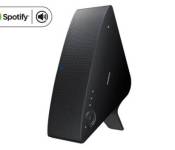
Spotify now handles multi-room streaming on Samsung devices

If you’ve decided to invest in Samsung’s wireless audio multiroom system instead of similar offerings from the likes of Sonos, there’s good news: it now supports Spotify’s Connect system. If you’ll recall, that’ll allow you to stream music on your Samsung speakers directly from the Spotify app on your tablet or handset, in a similar way to Chromecast. In addition, Samsung claims it’s the first to offer Spotify streaming to multiple wireless speakers at the same using its wireless audio multiroom system. To do so, you’ll need Samsung speakers like the M5 or M7 (with or without its WAM250 streaming hub), but you can also hook in certain Samsung soundbars, TVs and home entertainment systems. If your phone has NFC, you’ll be able to tap your wireless speakers to add them to Spotify. You can now give it a shot, if you’ve got a compatible Samsung speaker — all you’ll need is a downloadable app from Samsung and a subscription to Spotify’s premium service.
Filed under: Home Entertainment, Wireless, Samsung
Source: Samsung

Logitech’s universal remotes can now control your Sonos speakers

If you like to simplify your home theater with universal remotes, there’s a good chance that you also like multi-room audio systems. Wouldn’t it be swell if you could combine the two? As of today, it’s easy. Logitech has posted updates for both higher-end Harmony remotes (the Smart Control and Ultimate) and its Harmony mobile app that let you control Sonos audio systems. All of the remotes can handle at least basic playback duties, while both the app and Ultimate also provide quick access to your favorite Sonos playlists and stations. They can steer Philips’ Hue lights, too — just in case need to set the mood for a movie.
The Harmony app is getting one additional trick. It’s now possible to bring up a search field on set-top boxes like Amazon’s Fire TV and simply type in (or speak, if you use voice dictation) what you’re looking for. This last feature is slightly redundant given that some media hubs already have their own remote software, but it might pay dividends if you’re tired of switching apps just because you’ve moved to a different living room device.
Filed under: Home Entertainment, Peripherals, HD
Source: Logitech Blog
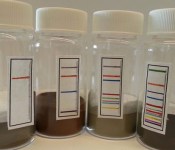
Nano barcodes can trace bombs even after they’ve exploded

You may not pay much notice to product trackers like barcodes and RFID tags, but they’re absolutely vital in some fields; they cut back on bootlegging and help police determine the origins of bombs. Worcester Polytechnic Institute may have just delivered a major breakthrough, then, by developing nanoparticle barcodes. The minuscule tracers identify an object by producing a unique thermal signature (those colored lines you see in the photo) when they reach their melting point. As they don’t participate in any chemical reaction, you can integrate them into any item and get a positive ID whenever you like, even if you’re dealing with exploded TNT.
The substance would most likely be used to stop counterfeiters, thieves and other shady dealers by making it impossible to erase evidence without destroying any ill-gotten goods. However, the technology might be particularly handy for fighting terrorism. Investigators could easily pinpoint the suppliers of not just explosives, but the chemicals used to make explosives — they could identify the manufacturer (and even the individual store) for the fertilizer in a homemade bomb. The scientists’ stealthy barcodes are a long way from reaching store shelves, if they do at all, but there could be a day when it’s possible to trace virtually any high-value product.
[Image credit: Ming Su/Worcester Polytechnic Institute]
Filed under: Science
Source: Scientific Reports

This smart hoodie lets you message friends on the sly

You don’t have to be a forward-thinking fashion designer or scientist to produce tech-savvy clothing. Need evidence? Just look at the smart hoodie developed by New York University grad students Alina Balean and Rucha Patwardhan. They’ve integrated a cellular-equipped Arduino board and switches into the wearable, letting you send messages through discreet movements; you can cover your head to text your mom, or roll up your sleeve to post on Facebook.
Balean adds that the hoodie could be useful in almost any situation where you’d rather not broadcast your intentions. You could let friends know that you’re threatened without tipping off a would-be assailant, for instance. While you’re not going to see this intelligent street wear at the local clothes shop, you might not have to wait that long — since it’s using off-the-shelf parts, there’s a good possibility that you can make it yourself.
Filed under: Wearables
Via: The Verge
Source: Alina Balean
 AIVAnet