



Iconic album covers reimagined with the help of emoji

Some folks like to pass the time with a playlist or TV show while getting a treadmill workout in, but for musician Wesley Stace, it was the perfect time to recreate highly-recognizable album covers. Using his emoji library, Stace has since created over 50 such works that range from The Beatles’ A Hard Day’s Night to Pink Floyd’s Dark Side of the Moon and Springsteen’s Born in the USA. He tells Fast Company that what started as a way to pass the time turned into a guessing game of sorts, so he decided to beam them to Twitter. If you ask me, the emoji version of Nirvana’s Nevermind is quite stellar.
Classic Emoji album covers #11: Nevermind
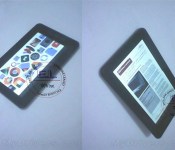
Purported Nexus 8 images and specs leaked

Leaked images claimed to be Google’s new Nexus 8 are making their way around the Internet. Besides showing a 7 to 8-inch device, not much else can be seen from the photos.
The Nexus 8, the follow up to last year’s Nexus 7 and possibly replacing the Nexus 10, is rumored to be unveiled at Google I/O in just a few weeks. Rumors have also suggested it will feature a 64-bit processor and be manufactured by HTC.
The purported images of the Nexus 8 come from MyDrivers.com, who claim that the device is wrapped in a protective shell to hide it from prying eyes. If it doesn’t have a case on it, that’s a pretty large bezel around the display, something that Google and nearly all manufacturers have been moving away from in recent years.
Also according to leaks along with these photos, it will come with a Qualcomm 64-bit processor, 3 GB RAM, and will run Android 4.5.
Nothing is confirmed until it’s official and hopefully we’ll see a new Nexus tablet sometime June 25 or 26.
Via G4Games

The post Purported Nexus 8 images and specs leaked appeared first on AndroidGuys.
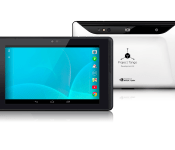
NVIDIA unveils Tegra K1-powered Project Tango tablet

NVIDIA on Thursday unveiled its Project Tango Developers’ Kit, which centers around a 7-inch Tegra K1-powered tablet. Packing 129 programmable GPU cores, it’s easily one of the most powerful devices of its kind and holds the keys to the future of mobile computing.
In addition to that beast of a processor, other hardware details include 4GB RAM and 128GB internal storage. What’s more, this monster runs Android 4.4 KitKat and features cameras and sensors for space, motion, and much more.
Game developers could, for example, use it to paint a 3D virtual battlefield in your living room. Or create large scale virtual and augmented reality experiences. Real estate companies could build interactive, 360-degree “fly-through” tours. Interior designers could scan a client’s home and test design ideas, such as moving walls or inserting furniture. Retailers can guide the user to specific places or products.
The Project Tango Tablet Developer’s Kit will be priced around $1,000 and is expected later this year.
The post NVIDIA unveils Tegra K1-powered Project Tango tablet appeared first on AndroidGuys.

iWatch Component Production Said to Start Gearing Up This Month, September Launch Speculated
Production of components for Apple’s iWatch is reportedly starting later this month, leading to speculation by Cantor Fitzgerald analyst Brian White that the device will see a launch as soon as September alongside the iPhone 6.
With the theme around wearable technology at Computex this year, our research has uncovered more data points as it relates to Apple’s “iWatch.” Our meeting with a tech supply chain company highlighted that initial production of certain “iWatch” components is scheduled to begin later this month and there are plans for a sharp acceleration into fall.
Given the trajectory of this ramp and our experience analyzing other product ramps at Apple, we expect the “iWatch” to be unveiled with the iPhone 6 in September. Since our research suggests the first iteration of the “iWatch” is more of a companion device, and thus requires a connection to an iPhone, we believe unveiling the two new devices at the same time makes sense.
White believes the iWatch will be available at several pricing increments much like the iPhone and the iPad, indicating that prices could start at $199 to $229 to compete with other smart watches currently on the market.
 iWatch concept by Todd Hamilton, based on the Nike FuelBand
Several other rumors have pointed towards a fall launch for the iWatch, with KGI Securities analyst Ming-Chi Kuo predicting a third quarter launch, which has also been echoed by various Asian news sources including the Economic Daily News and Digitimes. Apple is also likely aiming for a fall launch for its 4.7-inch iPhone 6, which could see the two devices unveiled together.
Little physical information has surfaced on the iWatch thus far, but supply chain rumors have suggested the device will come in two separate sizes (1.3 inches and 1.5-1.7 inches) to accommodate different sized wrists. It is also said to include a multitude of biometric sensors to measure various health metrics and it is also expected to interface with the new Health app in iOS 8.
White also believes that the 5.5-inch iPhone, which was rumored to be delayed due to production issues, could launch alongside the 4.7-inch iPhone and the iWatch. He released a report detailing his reasons yesterday and today confirms that research is “uncovering more evidence that the 5.5- inch iPhone 6 will launch this fall.”
Having previously predicted seemingly outlandish products such as the “iRing” able to control an Apple television set, Brian White does not have a particularly solid track record when it comes to predicting Apple’s plans, but with multiple rumors converging on a fall release date for both the iWatch and the two versions of the iPhone, it is possible we will see all three products before the end of the year.
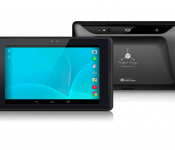
Project Tango Tablet Developers Kit Announced by Google; Packs Tegra K1, 4GB RAM and 3D Mapping Fun
Google has unveiled Project Tango Tablet Developers’ Kit today. It is pretty much the most badass tablet you can dream of owning so far, and that is putting it mildly.
 The Project Tango kit is a 7-inch Android powered tablet. Nothing amazing there. however, inside you find a NVIDIA Tegra K1 processor with a 192 programmable cores, 4GB of RAM and 128GB of internal storage. The front facing camera offers up 120 degree view and the rear camera is 4MP. There is third rear motion tracking camera too , along with a depth sensor. All of that means that the Project Tango Tablet can 3d scan rooms and create intense interactive augmented reality excitement. For instance, turn your living room into a battlefield, or scan a room and move things around for interior design.
What is Project Tango?
As we walk through our daily lives, we use visual cues to navigate and understand the world around us. We observe the size and shape of objects and rooms, and we learn their position and layout almost effortlessly over time. This awareness of space and motion is fundamental to the way we interact with our environment and each other. We are physical beings that live in a 3D world. Yet, our mobile devices assume that physical world ends at the boundaries of the screen.
The goal of Project Tango is to give mobile devices a human-scale understanding of space and motion.
Our team has been working with universities, research labs, and industrial partners spanning nine countries around the world to build on the last decade of research in robotics and computer vision, concentrating that technology into a unique mobile device. We are putting early prototypes into the hands of developers that can imagine the possibilities and help bring those ideas into reality.
We can’t forget to mention that the Project Tango Tablet also has Wi-Fi, Bluetooth LE and 4G LTE connectivity (depending on region and carrier, of course). Check out the cool little video they put out about it.
The Project Tango Tablet is being marketed toward developers and comes with a hefty price tag when it becomes available, $1024. Absolutely worth the money for the talent that exists in the world. We fully expect Google to show it off a bit at Google I/O and hopefully they will be able to give us all a little bit more hands on detail of how it all works. If you want to get on the list to be notified when the Project Tango Developers Kit is ready, pop on over to the sign-up page.
So, who is jumping on the list?
//<![CDATA[
ord = window.ord || Math.floor(Math.random()*1E16);
document.write('’);
//]]>
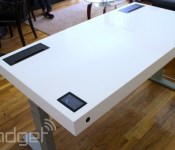
Stir’s ‘smart desk’ now works with Fitbit, shows how many calories you’ve burned while standing

Remember the Stir Kinetic, that $3,890 “smart desk” we showed you last fall? You know, the sleek-looking one made by someone who used to work on Apple’s iPod team? Yep, that’s the one. In any case, it’s about to get a few more features to help justify that insane price tag. Stir just announced that the desk will now integrate with Fitbit’s fitness-tracking platform, allowing you to tally up all the calories you’ve burned while standing.
What’s cool is that the exchange of information is actually a two-way affair: The desk uses its WiFi connection to pull in information from Fitbit (think: steps taken) and then display that on the table’s built-in touchscreen. Meanwhile, of course, the desk knows when you’re nearby, as it has motion sensors built in (obviously, too, it can tell, based on the height of the desk, whether you’re standing or seated). Using this information, Fitbit can calculate how many calories you’ve burned while working. This is especially nice because Fitbit’s fitness trackers couldn’t otherwise tell how many calories you’ve burned while standing still; they only know how many steps you’ve taken. So, if you’re trying to weigh your Fitbit activity against your daily food intake, you might be pleased by all the “bonus” calories you burn as a result of merely standing around.
If you happen to be one of the few who bought a Kinetic desk during its first production run, you’ll receive these latest features via a software update (again, the built-in WiFi comes in handy for this sort of thing). And if you didn’t, well, plenty of other fitness trackers can estimate your daily calorie burn as well — and for a fraction of the price.
Filed under: Household
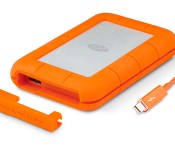
LaCie’s popular portable drive adds more convenience and durability

Who hasn’t misplaced an accessory cable at one time or another. We’ve all been there. Well, to combat that issue with it’s popular orange-draped Rugged portable drive, LaCie has built it right in. A Thunderbolt cable is now attached to the mobile storage unit, wrapping around the edge of the device for safe keeping. What’s more, there’s a cap that protects the jack and an additional USB 3.0 port with IP54-rated dust and water protection. This means that not only are the drives capable of taking a fall of up to 2 meters (just over 6.5 feet), it can also keep debris and moisture our whilst in the field.
In terms of speed, the Rugged clocks in at up to 387MB/s and can handle 100GB in less than five minutes. If you’re itching to grab one, you’ll have to wait until July, but 1TB and 2TB capacities in addition to 250GB and 500GB SSD options will range in price from $220 on up to $500.
Filed under: Storage

Asia’s biggest tech show is ASUS’ show

While covering Computex 2014 this year, we saw ASUS Chairman Jonney Shih take to the stage no-less than three times. Granted, two were to showcase his company’s seemingly limitless product launches, but he also snuck on stage at Intel’s keynote — arguably the only other company that makes an impact at the Taipei. ASUS is a Taiwanese company and when Shih appears, several lines of journalists pop up (as do their flashes), and the light show pretty much continues until he leaves — the home crowd like him. It also helps that the chairman comes across as super enthused whenever he talks up the products — we can recall a particularly cheerful “ubiquitous cloud computing” exclamation at last year’s showcase).
There’s also the fact that ASUS exceeds even Samsung when it comes to producing previously unseen form factors. From phone tablets to tablet phones, hybrids, and this year, a ‘five-in-one’ PC with a built-in smartphone. After a relentless flurry of announcements, journalists, analysts and bloggers are then unleashed into smallish demo area, where, if you’re lucky, there’s two of the new flashy devices to share around a room of hundreds. Apple events might carry a higher degree of pressure, but the chaos of an ASUS press launch at Computex, remains… unique. Here’s how ASUS made this Taipei tech event its own:
Filed under: Cellphones, Laptops, Tablets, ASUS
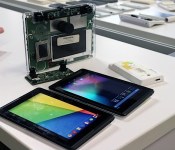
Google’s secretive 3D-mapping project now has a tablet: here it is

Comprehending the world around us is something we humans take for granted, but it’s not so easy for our technology. Sure, autonomous robots and military-grade research labs have hardware that can approximate the same visual acuity of human eyes, but Google’s Advanced Technologies and Projects (ATAP) division started Project Tango to bring that sort of tech to the masses. Its mission is to make mobile devices capable of using depth sensors and high-spec cameras to craft three-dimensional maps more cheaply and easily than other current efforts. ATAP announced its first piece of hardware in February, a prototype smartphone equipped with Kinect-like 3D sensors and other components, but the team is now expanding the project to a new form factor: a seven-inch tablet that’s packed with a lot more power.
The prototype tablet has a 1080p display and runs a stock version of Android 4.4 KitKat, but what’s most important is the oomph under the hood: NVIDIA’s quad-core Tegra K1 chip alongside 4GB of RAM and 128GB internal storage (microSD cards are not supported). That’s in addition to USB 3.0, micro-HDMI, Bluetooth LE and LTE (availability will depend on carrier, but Google isn’t announcing which frequencies are supported just yet) — and if that all sounds like overkill for a tablet, it’s because the team wanted to make it extremely difficult to hit a ceiling in terms of computing power.

The Tango tablet sees the world through the two cameras and a depth sensor on the back. One camera has a 4MP sensor and comes with (relatively) huge two-micron pixels that offer high light sensitivity and faster speeds than most standard options (similar to the UltraPixel sensor in HTC’s One), while the other camera tracks motion more broadly with a 170-degree wide-angle fisheye lens.
If that all sounds like overkill for a tablet, it’s because the team wanted to make it extremely difficult to hit a ceiling in terms of computing power.
The smartphone is a bit chunky and unsightly, from an industrial design standpoint, but the tablet actually looks like it could pass as a consumer device. It’s neither as thick as I expected, nor does it appear hastily put together. Even though device aesthetics don’t really matter in a tablet aimed squarely at developers, the ATAP team has put a lot of effort into the design to ensure its slate is best equipped to do its job. For example, the cameras are mounted at a 13-degree angle to give them the view needed to gather accurate data, while allowing any meatbag holding it to do so in a natural way — instead of awkwardly holding the tablet directly in front of their faces when mapping a room.

Through Tango, the ATAP team wants to give mobile devices a sense of human scale and an understanding of space and motion — it wants your phone or tablet to mimic the way we see the world. Should Tango succeed, the phone in your pocket will be able to map out a three-dimensional mockup of your office building or home, as well as measure the distance between objects within them (walls, counters, couches and so on).
The NVIDIA chip inside uses desktop GPU architecture, making it easier for companies to port over complex programs that they’ve already spent years developing on PCs.
The benefits of these spatial talents are broader than you’d think. If you’re wandering aimlessly through a Home Depot to find a small trinket, you could install an app that guides you through the store, like an indoor version of in-car GPS. Or, instead of imagining how that Swedish sofa would look in your living room, another app might deftly show you if the furniture will fit where you want it to go, no tape measures or imagination required. Virtual real estate tours could become much more realistic for buyers, while three-dimensional maps would be especially handy for visually impaired users. “If you walk around the office building, [a device with Tango tech] could read the names of each conference room out loud as you pass them,” says Johnny Lee, Tango’s technical program lead.
The project’s already getting plenty of support from the graphics community, with renowned game engine builders Unity and Epic among the many companies working with Tango; even Autodesk (the makers of AutoCAD) has several projects in the works. That corporate support, which began with Qualcomm’s Adreno GPU inside the Tango smartphone, should continue to grow stronger on the tablet because of the K1 chip involved. The NVIDIA chip uses desktop GPU architecture, making it easier for companies to port over complex programs that they’ve already spent years developing on PCs.
“If the device can understand your environment, you could turn your living room into a dungeon.”
Then there’s games: Lee showed us an impressive game demo that let us explore a fantasy world by walking around in real space, making the tablet a virtual window into a completely different place or time. “If the device can understand your environment,” said Lee, “you could turn your living room into a dungeon.” This type of environment also seems ripe for a good game of virtual hide-and-seek, with characters hiding behind real objects in your house.

This 3D mapping technology is still considered bleeding-edge, but Lee envisions a day in which the enhanced sensing capabilities are expected in a device, much like Bluetooth is a fundamental feature in phones today. To get Project Tango where it is today, ATAP collaborated with a number of manufacturers and component suppliers to produce the necessary hardware, while universities and research labs contributed much of the software. Work in the 3D mapping space has been ongoing for the last twenty years, but the challenge Tango tackles is condensing all that technology into a small enough device that consumers will want to carry around.
We’ve outlined a few examples of what Tango could bring to the table, but none of it would be possible without the creative input of developers. Back in March, the team distributed 200 phones to third-party devs, but in the next six months Lee plans to ship out these high-powered tablets on a far wider scale; beginning today, developers can sign up to get notified when they’re available. The tablet’s expected to go on pre-order later this month, but Google is hesitant to lock down a specific date for release. Whenever it shows up, however, it’ll cost $1,024 to get your hands on one — if you get whitelisted for an invite. (Like Google Glass before it, there are criteria one must meet to be deemed worthy.) Regardless, the team hopes to showcase the device at I/O if it’s ready.
Like Google’s continued experiment in wearable computing, this isn’t a consumer product yet. The tablet’s loaded with top of the line components throughout to give devs what they need, while retaining a realistic price tag. For their money, developers won’t be getting capabilities different from the phone released in Feburary, but the larger form factor does provide an upgrade in ergonomics. According to Lee, when holding the slate you’re less likely to block the cameras with your fingers. Plus, a bigger device can house a much larger battery (ATAP isn’t giving an official size yet, but it’s likely quite generous, if the phone was any indication). More space between the cameras and sensors also allows for more accurate 3D measurements, and there’s more room for heat to dissipate, which means these bigger devices can handle more computing power.
Eighteen months into the 24-month project, Lee and his team see a bright future, but Tango’s ambitions don’t stop with phones and tablets; the Program Lead believes that Tango could eventually extend to wearables as well. “[Tango] is a camera-based system … and in a wearable we can explore [always-on] cameras that constantly track positions everywhere.”
Filed under: Cellphones, Wireless, Mobile, Google

Tech CEOs push US Senate for stronger surveillance reform

The CEOs of AOL, Apple, Dropbox, Facebook, Google, LinkedIn, Microsoft, Twitter and Yahoo! all agree: more needs to be done to reform the government’s snooping capabilities. That’s the thrust of a letter that appeared online yesterday, anyway. Though the list of signatories contains a handful of rivals, all of them agree that the version of the USA Freedom Act that recently passed through the US House of Representatives still sucks and that the US Senate needs to fix it.
Why? Well, it was originally meant to stop the NSA’s bulk collection of metadata (like who emailed you or when you called someone) outright, but some (including the nine companies who issued the letter) believe the version of the act that passed was watered down to the point where it could easily be exploited. Naturally, there’s still a raging debate on just how valuable and safe that bulk collection actually is. The undersigned nine also call for greater transparency when it comes to user data requests it receives from the government, though that’s not a surprise considering how frequently they already bring up the issue. Just take a peek at, say, Facebook’s most recent transparency report — you’ll find that the social giant received between 0 and 999 national security requests for data. Painting in strokes that broad is unsatisfying at best and obscurantist at worse, which is why companies like Twitter are weighing legal options to push for more specificity.
Source: Reform Government Surveillance
 AIVAnet