



Forget training wheels: This bike balances itself

Training wheels are great for getting kids rolling, but they don’t really develop the balance required for real riding. Jyrobike takes a different approach to the learning process, providing a more authentic cycling experience while still offering the stability new starters need. That’s because it’s self-balancing, and though that sounds too good to be true, the technology that makes it possible is actually quite simple. Contained within the front wheel is a weighted, motor-driven disk that gets up to several thousand revolutions per minute (RPMs). This spinning disk, which emits a dull hum when at full speed, exerts a gyroscopic force that pushes against the turn and lean of the front wheel. As the rider tilts towards the point of no return, the front wheel corrects and as a result, nudges the child into a balanced body position. Watching someone ride a Jyrobike doesn’t give you a good idea of how stable the thing really is, but we were incredibly impressed by a live demo. With just a small amount of forward momentum, the prototype easily shrugged off sideways slaps with only a slight waver.
Jyrobike has three levels of stabilization, meaning you can gradually tone down how much help it’s giving the rider as they progress (lower RPMs produce a lesser corrective effect). There’s even an optional remote control parents can use to sneakily change the wheel’s balance setting on the fly, if a child is struggling or needs challenging. If you don’t have the remote, though, the Control Hub (aka front wheel) has buttons and LEDs for adjusting balance settings and displaying remaining charge. The wheel can also play bugle, siren and dinosaur sounds from its internal speaker to keep kids entertained while riding. A micro-USB port allows you to recharge the wheel (and update its firmware), which currently runs for around three hours per charge. When a child no longer needs aid, you can easily get into the Control Hub and remove the weighted disk so it becomes more or less a normal front wheel. Jyrobike isn’t just about teaching, though, as it allows some children with prohibitive disabilities and disorders to cycle like everyone else.

If the idea of Jyrobike sounds familiar, it started as a college graduate project before several early prototype runs. Now, the team behind it is looking to raise $100,000 through Kickstarter to turn it into a fully fledged product. A pledge of $249 will be you a full bike with 12-inch rims, while $299 will buy the larger, 16-inch model. As the technology is contained solely within the front wheel, you can always buy just a 12- or 16-inch Control Hub for retrofitting at $129 and $149, respectively.
Right now, Jyrobike is meant for kids. As you can probably imagine, bigger people, bikes and wheels have a massive impact on the physics at play. A Jyrobike for adults needs much re-engineering, but once the team has delivered everything they promised in its Kickstarter campaign, that’s the plan. Some preliminary work on an adult model has already been conducted, and it’s expected to be much more sophisticated, with a handlebar-mounted control system and smart features that dynamically adjust the level of stabilization. While it’ll obviously be helpful for late learners, the main use case for an adult version would be to give disabled or otherwise impaired cyclists a two-wheeler of their own.
Filed under: Transportation, Science
Source: Jyrobike (Kickstarter)

ASUS introduces us to the ‘world’s largest’ curved LED monitor

ASUS announced a slew of high-profile devices at its press conference yesterday, but the company’s booth at Computex still turned up a few gems today. Among them: a prototype of a 32-inch curved LED monitor, which ASUS says is the largest of its kind.
At least in its current incarnation, the monitor’s curve is very slight — the company’s experimenting with the ideal amount of bend in the display, and a rep said the subtle curve currently in place helps avoid any image warping. The 2,560 x 1,440 (WQHD) panel itself looks pretty crisp, though because of the display’s large size, you can clearly make out individual pixels. ASUS chose VA (vertical alignment) technology for the screen, which combines the best features of TN and IPS panels to offer wide viewing angles and accurate colors. Thanks to the combination of display tech, the slight curve and a glare-deflecting matte finish, the LED monitor can comfortably accommodate a family of four watching a movie. Entertainment is clearly the main focus here, and a DisplayPort connection is on board for grabbing content from your laptop.
As a prototype, the 32-inch curved monitor doesn’t have a set price tag or a launch date at this point. ASUS did say that it will cost more than its $800 models but less than its 4K monitors, which is admittedly a pretty big range. For now, though, you can check out a few photos in our hands-on gallery above.
Zach Honig contributed to this report.
Filed under: Displays, Home Entertainment, ASUS

FDA makes it easy for apps to give you public health data

Want to know if it’s safe to buy an unknown foodstuff or medicine when you’re already at the store? You’ll have that option soon. In step with the White House’s open data efforts, the FDA has launched OpenFDA, a platform that makes it easy for apps to fetch public health data. Developers only need to implement some search code to pull up information; before this, they had to sift through reports or make special requests. OpenFDA only provides data on adverse drug reactions and medication mistakes right now, but it should expand to recalls and labeling after the current trial phase. You’ll have to wait for the first FDA-savvy apps to roll out. Still, it shouldn’t be too long before you can walk up to the drugstore counter with confidence.
[Image credit: AP Photo/Kevork Djansezian]
Filed under: Cellphones, Internet
Source: FDA

Instagram Receives Major Update With New Image Manipulation Tools [iOS Blog]
Instagram received a significant update today, adding 10 new creative tools to the app to put it on par with more robust image editing apps. Users will now be able to manipulate and adjust brightness, contrast, warmth, saturation, highlights, and shadows.
When you go to select a filter, you’ll now see a new wrench icon. Tap it and you’ll find a tray of photo editing tools ready for you to explore. You can also now adjust how much of a filter you apply to a photo by double tapping the filter icon.
There’s also a new adjustment tool for cropping and straightening photos at the same time, as well as a vignetting tool for darkening the edges of a photo. Sharpen is designed to make photos clearer, while each filter will now be adjustable by strength to produce a range of new looks for pictures.
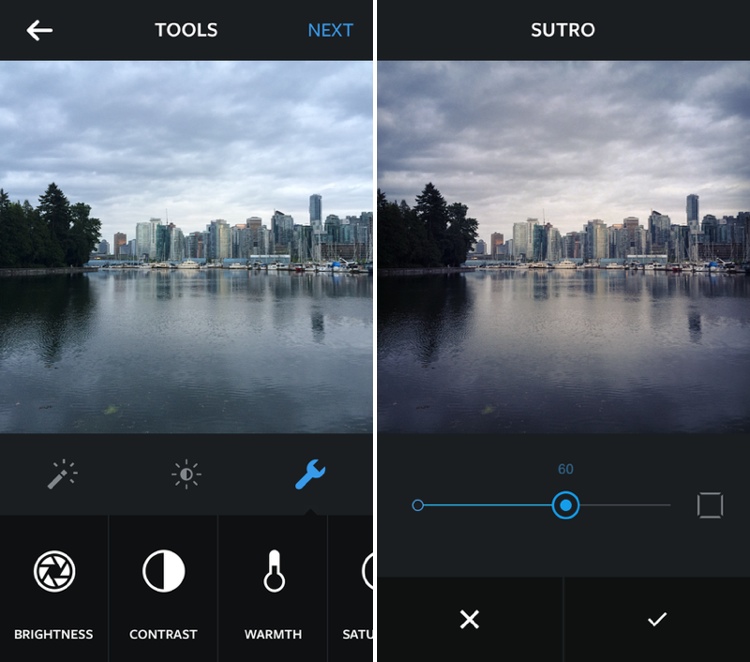
Here’s a full rundown of the new tools:
– Adjust: Crops and straightens at the same time.
– Brightness: Lightens or darkens a photo.
– Contrast: Brightens light areas, darkens dark areas further.
– Highlights: Lightens or darkens the lighter areas of the image.
– Shadows: Lightens or darkens the darker areas of the image.
– Sharpen: Subtly enhances the crispness of an image to make it clearer.
– Saturation: Increases the color intensity of an image.
– Warmth: A slider that allows for adjustments towards warm orange tones or cool blue tones.
– Vignette: Darkens the edges of a photo to highlight the center of the image.
– Filter Strength: Sliders that adjust how strong each filter will appear (includes Borders).
According to Instagram co-founder Kevin Systrom, who spoke to Re/code, the goal isn’t to complicate Instagram, but to improve image editing tools without removing focus from the main product.
“We are aiming to make the core better, creating more of an ecosystem,” he said “Everyone can build a photo app, but not everyone can build a community.”
Instagram‘s new tools, particularly the ability that allows images to be adjusted by filter strength, will allow for a whole new photo editing experience for users. The update is available immediately from the App Store.
Instagram can be downloaded from the App Store for free. [Direct Link]

Beats Acquisition Boosting Apple’s ‘Coolness’ Factor Among Young Consumers
 Last week, Apple confirmed its plans to acquire Beats Electronics and Beats Music in a $3 billion deal that would bring a successful headphone business and a fledgling streaming music service under Apple’s umbrella. While many have pointed to Jimmy Iovine as the acquisition target, Apple may also be using the deal to boost its “coolness” factor among younger users, as suggested in a survey by education technology company Chegg (via Re/code).
Chegg asked 10,000 students about their experience with Beats and their knowledge of the Apple-Beats merger. While most of the students surveyed were familiar with the Beats brand, only 15 percent had purchased Beats products and a mere three percent had subscribed to the Beats Music service. More than half of the students (60 percent) were aware of the deal with one quarter claiming the deal will make Apple more “cool” and fifty percent believing the acquisition will increase Apple’s popularity among students.
This is largely good, albeit unsurprising, news for Apple, which has long dominated the college market. In most college lecture halls across the country, you’ll see rows and rows of MacBooks — many of which were purchased using Apple’s educational discount or in Apple-affiliated campus stores. Still, more and more young people are streaming music using services other than iTunes. Spotify has more than 40 million subscribers, and 40 percent of its American users are between the ages of 18-24.
Beats is often criticized as being a bass-heavy fashion accessory and not a true audiophile product, but sales figures reveal that the typically younger consumers who buy Beats are more interested in appearance than audio quality. According to marketing research company NPD, Beats accounts for 27 percent of the $1.8 billion headphone market and more than half (57 percent) of the premium market for headphones with a starting price tag of $100 or more.

iOS 8 Offers Quick Access to Apps Based on Location
Apple outlined several of iOS 8′s major features during yesterday’s WWDC keynote, but with the operating system now in the hands of developers, details on several lesser known features have been leaking out.
One new feature sees the iPhone displaying apps on the lock screen based on location. For example, MacRumors readers have seen relevant app icons pop up while at or near brick and mortar locations like Starbucks and the Apple Store. While at a Starbucks, for example, the Starbucks app icon is displayed in the lower left corner of the iPhone’s lock screen, which allows a Starbucks Passbook card to be easily accessed.

This feature isn’t limited to Apple’s own stores or to major retailers, either, as one Twitter user has also seen an app for a train station on the lock screen while at that particular location.
Displaying location-based apps on the lock screen is particularly useful at Starbucks and the Apple Store as both locations allow users to make purchases using their iOS devices. In fact, a common theme between the apps that have demonstrated this functionality is a specific on-site function like the ability to make a purchase or display a ticket.
It is not clear how this feature works, or which apps are compatible at this point, but the iOS 8 release notes mention the location based apps as a facet of Location Services. “When Location Services is turned on, the device’s current location is used to recommend relevant apps on the lock screen.” Based on the description of the feature, it appears to work through both the App Store and physical location and will eventually be able to be turned off by turning off location services for the App Store.
As we approach the public release of iOS 8, it’s likely we’ll hear more about this new location-based alert feature. iOS 8 is expected to be available to the public in the fall, following a developer-oriented beta testing period.
(Thanks, Kyle!)

BRAVEN Announces the New Water-Resistant ‘Mira’ Bluetooth Speaker
Summer is right around the corner, for many it is already here. When I think warm weather and sunshine, I think rivers, lakes and pools. I also think music. BRAVEN has announces the availability of their latest Bluetooth speaker, the Mira.
 The Mira is a small hockey puck style Bluetooth speaker that has quite a bit to offer. Inside there is a 1200 mAh battery that is rated for 10 hours of audio playback. The battery is charged with a micro USB plug that is located under a rubber stopper. Under the plug you also find a aux port and a reset button. The Mira also has a multi function kickstand that also flips around to make a hook to hand the speaker on things, like the shower head. Externally on the front they have the power button, play/pause and volume up/down that also doubles as track forward and back. This gives you full control over your tunes while keeping your device at a safe, water free, distance.
 The Mira also has a mic allowing you to use it as a speaker phone while lounging in the pool with your drink. I did say it was water-resistant as well. The little speaker offers up a IPX5 rating.
“Mira has the power to fill a room with outstanding sound, a design that makes it multifunctional, and an understated look that complements your decor,” stated Andy Fathollahi, Chief Executive. “In simple terms, Mira embodies versatility and functionality.“
The new BRAVEN Mira is currently available in black or silver today for $99.99. BRAVEN will be releasing a light blue, light pink and a primary color combo in coming weeks. If you have ever owned a BRAVEN speaker, you know the sound is always stellar along with the build quality and battery life. We have reviewed a number of their speakers over he years and they just keep getting better.
You can get a better look and place an order for one over at Braven.com
//<![CDATA[
ord = window.ord || Math.floor(Math.random()*1E16);
document.write('’);
//]]>

ASUS crams 4K gaming into sleek and distinctive laptop

What should a company do immediately after unveiling an incredible 4K laptop that’s only 19 mm thick? Why, repeat the feat while throwing in some gamer-level GFX from NVIDIA on the way. You might have heard that we were particularly impressed with ASUS’ Zenbook NX500: Besides the specifications, it was quite the looker too. However, if brushed-metallic finishes aren’t your thing, maybe the moody black and red undertones of the ROG GX500 will be more to your liking. Has the Razer Blade finally got competition in the slimline gaming laptop market? We prodded and poked ASUS ROG’s new beast earlier today, and we reckon it’s a yes.
Back to that screen. Yes, it’s 4K and that’s incredible in its own right, but ASUS is also ensuring it delivers on color reproduction to, with 100 percent of NTSC’s color gamut, and 106 percent of Adobe’s RGB. In the flesh, the display is astoundingly crisp, while the fact that it’s IPS means it’s probably going to be Netflix-friendly too — especially when that 4K content starts rolling.

Streaming only video would be a gross underuse of the GX500, however, which crams in a powerful NVIDIA GeForce GTX 860M GPU for gaming muscle, while still weighing just shy of five pounds. The burning question remains: How do games run? We wish we could tell you, but unfortunately ASUS’s ROG launch event was mostly showcasing on-the-rails gaming footage, and the throng of pro gamers and reporters made gaming pretty much impossible. At least for now, early impressions are that it’s yet another impressive laptop screen from ASUS, while the keyboard felt far more responsive than we thought it would, given the shallow frame of the GX500. We’re also hoping it’s just the next step in a gaming rig design revolution.

Vertu’s Signature Touch puts the luxury back into specs

It’s been a year and a half since luxury phone maker Vertu ditched Symbian in favor of Android, thus slowly catching up with the rest of the mobile market. Its first Android phone, the Ti, fell behind the curve with its dual-core processor, tiny battery and low screen resolution; then the more affordable Constellation arrived with a larger screen but also let down by a similar chip. Somewhere along the line, though, Vertu finally decided “enough is enough.” The result is this good-looking Signature Touch which, for a change, packs pretty much everything you’d expect on a modern flagship smartphone: a 2.3GHz quad-core Snapdragon 801 chip, a 4.7-inch 1080p display, Cat 4 LTE radio (with bands covering many parts of the world), NFC plus Qi wireless charging.

The goodies don’t stop there. Most notably, the 13-megapixel main camera is actually certified by the renowned camera maker Hasselblad, so we look forward to giving it a test drive. Then there’s the acoustics part: This new model packs a pair of speakers that are tuned by Bang & Olufsen, which should sound just as loud and crisp as the ones on the Ti. And if you’re into it, the speakers also support Dolby Digital Plus surround sound. While they’re at it, Vertu also got B&O to help craft the optional over-ear headphones, which feature aircraft-grade aluminum, lamb leather and volume remote control. You can even get a Vertu-branded Bluetooth speaker for the phone, but it likely won’t sound as good as the B&O-tuned headphones.
The Signature Touch also features a 2.1-megapixel front-facing camera, 64GB of storage (no microSD expansion) and a modest 2,275mAh battery. Like its predecessors, this Android 4.4 device is hand-assembled with several tough materials, including Grade 5 titanium for the casing, toughened zirconia for the ear pillow and a large piece of fifth-gen sapphire crystal for the screen. Then you get to pick the skin — calf, lizard or alligator — and a color it offers, if any (we dig the Claret Leather and Pure Jet Red Gold editions). You end up with a 192g-heavy, 10.65mm-thick device, which is a given for such a tough, masculine luxury device.
Speaking of luxury, Vertu’s renowned concierge service plus exclusive access to events are included with this new phone, and you can check them out via their respective apps. However, it’s worth reminding that the concierge service is only free for the first year, and then it’s about $2,800 each year should you wish to keep using it. The Signature Touch also comes with the Vertu Certainty package, which includes iPass’ complimentary global WiFi, as well as Kaspersky’s security apps plus Silent Circle’s communication encryption service.

As nice as the Signature Touch sounds, let’s face it: Most of us here will never splash out $10,300/€7,900 for the base model, let alone $14,900/€11,500 for the maxed-out Pure Navy Lizard flavor. But then again, it’s made for folks with extraordinarily deep pockets, instead of us mere mortals. On the bright side, we won’t need to feel sorry for those who end up buying this surprisingly up-to-date bling phone, and Vertu deserves at least a pat on the back for finally recognizing and fixing its age old problem. Now, do excuse us while we set up a crowdfunding page to help us get a, ahem, review unit.
Filed under: Cellphones, Mobile

Study claims that virtual drug dealing cuts back on real violence

Few would say the FBI was doing something wrong by shutting down Silk Road’s online black market, but new research suggests that there may have been a silver lining to the service’s dark cloud. Researchers Judith Aldridge and David Decary-Hetu claim in a recent study that Silk Road was cutting back on violence. Since many of the sales were dealer-to-dealer rather than to customers, that supposedly reduced the chances for real-world confrontations — you can’t start a gun battle over prices when you’re on the other side of the country.
There’s some merit to the claims. Silk Road founder Dread Pirate Roberts designed his service in part to take away power from cartels, which regularly use violence to maintain their grip on the drug trade. An ordinary street dealer could avoid encountering cartels altogether while selling on a larger scale.
However, there are some holes in the study. For a start, it notes that most trades on Silk Road were focused on relatively soft drugs like ecstasy and pot. It doesn’t account for violence over harder stuff like cocaine, where dependency and “chaotic” (that is, frequently criminal) lifestyles are larger factors. An addict can’t wait for a mail order, for example, and many of the hardest drugs ultimately come from cartels and other criminal organizations. It’s also difficult to know whether online transactions were replacing in-person sales or merely supplementing them. In some cases, Silk Road may have just been a way to clear out drugs that didn’t sell at the street corner. You’ll have to take the findings with a grain of salt, then, even if they do illustrate how criminals can change their behavior when they go digital.
[Image credit: AP Photo/Fernando Vergara]
Filed under: Internet
Via: Wired
Source: Social Science Research Network
 AIVAnet