



Apparent Artwork From iOS 8 Banner Found on Stock Photo Site [Mac Blog]
The artwork seen on the banner for iOS 8 at WWDC 2014 has been discovered on stock photo site GreenBox Art, revealing where Apple sourced the image.
 “Water Rays” artwork by Christopher Ross
Titled “Water Rays”, the apparent photo was taken by artist Christopher Ross, who is noted as being the principal photographer for National Geographic Channel’s “Expedition Great White/ Shark Men” special and taking a particular interest in depicting marine life. The artwork itself is available to purchase for $139 on a 30×20 premium canvas.
 The banner displaying the artwork
The banner utilizing the artwork was first seen last week inside of the Moscone Center, as Apple will reveal iOS 8 for the first time during its WWDC keynote later today. iOS 8 is expected to retain the same general look as iOS 7, offering refinements along with new features including a new “Healthbook” app, new TextEdit and Preview apps, and possible improvements to both Siri and Maps.
Apple will be live streaming the event both on its website and on the Apple TV. MacRumors will also be providing a live blog, live tweets via the MacRumorsLive Twitter account, and a spoiler-free page for those who want to watch the full keynote afterward.
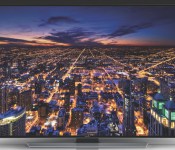
Samsung lets you make apps for Tizen-based TVs that don’t exist yet

The open source Tizen platform may only just be making its way on to wristwear, but Samsung has much bigger plans… in a very literal sense. The company is releasing a developer kit that will let you create apps for Tizen-based smart TVs, including software that supports hand gestures, mobile device pairing and voice commands. And unlike some TV development tools, you won’t need a real set to try things out; you can replicate many core features from the comfort of your PC.
The kit should be available from Samsung’s Developer Forum in early July if you’re eager to start tinkering, or just want to try the resulting apps. However, you’ll be waiting considerably longer for the hardware — to date, Samsung hasn’t said when it will release TVs running Tizen. While the software is a sign that these sets are getting close, the kit is mostly useful for aspiring coders who want a head start.
Filed under: Home Entertainment, Software, HD, Samsung
Source: Samsung Tomorrow
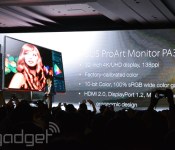
Here’s a semi-professional 32-inch 4K monitor from ASUS

Following ASUS’ $799 28-inch 4K monitor from earlier this year, the Taiwanese tech giant has today unveiled yet another high-res display, but this time it’s aimed at semi-professionals instead of mainstream users. The new ProArt Monitor PA328Q is a 32-inch, 16:9 3840 x 2160 monitor, and it boasts factory calibration with 10-bit color, 100-percent sRGB color gamut plus 350cd/m² brightness. On the back, you’ll find three HDMI ports (one of which with built-in MHL 3.0), one DisplayPort 1.2, one Mini DisplayPort 1.2 and four USB 3.0 ports. ASUS added that this pretty monitor lets you adjust its tilt, swivel, pivot and height.
As with many product announcements today at Computex, ASUS doesn’t yet have a solid date or price for the PA328Q, but our understanding is that it’s aiming for around half the price of the high-end $3,799 PQ series when it lands in Q4. If you need something fairly reliable for your graphics projects but are stuck with a smaller budget, then this monitor is probably worth your consideration — if you can wait for it, that is.

Scientists identify insects by listening to the music of their wings

It’s sometimes tricky to identify insect species, but it’s also important — you want to quickly find out whether you’re dealing with a disease-carrying threat or a harmless fly. That won’t be an issue once UC Riverside scientists get their audio identification system into the field. Their system uses lasers to translate the fluttering of an insect’s wings into an audio signal; since each wing beat has its own music-like tempo and tone, it’s possible to identify critters with uncanny accuracy. You can confirm a species 88 percent of the time purely through sounds, and the rate only gets higher when you factor in the location and time of day.
The laser sensors are potentially ideal for farmers and others who may want to track pests, but don’t always have the necessary cash or experience. The gear is cheap and easy to maintain, with parts that cost less than $10 and can run on solar power. More importantly, it’s easy to use — since the equipment is automatic, you don’t need an expert to look at insects caught in jars or on sticky traps. The sensors are only in limited use in Brazil and Hawaii right now, but UC Riverside’s team hopes to roll them out worldwide within a year.
[Image credit: Peter Phun/UC Riverside]
Filed under: Science
Via: Popular Science, Gizmodo
Source: UC Riverside

MIT’s cooking up robots that can assemble themselves in the oven

It’s 2050, and you’re prepping the oven to bake your next robotic minion while a 3D printer spews out its components. Wait a sec… bake a robot? As strange as that sounds, there’s already a group of MIT researchers developing the technology and the printable materials that can self-assemble into a robot when heated. Since we usually bake food and not robots (and this is all very new), the researchers are experimenting with different materials to find the best option. One is aluminum-coated polyster that folds or twirls itself to form the proper components inside an oven. The other is PVC plastic sandwiched between rigid polyester sheets full of cuts and slits — upon heating, the PVC becomes deformed and the slits close, forcing the whole thing to bend and fold into place.
Also, the scientists are looking into developing a system that uses CAD files to create 2D patterns, as described in one of the two papers they published about the research. Obviously, the team’s not going to develop the perfect material and method overnight, but MIT professor Daniela Rus says they ultimately hope to make it possible to create useful robots anytime.
We have this big dream of the hardware compiler, where you can specify, ‘I want a robot that will play with my cat,’ or ‘I want a robot that will clean the floor,’ and from this high-level specification, you actually generate a working device
The team is slated to present their findings at the ongoing IEEE International Conference on Robotics and Automation in Hong Kong. But if you can’t go, and you just can’t wrap your head around the idea of bakeable robots, watch the actual process go down in the video below.
Filed under: Robots
Via: TechCrunch
Source: MIT
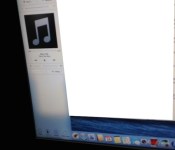
Alleged OS X 10.10 with Control Center, Visual Tweaks, and More Shown in Blurry Photos
Earlier today, a thread appeared on the Reddit Mac community claiming to share a set of four blurry photos of OS X 10.10. The poster, using a throwaway account, claimed to have taken the photos himself at Apple headquarters in Cupertino, but did not offer any further details on how he was able to gain access to a system running the next-generation operating system.
In researching the potential legitimacy of the images, we have been provided with some additional pieces of information that begin to paint a rather interesting picture pointing to an individual who may indeed have had such access. While we can’t say for sure that these images are genuine, the evidence we have seen privately is enough for us to consider it a distinct possibility.
Assuming the photos are legitimate, they reveal a number of changes in both the look and feel of the operating system, as has been rumored for OS X 10.10. Among the biggest additions is a Control Center very similar to that seen on iOS. In this case, the translucent pane slides out from the left side of the screen and offers quick access to a number of features, including “About This Mac” and System Preferences at the very top, followed by what appear to be buttons for an Airplane Mode and the existing Do Not Disturb feature currently accessible through Notification Center.

Below those are buttons with drop down menu functionality for Wi-Fi and Bluetooth along with a screen brightness slider, followed by audio controls that include the ability to display album art. The next section includes a volume slider, as well as AirDrop and AirPlay buttons. At the very bottom of the pane is a set of four buttons that appear to be for system sleep, log out, restart, and shutdown.
Read more 

ASUS’s Zenbook NX500 is a thin and light laptop with a 4K screen

Lest you think all the laptops announced at Computex this week are Yoga knockoffs, ASUS has at least one traditional notebook for you. The company has just announced the Zenbook NX500, a 15.6-inch Ultrabook that manages to pack a 3,840 x 2,160 screen, Core i7 processor, discrete NVIDIA GTX 850 graphics and up to 16GB of RAM into a relatively thin and light frame (it measures just 19mm thick and weighs 2.2kg, or 4.85 pounds).
As you can probably tell, with specs like that, it’s more of a Retina display MacBook Pro competitor than a typical Ultrabook — the sort of thing you’d recommend to creative pros who need to get work done on the go. To that end, the screen isn’t just high-res, but also uses ASUS’ “VisualMaster” display technology, with the color gamut covering 100 percent of the NTSC spectrum and 108 percent of Adobe RGB. No word yet on price or availability (ASUS rarely mentions such details at its press conferences), but we’ll let you know if we learn more.

The ASUS MEMO Pad 8 is ‘the world’s lightest eight-inch LTE tablet’

ASUS boss Jonney Shih is barreling through his announcements at Computex 2014. Between routers, 4K monitors and flagship laptops, he also revealing the company’s newest tablets, and the MEMO Pad 8 is the first salvo. With a 64-bit 2.3GHz Intel processor, Gorilla Glass 3 and a full HD display, Shih says it’s the lightest LTE tablet in the world — it’s only 299 grams.
It was swiftly followed by the slightly smaller, and logically named, MEMO Pad 7. It’ll also pack Intel’s 64-bit Atom processor, although the screen is merely HD(that’s 720p), not 1080p like the ‘Pad 8. If you haven’t quite bought an Android tablet yet (and you’re still in the market for one), the MEMO Pad 8 will arrive later this year in pink, white and royal blue color options, while the MEMO Pad 7 will be dressed in turquoise, red, white and yellow. Summer shades, people. Summer shades.

ASUS’ new Fonepads offer 3G, extra processing power

It wouldn’t be an ASUS event without a new device that functions as both a handset and a slate. And, as expected, the Taiwanese company delivered on that front here at Computex; CEO Jonney Shih announced the Fonepad 8, along with a 7-inch version, the Fonepad 7. A follow-up to ASUS’ Fonepad 7, the new devices sports similar specs, with improved performance and a slimmer design. Oh, and they boast a 64-bit processor that supposedly crushes other phones when it comes to real-world benchmarks.
On stage, Mr. Shih mostly emphasized the 64-bit processor’s performance; the Fonepad 8 runs a 1.8GHz Intel Atom Z3560 chip that apparently trounces the competition when it comes to power and efficiency. That speed should make navigating the device’s Zen interface a seamless experience, though we’ll reserve final judgment until we’ve tried it out for ourselves. The FonePad 8 also features 3G connectivity for its dual SIM slots.
Back to the more superficial stuff: the new Fonepads sport a very narrow bezel for easy one-handed use, and it will be available in black, red, gold and red. Other specs include dual front speakers (the standout feature on the previous Fonepad), a 1,280 x 800 IPS display (for both the 7- and 8-inch versions). We’ll be gathering more specs — and hands-on impressions — as soon as possible, so stay tuned.
Filed under: Cellphones, Tablets, ASUS
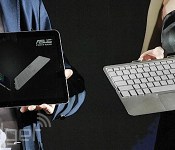
ASUS’ Transformer Book T300 Chi is a super-thin hybrid PC with a 2,560 x 1,440 display

We’ve heard companies make lots of claims, but this latest one from ASUS is mighty specific: The company says its new Transformer Book T300 Chi is the “world’s thinnest 12.5-inch detachable tablet.” Well then! Sounds like a not-so-subtle reference to the Surface Pro 3, if you ask us. In any case, to ASUS’ credit, this does look like quite the savory device, with or without the marketing hype. What we have here is a 12.5-inch tablet with an included keyboard dock, with top-of-the-line specs that include a 2,560 x 1,440 display, built-in LTE and “next-generation” Intel Core processors (like, so “next-gen” Intel isn’t even talking about them yet). As for that thin shape, it measures 14.3mm (0.56 inch) with the dock and 7.3mm (0.29 inch) thick for just the tablet. As usual, ASUS isn’t talking price or availability just yet, but we’ll update this post if we hear more.
 AIVAnet