



Acer shows off ‘Extend’ app allowing you to control your phone from your PC

For every promising concept we see, there’s one that gets scrapped before ever making it to market. That’s what happened with Acer’s “Extend” dock, an accessory that would have allowed you to connect your smartphone to a clamshell-style dock with a display, keyboard and a spare battery to recharge your handset. Turns out, lots of people already carry laptops, and don’t necessarily need to transform their phones into a de facto tablet or netbook. What they do need, though, is to move stuff on and off their phone, or pick up on their PC where they left off on their handset.
Enter Acer — again. The company has totally re-thought its Extend concept, so that rather than use a dock, you just have to install an app on your Windows PC, allowing you to control the phone. To connect your phone, you can either use a standard USB cable, or connect wirelessly, assuming your PC and phone are on the same network. Once your phone’s homescreen appears in a phone-shaped emulator box, you can do things like drag and drop files on and off the devices. You can also, say, share a YouTube video on your phone to Acer Extend, and have it open in whatever your default browser is. Ditto for other kinds of content, like PDF files and Microsoft Office documents. If you were desperate, you could also potentially use this to bypass your company’s VPN, and access blocked sites over 3G.
In the demo we saw here at Computex, the emulator ran consistently smoothly. Acer says this isn’t an accident: It’s aiming for frame rates of at least 24 fps for each device. The catch, though, is that the performance here depends partly on the phone, and apparently not every device is up to snuff. To meet that 24-fps minimum, then, Acer is only releasing the app for some of its phones — namely, flagships and some mid-range devices. So if you happen to be the lucky (?) owner of a Liquid E2, you’re going to be left out on this one.
Zach Honig contributed to this report.
Filed under: Cellphones, Software, Mobile, Acer

Acer claims its €79 Liquid Z200 is the cheapest branded Android phone

The Acer Liquid Z200, an Android phone with a 4-inch WVGA display and a plastic design, is nothing if not budget-friendly. What makes it special is that it’s the cheapest Android phone — at least excluding any off-brand devices you might come across in electronics markets, Acer says. It costs just €79, and while its specs are at the low end of the spectrum, it does what it says on the tin.
Of course, this assumes that you’re content with a 1GHz dual-core MediaTek SoC and 512MB of RAM. You also only get 4GB of internal storage, though Acer includes a micro-SD card slot to bring more media on board. There’s only one camera on board, and it’s a 2-megapixel module with fixed focus. Clearly, no bells and whistles here, but Acer makes no bones about this phone’s cheap pedigree.
Fitting its budget price, the Z200 comes in five “fun” (read: unsophisticated) colors including neon pink and black with red accents. The look isn’t sleek or sexy, but the stippled, patterned texture on the plastic backing feels good and helps your hands get a good grip. A dual-SIM version will be available, though Acer hasn’t shared pricing for that model. The Z200 will hit Africa, Europe and the Middle East in early August.
Zach Honig contributed to this report.
Filed under: Cellphones, Mobile, Acer

Walmart exploits Amazon publisher feud to remind people that it still sells books

While Amazon is caught up in an e-book pricing dispute with one of the world’s biggest publishers, Walmart is making hay. As the internet retailer continues to squeeze Hachette for better pricing on e-books by limiting the amount of printed books it orders, which include titles from J.K Rowling and James Patterson, competing booksellers are conducting fire-sales to remind consumers that they’re a viable alternative (and boost revenues in the process). Case in point: Walmart slashed 40 percent off nearly 400 Hachette titles (both online and in-store) and shortened delivery times in order to beat its internet rival. The tactic appears to have worked, the retailer said that by the end of last week, physical book sales were up 70 percent in just three days. Amazon seems unfazed by it all and has told inconvenienced customers that they can go to “one of [its] competitors.” Many customers have evidently done just that, but their actions aren’t likely to help put an end to this e-book feud.
[Image credit: Walmart, Flickr]
Source: CNN Money

ASUS’ Transformer Book Flip has a 360-degree rotatable screen, realistic pricing

Lenovo’s Yoga series has a lot of fans — and we just mean within the PC-making fraternity. ASUS might have initially bested the Yoga with its dual-screened convertible laptop, but two screens meant weaker battery life and well, it was expensive too. The Transformer Book Flip, then, also offers four different use cases: completely flat like a tablet, a house of cards style prop-up structure, a media-viewing mode with the keyboard down, and good-ole laptop mode. The notable thing here is that the Transformer Book Flip will arrive with similar pricing to ASUS’ middleweight to entry-level Vivobook series. (We managed to get UK pricing: the Flip starts at £449 for the 13.3-inch Core i3 model, with the top-of-the-range 15.6-inch Core i7 is priced at £699. Once we get some US prices, we’ll update this article.)
Screen resolutions go up to 1,900 x 1,080, and while there’ll apparently be cheaper 720p models in both 15.6- and 13-inch sizes. we’d advise sticking to the higher resolution models if you can afford to. The build quality feels a lot like the middleweight laptops that ASUS has shown in years past, although there’s a classy brushed aluminum effect to the top of the laptop. Both sizes will launch in Europe and Asia at the end of June, although we’re sure ASUS will want to capitalize on back-to-school/college sales in the US as well.
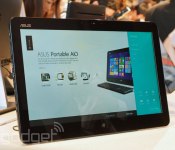
ASUS’ 20-inch ‘portable’ all-in-one PC has gesture controls and a carrying handle

Portable can mean different things to different people, and ASUS is also severely stretching the definition of the word with its new 20-inch all-in-one PC. The built-in battery will apparently go the distance, as long as said distance takes five hours, while a fold-out handle ledge offers a way to carry it without getting finger smudges on the screen. The unit weighs in at 3.2kg, and when we gingerly picked it up to carry, we were left wishing for a handle that was a little more substantial.
The AIO is pitched at families, with built-in gesture controls and navigation for web-browsing and more, as well as an adjustable hinge attempting to offer plenty of different ways to swipe around Windows 8 (yep, it’s touchscreen.) While it has no pretensions of being a games machine, there’s still 4GB of RAM, a Core i5 processor and NVIDIA’s GeForce 820M GFX powering it all, complementing the 1,600 x 900 IPS screen. As ASUS’ big Computex presentation kicks off, we haven’t been given a price yet, but if Jonney Shih decides to fill us in, we’ll share the knowledge.

Apple Rises to #5 in This Year’s Fortune 500 Rankings
Fortune has just released its annual “Fortune 500″ list, which is a high-profile ranking of the largest companies in the United States ranked by revenue. This year, Apple has taken the #5 spot, up from #6 in last year’s rankings and from #17 in 2012.
 The Apple Store Fifth Avenue in New York City, New York
Apple’s net sales keep climbing, as the tech giant continues to sell more iPhones and digital content. But the company faces pressure in the smartphone business, as Android phones grow increasingly dominant. Meanwhile, Apple reported an annual drop in net income in fiscal year 2013, a first in more than a decade. Activist investor Carl Icahn last year disclosed a stake in Apple and subsequently pushed for the company to spend billions on share buybacks. In April, the company increased the amount of shares it is authorized to repurchase and raised its quarterly dividend by 8%, and in late May it announced it was acquiring Beats Music and Beats Electronics for $3 billion.
Wal-Mart once again beat out ExxonMobil for this year’s #1 ranking, with Chevron and Berkshire Hathaway ranking ahead of Apple’s $170.9 billion in revenue. Apple’s profit of $37 billion dollars also ranked first among Fortune 500 companies despite falling 11.3% from last year.
Apple announced last week that it would be buying Beats Electronics and the Beats Music streaming service for a total of $3 billion, making it the largest acquisition in company history. Apple is also expected to launch a number of new products this year, including a larger iPhone, new Macs, new versions of OS X and iOS, and an “iWatch” smartwatch.

Watch YouTube videos while using other apps with Viral Popup [App of the Day]

Google’s stock youtube player is great, but if that app leaves you wanting more look no further than Viral Popup (Youtube Player).
Viral Popup is a full-featured Youtube player designed for phones and tablets. It has a familiar user interface and all the usual options that we have become accustomed to when using the stock app, but that’s where the similarities end.
The app is equipped with features you just can’t get with the stock offering. Advantages that Viral Popup has over the stock app include: allowing the user to play videos in its native resolution (even 1080p), and allowing the user to watch videos in a small “popup” screen while utilizing other apps. You can even turn off the video and have the sound playing in the background.
Get this app today and take your video viewing to the next level.
The post Watch YouTube videos while using other apps with Viral Popup [App of the Day] appeared first on AndroidGuys.

Samsung debuts 7-inch Galaxy W for Korea

File under: Seriously?
Samsung on Monday introduced a new 7-inch smartphone (not tablet) for its Korean home turf with the Galaxy W. Yep, the same model/branding used for another Android smartphone from 2011. And, much like the Mega line, this is a case of being bigger, but not necessarily better.
Featuring a display resolution of 720×1080 pixels, it’s a 4G LTE-A handset with mid-range hardware under the hood. Specifications here include a quad-core 1.2GHz processor, 1.5GB RAM, 16GB internal storage, and a 3200mAh battery. In terms of cameras, the Galaxy W offers an 8-megapixel rear shooter with a front-facing 2-megapixel experience.
Powered by Android 4.3 Jelly Bean, it will retail for roughly 499,400 won ($490, £290, AUS $526). Color options are black, red, and white and each comes with the faux-leather found in the Galaxy Note 3.
The post Samsung debuts 7-inch Galaxy W for Korea appeared first on AndroidGuys.

ASUS launches 3 new 64-bit tablets: ASUS Fonepad 8, MeMO Pad 7 and MeMO Pad 8 [Computex 2014]
 Computex 2014 is now in town and the biggest Asian technology manufacturers are out in force to show off their latest and greatest. Included in ASUS‘ usual grand showcase are 3 new tablets, the ASUS Fonepad 8, MeMO Pad 7 and MeMO Pad 8, all of which house 64-bit processors. Starting with the ASUS Fonepad 8 (pictured above), the device intuitively has an 8-inch 1280×800 IPS LCD display with side bezels that measure just 5mm. The quadcore Intel Atom Z3560 processor inside of it chugs along at 1.8GHz and is also 3G capable, and also features dual speakers situated on the top and bottom bezels of the device.
 Next is a newer version of the ASUS MeMO Pad 7 (above), which also intuitively has a 7-inch display and a more regular 720p resolution. There is a 5MP camera to be found on the back of the device and it is powered by a quadcore Intel Atom Z3745. Unsurprisingly, the MeMO Pad design does seem to take a lot of design cues from the ASUS-manufactured Nexus 7.
 And lastly is the ASUS MeMO Pad 8, which ASUS is calling “the world’s lightest 8-inch LTE tablet”. Also sporting dual speakers, this time on the rear of the device, the MeMO Pad 8 is a substantial jump from the 7-inch variant; with an 8-inch 1080p display and a 64-bit quadcore Intel Atom Z3580 clocked at 2.3GHz, the MeMO Pad 8 is a formidable tablet. Throw in some physical traits like a metal coated chassis and measuring only 7.3mm thick, and you have a very attractive device. Unfortunately, ASUS hasn’t yet explicitly mentioned availability or pricing for any of these devices, but that’s likely to come through soon.
Who would be interested in getting one of these three tablets? Is the fact they are 64-bit powered mean anything to you? Let us know what you think in the comments.
Source: ASUS via Phone Arena
//<![CDATA[
ord = window.ord || Math.floor(Math.random()*1E16);
document.write('’);
//]]>

Researchers are using 3D printers to make blood vessels

There has been talk of printing blood vessels for a few years, but it’s tricky to make tissue that fits the complex shapes of a human body while remaining effective. However, a research team at Brigham and Women’s Hospital may have licked that problem: they’ve 3D printed vessels using a new technique that allows for intricate yet capable designs. Their process first prints agarose (sugar-based molecule) fibers as templates for the vessels, and then covers that in jelly-like hydrogel to produce a cast. Since the agarose is sturdy, scientists can pull it out to create channels without damaging any cells inside the gel; the resulting vessels are much better at transporting liquid and otherwise behaving like the real deal.
This doesn’t mean that you’ll soon get vessels on demand. As the less than organic-looking cubes you see here suggest, there’s a long way to go before these artificial constructs get under your skin. Given time, though, this breakthrough could lead to both custom-made replacement tissues for your body as well as true-to-life drug testing that doesn’t involve a real human’s bloodstream.
[Image credit: Khademhosseini Lab]
Filed under: Science
 AIVAnet