


Motorola lowers price of Moto X to $399
Motorola on Wednesday dropped the price of the Moto X smartphone to $399, with no limited time promos or vouchers to worry about.
Today several wireless carriers offer good month-to-month or prepaid service plans that cost much less than the contract plans that come with subsidized devices. Combine one of those plans with our new $399 everyday pricing and you could save hundreds of dollars over two years while keeping the freedom to change service providers when you feel like it.
After following up the tremendous success of the $350 Cyber Monday promo price with another, similar discount, we got the sense that Motorola was feeling out a lower price point. Indeed, that may have been the case as now all carrier-supported versions of the Moto X are at a much more affordable cost.
The post Motorola lowers price of Moto X to $399 appeared first on AndroidGuys.

Switched On: The 2013 Switchies, Part One
Each week Ross Rubin contributes Switched On, a column about consumer technology.

It’s that special time of year between holiday sales and the pre-CES hype cycle that presents an opportunity to consider some of the most innovative devices of the year. Switched On is proud to present the 2013 Saluting Wares Improving Technology’s Contribution to Humanity awards, also known as The Switchies.
This installment marks the eighth annual Switchies, which are decided based on a rigorous examination of the opinion of me, and do not reflect the opinion of Engadget or its editors. For that latter honor, nominees will need to win an Engadget Award. Now, then, let’s stroll past the red carpet and tear open those envelopes.
This column will focus on TV, PC and gaming products while the next installment will focus on mobile and wearable devices.
The “Big Screen Scene” Award for Best New Video Device goes to the Google Chromecast. Taking an app-by-app approach, Google’s cheap stream-redirecting HDMI dongle took everyone by pleasant surprise with its small size and ease of use. It also helped Google show the power of bridging the assets of Android and Chrome and built momentum in a frustrating race for the living room. It’s now rapidly adding new content sources.
Honorable Mention for Best New Video Device goes to the Xbox One. Microsoft’s latest home console is not only a powerful game system, but also a living room experience that incorporates many leading-edge technologies, including speech control, gesture control, video chat and an expanding array of over-the-top entertainment. Honorable Mention also goes to the TiVo Roamio Pro, the latest generation of the venerable CableCARD DVR that can support up to six tuners and offers improved streaming and offload to mobile devices.
The “Play’s the Thing” Award for Best New Gaming Device goes to Sony’s PlayStation 4. By casting off much of the corporate baggage of the PlayStation 3, like in-house chips, 3D and expensive novel optical formats, Sony finds itself in the enviable sweet spot of offering top-notch performance without occupying the top end of the market. Sony’s simpler development proposition should also help enable a stronger flow of game titles coming into 2014.
The “Convertible Bonds” Award for Best New Hybrid Computing Device goes to Microsoft’s Surface Pro 2. Still a study in contrasts, the second generation of Microsoft’s Intel-based tablet combines high performance and dramatically improved battery life, but you’ll be spending most of your time in desktop mode to tap its potential. Honorable Mention goes to Nokia’s cellular-equipped, outdoor-optimized, Windows RT-based Lumia 2520 and HP’s Android-based Slatebook x2 “2-in-1″ detachable.
The “Guess We Just Click” Award for Best New Input Peripheral goes to the Leap Motion controller. While we continue to see many companies focus on bringing down the cost of gesture control at the expense of a rich experience, Leap Motion presented a new 10-inch paradigm that won it a partnership with HP. Leap Motion wrests this award from Microsoft, which won it for the past three years.
The “Critical Bits” Award for Best New OS goes to OS X Mavericks. In a year where Apple, Microsoft and Google all unveiled new versions of their operating systems for tablets, Mavericks was left virtually unchallenged to pursue improvements for the desktop paradigm and Apple delivered with better battery life through superior memory management and its best multiple-monitor support yet.
Ross Rubin is principal analyst at Reticle Research, a research and advisory firm focusing on consumer technology adoption. He shares commentary at Techspressive and on Twitter at @rossrubin.
Filed under: Gaming, Home Entertainment, Peripherals, Software, Apple, Sony, Microsoft, Google

Bump and Flock file sharing apps shut down this month as devs focus on Google projects

Google acquired Bump — developer of an NFC-like file sharing app with the same name and a photo sharing service called Flock — back in September, and both projects will shut down January 31st. CEO and cofounder David Lieb announced the discontinuation of both products on the Bump blog, saying his team is “deeply focused on our new projects within Google.” That bodes well for their mission of enhancing sharing on mobile devices, but the bad news for Bump and Flock users is that this shut down means everything must go.
After January ends the apps will no longer function, they’ll disappear from the App Store and Google Play and all stored data will be deleted from servers (locally saved files or photos will remain in place). Any of those millions of users can still keep their data though, just open up the app anytime in the next month, and follow the instructions shown (tap the “i” menu on iOS or “More” on Android). Afterwards, Bump will send over an email with a link to let you download all of your stored data.
Filed under: Cellphones, Software, Mobile, Google
Via: Android Police, The Verge
Source: Bump blog

Motorola’s New Year’s resolution is to sell more smartphones, drops unlocked Moto X to $400

It’s no secret that Motorola’s flagship Moto X hasn’t been a tremendous hit with consumers, and with considerable inventory likely building up, it’s time to move some product. Google’s smartphone arm is kicking off the new year with some aggressive new pricing. The base configured Moto X will now run you $400 without a contract or carrier affiliation, while the much-anticipated wood flavor now commands a cool $500. Moto Maker pricing remains at $100 with a new AT&T, Sprint or Verizon contract, if a two-year agreement is how you like to roll.
Filed under: Cellphones, Mobile, Google
Source: Motorola

US judge rules warrantless gadget searches at the border aren’t unconstitutional

A United States district judge has ruled that gadget searches upon crossing into the US aren’t a breach of the First and Fourth Amendments. In 2010, the National Association of Criminal Defense Lawyers, National Press Photographers and grad student Pascal Abidor challenged the 2008 ruling that authorizes unwarranted device search-and-seizures, saying that they exist to counteract protected speech and certain confidentiality privileges. However, district judge Edward Korman remarks that because the chance of the searches is so low (he estimates odds of less than five in a million, although the government’s count has been disputed) there aren’t any grounds for dismissing the rulings.
He further states that this is no different than having your baggage or person examined before crossing into the US, and that the government simply doesn’t have enough resources to inspect the devices of everyone who enters the country. Most worrying however is when Korman says that it’s “foolish, if not irresponsible” that the plaintiffs would store sensitive data on their gadgets in the first place. The ACLU is considering appealing the decision but attorney Catherine Crump tells the New York Times that for now the status quo remains, and in many areas of the country, “the government is free…to conduct all types of electronic device searches without reasonable suspicion.”
[Image credit: Flickr/Crashworks]
Filed under: Transportation
Via: New York Times, Associated Press
Source: ACLU (PDF) (1), (2)

Snapchat user info database leaks, claims to hold most numbers and usernames

Last week security researchers published a way to skim Snapchat’s full database, and it appears someone did it before the vulnerability was addressed. A website called SnapchatDB! has appeared posting SQL/CSV files that it claims contain the username and associated phone number for a “vast majority” of the service’s users, with the last two digits of the numbers obscured. That amounts to 4.6 million pairs, although actually downloading the files to actually use them or verify the claim seems impossible, presumably due to an overload of traffic. We don’t know who is behind the website (its WHOIS record is hidden by WHOISGuard), but the homepage claims this release is happening to “raise awareness” of the fact that companies with our private information should be more careful with it. As the site mentions, even the info included could be enough to figure out someone’s phone number from their username (if it’s also used publicly on Twitter, for example), especially problematic for those with unlisted numbers. They also have not ruled out releasing the uncensored database “under certain circumstances,” so if you’ve ever used the service, this may be something to keep an eye out for.
Filed under: Internet
Via: HackerNews
Source: SnapchatDB.info

Samsung’s new TV remote for 2014 is 80 percent smaller, has touch, voice and gesture control

Samsung couldn’t wait for CES to start leaking information about its new HDTVs, starting with the remote. After rolling out larger and larger contraptions over the years with more buttons (on both sides, even), this year’s “Smart Control” model is 80 percent smaller than the 2013 version. It has a touchpad in the middle which, combined with a new button layout and gesture control — similar to LG’s Magic Remote, among others — promises to make controlling apps and content even easier.
Filed under: Home Entertainment, HD, Samsung
Source: Samsung Tomorrow

Netflix is testing multiple new subscription plans, like 3 streams for $9.99

Netflix likes to run small tests of features and packages before it offers them widely (like its new unified UI), and that includes the “1 SD stream for $6.99″ some have started seeing recently. Another offer currently in testing covers the hole between the standard $7.99/month offer that provides up to two simultaneous streams on one account and the $11.99 offer that goes up to 4 at once. Just like the 1 stream offer not everyone will see it and there’s no way to know if it will ever become widely available, but a few will see a $6.99 option that provides 3 simultaneous streams.
Netflix has declined to push cable TV-style tiers and pricing packages, but the multiple tests seem to show how it’s trying to find the sweet spot with what it offers. We also checked on a widely-reported reported list of movies that may leave streaming January 1st, but Netflix could not confirm which titles will actually go away, referring to the constant ebb and flow of titles on Watch Instantly. We’ll be interested in seeing what’s still available after the ball drops and what new options arrive (seasons 5 – 8 of Dexter and Jack Reacher are incoming, and original content like S2 of House of Cards isn’t far off) but if you really need to watch Half Baked this wouldn’t be a bad time to press play.
Filed under: HD
Mac Pro/OS X 4K Display Compatibility ‘Like the Wild West’, Some 4K Monitors Unsupported
In its lengthy review of the new Mac Pro, AnandTech discovered that the Mac Pro’s current support for 4K monitors leaves something to be desired. The reviewer connected the Sharp 32″ 4K display that Apple currently offers on the Apple Online Store, expecting that OS X work the same way on that panel as Apple’s current Retina MacBook Pro models do.
On those machines, Apple renders the screen at full resolution but then renders text, menu and UI elements at 4x their normal resolution so they are the appropriate physical size for the user. It also offers multiple options to scale UI elements up or down as the user prefers. Instead, using the Sharp panel with the Mac Pro makes text and other on-screen elements — aside from photos and video — very small and difficult to read.
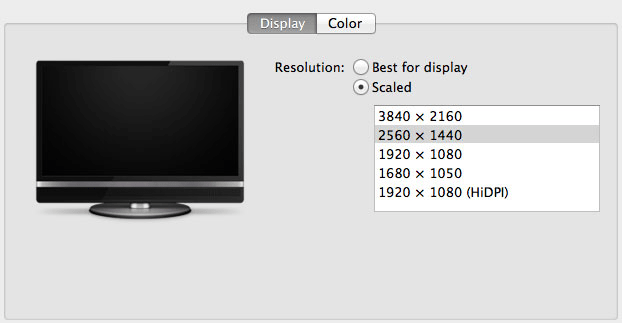
I was fully expecting all of this to be available on the Mac Pro when connected to a 32” 4K display. By default, there’s only a single supported scaled resolution: 2560 x 1440. Unfortunately it doesn’t look like Apple is running the same supersampling routines when you pick this resolution, instead you get a 2560 x 1440 desktop scaled up to 3840 x 2160 (rather than a 5120 x 2880 screen scaled down). The result is a bit of a blurry mess.
You can use tools like SwitchResX (or Quartz Debug or the necessary Terminal command) to enable a 1080p HiDPI mode, but then you end up with insanely low point density of around 68 PPI. Unfortunately it doesn’t appear to be possible to define your own HiDPI modes in OS X, you have to rely on those that Apple officially supports. I tried creating a 5120 x 2880 (2560 x 1440 HiDPI) mode but I couldn’t get it working under Mavericks. I’m not sure if I was limited by the OS or if Sharp’s EDID-specified max resolution of 3840 x 2160 prevented OS X from accepting what I was trying to do.
AnandTech also tried the new Dell UltraSharp 24 Ultra HD display but found that the display is not properly supported by the Mac Pro.
The reviewer calls OS X’s 4K display support “a bit like the wild west at this point”, though he anticipates Apple will fix things with both software updates and its own displays in the future — but urges early adopters to be aware of what they’re getting into.
I am disappointed that Apple didn’t enable any HiDPI modes on the 32” Sharp display. While I found 3840 x 2160 a great resolution for video work, for everything else it made on-screen menus and text a bit too small. I would love to see a 2560 x 1440 HiDPI option (rendering offscreen at 5120 x 2880 and but scaling down to 3840 x 2160 for display) but it looks like I may have to wait for Apple’s own display before I get something like that.
It’s been two years since Apple has updated its standalone display lineup, and the company is expected to come out with new models sooner rather than later. However, there are no concrete rumors suggesting when such an update might happen.
     |

Dell portrays itself as a feisty startup in its first ad after going private (video)

Now that Dell is once again a private company, it’s trying to shake off its reputation as a member of the status quo. Appropriately, the PC builder just unveiled a new TV ad that suggests it has all the energy and vision of a technology startup. The minute-long spot connects Dell’s mindset to that of companies like Dropbox, Gilt and Skype, which started out in modest places but went on to accomplish great things. We’re hopeful that the ad reflects fresh thinking in Round Rock’s offices, but actions will speak louder than words — it’s hard to believe that a tech giant can be as nimble and innovative as a tiny outfit with something to prove.
Filed under: Desktops, Laptops, Dell
Via: CNBC (Twitter)
Source: Dell (YouTube)

