


Google, Microsoft and Instagram rush to fix Flash flaw that could steal your data

Yet another critical security flaw has been found for Adobe’s notoriously sieve-like Flash plug-in, this time by Google Engineer Michele Spagnuolo. His exploit tool, called “Rosetta Flash” is just a proof of concept, but could allow hackers to steal your cookies and other data using malicious Flash .SWF files. The exploit is well known in the security community, but had been left unfixed until now as nobody had found a way to harness it for evil. So how does this affect you? Many companies like Twitter, Microsoft, Google and Instagram have already patched their sites, but beware of others that may still be vulnerable. Adobe now has a fix, and if you use Chrome or Internet Explorer 10 or 11, your browser should automatically update soon with the latest versions of Flash, 14.0.0.145 (check your version here). However, if you have a browser like Firefox, you may want to grab the latest Flash version from Adobe directly (watch out for unwanted add-ons with pre-checked boxes). Finally, if you use apps like Tweetdeck or Pandora, you’ll need to update Adobe AIR — that should happen automatically, but the latest version is 14.0.0.137 for Windows, Mac and Android.
Filed under: Internet
Via: Krebson Security
Source: Michele Spagnuolo, Adobe
What you need to know about social media activism

Protests in the Middle East, known as “The Arab Spring,” echoed around the world. On Friday, December 17, 2010, a fruit vendor named Mohamed Bouazizi covered himself in flammable liquid and lit a match. His body was quickly engulfed in flames and, despite attempts to save his life, Bouazizi died on January 4th, 2011. He was 26 years old. Like how Buddhist monk Thích Quảng Đức’s self-immolation in Saigon nearly 50 years earlier represented the frustration of many Vietnamese, Bouazizi’s action became symbolic of a much larger frustration in Tunisian society.
What happened next, however was a product of modern times: Word spread of Bouazizi’s action through social networks, with Facebook specifically becoming a flashpoint for protest organizations across the country. By the time Tunisia’s former leader, Zine El Abidine Ben Ali, resigned and fled the country in mid-January 2011, over a fifth of Tunisia’s population was on Facebook.
WHAT IS IT?

The term “social media activism” is ambiguous. That’s intentional, as its application varies depending on what it’s connected with. Both Occupy Wall Street and “#CancelColbert” fall under the umbrella of “social media activism,” so the term needs to be ambiguous by its nature. With those two examples, you already kinda know what it is, right? Social media activism can be as simple as a trending topic (“#CancelColbert”) for interested parties to engage in a bigger conversation, and as complex as Occupy Wall Street’s multiplatform, multimedia initiative. As the name implies, there’s no standard social network used for social media activism; YouTube, Twitter, Facebook, Sina Weibo and myriad others are employed as need be.
In the case of Tunisia, Facebook was the social service of choice, with hackers, protesters and everyday Tunisians using the service collaboratively. It served as a message board for sharing images, video and stories, in addition to creating a public forum for communication.
In response to the Santa Barbara shootings by Elliot Rodger, activists and general newsreaders alike used the “YesAllWomen” hashtag on Twitter. The hashtag is still in use over a month later, where it’s become an ongoing conversation about women’s rights versus how women are treated in reality.
WHY SHOULD I CARE?

Beyond the whole “you’re a participating member of human society” thing, social media activism is a fascinating modern version of protest and communication. Because of the internet, social media platforms and the ubiquity of mobile phones with cameras, activism and protest are now truly global events. Not interested in participating? That’s fair!
The other side of the coin is that, sometimes, these movements affect your life whether you like it or not. If you were in Egypt in early 2011, whether you were part of the conversation or not didn’t matter: The president was overthrown.
WHAT’S THE ARGUMENT?
While not an “argument” per se, some say that media coverage focuses on the medium — social media — over the message, and it ends up diluting the protest. Author Malcolm Gladwell argues as much in The New Yorker: “People protested and brought down governments before Facebook was invented. They did it before the internet came along. Barely anyone in East Germany in the 1980s had a phone – and they ended up with hundreds of thousands of people in central Leipzig and brought down a regime.” Gladwell’s also questioned the efficacy of social media in organizing physical protest; it’s easy for people to participate online, but far more difficult to turn those words into action (so the argument goes).
Back in May, a tweet from The Colbert Report‘s official Twitter account made a grave error: publishing a punch line from Colbert’s show that night without including the joke’s setup. In lampooning Washington Redskins owner Dan Snyder, Colbert made the following punch line in reference to a (fake) video that proposed Colbert was caught making racist remarks about Asians. The tweet, since deleted, said this:

In response, writer/activist Suey Park created the “#CancelColbert” hashtag. It became a rallying cry for some Asian Americans to speak about their experiences with racism in America. Except that some Asian Americans — notably Deadspin‘s Tommy Craggs and Kyle Wagner — found Park’s use of “hashtag activism” only served to misdirect the original conversation away from Snyder. It’s not the first, but it’s certainly the most prominent example of social media activism that many believe to be a misuse.
WANT EVEN MORE?

We sure hope you do, because there’s quite a bit on the subject that’s worth reading. The MIT Technology Review has a great piece from John Pollock digging in on the hackers behind Tunisia’s uprising. Al Jazeera America wrote about “#CancelColbert” and whether social media activism is effective; The New Yorker spoke with Park and discussed her background. The New York Times has a thorough background on Bouazizi and similar actions.
And finally, Jehane Noujaim‘s excellent 2013 documentary The Square both demonstrates the use of social media activism in a real-life revolution setting, and grippingly details the movement in Tahrir Square. It’s on Netflix, even! Don’t miss it!
[Image credit: AP Photo/John Minchillo (Zuccotti Park), The White House (Michelle Obama), Ferdinand Delacroix, Comedy Central, Twitter (@ColbertReport), AP Photo/Maya Alleruzzo (Facebook/Twitter)]
Filed under: Cellphones, Handhelds, Internet, Software, Facebook
Twitter’s ‘Buy Now’ shopping button shows up in tweets

It looks like Twitter”s leaked ‘Buy Now’ button is more than just a proposal, after all. Recode has spotted the button (since yanked) lurking in tweets seen from the mobile app, enticing people into making impulse purchases when browsing their social feeds. While the shopping link was frequently broken, one tipster reports getting a checkout page in-app; apparently, it wouldn’t take long to buy whatever caught your attention. Neither Twitter nor its project collaborator, Fancy.com, are commenting on the inadvertent leak or their future plans. However, the appearance confirms that ‘Buy Now’ has at least made it far enough to become yet another Twitter experiment. The real question is whether or not it will survive beyond that stage — Twitter is known to shelve features in testing if they don’t pan out.
[Image credit: Andrew Burton/Getty Images]
Filed under: Internet
Via: CNET
Source: Recode
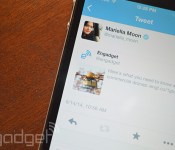
Twitter’s latest experiment rethinks the retweet

Twitter already made the move to allow tweets inside tweets, but it appears the 140-character social stream is looking to revamp the way we all retweet, too. According to TechCrunch, a new feature being labeled as “retweet with comment” that enables users to better participate in the on-going convo by adding proper context could be on the way. Currently, in the company’s own app there are options for a straight retweet and quoting the musing to be recast. Rumor has it that the new method could replace that latter choice, and in the process allow for a proper comment where the ol’ RT text count doesn’t eat into your precious character allotment. That original tweet will likely appear in card form — much like the embeded option — but hopefully via a single button press rather than the current copy/paste method.
Filed under: Internet, Software, Mobile
Source: TechCrunch

HTC giving away 24K Gold One M7 on Twitter

HTC UK have announced they’re giving away a 24 carat gold HTC One (M7) phone in celebration of winning several Phone of the Year awards last year.
Launching on Saturday and running to June 29th, the giveaway allows Twitter users to have one entry by following and retweeting @HTC_UK’s original twitter post.
To celebrate the #HTCOne winning ‘Best Phone of 2013′ we are giving away one in 24ct REAL Gold. FOLLOW and RT to win pic.twitter.com/KnQXnaguGk
— HTC UK (@HTC_UK) June 21, 2014
Great if anyone wants last years HTC One (M7) and also a phone made of 24ct gold!
The post HTC giving away 24K Gold One M7 on Twitter appeared first on AndroidGuys.

Twitter’s latest acquisition could bring more video clips to your feed

Another day, another startup acquisition by a tech giant. Earlier this morning the social gurus at Twitter announced that it snapped a San Francisco-based outfit called SnappyTV in a move that could mean even more video clips from live events finding their way into your tweet stream. Haven’t heard of SnappyTV before? We can’t really blame you: it’s a tool for media producers and broadcasters to snip and edit short bits of video from a live feed so they can be cast to the social winds. Doesn’t sound like the most exciting mashup at first blush, but think about it — the proliferation of short-form video like Vines and Instagram clips are signs that thrilling, visceral moments don’t need ages of build-up and gobs of context to really hit home. That’s been Snappy’s M.O. too, except it’s been used to clip and share moments straight from live basketball games to newsy interviews to absurd award show nonsense. Don’t expect those sort of buzzy highlights to become a Twitter-only phenomenon though: the company doesn’t plan on making it any harder for those clips to wind up on Facebook or Google+.
Source: Twitter
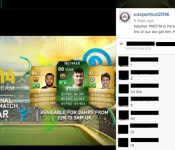
Watch out: fake EA social accounts are swiping World Cup fans’ logins

Internet scams certainly aren’t new, but they’re kicking into high gear now that the World Cup has many people eager for some futbol. For example, Malwarebytes has spotted a fake EA Sports account on Instagram (fake accounts have been on Twitter for a while) that lures FIFA 14 gamers with promises of free team members. If you’re tempted enough to click through, you wind up at a plausible-looking phishing site that asks for your EA Origin and Xbox Live credentials — do that and you’ll quickly lose control of both logins. There’s no guarantees that Instagram or authorities can shut the Instagram account (or any other nogoodnik) down for good, so the best defense is a healthy dose of caution: always double-check an offer if it seems too be good to be true, no matter where it comes from.
Filed under: Internet

Twitter now lets you share gifs on the web, Android and iPhone

And there was much rejoicing.
Starting today, you can share and view animated GIFs on http://t.co/wJD8Fp317i, Android and iPhone. http://t.co/XBrAbOm4Ya
– Twitter Support (@Support) June 18, 2014
Filed under: Internet
Source: Twitter Support (Twitter)

4SRS: the FBI built a list of Twitter slang to keep up with the kids

Forget passwords: the FBI wants to crack your internet slang. Thanks to a FOI (freedom of information) request published over at Muckrock, we now know that the Bureau is TCOB (taking care of business) when monitoring the nation’s social media use. Bypassing UrbanDictionary or the odd Wikipedia definition, the FBI compiled its own 83-page list of over 2,800 acronyms that range from the well-known, like LMAO, TMI, YOLO and SMH, to the outright ridiculous, including EOTWAWKI (end of the world as we know it) and IITYWTMWYBMAD (if I tell you what this means will you buy me a drink?) The agency says the list will help agents “keep up with your children and/or grandchildren,” and also invites them to add their own. Perhaps that’s why AMOG (alpha male of group) and DTP (disturbing the peace) have made it in, but we secretly hope it was an Engadget reader who added KIRF (keeping it real fake).
[Image credit: neolao, Flickr]
Filed under: Internet
Via: Vice
Source: Muckrock
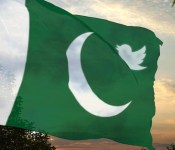
Twitter restores accounts and tweets previously blocked in Pakistan

The reversal of the block might answer critics that argued that the social network’s current policy gave too much power to the already powerful — allowing censorship from agencies and agents even if their country hasn’t afforded them the right to do so. We’ve added the rest of Twitter’s explanation after the break.
“We always strive to make the best, most informed decisions we can when we’re compelled to reactively withhold identified content in specific jurisdictions around the world. On May 18, 2014, we made an initial decision to withhold content in Pakistan based on information provided to us by the Pakistan Telecommunication Authority. Consistent with our longstanding policies we provided notice to all of the affected account holders and published the actioned takedown requests on Chilling Effects to maximize transparency regarding our decision.”
Filed under: Software
Source: Chilling Effects
 AIVAnet