



Head of Intel’s former internet TV project abandons ship

When Intel formally abandoned its IPTV project in a sale to Verizon, the team behind it transitioned as part of the deal. Now, only four months later, the man who’s been in charge of the venture all along has washed his hands of it, too. Erik Huggers, who originally outed Intel’s plan to create an IPTV service/hardware platform (later dubbed OnCue), moved to Verizon and continued on as project lead. There’s no indication that Huggers left on bad terms, or that OnCue’s progression is stagnating at Big Red.
“There were no conflicts at all. The technology is great, the team is great, the future is secure, the dream lives on,” he told Reuters. While Huggers isn’t leaving for anything in particular, apart from telling the WSJ that it’s simply “time to move on,” he’s apparently got a “couple of irons in the fire.” What we’re more interested in, however, is the future of the OnCue platform now its leader’s departed. Perhaps a set of fresh legs is exactly what Verizon needs to finally create a product that, up to now, has been nothing more than high-profile vaporware.
Filed under: Home Entertainment, Wireless, Internet, HD, Verizon, Intel
Source: Reuters

Android TV to debut at Google IO – report says

It wasn’t that long ago that Google had plans get a place in your living room with a TV service , unfortunately that didn’t pan out quite as well as hoped with Google TV becoming a bit of a flop, mainly due to the half-baked integration of trying to combine apps and Pay TV services.
Google knows that there is a future in TV and the demise of their original TV offering has not put them off. According to Gigaom the much rumoured Android TV, the company’s new iteration of a TV platform, will see its debut at this year’s Google I/O conference in June.
Android TV is not set to be a piece of hardware instead Google will be pushing the platform the same route as it has done with Android for smartphones and will be looking for support from TV manufactures to have their hardware running Android TV straight out of the box, whether this is a TV or set-top device.
The focus for Google is to allow users to customise their TV with the content they actually want to see on their screen, very much like what they have in place with the Android OS. Applications for online tv providers , games and music are expected to be a big part of the Android TV experience with the likes of Netflix , Hulu plus and Google’s own music and content apps being available from launch.

Google needs this to be an enjoyable way to watch TV and for this to happen you need a very intuitive UI , so out steps PANO, Google’s secret weapon for keeping the user interface simplistic and probably very Google Now ish.
GigaOm quotes that “The idea behind Pano is that apps can surface individual pieces of content right on the home screen in a card-like fashion so that users can browse movies, TV shows and other types of media as soon as they turn on an Android TV.”
Early in the year the Verge released what was reported to be a leaked internal document that showed Android TV’s interface which really highlights Google’s method of keeping it simple with a nice clean layout and easy navigation and I hope that this is what we will see come June.
So Google’s TV vision looks to be taken care of but they need to get the TV manufacturers on board for this to succeed and with the fail of Google TV probably still fresh in the minds of these companies , it may not be an easy task to convince them that this will be better however it seems that some companies love to work with Google , LG for example, so it may not be that hard.
What about Chromecast ? I hear you say. Well it won’t fade away, the success of the streaming dongle has been immense especially with its competitive pricing but it is just that – it’s a way to get content off of your mobile device to the big TV and Google still sees this a cheap way to way to keep in the TV game , plus it keeps the company competing with the likes of Roku and Apple in the streaming market.
There are exciting times ahead for Google fans and we look forward to what I/O will bring for the TV.
Source:gigaom
The Post Android TV to debut at Google IO – report says appeared first on ChromeWatching.
Read the rest of the source, ChromeWatching.com
The post Android TV to debut at Google IO – report says appeared first on AndroidGuys.

Engadget Daily: Apple and Beats, GoPro’s media empire and more!

Today we discussed Apple’s purchase of Beats Electronics, got a taste of GoPro’s growing media empire, went hands-on with Beats’ new Solo² headphones and learned about an American-made TV that sits behind your bathroom mirror. Read on for Engadget’s news highlights from the last 24 hours.

With Beats, Apple faces the music
Music streaming is on the rise, but it’s still a largely untested source of revenue. So, is Apple’s acquisition of Beats guaranteed to turn a profit, or have Cook and Co. purchased a very expensive business lesson?

Extreme exposure: Inside GoPro’s burgeoning media empire
GoPro doesn’t want to simply build a camera to capture thrilling close-calls and daredevil stunts; it wants to be a media empire. Read on as our own James Trew investigates how the company aims to transform athletes into viral video creators.

Beats’ new Solo2 headphones sound way better than they feel
It’s been a busy week for Beats, what with being purchased by Apple and releasing a brand new model of headphones, the Solo². This $200 over-ear set of cans has a well-balanced sound and an attractive look, but it’s almost as uncomfortable to wear as the Solo HD.

A return to American-made TVs, by way of the bathroom
Ever heard of Séura? Born in the garage of Gretchen and Tim Gilbertson, it’s one of the few consumer electronics manufacturers still operating in America. What’s more, it builds TVs that sit behind your bathroom mirror.
You also might like:
Filed under: Misc

A return to American-made TVs, by way of the bathroom

It’s a story we’ve heard from Apple, Google and Amazon. From humble beginnings, those companies grew into global giants. But countless other American companies start the same way; they just aren’t household names. Yet. Séura, one of the few consumer electronics manufacturers still operating in America, traces its roots to the garage of Gretchen and Tim Gilbertson in Green Bay, Wisc.
The couple started tinkering with an idea for a product-and an entire company-after Gretchen had a “light-bulb” moment in 2003. “There was a big trend at that time for moms to create this personal sanctuary within their homes,” she says, especially when it came to bathrooms. “They were spending so much money on these spaces that they didn’t want to put ugly technology in the room, so this was a really great idea for us to be able to capitalize on that trend.”

The idea? Hide the ugly television behind a mirror. When it’s on, the television picture comes through specially designed glass. When it’s off, it’s just another mirror in a bathroom. Nice idea in a world where technology and gadgets are invading every part of our daily lives. But neither Gretchen nor Tim was a technologist. Or even knew much about what would go into creating a prototype. In college, they focused a lot on football. Gretchen had been a cheerleader at the University of Wisconsin and Tim was Bucky Badger, the celebrated team mascot. After graduating, Gretchen worked in marketing for Kimberly-Clark, maker of toilet paper among other things. And Tim honed his skills in product development working for a company that made icemakers and wine coolers.
Not knowing much about TV technology didn’t stop them, however. The couple sketched their first design in their car coming back from a home showcase where they were doing market research. With just a pad of paper, a pen, and a calculator to figure out sizes and costs, they drafted up what the product should look like. Four months later, they had a prototype made with glass coating they found from a local store, a custom-made metal housing and a television they bought off the shelf. Less than a year after cobbling together the prototype, they hired their first official employee, Air Force veteran Pat Sheahan, and moved their offices from their basement to the garage.
Chapter 1: Wisconsin Born

A decade later, Sheahan still works at Séura assembling their bathroom mirror televisions. The work he does could have been shipped overseas years ago. It’s time-consuming, methodical and detailed. But the company has beat the competition by assembling products in America, allowing them to give customers high quality and fast turnarounds on delivery times. “Pat is an artisan,” Gretchen says. “At Séura, we put quality above all else. That means quality of the electronics, the glass, and the technology. In order for these to come together perfectly, our residential units are assembled individually with a lot of care and expertise.”
Another 29 people have joined Sheahan and the Gilbertsons at the company’s Green Bay headquarters. At 50,000 square feet, it’s nearly 100 times the size of the 600-square foot garage they once worked in. There’s a sales team and research and development. That’s a far cry from when the Gilbertsons were in startup mode. They handled everything themselves, even as they managed to avoid revealing that there were only three people working at the company back then. “The phone would ring and I would pick it up, ‘Hello, Séura,’ and they’d say ‘Can I speak to accounting?’,” Gretchen remembers. “And whoever they were looking for on the other end, Tim had to be that person or I had to be that person.”

But even as the company has grown, the Gilbertsons have stayed in Green Bay, although they now source some of their new products from Asia. The choice to stay in Wisconsin has been a conscious one, even if Green Bay is far away from a big city-or most of their customers. “In the first three to four months of us starting our business, I remember a consultant in the industry who had said, ‘You really need to move your business to a major gateway city,” Gretchen says. “Obviously we didn’t listen to that. There’s a lot to offer here.”
Staying in their hometown is important to them, particularly because as the company has grown-an average of 65 percent increase in sales each year-they have been able to hire people in a community whose industrial core has all but moved overseas. “The quality and the craftsmanship of what we’re able to deliver here in Green Bay, Wisconsin is second to none,” Gretchen says. That does mean that Seura’s products are more expensive than the televisions you’ll find at Costco or Best Buy. They start at about $2,000, but most are built to order, many of them still by Sheahan himself.
Chapter 2: A Natural Evolution
In the 1950s, more than 90 television manufacturers operated in the U.S., including storied names such as RCA and Zenith. By the mid-1990s, television manufacturing had literally disappeared, making it impossible for a company like Seura to build its sets with all American-made components. They have to import the display panels and some electronics from Asia, because those things simply aren’t made in America anymore. But the Gilbertsons try to find everything else they can to make their televisions within reach of Green Bay, including metals and glass. They do all their product development and their final finishing at the U.S. factory. It’s that attention to detail that has given Seura the edge against global competition.
Asian factories typically don’t accept small-batch orders, while Séura has much more control over assembly at its headquarters. It can take a customer’s own frame and fit a television into it, creating a personalized product out of what has basically become a commodity. Instead of a hulking piece of black glass overpowering a living room, Seura sets are in many ways works of art. Which makes sense considering the company’s name is an homage to Georges Séurat, the French impressionist who is credited with creating a technique called pointillism. He painted millions of colored dots to make up a larger image, much like the painting and pixel technology in Séura’s televisions.

From the bathroom sets, Seura has evolved into building televisions for virtually every room in the house. As people have added more and more technology to their homes, the tech clutter has taken over. Seura’s stylish sets offer a streamlined solution. An off-the-shelf set in the bathroom would take up precious counter space. So Seura sets can be mounted on the wall. In a bedroom, a 100-inch flat screen might make some people giddy, but put a custom frame around it and a mirrored glass in front of it and everybody is happy.
Seura paints hard coatings on the glass screen, and customizes it for whatever room it’s in. So in the bathroom, it’s more reflective so the mirror is usable. In a living room, it’s more “transmissive” — meaning you can see the television better. And then there’s the whole great outdoors. Normally televisions and the outdoors don’t mix, but Seura may have solved that problem, too.
Chapter 3: Moving Outdoors

A few years ago, customers began asking the Gilbertsons if they could make an outdoor television. Seura’s first television was for the bathroom, so the idea seemed possible. But an outdoor set has to withstand much colder temperatures than a bathroom-and a lot more water than the mist from a shower. So the team developed the Storm, a television that can survive temperatures between minus-30 degrees and up to 140 degrees Fahrenheit. It uses aircraft grade metal to protect the internal circuitry and a cooling system that filters cool air through the bottom of the television. To keep the set weatherproof, the developers took a cue from the automotive industry using sealers like those used in car doors to keep out moisture.
While the Storm was developed in Green Bay, it’s produced in Asia to help keep manufacturing costs in check. Most people put the sets, which aren’t cheap at between $5,000 and $10,000, in their open-air living rooms, the next big thing in home decorating. But probably the most impressive and for football fans like the Gilbertsons, the most satisfying installation was at Lambeau Field in 2013. For those not familiar with the iconic stadium, Lambeau is home to the Green Bay Packers. Green Bay is the smallest city with a national football team, but it’s got one of the biggest and most ardent fan bases in the country. Now it also has 330 Storm screens painted “Packers Green.”

“In Green Bay they are our “hometown” team in every sense of the word,” Tim says. “For any company to be a part of the Lambeau experience is to be a part of what made this community Titletown. It’s about team, it’s about excellence, and it’s about Green Bay.” After waiting for years, Tim’s name finally came up to be able to buy season tickets for the Packers this year. It’s a list many diehard Cheeseheads can be on for decades.
For the Gilbertsons, a family that feels so connected to the city of Green Bay, being able to watch every home game in a stadium housing televisions they developed is particularly gratifying. Not that it’s really gone to their heads. As Tim jokingly points out, although he may have scored season tickets, his kids are probably still 84,000 on the waitlist.
Photos and video by Josh Kufahl.
This Built America is a project devoted to the people and companies re-imagining and rebuilding American manufacturing. Every week, Aol will feature their stories, their struggles and their successes as they forge a new path in this country’s future.
Filed under: Home Entertainment
Source: This Built America – Séura
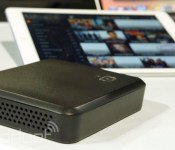
Simple.TV’s streaming DVR now sends shows to your Chromecast

Simple.TV’s streaming DVR is handy if you want to catch up on shows while on the road, but what if you want to watch on a friend’s TV, or don’t have an internet connection at all? Neither should be a big issue following an update to the company’s Android, iOS and web apps. You can now send both live and recorded TV to a Chromecast, so that big-screen experience will follow you outside of the home. And if you travel to a place where internet access isn’t guaranteed, you won’t be deprived of viewing material — it’s now possible to download recordings to a computer (sadly, not mobile devices) in advance. They’re not the biggest improvements, but they make all the difference if you’re scrounging for something to watch while on vacation.
Filed under: Cellphones, Home Entertainment, HD
Source: App Store, Google Play

Eddy Cue: It’s ‘Complicated’ Solving Problems With TV
Eddy Cue, Apple’s SVP of Internet Software and Services, and new Apple employee Jimmy Iovine sat down with Re/code’s Walt Mossberg and Kara Swisher tonight at the inaugural Code Conference and were asked about the much-rumored Apple TV. Cue echoed past Apple sentiments that today’s TV experience “sucks” and that Apple was working on a way to fix it, but that “it’s complicated”.

The problems aren’t complicated. Solving them is complicated, because there are lots of parties involved.
A lot of the problems with TV, according to Cue, are because there are no global standards and because of the complicated rights issues with content, issues that are far easier to deal with in the music industry. Cue does confirm, however, that Apple is talking with various industry players to work on fixing TV.
Specifically, Cue noted that Comcast CEO Brian Roberts “is the best” and that Cue himself is a Comcast subscriber that is able to watch ESPN and HBO on his Apple TV, which he says Apple will keep evolving and improving. He noted that Apple is looking to add even more content. In March, it was reported that Apple was in talks with Comcast about a potential streaming TV service on a future Apple TV.
Despite Steve Jobs biographer Walter Isaacson speculating that Iovine could be key in any potential TV deals, Iovine told Swisher and Mossberg that he was “not going anywhere near TV”. He did, however, acknowledge the challenges of movie curation, pointing to difficulties in finding content to watch on the various video-on-demand platforms like iTunes and streaming services like Netflix.

Google to plug Play Music in UK’s first live music TV ad

Google’s run plenty of ads on UK TV over the years, but its next campaign is set to break new ground for the company and for British TV. AdAge reports that the search giant has teamed up with the UK’s Channel 4 for the first live music performance across a full ad break on UK television. On Friday night around 22:45 local time, singer Sam Smith will belt out his current single Stay With Me live from London’s iconic Roundhouse venue. Beyond Smith getting some priceless promotion for his album, Google’s using the spot to plug its Play Music download and streaming services. It’s on this very store that Google will host the live performance and exclusive tracks shortly after the ad airs. And, if you’re not a Smith fan, well at least it’s three-and-a-half minutes you didn’t have to watch tacky ads for things you don’t need.
Source: AdAge

Amazon’s Prime Instant Video gets its first HBO shows, right on cue

If you’ve been waiting for the day you could marathon The Wire without buying a DVD set or an iTunes pass, your moment has come: as promised, Amazon has rolled out the initial wave of HBO shows on Prime Instant Video. Those shelling out $99 per year (or $79 if you’re lucky) can now stream every season of older series like Deadwood, The Sopranos and The Wire as well as a handful of seasons from ongoing productions like Boardwalk Empire and True Blood. You’ll also get a smattering of comedy specials, documentaries and movies. While you’ll have to remain patient if you want to watch fresher shows, such as Girls or Veep, this is still a big deal if you want to see what you’ve been missing on premium cable TV — or if you’d just like to revisit a favorite episode.
Filed under: Home Entertainment, HD, Amazon
Source: Amazon (1), (2)

BBC will soon show you how green its TV programmes are

In an effort to reward programme makers for doing their bit for the planet, the BBC will soon start displaying a seal of approval on shows that are greener than most. In partnership with BAFTA, the Beeb will award TV programmes that “meet higher environmental standards” with a new “Albert+” certification badge on the credits. To be eligible for the badge, content producers need to have a strong focus on sustainability, share those goals with cast and crew, measure their carbon footprint and take the necessary steps to reduce carbon emissions when filming. Quite the list, but two programmes (From There To Here and Springwatch) have already earned their green (or should it be gold?) stripes and are set to air in the next week. Despite its small beginnings, the BBC and BAFTA hope that other UK producers and broadcasters will follow suit, making Albert+ “the expected standard for all publications.”
Filed under: Home Entertainment
Source: BBC Media Centre

Brazilians will see every blade of World Cup grass on outdoor 4K screens

If you’re in Rio de Janeiro this summer but can’t attend any World Cup matches in person, don’t fret; you may still be in for a treat. Brazilian TV giant Globo is teaming up with Sony to broadcast three live Cup games (a second-round match, a quarterfinal and the final) in 4K quality, and it’s putting 65-inch sets in Rio’s Jardim Botanico neighborhood so that the public can watch. This isn’t the first time we’ve seen live soccer futebol play out in 4K, and there will be a handful of feeds in other countries. However, Globo’s offering promises to be one of the more exciting test runs for high-res sports — particularly for locals determined to cheer on the home team.
[Image credit: AP Photo/Silvia Izquierdo]
Filed under: Home Entertainment, HD, Sony
Via: Bloomberg
Source: Globo (translated)
 AIVAnet