


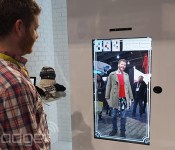
Toshiba’s Virtual Fitting room doesn’t have men’s wear

Toshiba was demoing its Virtual Fitting Room at CES this year. The premise is simple, stand in front of a large display while your image is projected on it. Using a Kinect for motion tracking, Toshiba’s software is able to superimpose various outfits onto your reflected self. Hold your right hand up to change outfits and your left to snap a selfie, that the software then throws up as a QR code so you can grab your pic. Typical of this type of virtual thing the clothes tended to wiggle about and were a bit ill fitting, but they were women’s outfits so we’ll give them a break there. We can see practical applications for trying clothing combinations without having to use a dressing room if you’re in a hurry, for example. Though, we don’t think using it for sizing would be useful at all, which is a large part of a fitting room’s job.

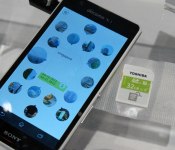
Toshiba’s TransferJet SD cards get NFC previews

Toshiba’s been hawking its Eye-Fi-troubling TransferJet technology for years now, letting you push data from your SD card to your PC without removing it from your camera. Now, however, the company has cooked up a way for users to see what’s on the card without even picking it up off the table. Simply pick up an Android smartphone, activate the company’s companion app, and the built-in NFC will show you up to 16 random thumbnails of the images included therein.
Of course, you’d only really need that sort of feature if you had thousands of SD cards that, for some reason, you hadn’t archived to your computer. That clearly hasn’t deterred the company in gearing this up for retail, and it’s expected to hit stores in the US at some point in February, with other territories given the option of joining in as they see fit. There’s no word on pricing yet, but the company expects it to cost a little more than your average SD card for obvious reasons.

Toshiba joins other tech giants in growing super-clean vegetables

The name “Toshiba” conjures images of stacks of laptops piled high and maybe the occasional television, but the Japanese electronics giant is turning its attention to something just a little more humble: lettuce. Well, spinach too. And swiss chard. Quartz’s Dan Frommer tells the tale of a Toshiba-owned clean room nestled in the industrial corners of Yokosuka where people clad in special suits dutifully plant seeds and plop them on tall racks under an array of fluorescent lights. The end result? Tasty veggies that you won’t need to wash (though if you’re a mild hypochondriac like your author, you’d probably give ‘em a quick rinse anyway).
Toshiba isn’t diving into the world of clean cuisine just because it wants to appease Japan’s gourmands. No no — it aims to produce some 3 million bags of greens a year to help firm up its position as an end-to-end healthcare company. It’s actually pretty brilliant, if a bit paradoxical: Toshiba wants to sell those healthy, pristine greens and the technology (mostly centered around internal imaging for now) that’ll help when something ails you. It’s not the only Japanese megaconglomerate to dabble in a spot of indoor agriculture, either. Sony converted a closed semiconductor factory in Miyagi prefecture into an elaborate growing operation that churns out specially tweaked lettuce that’s chock full of extra beta carotene, and Fujitsu — a massive company that dabbles in some really obtuse stuff — has a room in Wakamatsu churning out low-potassium lettuce for folks with chronic kidney disorders. Forget about hacking gadgets together, maybe the future is in hacking the very stuff that keeps us going.
Source: Quartz
Apple is now the fifth-largest PC maker in the world, if you ask IDC

Apple is historically a small player in the PC world compared to many of its peers, but it may have just entered the big leagues. IDC estimates that the company jumped to 6.3 percent market share in the third quarter of the year, making it the fifth-largest PC builder worldwide — a feat it hasn’t managed in decades. It’s still no major threat to heavy-hitters such as Lenovo (20 percent), HP (18.8 percent) and Dell (13.3 percent), but IDC believes that a combination of slight price cuts and improved demand in “mature” markets like North America have helped it grow in a computer market that’s still shrinking.
With that said, the crew in Cupertino probably isn’t breaking out the party streamers right away. Gartner contends that ASUS claimed the fifth-place spot with 7.3 percent, and that Apple only sits in the top five in its native US. So what gives? In short, it’s a difference in methodology; Gartner and IDC don’t have official shipping numbers from everyone, and there’s enough wiggle room in their estimates that it wouldn’t take much for the rankings to change. As precise as these figures may be, you’ll get a better sense of how Apple fared when it posts its fiscal results (and real shipping numbers) in a couple of weeks.


Filed under: Desktops, Laptops, Apple, ASUS, HP, Dell, Acer, Lenovo
.CPlase_panel display:none;
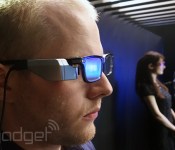
Toshiba’s new prototype is a simpler, lighter Google Glass rival… with a catch

Nearly every tech company wants in on the wearables game, but they can’t all be Google Glass or Apple Watches — not that they have to be. But hey, here’s Toshiba — and it’s got a Toshiba Glass prototype to show off. We’ll say this right at the start: this remains a reference product that the company’s showing off at CEATEC in Japan this week. And yes, technical specifics (let alone a price) aren’t being discussed yet, but the vision for Toshiba’s eye-based wearable prototype is a gentle, predictable one. The hardware is the combination of a tiny projector, attached to admittedly normal-looking frames. However, there’s actually a special kind of one-sided reflective glass to catch the projection. The projection module itself is kind of bulky, but actually lightweight… which is great, until you realize that this prototype requires a constant wired connection to work.
According to Toshiba, there’s no computational component in the arm, which primarily consists of a tiny projector and not much else. There’s no camera, rather Toshiba’s concept would act primarily as a notification system. The concept teaser (and accompanying projected images) offered glimpses of fitness tracker notifications, call reminders and a handful of business-based applications point towards security and warehouse use. Toshiba’s New Business Development Division’s Yuki Kaneko told us that’s a device headed for B2B first: it’s for other companies that also want Toshiba’s system support and other business-type stuff… that we leave to other dustier tech publications.
When we brought up the inevitable Google Glass comparison, Kaneko-san was (surprisingly!) positive about the ever-present wire, citing that it kept the weight down by offloading not only computing (and other frills like cameras), but also the battery. Battery life is thus dependent on whatever device it’s connected to, leaving the wearable lighter and more, well, wearable. The real device will appear next year, but consumer models for us mere muggles will likely be a while after that — for now, this is a business-centered wearable — which probably explains the “goggle edition.” (Our words, not theirs.)

Filed under: Wearables
.CPlase_panel display:none;

Toshiba’s new android ’employee’ uses sign language, speaks Japanese

Toshiba’s newest hire (of sorts) is called Aiko Chihara — and she’s manning a reception desk at the company’s booth at CEATEC 2014 in Japan. Oh, and she’s silcone-coated robot. Interaction isn’t in her repertoire just yet — a Toshiba spokesman said that it was certainly a possibility in the future — as Aiko only came into being last month. There’s 15 actuators inside the head for expression, while yet more are paired with air compressor to give (unerringly) smooth motion to the arms and hands. Toshiba collaborated with several universities, including Osaka University, to develop the robot and its sign language skills are geared for Japanese (with voice commands narrating along with it). While the bot is lifelike and fluid, there’s no intelligence to speak of: actions are all preprogrammed. The company says that there are also plans to teach Aiko American Sign Language in the future, as well as hoping to install the android and its (sign) language skills at other exhibitions and shows in the near future — something that a handful of other robots are already being tasked with. We’ve got video-based glimpse of the uncanny valley right after the break.
Filed under: Robots
.CPlase_panel display:none;
Toshiba’s shift away from consumer PCs means 900 lost jobs

Toshiba has been slinging Satellites and Qosmios and Kirabooks for basically ages now, but its days a purveyor of consumer computers may be winding down in a market near you. According to a statement the company issued last night, it’s shifting its focus a bit — the big priority is now crafting PCs to woo business customers, and Toshiba’s going to cut about 900 jobs as part of the transition. Don’t fret too much, though: Toshiba might be looking to streamline its consumer computer operations, but it’s not going to give up entirely. To hear them tell it, the new Toshiba will “withdraw from unprofitable markets” and continue bringing those consumer-friendly PCs to developed countries, though we’re still not sure how its mix of gadgets will wax and wane ’round those parts. The move will be a somber one in some places (especially for anyone who’ll soon be out of a job) but there’s not much else to be done — the global PC market may not be shrinking as fast as some thought it would, but the seas are still rough for companies trying to plot a course to PC profitability.
Via: ZDNet
Source: Toshiba
.CPlase_panel display:none;
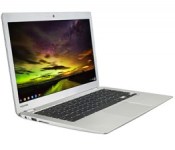
Toshiba tosses out their Chromebook 2 with 11.5 hour battery on a 13.3-inch HD screen
The Chromebook battles are finally starting to get a little interesting. Over the last few months there have been some pretty interesting Chromebook devices to come from a variety of OEM’s. Lenovo pushed out the N20p convertible and Acer announced the ChromeBook 13 with the NVIDIA Tegra K1. Toshiba is stepping back into the ring with their aptly named Chromebook 2.
 Spec wise you are looking at:
- 13.3-inch 16:9 display in either a 1366 x 768p offering or a 1920 x 1080p offering
- Intel Celeron Processor
- 16GB internal storage
- 100GB free Google Drive storage
- 4GB DDR3L or 2GB DDR3 RAM (model dependent)
- 1 HDMI out
- 1 USB 2.0
- 1 YUSB 3.0
- SD/SDHC card slot
- Headphone/mic combo jack
- 802.11ac+agn
- Bluetooth 4.0
- HD Webcam with dual mics
- Skullcandy stero speakers
- 11.5 hours battery life on the 768p version and 9 hours battery life on the 1080p version
Toshiba has the new Chromebook 2 pegged for an October 5th release here in the states with a price tag of $249.99 on the 2GB of RAM 768p version and $329.99 for the 4GB of RAM 1080p version.
Source: Toshiba Press
//<![CDATA[
ord = window.ord || Math.floor(Math.random()*1E16);
document.write('‘);
//]]>
The post Toshiba tosses out their Chromebook 2 with 11.5 hour battery on a 13.3-inch HD screen appeared first on AndroidSPIN.
.CPlase_panel display:none;
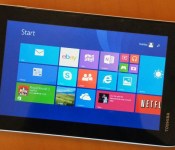
Toshiba gets aggressive with a $120, 7-inch Windows tablet

Over the years, Windows tablets have been getting smaller and smaller — and cheaper and cheaper. Well, surprise! They’re getting tinier, and we’ve just about hit bargain-basement pricing. Toshiba just announced the Encore Mini, a 7-inch slate that will sell for just $120 — an aggressive move, considering 8-inch models hover around the $200 mark. Technically speaking, the Encore Mini is not the cheapest Windows tablet out there, but it’s definitely the lowest price we’ve seen from a tier-one brand. For the money, you get full Windows 8.1, though the specs are, as you’d expect, pretty low-end. These include a 1,024 x 600 display, a quad-core Intel Atom Z3735G processor with 1GB of RAM, 16GB of built-in storage and dual 2MP/0.3MP cameras. At 0.78 pound, it’s heavier than, say, the 7-inch Galaxy Tab 4 Nook, which we just reviewed, but either way, you shouldn’t have a problem toting it around.
On a bright note, Toshiba is throwing in 1TB of One Drive storage, free for one year, and there’s also a microSDXC slot that takes cards up to 128GB. One year of Office 365 service is included too. Additionally, Toshiba worked with Microsoft to optimize the scaling, so that even when you’re in desktop mode, on-screen objects should still be big enough to hit with your fingers. This worked well in my hands-on, but then again, I have slender fingers, so maybe take that with a grain of salt. In any case, if you’re tempted, it’s available now.
Filed under: Tablets
.CPlase_panel display:none;

Toshiba intros a slimmer Chromebook, budget Windows convertible

Toshiba isn’t showing off a whole lot here at IFA, Europe’s biggest trade show. That said, the stuff it has announced at least manages to run the gamut. Today, for instance, the company unveiled both a slimmed-down Chromebook 2 and the Satellite Radius 11, a small-screened Windows convertible. Starting with the former, the Chromebook 2 has the same 13-inch screen size as its predecessor, along with the same textured plastic design. This time, though, it’s thinner and lighter, at 2.95 pounds, with the sort of compact dimensions you’d expect to find on a 12-inch system. Toshiba bumped up the resolution too, so that you can now get it with a 340-nit, 1,920 x 1080 IPS panel (the base model still has a 1,366 x 768 display). Depending on the resolution, you can expect either 11.5 hours of battery life on the lower-res version, or nine hours with full HD. In addition, Toshiba added Skullcandy audio. The firm seems proud of it, but after a few minutes of hands-on time, I actually found the sound to be rather tinny (it is loud, though).
Other changes include faster 802.11ac WiFi and dual array mics, though the port selection is otherwise the same (USB 3.0 and 2.0, HDMI and a full-sized SD slot). All told, it seems like an improvement, except for one thing: Toshiba downgraded the processor from a Haswell-series Celeron CPU to a Bay Trail one (the N2840, to be exact). If our review of the ASUS C200 Chromebook is any indication, using a chip like this would seem to be a step down in speed, but who knows? Maybe Toshiba found a way to better optimize performance, especially on the 1080p edition, which has four gigs of RAM instead of two. Really, though, it seems like the company had to cut corners to squeeze in a full HD display and still keep the price down. This would seem to be the place where Toshiba chose to make some sacrifices.

The Satellite Radius 11, meanwhile, is a follow-on to the 15.6-inch Satellite Radius, which came out earlier this year. Both have a Lenovo Yoga-like design, with a 360-degree hinge allowing the screen to fold back into tablet mode, tabletop mode (with the screen flat), stand mode (with the screen facing away from the keyboard) and tent mode (with the laptop balanced upside down). Similar to the Yoga, too, the keyboard locks up when you’re not in clamshell mode, to avoid accidental button presses.
But while the Radius 11 mimics the design of some full-fledged laptops, it has the guts of a netbook: Bay Trail-series Celeron and Pentium CPUs, and either a spinning HDD or a small flash drive, similar to what you’d find in a Chromebook. Aside from what’s sure to be a low price, the benefit to having a low-powered processor like this is long battery life. The chassis has a smooth, fanless look too, if that matters to you. No word yet on how much this will cost, but if Toshiba is smart, it’ll price this against other 11-inch convertibles like the Dell Inspiron 11 3000 and HP Pavilion 360, both of which start at $400. (Just sayin’, Toshiba!)
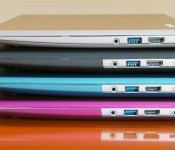
The Chromebook 2 will go on sale in the US on October 5th starting at $250 for the base model and $330 for the full HD version. It’ll be available in Europe as well, but later on in Q4. You’ll also be able to buy optional two-piece plastic cases in a variety of colors, as you can see in the shot above. The Radius 11, meanwhile, will arrive in late October or early November. Again, no word on price just yet. In the meantime, we’ve got hands-on shots aplenty. Check ‘em out.
Filed under: Laptops
.CPlase_panel display:none;
 AIVAnet