


NTT DoCoMo’s Fujitsu LOOX F-07C goes official, dual-boots to Windows 7 and Symbian

Yes, ’tis quite a shock for a Monday morning, but it turns out the dual-booting Fujitsu LOOX F-07C smartphone is indeed legit. According to NTT DoCoMo’s preliminary spec sheet, this 7.69-ounce landscape slider handles both Symbian and Windows 7 (Home Premium, 32-bit Japanese edition) with its 4-inch 1,024 x 600 LCD (that’s 297ppi right there!), along with a 1.2GHz Intel Atom processor, 1GB of LPDDR400 RAM, 802.11b/g/n WiFi, 32GB of eMMC disk space, and expandable memory via microSDHC. You’ll also find a 5 megapixel autofocus camera with face detection on the back, coupled by a VGA front-facing camera. Of course, the main concern is how the battery life fares here: we’re told that in “mobile phone mode” you get up to 600 minutes of standby time (the sheet quotes hours, but it’s a mistake) and up to 370 minutes of 3G talk time; whereas in Windows 7 mode you’ll have to make do with just two hours, and then you’re forced into mobile phone mode when the battery level is low. If you’re itching to get yourself an eccentric F-07C, then watch out for its launch in June or July. Full list of specifications and press release after the break.
ASUS preparing Eee Slate B121 – business edition EP121

ASUS’ 12-inch Eee Slate EP121, with its combination of Windows 7 and Wacom active digitizer and IPS display has attracted a lot of attention especially in niche education and graphic design markets and no doubt business folks, so the company preparing a business version, the Eee Slate B121 seems like a natural progression. First spotted up on the ASUS driver pages and then mentioned during an interview with ZDnet by ASUS business operation manager Bernard Wen. No details out yet but it will have Windows 7 Professional.
Android 3.1 on the Motorola Xoom: hands-on (video)
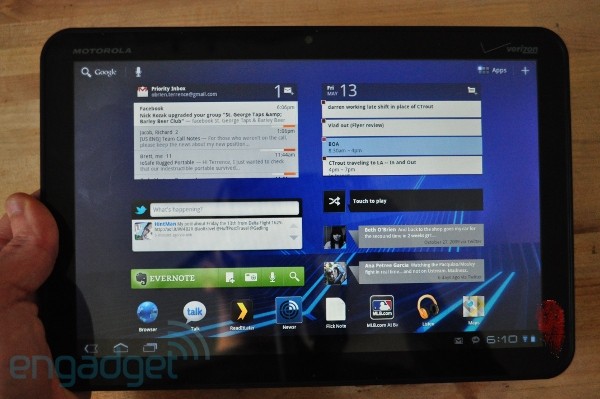
That Android 3.1 update that Google announced during I/O is slowly rolling out to 3G Xoom owners as we speak. How’d we know such a thing? Why, it just landed on our in-house Xoom, of course! Most of the changes to Honeycomb are happening under the hood — better HTML5 support, faster performance, and USB host functionality for connecting peripherals like game controllers and mice — but there are some improvements that will be a lot more obvious to the user. Perhaps our favorite is the addition of resizable widgets. For the moment only the email and Gmail inbox, calendar and bookmarks widgets can be stretched or shrunk, but we’re sure others will follow. We’re particularly appreciative of the expandable calendar widget, which always felt a tad cramped. The task switcher also received a much requested upgrade and now lets you scroll through your last 18 launched apps, instead of just the five most recent. Lastly, the Android Market now offers movie rentals, alongside books and apps, which range in price from $1.99 to $4.99 for 24 hours of playback. There isn’t a ton of revolutionary stuff going on here, but it’s certainly a welcome and worthwhile update. Check out the video after the break to see Android 3.1 in action.
via Android 3.1 on the Motorola Xoom: hands-on (video) — Engadget.
Fujitsu’s TH40/D convertible tablet slides into Japan, packs Atom Z670 and Windows 7

A slide-out tablet running on Windows 7, you say? Not to be confused with the Samsung Sliding PC, what we have here is the Fujitsu LifeBook TH40/D that’s just been announced for the Japanese market. Inside this 2.4-pound convertible laptop you’ll find a 1.5GHz Oak Trail Atom Z670, 1GB of non-expandable DDR2 RAM, a 10.1-inch 1,024 x 600 touchscreen, a 120GB 4200rpm hard drive, and a battery life of around 6 hours. Other tidbits include 802.11b/g/n WiFi, Bluetooth 3.0, a couple of USB 2.0 ports, HDMI-out, an SD card slot, and a teeny optical trackpad placed next to the short space bar. Can’t say we’re digging some of the limitations on this TH40/D, but if you still want one, then be ready to fork out about ¥80,000 ($990) at the end of June.
via Fujitsu’s TH40/D convertible tablet slides into Japan, packs Atom Z670 and Windows 7 — Engadget.
HTC Flyer available across Europe today, £600 for 3G, £480 for WiFi-only version

The day every fan of 7-inch Android tablets has been waiting for has finally arrived. HTC has just announced widespread availability across Europe of its 1.5GHz Flyer. Pricing is set at £600 / €649 for the 3G-equipped 32GB variant or £480 / €499 for the one with only WiFi and 16GB on board — though local carriers are offering subsidized pricing as low as £129 on contract. The contentious capacitive stylus, now dubbed the Magic Pen, will be shipping in each and every box, so you don’t have to worry about ponying up extra for it. The HTC store linked below still offers only pre-orders, but HTC promises that there will be aluminum unibodies hitting shelves today.
HTC Flyer spec sheet leaks with Android 2.3, stylus and 7-inch screen?
 Wondering what sort of goodies might be inside HTC’s upcoming tablets? Norwegian tech site Amobil isn’t — they claim to have a pair of inside sources spoon-feeding them all the pertinent details. For the rumored HTC Flyer — which may or may not be pictured at right — that includes the same 1GHz Qualcomm MSM8255 chip you’ll find in several high-end handsets, 1GB of RAM, as well as a 7-inch, 1024 x 600 capacitive touchscreen, a front-facing 1.3 megapixel camera and a rear 5 megapixel imager, and a piddling 4GB of flash storage to hold all your apps (which sounds a little fishy to us). There’s also allegedly 3G for data and Skype calls, an HDMI port, DLNA support and a bonafide stylus to write with, though it’s not clear whether we’re rumoring a fancy N-Trig display or simply a pack-in capacitive pen.
Though Amobil’s sources say the tablet will be sadly limited to Android 2.3 out of the gate, it will allegedly have a brand-new tablet version of HTC’s Sense UI designed to provide a “desktop feel,” which might be a nice pairing for the “HTC Sensation” trademark presently floating about the internet. If so, don’t expect that UI to be limited to a single slate, though — the last part of this oh-so-juicy rumor is that HTC’s also supposedly got a 10-inch LTE tablet (perhaps the Scribe?) arriving in the second half of the year.
Hands on with the Motorola Xoom tablet for Verizon
 There’s been a ton of buzz around CES over Motorola’s newly-announced Xoom tablet, running Honeycomb and coming to Verizon’s network. We stopped by the Motorola booth, and were able to get a brief walk-through of Motorola’s new baby, and we must say, it looks incredible. The Xoom includes:
- Nvidia Tegra2 1GHz dual core processor
- 1GB DDR2 RAM
- 10.1inch capacitive gorilla glass touch screen display
- 1280 x 800 resolution
- 802.11n WiFi
- Bluetooth 2.1 + EDR
- 5 mega pixel camera with limited auto focus
- 32GB storage capacity
- 720p Video Recording
- Adobe 10.1 flash
- HDMI port connectivity
We’ve got a video rundown and full photo gallery of this new device, and we want to know your thoughts on the Xoom. So, be sure to hit the break to check out the video and photo gallery, and leave your thoughts in the comments.
Gigabyte shows off its new S1080 Windows 7 slate in Taiwan to little fanfare and even less excietment
 So, while all the cool kids were showing off their wares at CES, the good people at Gigabyte decided to throw their own tablet party across the Pacific. The S1080 is the slate you never asked for, in that it runs Windows 7 on a dual core Atom N550 processor underneath a 10.1-inch capacitive touchscreen with 1024 x 600 resolution. If multitouch navigation isn’t your thing (an odd preference for those buying tablets), there are a couple of tactile mouse buttons on one edge and an optical mouse on the opposite side for thumbs-only operation. The device has a massive (for a tablet) 320GB hard drive, SD card reader, ethernet port, and USB 3.0 connectivity to sate your computing needs. Also included is a 1.3 megapixel webcam, 802.11b/g/n WiFi, and Bluetooth 3.0. Lastly, in what can only be considered an odd design choice, our Taiwanese friends elected to give the S1080 a VGA port instead of an HDMI connection. Word on the street is that the device will be less than $300 when it goes on sale next month, so if you are a member of the (presumably small) group of people who aren’t interested in an Android, Apple, Blackberry, or HP slate, the S1080 may be the tablet for you.
Asus Eee Pad Android tablet might have a sliding keyboard
 Those teaser pics of the Asus Eee Pad upcoming tablets with Windows and Android last week definitely had something going on about them. One of them clearly showed a keyboard attached to the tablet, and in another one two halves were present. Then we deduced that it is most likely a detachable keyboard shot at different angles, similar to the accessory for the Windows 7 Asus EP121 with the 12″ screen.
Taiwan’s Central News Agency has reported now that actually both scenarios are in place for Asus tablets, that are to be announced at CES as soon as tomorrow. The Android tablet is supposed to feature a slide-out keyboard, and the Windows slate will have a detachable keyboard as a separate accessory.
Sounds quite innovative already, and its Eee Pad tablets also sport slick design and high-end specs like USB 3.0 (for the Windows version). Well, we know Asus is aiming for double digit share of the non-iPad tablet market this year, and that will not be easy to achieve with anything less.
Asus is said to release six tablets in total this year, and they will most probably be shown at CES, where we will be scouring the floors, so stay tuned for more updates on this and other tablet surprises
Toshiba announces unnamed Tegra 2-powered Android tablet, waits only for Honeycomb
 Let the Tegra 2-powered, Android Honeycomb tablet announcements begin! Apparently (andunderstandably) staying away from a Folio 2 moniker, Toshiba is kicking off CES with its new unnamed 10.1-inch Android tablet, and we have to say from our brief look at a non-working unit a few weeks ago, it may just have what it takes to stick out from the rest.. at least on the spec and manufacturing quality front. The tablet has a capacitive, high 1280 x 800-resolution display along with an accelerometer and ambient light sensor (or what Toshiba has dubbed as Adaptive Display technology). It also has a 5 megapixel rear camera as well as a 2 megapixel front-facing one. Yep, this one is well stocked and just a quick look at the pictures below will show that the slab has got full sized USB and HDMI jacks, a single mini-USB socket, and an SD card slot.
While we couldn’t turn on the dual-core Tegra 2-powered tablet, which will eventually run “the next version of Android designed for tablets” aka Honeycomb, we have to say the EasyGrip, spill-resistant, rubberized back felt really solid in hand and the 1.7-pound, .6-inch thick tablet felt comparable to the iPad in terms of portability. Oh, and did we mention that the aforementioned rear cover is swappable, so not only can you change its color but you can replace the battery? We told you it had some of the ingredients to make it go far, but we’re obviously lacking quite a bit of information here to make any further decisions. Toshiba’s maintaining that the tablet will be released in the first half of 2011 and the pricing will be competitive, but we’ll be digging for more when we get to Vegas and hopefully reporting back with some impressions of a working unit.
 AIVAnet