


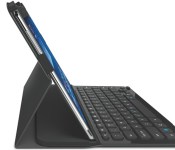
Logitech rolls out full-size keyboard case for Samsung’s Galaxy Note Pro and Tab Pro

Are you already planning to buy a Samsung Galaxy Note Pro or Tab Pro, but are worried that your mammoth tablet might go unprotected? Never fear, as Logitech has just unveiled a new Pro keyboard case that will shelter the 12.2-inch versions of both slates. While the design will look familiar to anyone who has seen one of Logitech’s earlier folios, the Pro’s extra space allows for a full, laptop-sized keyboard with a dedicated row of app shortcut keys. You will be paying a premium for going big, though, as the case will sell for $130 when it ships to the US in February.
Filed under: Peripherals, Tablets, Samsung
Source: Logitech

ASUS’ Transformer Book Duet can switch between Android and Windows as a laptop or tablet

If you’re looking for a dual-booting convertible but find ASUS’ Transformer Book Trio a little too clever, you’ll want to check out the company’s just-unveiled Transformer Book Duet TD300. The 13.3-inch PC is really a dual-OS tablet that bundles a keyboard dock with its own hard drive and ports — whether you’re in laptop or tablet mode, you can switch between Android 4.1 or Windows 8.1 on the fly. The slate includes up to a 1080p display, a Core i7 processor and 128GB of solid-state storage; attach the dock and you’ll get up to 1TB in disk space alongside USB, Ethernet and HDMI. ASUS plans to ship the Duet to Asia and Europe late in the first quarter of the year, and to the US by late in the second quarter. When it does ship stateside, the system will start at $599 for a Core i3 model with an “HD” (read: 1,366 x 768) screen, and $699 for a 1080p unit.
Filed under: Laptops, Tablets, ASUS
Source: ASUS

ASUS reveals the VivoTab Note 8, an 8-inch Windows tablet with Wacom pen input

ASUS’ VivoTab Note 8 has been one of CES’ worst-kept secrets, but we’re still glad to see that it’s finally official. The 8-inch Windows 8.1 tablet is a direct foil for Dell’s Venue 8 Pro, and includes a familiar-sounding 1,280 x 800 IPS display, 2GB of RAM, a 5-megapixel rear camera and an HD-capable front cam. Most of the differences revolve around its namesake pen input; the VivoTab includes a Wacom stylus that can handle 1,000 pressure levels, arguably trumping Dell’s less sophisticated (and purely optional) approach. An ever-so-slightly faster 1.86GHz Bay Trail Atom chip doesn’t hurt, either. The tablet should ship either late in the first quarter or early in the second, with prices starting at a frugal $299 for a 32GB model and climbing to $349 for a 64GB edition.
Source: ASUS

ASUS PadFone Mini coming to the US for $249

ASUS is giving American tablet fans more than the PadFone X — it just revealed at its CES event that the PadFone Mini will also be coming to the US for $249. The 4-inch smartphone and 7-inch tablet combo that will reach the US isn’t quite the same as what surfaced in Taiwan, though. This version touts a phone with 1.6GHz dual-core Atom Z2560 chip, 8GB of storage and an 800 x 480 display rather than the Snapdragon, 16GB of space and 960 x 540 display from before. ASUS hasn’t said exactly when we’ll see this new Intel-powered PadFone, but we’ll keep you updated.
Filed under: Cellphones, Tablets, Mobile, ASUS

Mozilla kicks off Firefox OS tablet developer program, teases new ZTE phones

As it turns out, Mozilla’s Panasonic smart TV deal is just the start of its Firefox OS plans for this year. The web pioneer has just unveiled a tablet developer program that will give dedicated contributors both reference hardware (initially from Foxconn) and other resources; they’ll help create the tablet-native Firefox OS in the same communal fashion that Mozilla builds its desktop browser. The firm tells us that it wants to start the program shortly after CES, with a goal of finishing its slate interface sometime this year.
The company is also providing the first details of ZTE’s second-generation FFOS smartphones. The Open family is expanding to include two upgraded models, the Open C and the dual-core Open II; there isn’t much more to say at this point, although we should learn more in the near future. If you’re looking for something more tangible, you’ll be happy to hear that VIA Technologies has released a version of its tiny APC Rock desktop PC with Mozilla’s OS pre-installed. The bare system is available by itself for $59, while those who want it in a recycled case (Paper) will pay $99.
Filed under: Cellphones, Desktops, Tablets, Mobile
Source: APC (1), (2), Mozilla Blog

Samsung ad outs Galaxy Note Pro and Galaxy Tab Pro ahead of CES

In the days leading up to CES, there are always a few unfortunate products that are prematurely outed by banners being put up over night. In this case, the victims are Samsung’s upcoming Galaxy Note Pro and Galaxy Tab Pro, as shown by this massive ad at the South Hall of Las Vegas Convention Center. Stylus and SIM card slot aside, it’s hard to tell what else the pictured Galaxy Note Pro has to offer. Its screen size is also a mystery here, though rumors are pointing at 12.2 inches, which would make it Samsung’s largest mobile tablet to date. According to an earlier report by SamMobile, the Galaxy Tab Pro will come in two smaller sizes: 8.4 inches and 10.1 inches. All shall be revealed at Samsung’s press conference in Las Vegas tomorrow afternoon, so stay tuned.

Qualcomm shows more of the Snapdragon 805’s camera and pen tricks (video)

Can’t make it to CES to see the Snapdragon 805 processor flex its muscles? You won’t have to. Qualcomm has posted a slew of videos showing what the chip can do for photography, including automatic close-ups through OptiZoom, continuous focusing on a subject through Touch to Track and natural-looking low-light shots through Chroma Flash. The CPU can even begin recording video as soon as a subject crosses a line, such as at a race. As a bonus, the company has also demonstrated Ultra Sound NotePad, a refinement of an earlier technique that uses microphones to translate a pen’s ultrasonic vibrations into on-screen handwriting. It could be a while before you’re trying any of these features on a shipping device, but the clips should at least prepare you for the real thing.
Via: Liliputing
Source: Qualcomm (YouTube 1), (2), (3), (4)

Hands-on with Acer’s 2014 Iconia Android tablets

Acer’s been quick to make its immediate plans for the new year known, including the impending release of its refreshed Iconia Android tablets. Today the company’s been kind enough to show the new slates to us, both of which will ship with 4.2 Jelly Bean. The A1-830 is the more premium of the pair, and to give you a quick reminder of the specs, it sports a 1.6GHz dual-core Intel Atom processor, 1GB of RAM, 16GB of internal storage (don’t worry, there’s a microSD slot if you need more), and 5-/2-megapixel cameras. With its 4:3 aspect ratio and 1,024 x 768 display, you’d be forgiven for mistaking it for a iPad mini from afar — the form factor is deceptively similar. It sits at the top of Acer’s tablet range, and fittingly, has an aluminum back to prove it. It doesn’t look half bad, either, although the plastic which encroaches the top edge, framing the camera, kind of ruins the upper-end look. The screen appears to be relatively good quality and it feels solidly built. With a noticeably thin profile, it gives a good first impression. Its specs might be of a mediocre standard, but the price makes up for it. When the tablet hits the North American market in late Q1 2014, it’ll set you back $149, which we wouldn’t say is an unfair ask after out brief flirtation with the hardware.
Acer’s refreshed Iconia B1 tablet (aka the B1-720), which falls in behind the A1, didn’t score nearly as high in our estimation, however. There’s a lot of bezel surrounding its 7-inch, 1,024 x 600 display, making the screen look smaller than it really is. Spec-wise, it’s not all that different from the A1. You’re looking at a 1.3GHz dual-core Mediatek CPU, 1GB of RAM, 16GB of storage (microSD-expandable), and only a 0.3 megapixel front-facing camera. It’s significantly thicker than the A1 and swaps the aluminum backing for textured plastic. You can squeeze a fair few creaks out of it; in general, it feels leagues behind the build quality of the A1. The screen, too, is of noticeably lower quality, but then again, it’ll only be $130 when launched in black and red hues later this month. If you want 3G connectivity on top of WiFi, a SIM-friendly model (B1-721) will be available soon after, but it’ll arrive for at least a $50 mark-up.

Acer made a last-minute pricing adjustment to the A1, bringing the cost down from $180 to $149. While that’s great for enticing eyes to the A1, it has a completely different impact B1. Given there’s been no price adjustment for the lower-end slate, we’d highly recommend chucking the extra 20 bones down for the altogether better tablet.
Alexis Santos contributed to this report.
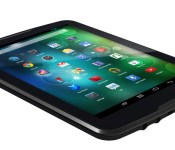
Polaroid’s Q-series Android tablets offer a taste of KitKat starting at $129

Polaroid isn’t known as a technology vanguard, but it’s showing a little forward thinking today with the launch of three budget tablets. The 7-inch Q7 (pictured below), 8-inch Q8 (above) and 10.1-inch Q10 all run Android 4.4 KitKat out of the box, giving them a slight edge over more advanced devices that are still running older software. Not that they’ll be especially noteworthy otherwise. All three ship with unnamed (but likely low-end) quad-core processors, and HDMI video is the only real standout feature. You may forgive the modest specs when you see the pricing, however. The Q series will sell at prices between $129 and $179 when it ships in the spring, which makes it one of the cheapest ways to try Google’s latest mobile OS.

Filed under: Tablets
Source: Polaroid
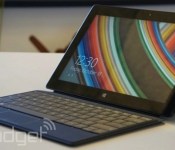
Surface Pro 2 tablet gets a quiet speed bump to 1.9GHz

Sometime, it pays to avoid the bleeding edge of technology. Microsoft has confirmed to The Verge that newer Surface Pro 2 tablets are shipping with a faster 1.9GHz Core i5 inside instead of the 1.6GHz chip that came with the earliest models. The company isn’t saying just why it rolled out the stealthy upgrade, although it notes that “routinely” tweaks designs based on part availability and customer value. The move may frustrate early adopters whose two-month-old Windows slates are already behind the times, but it’s good news for latecomers who’ll get more for their money.
Filed under: Tablets, Microsoft
Via: The Verge
Source: Microsoft Community
 AIVAnet