


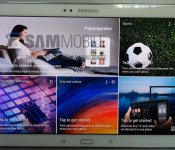
Samsung Galaxy Tab S 10.5 poses for the camera

Samsung shows no signs of stopping when it comes to pushing everything they come up with to the market, this is not exception.
We’ve recently posted some details regarding Samsung’s new tablet and this time around we bring you some pictures of said device. Samsung Galaxy Tab 10.5 posed for some pictures and it looks really similar to Galaxy TabPRO/NotePRO 10.1 tablets they launched earlier this year, Samsung decided to go back to OLED displays, at least in this case. In comparison to Galaxy TabPRO and NotePRO’s LCD panel this device is going to feature an AMOLED panel, 2560×1600 in resolution.
Judging by the pictures, Samsung Galaxy Tab S 10.5 is going to have a textured back, similar to the one on Samsung Galaxy S5. Front side of the device also follows the same pattern as previous devices along with the hardware button which looks the same as the one on previous tablet devices. In other specifications the tablet will come with an octa-core Exynos 5420 CPU with four 1.9GHz Cortex-A15 cores and four 1.3GHz Cortex-A7 cores, usual array of sensors, IR blaster, Samsung’s Magazine UX and Android 4.4 KItKat. You can find more details in a linked posted above.


SOURCE: SamMobile
The post Samsung Galaxy Tab S 10.5 poses for the camera appeared first on AndroidGuys.

Samsung’s next Android tablet looks like a supersized Galaxy S5

Samsung has already launched a cavalcade of new Android tablets this year, but it looks like the company isn’t quite done yet. SamMobile claims to have the first photos of the Galaxy Tab S 10.5, a recently rumored Android design that would mark Samsung’s return to slates with OLED displays. As the name suggests, it would have a 10.5-inch, 2,560 x 1,600 AMOLED panel that promises higher contrast and bolder colors than an LCD; there’s reportedly an 8.4-inch equivalent in the works, too.
However, the hardware surrounding that display may be as much of an attention-getter. Where the Tab Pro range aped the Galaxy Note 3, the Tab S looks like a Galaxy S5 writ large — you’d get the same dimpled plastic back and, apparently, the same fingerprint sensor. Connectors on the back also hint at a possible smart screen cover. About the only disappointment may be the performance, since there’s talk of the Tab S carrying the same 1.9GHz Exynos 5 Octa processor that we saw in the Tab Pro early this year. Assuming the leak is accurate, the biggest mystery may be when this (mostly) upgraded device hits store shelves.
Via: Liliputing
Source: SamMobile

Tesco to launch an Android smartphone alongside the Hudl 2 later this year

After accumulating more than 500,000 sales of its first ever own-brand tablet, the Hudl, supermarket giant Tesco is to expand its device line-up by launching a high-powered Android smartphone. Speaking to BBC Radio 5 Live, chief executive Philip Clarke confirmed that the company’s upcoming handset will feature hardware comparable to Samsung’s Galaxy S5 and, like the Hudl, come preloaded with Tesco apps and services. Speaking of the tablet, Clarke also said Tesco will release a refreshed version of its discount slate, appropriately named the Hudl 2, in September. While the tablet has been priced at the low end of the market at £119 (even less if you used ClubCard vouchers), Tesco’s smartphone is expected to command a higher price to match its specifications. That might make the handset less of an impulse buy, but Tesco says it will still price the handset aggressively, allowing shoppers to pop a couple of Android devices into their trolley alongside their bread and milk.
Filed under: Cellphones, Tablets, Mobile
Source: BBC News

Chairman tries to boost confidence in Acer as he slips out the back

Six months ago, the co-founder of Acer stepped out of retirement to take up the positions of Chairman and CEO, with the intention of turning the embattled PC maker’s fortunes around. Stan Shih now claims that he’s succeeded in this mission, and that people’s confidence in the company should be restored by the end of 2014, with a full-fledged “return to glory” to be expected within three years. He won’t be sticking around to see if any of that happens, however: The 69-year-old has already handed over the chief exec’s reins (twice), and now he’s decided to give up the chairmanship too. As of June, he’ll retreat to the relative obscurity of Acer’s cloud department. He’ll oversee the company’s effort to make money from its “Build Your Own Cloud” service, based on the idea that customers may want to store their data centrally but privately, rather than on someone else’s servers. Ultimately, though, Acer’s future still rests on its hardware, and its most recent products — the Switch 10 and Iconia Tab 7 — look a lot like business as usual.
[Image credit: CEIBS]
Filed under: Laptops, Tablets, Acer
Via: PC Advisor (IDG)
Source: PC Advisor (IDG)
Laptop mode finally returning to the ASUS PadFone line

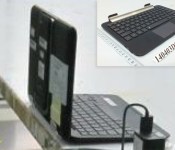
When we last hung out with ASUS CEO Jerry Shen, the exec expressed his support for bringing back the keyboard dock to the PadFones, which would mean you’d get three form factors with one product: a phone, a tablet and a laptop. Now, we have a leak confirming that this is definitely in the works. Courtesy of an FCC document dug up by our friends at Mobile Geeks, we’re looking at an “ASUS Mobile Dock Keyboard” (PF-06 or “TransBoard”) which, for a change, uses Bluetooth instead of a physical docking interface.
Judging by the above blurry photo plus its matching 25cm width, the dock appears to be designed for (and lab-tested with) the upcoming PadFone X for AT&T. However, the lack of locking mechanism suggests it might accommodate other similarly-sized PadFone Station tablets as well, though there’s no telling how secure the fit would be.
More interestingly, it appears that for the sake of keeping the dock lightweight, ASUS has opted to leave the bulky battery out, meaning you won’t be able to charge up the phone and tablet with the dock. Instead, you’ll only find a tiny 450mAh cell that powers the Bluetooth radio plus the multi-touch trackpad, and you’ll need to charge it up separately via the dock’s micro-USB port. And of course, there’s no SD slot here, so you’ll need to rely on USB OTG to plug in a memory card.
Despite some missing features compared to the original keyboard dock, we’re certain that this is still music to the ears of PadFone fans. We should hear more at Computex early next month, so stay tuned.
Filed under: Tablets, Mobile, ASUS
Via: Mobile Geeks
Source: FCC

Tablet demand hits a wall as many are happy with the devices they own

It looks like Apple wasn’t the only tech firm to see its tablet business take a hit this winter; according to IDC, others suffered a similar fate. The analyst group estimates that overall tablet shipments grew just 3.9 percent year-over-year in the first quarter, a sharp contrast with the breakneck pace of the past few years. Amazon took a particularly severe blow, as its shipments dropped almost 50 percent. So what prompted the suddenly chilly market? If you believe researchers, many are happy with the devices they’ve got — they either have a good-enough tablet or a big-screen smartphone that will do in a pinch. Simply put, there was no compelling reason to splurge on something new.
It wasn’t all doom and gloom. Samsung’s shipments grew by a third, in part because it encouraged carriers to bundle cellular tablets with smartphones. Lenovo’s success with slates also continued unabated. While it’s still relatively small in this field compared to Apple or Samsung, its unit numbers more than tripled in the past year thanks to hits like the Yoga Tablet. These are shipments and not sales, so they don’t tell a complete story — Apple claims that pent-up iPad mini demand skewed its figures last year, for instance. Even with that in mind, it’s evident that tablet makers will have to fight harder to capture people’s attention.

Filed under: Tablets, Apple, Samsung, ASUS, Amazon, Lenovo
Source: IDC
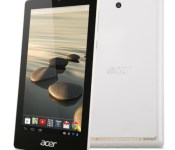
Acer introduces Iconia Tab 7 and Iconia One 7 tablets

Acer have today announced their new Iconia Tab 7 and Iconia One 7 tablets at its “A Touch More Connected” event in New York.
The Iconia Tab 7 is a tablet combined with phone functionality and 3G connectivity all in a 7-inch screen. The device is 0.89cm thin and 11.6cm wide, weighing in at only 298 grams. It comes in two screen options: a 7-inch 1280 x 800 HD resolution or an IPS display. In addition, the Iconia Tab 7 has a quad-core processor and dual cameras with Android 4.4 KitKat, touting 6 hours of battery life. The Acer Iconia Tab 7 will be available in Latin American markets at the end of June with prices starting at $1,990 MX Peso; in Europe, Middle East and Africa middle of May with prices starting at €149.
The Iconia One 7 features a dual-core Intel Atom Z2560 processor, 7-inch LED-backlit display at 1280 x 800 HD resolution. In addition, the tablet touts 7 hours battery life when viewing 720p video at 16:10 display ratio, and runs Android 4.2 Jelly Bean. Acer are also offering the Iconia One 7 in a variety of colours including red, white, black, blue and pink. The Acer Iconia One 7 will be available in Pan American markets at the end of June with prices starting at US$129.99; in Europe, Middle East and Africa middle of May with prices starting at €139.
The post Acer introduces Iconia Tab 7 and Iconia One 7 tablets appeared first on AndroidGuys.

AMD wages benchmark war on Intel’s tablet chips

For all the success AMD has been having in the console and PC graphics spheres, none of it has really translated into the world of Windows-based tablets and ultraportables. The chip maker insists that’s going to change in 2014, however, and it has released a number benchmarks showing that its latest processors have a lead not only over AMD’s previous generation, but also over the Intel chips that currently reign supreme in these form factors.
We won’t bore you with a gabble of numbers when you can check out charts for yourself in the gallery below, but the main curiosity here is probably the 4.5-watt tablet platform, known as “Mullins.” This replaces last year’s Temash processor, which had impressive gaming skills but failed to catch on in the market. AMD’s in-house scores suggest Mullins offers much better performance per watt, with the new A4 Micro-6400T achieving a 15 percent lead over Intel’s Bay Trail T (the Atom Z3370) in PCMark 8 — a lead that could potentially be significant enough to bring the chip into more slim-line (and passively cooled) Windows 8 machines. What AMD doesn’t reveal, however, is whether devices equipped with this A4 chip will have comparable battery life to Bay Trail, so it’s all academic until actual, commercial devices come around.
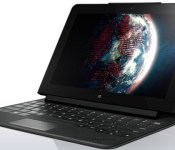
Lenovo teases a new 10-inch ThinkPad tablet in Australia

Online stores have been hinting that Lenovo was working on a 10-inch counterpart to its ThinkPad 8 tablet, and now there’s no doubt: the company’s Australian branch has listed a ThinkPad 10 ahead of an official announcement. While a full-fledged product page was only briefly available, it was enough to show that the new Windows slate shares much in common with its smaller sibling. You’ll find a slightly faster 1.6GHz quad-core Atom processor and up to 4GB of RAM, but there’s still a 1,920 x 1,200 screen, up to 128GB of storage, an 8-megapixel rear camera and a 2-megapixel front shooter. Not that we’re griping about the similarity between models, since this ThinkPad 10 should still be leaps and bounds more powerful than the aging ThinkPad Tablet 2.
The ThinkPad 10′s big advantages over its 8-inch cousin are likely to revolve around its optional gear. As with the Tablet 2, there are promises of versions with LTE data and pen input. You’ll also have the choices of a basic dock, a keyboard dock and a keyboard case if you need your tablet doubling as a workstation. Lenovo didn’t give out any release details as part of its teaser, but an official listing suggests that a launch is just around the corner. We’d also expect a price premium over the $399 ThinkPad 8 — that extra display area and processing power won’t be cheap.
Via: TabTech (translated)
Source: Lenovo

Samsung’s Galaxy Tab 4 lineup reaches the US on May 1st

Americans no longer have to splurge on the high-end Galaxy Tab Pro or Note Pro if they want a modern Samsung tablet — the more affordable Galaxy Tab 4 range is headed to the US. WiFi versions of the Tab 4 7.0, 8.0 and 10.1 should hit shelves on May 1st at respective prices of $200, $270 and $350. Travelers craving cellular data can expect LTE variants from AT&T, Sprint, T-Mobile and Verizon sometime this summer. Pricing hasn’t surfaced for these 4G models, but it’s safe to presume that they’ll carry a premium over their WiFi-only counterparts.
The devices don’t carry the biggest bang for the buck. The Nexus 7 offers a sharper display and overall faster performance, for example. However, the two largest Tab 4 WiFi models cost significantly less than their Tab 3 equivalents did when new — they’re potentially good bargains if you’re not concerned about raw performance.
Filed under: Tablets, Samsung, Verizon, Sprint, AT&T, T-Mobile
 AIVAnet