


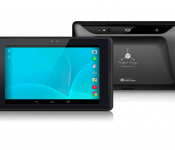
Project Tango Tablet Developers Kit Announced by Google; Packs Tegra K1, 4GB RAM and 3D Mapping Fun
Google has unveiled Project Tango Tablet Developers’ Kit today. It is pretty much the most badass tablet you can dream of owning so far, and that is putting it mildly.
 The Project Tango kit is a 7-inch Android powered tablet. Nothing amazing there. however, inside you find a NVIDIA Tegra K1 processor with a 192 programmable cores, 4GB of RAM and 128GB of internal storage. The front facing camera offers up 120 degree view and the rear camera is 4MP. There is third rear motion tracking camera too , along with a depth sensor. All of that means that the Project Tango Tablet can 3d scan rooms and create intense interactive augmented reality excitement. For instance, turn your living room into a battlefield, or scan a room and move things around for interior design.
What is Project Tango?
As we walk through our daily lives, we use visual cues to navigate and understand the world around us. We observe the size and shape of objects and rooms, and we learn their position and layout almost effortlessly over time. This awareness of space and motion is fundamental to the way we interact with our environment and each other. We are physical beings that live in a 3D world. Yet, our mobile devices assume that physical world ends at the boundaries of the screen.
The goal of Project Tango is to give mobile devices a human-scale understanding of space and motion.
Our team has been working with universities, research labs, and industrial partners spanning nine countries around the world to build on the last decade of research in robotics and computer vision, concentrating that technology into a unique mobile device. We are putting early prototypes into the hands of developers that can imagine the possibilities and help bring those ideas into reality.
We can’t forget to mention that the Project Tango Tablet also has Wi-Fi, Bluetooth LE and 4G LTE connectivity (depending on region and carrier, of course). Check out the cool little video they put out about it.
The Project Tango Tablet is being marketed toward developers and comes with a hefty price tag when it becomes available, $1024. Absolutely worth the money for the talent that exists in the world. We fully expect Google to show it off a bit at Google I/O and hopefully they will be able to give us all a little bit more hands on detail of how it all works. If you want to get on the list to be notified when the Project Tango Developers Kit is ready, pop on over to the sign-up page.
So, who is jumping on the list?
//<![CDATA[
ord = window.ord || Math.floor(Math.random()*1E16);
document.write('’);
//]]>
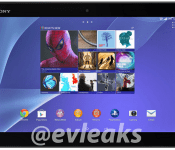
Verizon Xperia Z2 tablet on the way

Sony Xperia Z2 is one of the most powerful smartphones on the market today, same goes for its tablet counterpart. According to a new leak Z2 tablet is going to reach Verizon soon.
@evleaks is at it again, this time he brings us an image of an alleged Xperia Z2 tablet for Verizon (LTE variant). This device should pass certification soon and make its way to Verizon’s lineup. To refresh your memory we’re talking about a device carrying a Snapdragon 801 processor along with an Adreno 330 GPU and 3GB of RAM. On the front it has a 10.1 full HD Triluminos display with Sony’s X-Reality Engine and a 2.2MP secondary camera, while on the back it sports an 8.1MP shooter. The device is powered by a 6000mAh battery.

Are you going to buy one when it becomes available?
SOURCE: @evleaks

The post Verizon Xperia Z2 tablet on the way appeared first on AndroidGuys.

HP’s Pro x2 612 laptop-tablet hybrid brings pen support, a sturdy keyboard

If you read our Surface Pro 3 review, you know we recommend it, but only for a certain kind of person: someone who needs both a laptop and a tablet, preferably one that allows for pen input. Even then, is Microsoft’s approach the smartest one? Can you really call something a laptop replacement if it’s not as comfortable to use in the lap, or if the keyboard isn’t as sturdy? For all of you skeptics out there, there’s an alternative incoming: HP has just announced the Pro x2 612, a laptop-tablet hybrid that offers many of the same features as the Surface Pro 3. Like the Surface, this is a 12-inch tablet that supports pen input and runs on Ultrabook-caliber Intel Core processors. The main difference is that rather than use a flat, click-in keyboard, the Pro x2 612 comes with a backlit, spill-resistant keyboard dock. As a bonus, that dock also includes a spare battery that brings the total runtime to about 14 hours.
As for the tablet itself, it uses a Wacom pen digitizer, which is what the Surface Pro had before Microsoft switched to N-Trig. As a quick refresher, Wacom’s chief benefit has always been its precision, with 1,024 levels of pressure sensitivity. The downside, though, is that Wacom tablets tend to be thicker than N-Trig ones, which is the primary reason Microsoft made the switch. Indeed, that seems to be the biggest drawback here: the tablet and keyboard dock combined weigh around four pounds, compared with two or so for the Surface Pro 3. In exchange, you get a bunch of ports on the dock, including VGA, DisplayPort and Ethernet sockets; an SD slot; and two USB 3.0 ports. The tablet, meanwhile, has a microSD slot, along with a slot to stow the pen — something you won’t find on the Surface. In effect, then, the Pro x2 612 is a laptop first and a tablet sometimes, whereas the Surface Pro 3 tries to be both in equal measure. Again, different approach here.
Given that HP plans on selling this to businesses and government agencies, you can bet it has all sorts of security measures in places. These include TPM and a Smart Card reader, as well as an optional fingerprint scanner. Spec-wise, it’ll start with a Celeron processor, with options for Pentium, Core i3 and Core i5 (the Surface Pro 3 goes up to i7). Storage capacity ranges from 64GB to 512GB; screen resolution starts at 1,366 x 768 but goes up to full HD. A built-in 4G radio will be an option too, as will Windows 7. HP says it will retail ship in September, with the power keyboard included. You can also buy the standalone tablet, in which case it’s just called the Pro Tablet 612 (no “x2″). Oh, and if you’re put off by the weight, there’ll be a lighter-weight “travel” keyboard too. Until then, check out our hands-on photos above — and take our word for it when we say the keyboard is pretty good.
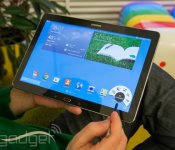
Samsung’s Galaxy Tab 4 and Note Pro reach AT&T sporting giant price tags

Want to get one of Samsung’s latest and greatest Android tablets with fast LTE data on AT&T? You can snag one very soon… but it might cost you a pretty penny. The carrier will offer both the Galaxy Tab 4 10.1 and Galaxy Note Pro 12.2 on June 6th at respective prices of $380 and $799 on-contract. While those figures are in the ballpark of what you’d expect for big, cellular-equipped slates, they’re not exactly pocket change. And you’ll want to be sitting down before you look at the off-contract prices. The ‘budget’ Tab 4 will cost $480 without obligations, while the Note Pro will set you back $900 — $50 more than its already expensive Verizon counterpart. If you have the cash to burn, though, these are solid options for staying online during your next big trip.
Filed under: Tablets, Wireless, Samsung, AT&T
Source: AT&T Consumer Blog
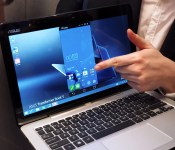
Up close with ASUS’ quirky Windows laptop / Android phone hybrid

Computex hasn’t even officially started, and we’re already blown away by ASUS’ rather eccentric Transformer Book V from this morning. The name doesn’t tell the whole story; it’s actually a Windows 8.1 hybrid laptop that lets you dock a Android phone on its back — a bit like the PadFone concept except the tablet has its own brain. That’s right, you can use both the 12.5-inch tablet and the 5-inch LTE phone simultaneously with their own brains. When docked, you’re shown the phone’s live Android phone interface within Windows (as pictured above), but you can also toggle the full Android tablet interface. It’s easily the most versatile product we’ve seen of late, but is it practical?
First of all, we should note that the Transformer Book V is apparently still about six months away from market, which may explain why ASUS only had one prototype available for hands-on. The design wasn’t even final; it’s supposed to look very much like the ZenFone 5. Understandably, the early software didn’t perform that well at the time: I couldn’t swipe between Android home screens in the windowed mobile interface, for instance. That said, I could launch Android apps just fine in the window, and it didn’t take long for the Android mobile interface to pop up in Windows after docking. It’s like Motorola’s Webtop implementation but much more powerful. On a similarly positive note, switching between the Android tablet interface and Windows was just a matter of pressing one button on the keyboard.
Since the docked phone is recognized as an external device in Windows here, you’ll still have to handle file transfer the usual way via Windows Explorer, rather than through a more seamless experience with some sort of drag and drop action over the Android interface (at least not for now, anyway). On the bright side, you can transfer files and charge the docked phone without a cable nor having the phone lie around the laptop. Another plus is with tethering enabled, you also have yourself an LTE-enabled Windows or Android laptop.
For a tablet of such size, 800g is a pretty nice weight, and this means you’re still under 1kg in total when you dock the 140g phone. There was no mention on the weight of the keyboard dock, but I found the full package to be of acceptable weight — my guess is somewhere just around 1.6kg. This is based on the fact that the slightly larger 13.3-inch Transformer Book T300 has an 800g keyboard dock with a built-in battery, so the Transformer Book V’s battery-less dock should be slightly lighter.
Due to the prototype nature of the device we played with, we’ll save our hardware comments for a mass production unit. The only complaint we have so far is that the tablet’s 1,366 x 768 display is an eyesore for those who are used to much sharper screens; though if — and it’s a big “if” — this product does take off, there’s a good chance that the displays will be upgraded.
Regardless, we think ASUS is at least headed in the right direction: the tablet dock is no longer dependant on the phone; and in fact, it’s a full-fledged Windows PC on its own but with the versatility of having Android run in Windows or run natively. But as with many products, this concept’s success will ultimately depend on the pricing. We also hope this Windows/Android hardware combo doesn’t mean ASUS has given up on the idea of a Windows Phone-powered PadFone.
Hands-on photos by Zach Honig.
Filed under: Cellphones, Laptops, Tablets, Mobile, ASUS
ASUS Transformer Pad refreshed with front speakers, lighter keyboard

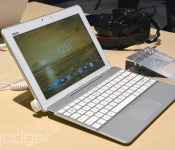
It’s been a while since we last heard about ASUS’ Transformer Pad series, so today’s announcement of two new 10.1-inch models was a nice surprise. Starting from the higher end we have the TF303CL, which not only features Intel’s 64-bit, 1.86GHz quad-core Atom chip (Z3745), but it also supports LTE for Europe and Asia-Pacific. Otherwise, the plastic tablet packs the usual set of goodies for a decent Android tablet: a 1,920 x 1,200 IPS display, 2GB of RAM, 16 or 32GB of storage with microSD expansion, 5MP/1.2MP cameras (a downgrade from the old 8MP main imager) and a 25Wh battery. The TF303CL is also enhanced with stereo front-facing speakers, as opposed to the old single-channel speaker (but with two drivers) on the back.
A less obvious change is the removed battery in the new keyboard dock, which is for both reducing its weight — from 546g to 505g, so just 1.1kg when docked — and also for keeping the price competitive; though there’s no pricing info at the launch event. As with most ASUS tablets, this one seems to have a solid build quality, and we dig its textured shell that deters fingerprints. ASUS’ Zen UI is also a nice touch on Android 4.4 — elegant and not too heavy. Expect this device to arrive in Q3 with blue and gold color options.

ASUS also announced the WiFi-only TF103C as the entry-level refresh of the Transformer Pad line. Apart from the processor and the microSD expansion, pretty much everything else have taken the cost-down route: 1,280 x 800 IPS display, 1GB of RAM, 8 or 16GB storage options, 2MP/0.3MP cameras and a 19Wh battery. This will arrive in the coming weeks with white and black options, followed by a 3G version (TF103CG) due July. Again, no prices for now, but they will no doubt be very attractive.

ASUS’ new Fonepads offer 3G, extra processing power

It wouldn’t be an ASUS event without a new device that functions as both a handset and a slate. And, as expected, the Taiwanese company delivered on that front here at Computex; CEO Jonney Shih announced the Fonepad 8, along with a 7-inch version, the Fonepad 7. A follow-up to ASUS’ Fonepad 7, the new devices sports similar specs, with improved performance and a slimmer design. Oh, and they boast a 64-bit processor that supposedly crushes other phones when it comes to real-world benchmarks.
On stage, Mr. Shih mostly emphasized the 64-bit processor’s performance; the Fonepad 8 runs a 1.8GHz Intel Atom Z3560 chip that apparently trounces the competition when it comes to power and efficiency. That speed should make navigating the device’s Zen interface a seamless experience, though we’ll reserve final judgment until we’ve tried it out for ourselves. The FonePad 8 also features 3G connectivity for its dual SIM slots.
Back to the more superficial stuff: the new Fonepads sport a very narrow bezel for easy one-handed use, and it will be available in black, red, gold and red. Other specs include dual front speakers (the standout feature on the previous Fonepad), a 1,280 x 800 IPS display (for both the 7- and 8-inch versions). We’ll be gathering more specs — and hands-on impressions — as soon as possible, so stay tuned.
Filed under: Cellphones, Tablets, ASUS
ASUS’ PadFone X goes global: still a 5-inch to 8.9-inch transformer

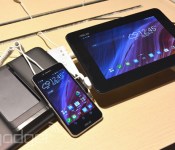
The ASUS PadFone X due June 6th can be considered as a slightly rugged version of the regular PadFone Infinity flagship line, but it’s only limited to AT&T customers. Luckily, for those outside the US, there will soon be a global variant dubbed the PadFone S. These two models are pretty much identical: you get the same 5-inch phone to 8.9-inch tablet transformation, and the guts include the 2.3GHz quad-core Snapdragon 800, 2GB of RAM, full HD displays, microSD slot, 13MP plus 2MP cameras on the phone (1MP front camera on the tablet) and 2,300mAh plus 4,990mAh batteries. The only differences are the 3G and 4G bands for obvious reasons, plus the wireless charging here follows the more popular Qi specifications, as opposed to PMA’s. There’s no info on pricing yet here at Computex; all we know is that it’ll arrive in select markets as early as late Q3 this year.

Also announced alongside the PadFone S are an LTE-enabled ZenFone 5 (A500KL, with a 1.2GHz quad-core Snapdragon 400) and a ZenFone 4 with a slightly newer Intel chip. Both are due some time between late Q3 and early Q4 in select markets. We’ll have more info closer to the time.
Filed under: Cellphones, Tablets, Mobile, ASUS

Samsung’s 7-inch Galaxy W blurs the line between phones and tablets

If you thought that big devices like the Galaxy Mega 6.3 were already blurring the distinctions between phones and tablets, hold on to your hat — Samsung has just erased those distinctions altogether. Its new Galaxy W (not to be confused with the 2011-era W) blends the 7-inch screen of a small tablet with a relatively compact design that lets you hold it one-handed for phone calls. This isn’t the first crossover we’ve seen by any means, but it promises to be more comfortable than truly finger-straining rivals like ASUS’ Fonepad 7 or HP’s 7-inch VoiceTab.
As with the Mega, this isn’t the flagship you might expect given the gigantic dimensions. You’ll be making do with a 720p display, a 1.2GHz quad-core processor, 16GB of expandable storage, a 8-megapixel rear camera and a 2-megapixel front cam. The W is even stuck on Android 4.3 rather than 4.4. It won’t be the cheapest device, either, as it’s selling for 499,400 won ($489) off-contract in its native Korea — Samsung is no doubt expecting customers to treat this as a two-in-one purchase. There’s no mention of an American launch, but you shouldn’t count on one when US carriers have so far been skittish about offering category-defying hardware.
[Thanks, Phil]
Filed under: Cellphones, Tablets, Mobile, Samsung
Source: Samsung (translated)

Leaked image shows gigantic 7-inch Samsung Galaxy Mega 2

Huge phones aren’t foreign territory for Samsung, far from it. They basically started the phablet game with the Note line and a year ago they released their Galaxy Mega devices. One fo them sporting a 5.8″ screen and other 6.3″, which is almost tablet territory.
Many thought that Samsung has reached the line and won’t step over it, but those people were wrong. Earlier this month a mysterious Galaxy W (Mega successor) device leaked sporting a 7″ screen and that device was not dubbed a tablet. Sure, that seemed rather odd, but if someone was going to do it it’s Samsung.
That huge device (Mega 2 from now on) was cleared by USA’s FCC yesterday and today it leaks in some images. There aren’t any additional leaked specifications at this time, but if an earlier leak is to be believed the device will sport a 720p screen, a 1.2GHz quad-core chip, 1.5GB of RAM, 8GB of storage (+microSD card) and a 8MP camera. All that should be operated by an Android 4.3 JellyBean OS.
There aren’t any release date information at this time, but Samsung is going to hold a press even on June 12. Galaxy Tab S lineup will probably get announced there but that doesn’t mean Galaxy Mega 2 will not make an appearance.
Would you ever buy a phone with a 7″ display?
The post Leaked image shows gigantic 7-inch Samsung Galaxy Mega 2 appeared first on AndroidGuys.
 AIVAnet