Sprint breaks ranks with other ISPs on net neutrality

Sure, AT&T and Verizon claim that if the FCC increases regulation of internet service to enforce net neutrality then they’d have reason to slow down investing in new upgrades, but Sprint is saying something different. GigaOm points out a letter to the FCC from Sprint (PDF) saying that it doesn’t think the application of Title II classification under the Communications act (treating internet like a utility, like phone service) will cause any problems. Stephen Bye, Sprint’s Chief Technology Officer writes that “Sprint will continue to invest in data networks regardless of whether they are regulated by Title II, Section 706, or some other light touch regulatory regime” — supporting what most net neutrality advocates, including the President, are pushing for.
It’s also in opposition to not only AT&T and Verizon, but T-Mobile CEO John Legere who previously tweeted that Title II qualifies as “heavy” regulation, and a push by Republicans in Congress to bar the FCC from making use of it. John Bergmayer of the consumer advocacy group Public Knowledge applauded the letter, saying “Sprint has shown enormous courage by daring to say openly in Washington what every other major carrier has admitted on Wall Street.” The FCC is scheduled to vote on new rules February 26th.
Filed under: Internet, HD, Mobile, Verizon, Sprint, AT&T, T-Mobile
Source: GigaOm, Sprint FCC Letter (PDF)

T-Mobile will soon offer no-frills Simply Prepaid plans

T-Mobile really wants your prepaid business, so it’s expanding its offerings with a new lineup of affordable plans. Big Magenta calls it Simply Prepaid, and it might be the better option for people who don’t need another line for family or friends, since it’ll cost every customer a minimum of $40 a month for unlimited talk and text and up to 1GB LTE. That data allowance increases to 3GB for $50 and to 5GB for $60. According to the carrier, the lineup was designed to be as straightforward as possible, so it “has fewer bells and whistles” than the Simple Choice plans. T-Mobile didn’t exactly list which features won’t cross over, but these might include music streaming, tethering, international data and texting, and unused data rollover. That said, these new options still come with WiFi calling, so check them out on January 25th when they become available if fancy features aren’t your thing anyway.
[Image credit: JeepersMedia/Flickr]
Filed under: Misc, Mobile, T-Mobile
Source: T-Mobile
T-Mobile Simply Prepaid plans announced with price cuts on monthly service
T-Mobile continuously keeps pushing the boundaries of what the current state of the wireless industry deems as ‘normal’. Today the carrier is pushing the boundaries in the prepaid sector of the company with three new Simply Prepaid plans which are scheduled to launch on January 25th. The new Simply Prepaid plans are identical to the […]
The post T-Mobile Simply Prepaid plans announced with price cuts on monthly service appeared first on AndroidSPIN.

T-Mobile announces new ‘Simply Prepaid’ plans for January 25


T-Mobile on Thursday introduced a new set of option for customers looking for just the most basic of prepaid service. Dubbed “Simply Prepaid”, the trio of rate plans offer unlimited talk, text, and (2G) data. Prices range from $40-$60 per month and include at least a portion of data at 4G LTE (8Mbps) speeds.
Simply Prepaid:
- $40 / month for unlimited data, talk and text + up to 1GB of 4G LTE
- $50 / month for unlimited data, talk and text + up to 3GB of 4G LTE
- $60 / month for unlimited data, talk and text + up to 5GB of 4G LTE
Should a customer end up going over the allotted bucket of data they will find speeds throttled to 128kbps, or 2G. These new plans do not include the Music Freedom, Data Stash, and other features; this is straightforward prepaid.
The new Simply Prepaid plans take effect on January 25 at retail stores, dealer locations, and at authorized retailers.
The post T-Mobile announces new ‘Simply Prepaid’ plans for January 25 appeared first on AndroidGuys.
T-Mobile will carry the YotaPhone 2 this year
 We know that one US carrier plans on selling the YotaPhone 2, but up until now, we didn’t have any specific information about which carrier that would be. The latest rumors point to T-Mobile picking up the device sometime in the spring, likely around March to April. That makes sense, considering T-Mobile tends to be the carrier that takes chances on devices that the other three major carriers won’t sell.
There’s still a good chance that a Canadian carrier will sell the device as well, but no concrete information has come up yet. Keep an ear out for it over the next few months.
source: Android Authority
Come comment on this article: T-Mobile will carry the YotaPhone 2 this year

The two-face YotaPhone 2 is coming to T-Mobile this spring

The YotaPhone 2 made quite a splash at last week’s CES 2015, after a few rumors began circulating around the web regarding the availability of the device. Currently, the YotaPhone 2 is available in 20 countries throughout Europe, the CIS and the Middle East, though it was originally slated to head to the US by the end of 2014. Up until now, we’ve had no word as to which US carrier would get the device.
According to our sources that are familiar with the matter, the YotaPhone 2 will make its way to T-Mobile around March-April. Though we are very confident in the validity of this information, sometimes even the most reliable sources can prove inaccurate, so do not treat this information as official. There’s always a chance that unforeseen issues will change the schedule.
The device is also headed to a Canadian carrier sometime in 2015, but that name has yet to be disclosed.
So far, no pricing information has been revealed regarding the device in the US. The YotaPhone 2 is currently available in Europe for €699 (~$850), which is the typical price of a flagship device. We can only speculate that the cost will be around . The fact that this device is headed to T-Mobile isn’t necessarily a surprise, given the carrier’s track record with other devices that normally wouldn’t make their way to the US. T-Mobile was one of the first carriers to offer the LG G Flex, as well as one of the only carriers to offer any device from Sony’s Xperia line. So, it’s not unlike T-Mobile to carry a device such as this one.
We interviewed Vlad Martynov, CEO of Yota Devices, last week at CES. While he didn’t comment on specific carrier availability, we got a first-hand look at Yota Devices’ vision for future smartphones and what they’re doing to improve the E Ink technology on the back of the phone.
If you’d like more information on the YotaPhone 2, check out our full review!
We’ll be sure to keep you updated when we hear more about the YotaPhone 2’s availability. If this device comes to T-Mobile for around $600-$700 unlocked, are you willing to try it out? Let us know what you think in the comments!

Verizon adjusts T-Mobile’s 4G LTE coverage in new promo

Near the end of 2014, Verizon was faced with some criticism regarding one of its advertisements that featured a map of a competitor’s 4G LTE coverage. The ad compared its network to that of T-Mobile; however, it was greatly skewed in favor of Verizon. The map portrayed T-Mobile’s 4G LTE coverage as extremely scarce by removing the HSPA/HSPA+ coverage. Yesterday, Big Red uploaded an updated version of the ad which shows a much more purple map of the United States (above). The coverage is still dwarfed by Verizon’s but T-Mobile has committed heavily to its growth.
Hit the break for the videos.
This is the ad rolled out in December:
Click here to view the embedded video.
And this is the one that arrived on January 11:
Click here to view the embedded video.
Via: TmoNews
Come comment on this article: Verizon adjusts T-Mobile’s 4G LTE coverage in new promo
Leaked marketing material suggests AT&T Rollover Data will be announced at CES 2015
T-Mobile‘s Data Stash is a pretty hard act to follow – allowing your customers the ability to roll-over unused data to other months is a pretty risky move, but one that has ultimately started to pay off for the American telco, and it seems other carriers have no choice but to match their efforts with […]
The post Leaked marketing material suggests AT&T Rollover Data will be announced at CES 2015 appeared first on AndroidSPIN.

Dealing with cellphone carriers is confusing on purpose

Several days ago, the New York Times ran an interesting piece that pointed out just how confusing wireless plans are presented to consumers. As the story pointed out, even executives at several wireless phone companies are admitting that such confusion exists due to a “a Tower of Babel of competing plans, with highly specific requirements and offerings and even, in many cases, unique language buried in the fine print.”
But at what point will people realize that such plans are intentionally as confusing as possible? AT&T’s new chief executive has since admitted to “propagating some confusion in the marketplace” while T-Mobile’s chief marketing officer admitted to being part of an “industry where the carriers have sown a massive amount of confusion.”
So let’s get into the confusion that always adds to the carriers financial pockets.
Upgrading
When Verizon and AT&T first introduced their new upgrade programs (in response to T-Mobile), they made sure to make it as difficult as possible to understand for the average consumer. Why? Because customers weren’t saving whatsoever with the upgrade plans. In fact, customers were paying twice for the same phone.
For years, carriers have admitted openly to jacking up the cost of service to counter handset subsidies. Yet, when the new upgrade plans were introduced which eliminated the subsides, the price of service didn’t drop at all. In fact, it took some national attention over several months for the carriers to make changes to the upgrade programs so that they weren’t a complete and utter “rip-off” (as Lifehacker flatly stated).

Or as the New York Times explained:
One wireless phone plan allows customers to upgrade to a new phone in less than two years. Another allows a pool of data to be shared across multiple devices. Yet another offers unlimited data, but only at slower Internet speeds. All these perks are there for the taking, yet the average wireless phone bill continues with its monthly sting. Confused yet?
Unlimited Data
When T-Mobile went around the country with their “unlimited data” plans, they really meant that customers could use their service up to a select amount of GB’s. If customers went over a capped amount, they wouldn’t be charged overages but were throttled to speeds of 64 kbps or 128 kbps for the remainder of their billing cycle. T-Mobile was even nice enough to exempt speed-tests from their usage caps so throttled users wouldn’t be able to tell if they were being throttled. How nice.
When Sprint was advertising to all the benefits of their “Truly Unlimited Data” plans that allowed customers to “avoid the data dilemma”, they really meant that customers could only use 5GB on their phones/tablets without paying ridiculous overages.

When Tracfone Wireless advertised that their MVNOs Straight Talk and Net10 plans included “unlimited data”, they really meant that customers had unlimited data up to 2.5GB and then dial-up speeds for the rest of the month. Of course, you could purchase more data per month for an additional fee.
A TracFone spokeswoman said in a statement that Straight Talk’s 30-day $45 “unlimited” plans and $60 “unlimited international long” plans include 2.5 GB of high-speed data. – FierceWireless
When AT&T advertised their “unlimited data” plans to iPhone users for several years, AT&T really meant that they could only use 2GB, or maybe 3GB, or top 5% of data in your area….or something.
Service Contracts
When FreedomPop was advertising their “free wireless service“, they really meant that customers had to pay a multiple number of fees for such things as receiving usage alerts, rolling over bytes to other months and other charges for simply using the service (such as the $0.99 “Active Status fee” which has since been removed by FreedomPop).
AT&T must have forgot to tell wireless customers that they were raising the “Activation Fee” for those on two-year contracts. Rather than being forced to pay just $4 for the arbitrary and unnecessary fee, customers are now paying around $40 for it. It is what I call a BIC “Because I Can” fee.

Speaking of AT&T, let’s not forget about the addition of another BIC fee. Last year, AT&T announced that wireless users would need to pay a $0.61 “Mobility Administrative Fee”. Although AT&T claimed it was to help “defray certain expenses,” it was clearly AT&T looking to add yet another below-the-line fee that allows companies like AT&T to jack up the cost of service without raising advertised rates.
When T-Mobile advertised to consumers in Washington that they could have a “no-contract” plan for an iPhone 5 with an upfront cost of $99, Washington State’s Attorney General slammed T-Mobile for false advertising since customers still were forced to sign an agreement stating that they would pay off the total owed. T-Mobile eventually changed their advertising language and acknowledged that they were “misrepresenting that customers can obtain wireless service and telephone equipment without restrictions.”
Technology Terms
As I have written about a number of times, wireless carriers seem to enjoy advertising technology that they don’t actually offer. Apparently the carriers believe that by stating that you offer something a number of times, then you magically do offer that technology. If that doesn’t work, the carriers push the International Telecommunication Union (ITU) to dumb down the definition of the technology so that everyone can suddenly offer it.
For years, T-Mobile, AT&T and Sprint have spent many millions in advertising of their 4G networks that didn’t even speeds anywhere near 4G speeds. T-Mobile claimed that their 3G HSPA+ service was the “largest 4G network” while Sprint and AT&T pretended that their Mobile WiMax and HSPA+ networks (from several years ago) were also “4G.”
During 2011, Rogers Communications in Canada publicly admitted that their LTE network was not going to be nationally available for some time. That didn’t stop Rogers from promoting their new “4G” network that was simply their current HSPA+ network. When asked as to why they were suddenly introducing their HSPA+ network as 4G, Rogers tried to blame competitors for “confusion” as to what “4G” entailed. So to avoid confusing consumers, Rogers joined other wireless carriers in calling everything and anything “4G”.
In both 2011 and 2013, Representative Anna Eshoo, D-Palo Alto, introduced the Next Generation Wireless Disclosure Act which would have required carriers to disclose a list of details about the network, including minimum data speeds, network reliability and coverage, and specifically what technology was being used to provide “4G” service. Both times, the industry managed to kill the bill through intensive lobbying.
Cramming
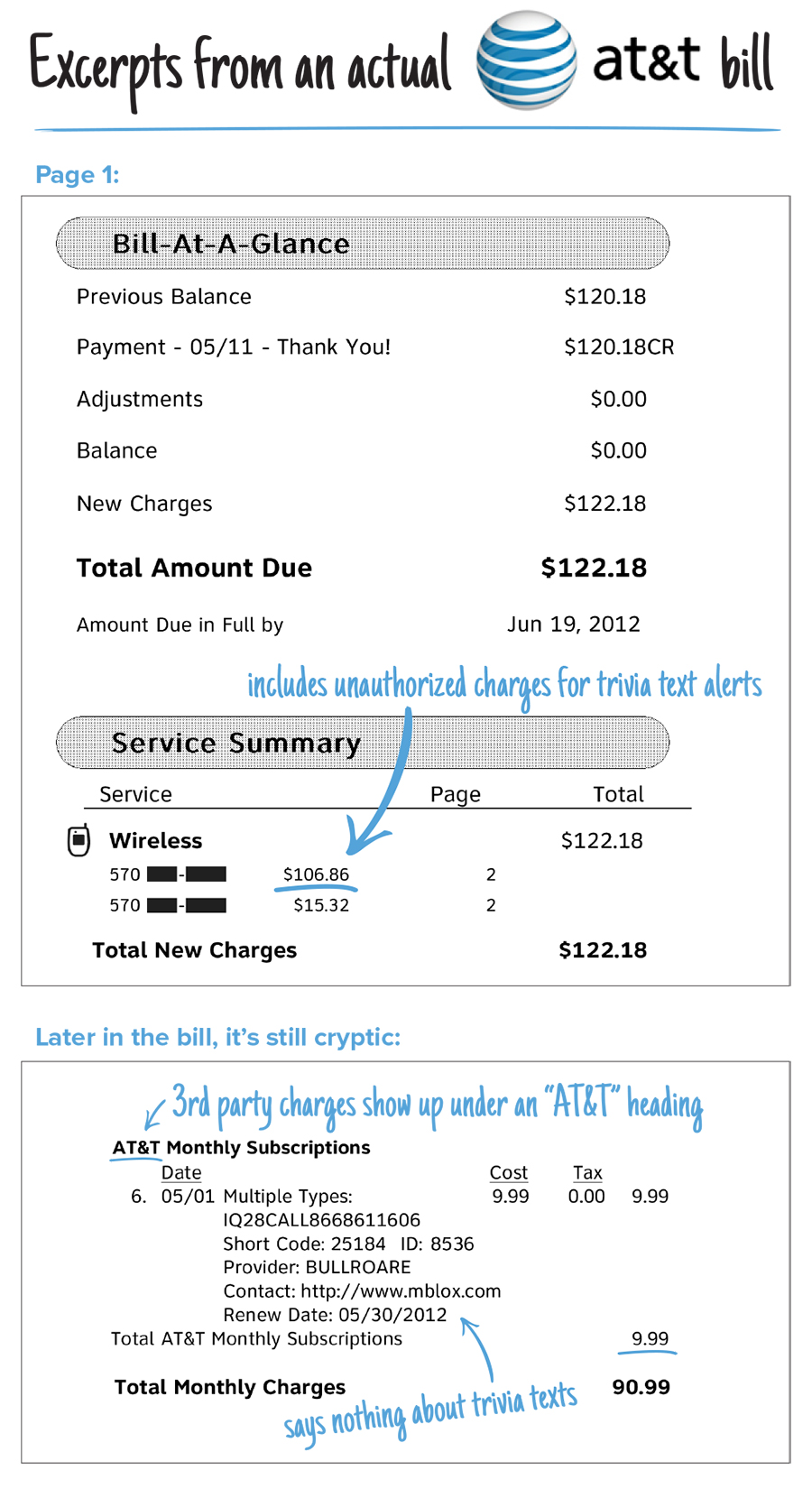
As this site has reported on a number of occasions, T-Mobile, Verizon, AT&T and Sprint have all been involved with cramming tactics for years now and have reaped the benefits of such tactics to the tune of millions of dollars per year. Cramming refers to wireless carriers who would sign up consumers to a $10 a month service that sent text messages containing a variety of news/tips/horoscopes. The carriers would then try to confuse the charges on a customer’s bill, ignore requests to be removed and dodge any attempts to be contacted.

Over the last year, the FCC has surprisingly been active in stopping this practice through a variety of fines.
- Sprint is facing a $105 million fine for cramming.
- AT&T has paid a $105 million fine for cramming.
- T-Mobile has paid a $112.5 million fine for cramming.
- Verizon has been involved with several class-action lawsuits for their past cramming actions.
Conclusion
Wireless carriers make it difficult for a reason: Money.

T-Mobile’s John Legere talks about the state of the wireless industry in 2015
 T-Mobile’s CEO John Legere has posted a blog entry on the carrier’s website detailing his prediction for where the wireless industry will be heading in 2015. He talks about the direction T-Mobile is going in, and in typical Legere fashion, he doesn’t pull any punches when it comes to throwing other carriers under the bus.
Right out of the gate, Legere talks about all of the different moves T-Mobile has put into place with their Uncarrier revolution. This includes the recently announced roll over data, unlimited music streaming, and ending annual service contracts, among several other things. There’s even a nice chart that shows how each of the four carriers fares when it comes to those Uncarrier moves, and while it’s definitely weighted in T-Mobile’s favor, it does show that T-Mobile is committed to offering a better value for your money than the other big three.
When it comes to other carriers, John Legere is happy with where T-Mobile is standing. Their LTE network covers about 264 million customers, and even though it’s trailing Verizon’s 303 million, the carrier plans on catching up to at least 300 million customers by the end of 2015. On top of that, T-Mobile’s network is typically very competitive with Verizon’s when it comes to speed, even beating out Big Red in many markets. He also hit the other big three carriers with some pretty rough comments about promotions they’ve been running, including slamming AT&T for squeezing money out of their customers with old unlimited data plans and bashing Verizon for their “BS promos.”
Of course, the entire blog post isn’t just carrier trash talking, and Legere discussed how he thinks wearables are the next major component in the wireless industry, especially after Apple releases their first smartwatch, and he believes phablets will continue to grow in popularity. That insane phablet growth has two pretty major side effects, however; increased data usage thanks to the extra data screen that’s ideal for streaming and consuming media, and lowered tablet sales as people switch over to using phablets exclusively as opposed to a smartphone and tablet.
Legere made a few witty jokes about his Twitter account, then ended on a high note that T-Mobile plans on staying the course of what they’ve been doing. Expect to see some more moves by T-Mobile in 2015 to try and stay ahead of the competition.
You can find the full post at the link below.
source: T-Mobile
Come comment on this article: T-Mobile’s John Legere talks about the state of the wireless industry in 2015
 AIVAnet