



Sony CES 2014 press event liveblog

Sony likes to dip into all the CES waters, so expect mobile, audio and imaging news from the company. We’re betting there will be plenty of big-screen TVs looking to ruin that savings nest-egg too, and we’ll be covering it all when the company’s big presentation starts at 8PM ET — that’s 5PM right here in Vegas.


Filed under: Cellphones, Cameras, Gaming, Home Entertainment, Tablets, HD, Mobile, Sony
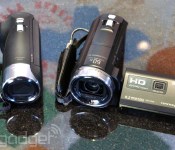
Sony announces seven HD Handycam camcorders at CES, priced from $230 to $1,500

Bear with us here; Sony’s announcing quite a few new Handycam models at this year’s CES. At the pricier end of the spectrum, the HDR-CX900 sports a 1-inch CMOS sensor, 50 Mbps XAVC S recording, and a boatload of other high-end features. In fact, it’s identical to the $2,000 AX100, though the CX900 excludes 4K-capture capabilities. That omission will save you 500 bucks, with this model shipping in late February for $1,500. Next up, the projector-equipped PJ810 will run you $1,100, and includes WiFi with NFC, 24.5-megapixel stills capture, a 26.8mm wide-angle G lens with hood, a 3-inch 921k-dot LCD and a 50-lumen projector. Meanwhile, for $700, you can pick up the PJ540, which sports a 5.1-channel mic, a 3-inch 460k-dot LCD, 32GB flash storage, WiFi, NFC, a 25-lumen projector and our favorite feature, Balanced Optical SteadyShot.
At the lower end, you can pick up the PJ340, which includes a 26.8mm wide-angle G lens with optical SteadyShot, 16GB flash storage, WiFi, NFC and a 13-lumen projector for $480. Next up is the cheapest projector-equipped model, the PJ275. This $400 shooter features a 29.8mm Zeiss lens, 8GB flash storage, WiFi, NFC and a 13-lumen projector. Meanwhile, videographers on a budget may want to check out the $330 CX330, which ships with WiFi, NFC and a 26.8mm G lens with optical SteadyShot. The $230 CX240, however, does not include WiFi. It does feature a 9.2-megapixel CMOS sensor, a 29.8mm lens with digital stabilization, full HD (60p) capture and a 2.7-inch LCD. All seven models ship next month alongside several new accessories, including a $100 shotgun mic, ECM-W1M and ECM-AW4 $230 wireless microphones and a $30 lens filter for the PJ540.
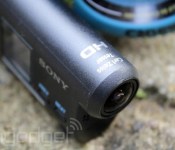
Sony Action Cam update brings live streaming to older cameras this summer

Existing Action Cam owners will net two of the AS100V’s banner features through a software update. The most significant addition, live streaming, will enable real-time video uploads to sharing sites like Ustream through a connected smartphone or tablet. Sony’s also adding a high-speed continuous shooting mode, letting you snap a “limitless” number of high-res stills with previous-gen Action Cams. Expect both new features to make their way to your compatible shooter sometime this summer.
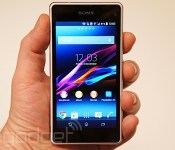
Sony announces Xperia Z1 compact, a smaller flagship with full-size features

At last year’s CES, Sony introduced us to the Xperia Z, which would be its flagship phone for most of 2013, until the Xperia Z1 was unveiled at IFA. Here at CES 2014, Sony is giving the Z1 some company at the top, as it introduces the Z1 compact. Yes, don’t call it a mini; Sony is very keen to distance itself from the current trend of, what it considers, watered-down versions being sold as mini-flagships. As such, the Z1 compact is almost entirely identical to the original, with the same quad-core Snapdragon 800, the same 20-megapixel camera and the same waterproof design, just this time with a 4.3-inch screen, oh, and color options! We spent a few moments with it ahead of today’s announcement to find out if it lives up to Sony’s “no compromise” boasts. Head past the break to find out.
Usually at this point, we’d reel off the key specifications, but in this case we’re going to start with what’s different between the Z1 compact and the full-fat version. Obviously, the main distinction is the screen size, down from five to 4.3 inches. Given that the whole point is to make a smaller version, this key lower specification (numerically speaking) isn’t to be seen as a compromise. It’s worth pointing out that the smaller (now IPS) display also brings a drop from 1080p to 720p resolution (the ppi is still a solid 340 though). The next main difference is the battery. The Z1 compact comes with a 2,300mAh cell, down from the 3,000mAh battery in the larger version, but given the lower power requirements from that reduced amount of screen, Sony is confident you’ll get a similar amount of battery life overall. The Z1 compact also comes with Android 4.3 straight out of the box.

So, the rest of the specifications are just as you’d find in the original Z1. That means you get a 20.7-megapixel (1/2.3-inch) main camera, Triluminos display with X-Reality engine, 2.2GHz of Snapdragon 800 quad-core goodness, NFC (Sony isn’t shy when it comes to NFC), and 16GB of onboard memory (there’s a microSD card slot, too). All of the above with the same IP58 level of waterproofing — something of an Xperia trademark these days. But what about the color options we hear you cry? Well, there’s black and white for the monochrome fans, and a rather loud lime (which looked quite yellowish to us) as well as a fairly hot-pink hue. The colors look bright and bold, and even extend to the milled aluminum parts. So, where the plum-colored Z1 was broken up by the metal sections, this time around, the phone is one color throughout. The yellow lime version gets almost a goldish tone on its metal parts, and the metallic parts of the pink version also stand out.
Sony, and in particular the Xperia line of phones, isn’t noted for swift and dramatic design moves, and there is unsurprisingly even less deviation this time around. It’s clear the company wanted to make a mini compact version of the Z1 as faithfully as possible, and by and large, it’s done just that. That said, the Z1 compact is — gasp — a whole millimeter thicker than its sibling, but as you can imagine, that’s mostly down to cramming much of the same hardware into a more diminutive frame.

Our impressions, from the short time we had with the handsets, are that this is a promising step from Sony. The Z1 compact feels just as well-built as its larger counterpart, and the user experience is, obviously, much the same. The display is even arguably an upgrade (unless 1080p is a must for you), thanks to Sony plumping for an IPS panel, improving those much-maligned viewing angles. The choice of colors will only serve to broaden its appeal, and while it’s a little wild, we kinda like the lime.
The reduction in display size makes the Z1 compact feel a lot easier to use one-handed, and we can see this really appealing to folks who like the form factor of, say, the iPhone, but are in the market for an Android. While we’re on the subject, Sony is clearly hoping to steal a few of Apple’s customers along the way by providing a cable (potentially in the box) that will make transitioning from the iPhone to the Z1 compact a snap — literally by directly connecting the two phones. The software on the handsets we saw isn’t final, so we’re unable to pass full judgment, but given its hardware capabilities, and the few moments we did have with it, the Z1 compact promises to fly like a rocket. It also comes with all those social-camera goodies that were introduced with the original Z1, which is great news for those who want those augmented reality dinosaurs (or the other, more useful, camera tricks).

Most importantly, Sony has pleased us by taking the approach that many of the other big-name phone makers seem unusually reluctant to do — to make a mini compact flagship, with the same — or as reasonably close as possible — specifications as the handset it mimics. Some people will love the Z1 compact (it ticks a lot of boxes after all); others might not fancy it, but above anything else, we hope it steers the mini-mobile trend in the direction many would have liked to see it go in the first place. You can get your hands on one mid-February, and while Sony is keeping tight-lipped on the price for now, it’ll likely come in somewhere between other existing “minis” and the full-sized Z1.
Filed under: Cellphones, Mobile, Sony

Dish announces streaming app for PlayStation consoles

A troop of new Joey devices wasn’t the only thing Dish had up its sleeve for CES. In an effort to bring its streaming chops to game consoles, the company has just announced an app for PlayStation that does just that. Dish customers will be able to take advantage of the Hopper’s functionality via its Virtual Joey software on both PlayStation 3 and PS4 consoles to access their favorite TV shows without having to switch devices once that marathon gaming session is up. This software also allows for control via either the DualShock 4 or the Dish remote. The app should arrive for download this spring in the PlayStation Store.
Filed under: Home Entertainment, HD, Sony
Our 2014 CES stage schedule is here and it’s awesome!

Sure, there’s a certain amount of creeping dread in the lead up to CES each year. It’s a sleep-deprived week spent elbowing our way through the packed halls of the Las Vegas Convention Center. The food is bad, the facilities few and far between and the hygiene practices of the tech-blogging community questionable, at best. But there are also plenty of things that make it one of the most exciting weeks of the year, not the least of which is our stage. As with the last couple of years, we’ve got a prime spot in the convention center lobby, where we’ll be speaking to some of the biggest and most innovative companies in the world of consumer electronics.
The list includes Sony, Ford, Pebble, Nokia, Leap Motion, Oculus, MakerBot, Lenovo, Samsung, AT&T and the Electronic Frontier Foundation, to name a few. You can check out the full schedule here and stay glued to our CES event hub for updates. See you on stage!
Filed under: Announcements, Cellphones, Desktops, Cameras, Displays, Misc, Gaming, GPS, Home Entertainment, Household, Laptops, Meta, Peripherals, Robots, Tablets, Transportation, Wearables, Wireless, Internet, Software, HD, Mobile, Samsung, Sony, Nokia, AT&T, AMD, Lenovo, NVIDIA
Source: CES 2014

Get your CES 2014 liveblogs right here

We realize that not everyone can be at CES this year – after all, that Las Vegas Monorail only holds so many people at any one given time – but here’s the next best thing. As per usual, we’ll be liveblogging the week’s biggest press conferences, so you can follow the action from the comfort of your own computer. Speaking of making things a bit more comfortable for you, the reader, we’ve compiled links to all of our liveblogs for this year’s show just after the break.
Monday January 6th
- 11:00AM ET: LG CES press event liveblog
- 3:000PM ET: Live from ASUS’ In Search of Incredible event at CES 2014
- 4:00PM ET: Live from Intel’s CES 2014 press conference
- 5:00PM ET: Samsung CES 2014 press event liveblog
- 8:00PM ET: Sony CES 2014 press event liveblog
Filed under: Cellphones, Desktops, Laptops, HD, Mobile, Samsung, Sony, ASUS, LG, Intel
Switched On: The 2013 Switchies, Part One
Each week Ross Rubin contributes Switched On, a column about consumer technology.

It’s that special time of year between holiday sales and the pre-CES hype cycle that presents an opportunity to consider some of the most innovative devices of the year. Switched On is proud to present the 2013 Saluting Wares Improving Technology’s Contribution to Humanity awards, also known as The Switchies.
This installment marks the eighth annual Switchies, which are decided based on a rigorous examination of the opinion of me, and do not reflect the opinion of Engadget or its editors. For that latter honor, nominees will need to win an Engadget Award. Now, then, let’s stroll past the red carpet and tear open those envelopes.
This column will focus on TV, PC and gaming products while the next installment will focus on mobile and wearable devices.
The “Big Screen Scene” Award for Best New Video Device goes to the Google Chromecast. Taking an app-by-app approach, Google’s cheap stream-redirecting HDMI dongle took everyone by pleasant surprise with its small size and ease of use. It also helped Google show the power of bridging the assets of Android and Chrome and built momentum in a frustrating race for the living room. It’s now rapidly adding new content sources.
Honorable Mention for Best New Video Device goes to the Xbox One. Microsoft’s latest home console is not only a powerful game system, but also a living room experience that incorporates many leading-edge technologies, including speech control, gesture control, video chat and an expanding array of over-the-top entertainment. Honorable Mention also goes to the TiVo Roamio Pro, the latest generation of the venerable CableCARD DVR that can support up to six tuners and offers improved streaming and offload to mobile devices.
The “Play’s the Thing” Award for Best New Gaming Device goes to Sony’s PlayStation 4. By casting off much of the corporate baggage of the PlayStation 3, like in-house chips, 3D and expensive novel optical formats, Sony finds itself in the enviable sweet spot of offering top-notch performance without occupying the top end of the market. Sony’s simpler development proposition should also help enable a stronger flow of game titles coming into 2014.
The “Convertible Bonds” Award for Best New Hybrid Computing Device goes to Microsoft’s Surface Pro 2. Still a study in contrasts, the second generation of Microsoft’s Intel-based tablet combines high performance and dramatically improved battery life, but you’ll be spending most of your time in desktop mode to tap its potential. Honorable Mention goes to Nokia’s cellular-equipped, outdoor-optimized, Windows RT-based Lumia 2520 and HP’s Android-based Slatebook x2 “2-in-1″ detachable.
The “Guess We Just Click” Award for Best New Input Peripheral goes to the Leap Motion controller. While we continue to see many companies focus on bringing down the cost of gesture control at the expense of a rich experience, Leap Motion presented a new 10-inch paradigm that won it a partnership with HP. Leap Motion wrests this award from Microsoft, which won it for the past three years.
The “Critical Bits” Award for Best New OS goes to OS X Mavericks. In a year where Apple, Microsoft and Google all unveiled new versions of their operating systems for tablets, Mavericks was left virtually unchallenged to pursue improvements for the desktop paradigm and Apple delivered with better battery life through superior memory management and its best multiple-monitor support yet.
Ross Rubin is principal analyst at Reticle Research, a research and advisory firm focusing on consumer technology adoption. He shares commentary at Techspressive and on Twitter at @rossrubin.
Filed under: Gaming, Home Entertainment, Peripherals, Software, Apple, Sony, Microsoft, Google
Sony launches dedicated Xperia Z Ultra cases for QX lens cameras

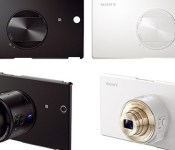
Though Sony’s crazy QX10 and QX100 lens cameras can attach to most smartphones, the company naturally favored its own Xperia Z and Z1 handsets by creating custom cases for those devices. Now it’s doing the same for its crazy-large 6.4-inch Xperia Z Ultra, according to our sister Engadget Chinese site. A new attachment cover in black or white will fix either camera to its latest phablet for HK$238 (about $30) on top of the price of the QX10 ($249) and QX100 ($499). If you’ll recall, that’ll boost your smartphone’s shooter to either an 18.2- or 20.2-megapixel monster, respectively, with the latter boasting the same sensor as the formidable Sony RX100 Mark II. It’ll arrive next month in Hong Kong, and while Sony hasn’t divulged availability elsewhere, we can picture it hitting the US soon as well.
Source: Engadget Chinese (translated)

Sony’s first PlayStation 4 ad for Japan teases the Japanese with everyone’s joy

Japan, you’ll get the PlayStation 4 soon. Promise. For now, look at everyone else enjoying it. Don’t they look happy? That could be you on February 22nd!
Source: YouTube
 AIVAnet