



We’re live-blogging Kaz Hirai’s CES keynote, don’t miss it!

It’s crazy, yes, but CES 2014 is only just beginning. Though we’ve been on the ground for two days already, the show floor is officially opening tomorrow. To kick things off, Sony CEO Kaz Hirai will be delivering the opening keynote. 4K’s a huge trend this year, so expect him to talk about his company’s efforts in this area. Of course, there may be some product announcements in store for us as well. We’ll be live-blogging his presentation — catch our updates here.
Filed under: Announcements, Sony
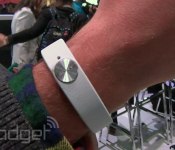
Sony’s Core isn’t a wearable, it’s a sensor (hands-on)

The Core is tiny. Thick as two sticks of gum, but twice as smart, this is Sony’s renewed effort for wearables and it really couldn’t look more different from the SmartWatch we saw in 2013. It’s a different device to begin with: an activity tracker with no screen. Sony’s still keeping it all pretty vague, but going on the details of the colorful, oddly appealing app, it’s more life logger than health monitor. The idea Sony is chasing is to collect what you do in your life, your movement, your photos, music listened to and your social network goings-on, and collate them into a sort of automated journal — a new LifeLogger app that will launch alongside the hardware.
You’ll need to hook the Core up with your smartphone (through Bluetooth) to see what’s happened activity-wise, and we’ve been told the battery should be good for up to five days on a single charge: it’s tiny but there’s no blinking lights or vibration to sap power. There’s a micro-USB port for recharging, but the whole thing is also waterproof. Sony promises to reveal all the details at MWC next month, but we did get a glimpse at one of the places the Core will reside and, in true CES 2014 style, it’s a wristband. We’ve got a quick video peek and a few more details after the break.
With a textured rubber band (and coming in a stack of colors and patterns) we were reminded of the Misfit Shine: the band is really just a stylized case for the Core. With the sensor stored inside, the SmartBand remained light and comfortable. Because it’s flexible and soft, it shouldn’t jar when you rest your arms on a desk or laptop, something the FuelBand fails on. There’s a machined aluminum Sony decal, while metal studs make sure to keep the band on. In short, details were hazy, but Sony’s at least got a plan where it wants the Core to go — somewhere that could play to the company’s strengths across entertainment, imaging and its mobile devices. Here’s hoping they can perfect the sales pitch at Barcelona.
Filed under: Cellphones, Wearables, Mobile, Sony
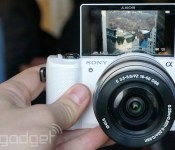
Sony announces Alpha 5000 with 20.1MP sensor, 180-degree display, WiFi for $600 with lens (hands-on)

Sony’s NEX branding is officially no more. The Alpha 5000 is the company’s first entry-level camera to drop the familiar moniker, falling instead under the higher-end Alpha lineup. Everything else about this CES model fits the mold, however. There’s a 180-degree tilting LCD that flips forward for self-portraits, built-in WiFi (with NFC) for instantly sharing pictures and videos on the web, Camera Apps for tweaking shots and uploading directly through a wireless hotspot and Sony’s latest 16-50mm power-zoom kit lens for smoother zooming during video capture. On the imaging front, there’s a 20.1-megapixel sensor, a 16,000 top ISO and 1080p shooting at 60i, 30p and 24p. There’s also a built-in flash — an appropriate feature for Sony’s target demographic of beginner photographers stepping up from a less-capable point-and-shoot.
Despite the new name, the Alpha 5000 feels very much like an NEX. There’s a more pronounced grip (think NEX-5T, not 3N), and the same tweaked (and improved) multi-page settings interface that we first met with the Alpha 7 and 7R back in October. Like its recent Sony counterparts, the 5000 charges via its micro-USB port, and it sports an HDMI output (this time, with 4K image support), for photographers looking to share their captures on a TV. Of course, with WiFi built in, you can also transfer shots to a smartphone or tablet, back up your media on a connected computer or boot content to a compatible television via DLNA. You can take a closer look at the Alpha 5000 in the gallery below. Expect it in stores this March in black, white and silver for $600, including the 16-50mm power-zoom lens.
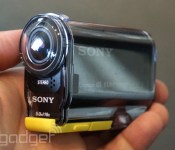
Sony’s latest Action Cam sports splash-proof body, pro features for $300

Sony’s targeting amateur shooters and professionals alike with its new HDR-AS100V Action Cam. For consumers, the biggest addition here is the new splash-proof body, which lets you shoot in rain or snow without using the bundled (and relatively bulky) waterproof case. There are also “vast improvements in the optics,” according to Sony, including an updated lens with a fixed 170-degree viewing angle (120 degrees with SteadyShot turned on), an 18-megapixel Exmor R CMOS sensor and new capture options, including 1080/24p, 720/120p or 720/240p video shooting and an ability to snap 13.5-megapixel stills. There’s also an integrated stereo mic and an input jack, should you wish to add an external mic.
Professional shooters can take advantage of new time-code support when editing XAVC S footage with Vegas Pro, making it easy to merge clips from the Action Cam with content from a variety of other cameras. There’s also a new option to shoot at 50 Mbps XAVC S, thanks to the new BIONZ X processor, and a record light up top that makes it easy to confirm that the camera’s actually recording. Cosmetically, the AS100V looks nearly identical to its predecessor, with limited on-camera controls and a basic info readout on the right side and SD and Memory Stick Micro storage in the rear, along with USB, HDMI and a mic jack hidden behind a panel at the bottom of the cam.
The new AS100V will hit stores in March for $300, or $400 when bundled with Sony’s live-view remote. The previous-gen AS30V will remain on the market, albeit with a TBA reduced price. A software update will add livestreaming and a high-speed continuous-shooting mode to both models this summer.

Sony’s new UHD TVs are built to support Netflix in 4K when it arrives

3D? Pah. 2014 is the year that 4K makes its first grand assault upon the mainstream. Naturally, Sony is one of the names leading the charge, and is bolstering the 4K support it added to the Video Unlimited service back in September. The company’s new range of UHD TVs will now pull down 4K video from a variety of sources, but most importantly, will work with Netflix’s forthcoming native 4K streaming. This year’s flagship is the XBR-X950B, available to buy in 95- or 85-inch models, while the middle tier is now occupied by the XBR-900B, offering 79-, 65- or 55-inch units. For those of us who aren’t on the roster of a Major League Baseball team, however, the company is also releasing an “entry level” XBR-X850B line, which can be snagged in 70-, 65-, 55- and 49-inch versions. Each one has the usual cluster of Sony technologies, including X-Reality Pro, Triluminos and ClearAudio+, as well as screen mirroring, NFC and built-in WiFi. All of them will arrive in spring, but there’s no word, yet, on how much these will set you back, but we’d wager that the hardware isn’t yet into the “impulse purchase” category just yet.
Filed under: Home Entertainment, Internet, HD, Sony
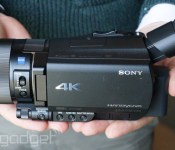
Sony’s compact FDR-AX100 4K Handycam ships in March for $2,000 (hands-on)

Television manufacturers have been peddling 4K TVs for several years now, but just as we experienced during the early years of HD, limited content deters educated early adopters when it comes time to make a purchase. One solution for marketers, while an arguably weak selling point, is that consumers can capture their own 4K footage to play back for family and friends on a compatible high-res set. And while we’re not yet ready to hop in line to make a pricey Ultra HD purchase, Sony’s counting on at least a few deep-pocketed videographers to pull the trigger. If you’re in the market for an affordable 4K camcorder, you probably won’t do much better than Sony’s FDR-AX100 Handycam.
The AX100 is a reasonable alternative to Sony’s recently announced AX1. This compact CES model is considerably more portable, with a 74 percent reduction in size and a 66 percent drop in weight. There’s a 14.2-megapixel 1-inch Exmor R CMOS sensor and a BIONZ X processor, enabling full-resolution 4K shooting at 24p and 30p with XAVC S encoding. There’s an optically stabilized Zeiss Vario-Sonnar T* lens with 12x optical zoom and a seven-bladed aperture, which Sony claims should offer some significant bokeh. A new My Voice Canceling feature reduces vocals from behind the camera, serving to minimize capturing the videographer’s own voice. There’s a 3.5-inch (921k-dot) LCD and an OLED viewfinder for framing; 1/4, 1/16 and 1/64 ND filters; WiFi with smartphone control; and output to a 4K TV via a single HDMI cable. Sony’s Handycam AX100 4K camcorder is set to ship in March for $2,000.

Sony’s new Bravia HDTVs get a wedge-shaped redesign

Unconvinced by 4K? Don’t worry, because Sony’s still got your back. The company has unveiled its 2014-era HDTVs for those who, whatever the reason, aren’t ready to dip a toe into the Ultra High-Definition pool. Both the flagship Bravia W950B and W850B come with a new design, apparently allowing for bigger speakers and a lower center of gravity, reducing the size of the accompanying pedestal. The lesser lights of the new arrivals, including the W800B, W630B and W600B all come with the usual Sony tech, including X-Reality Pro, ClearAudio+ and built-in WiFi, and all will be arriving for various quantities of your cash in the spring.
Filed under: Home Entertainment, HD, Sony

Sony Xperia Z1S: a waterproof flagship exclusive to T-Mobile (hands-on)

For the past two years, Sony Mobile could be counted on to introduce new Xperia smartphone lines at CES — the S and Z, specifically. Not so this year, as the company’s instead offering twists on previously announced hardware, which, for the US market, results in the Xperia Z1S for T-Mobile. If you followed our IFA coverage from last summer, you’ll be familiar with what Sony and exclusive US partner T-Mobile have to offer. The Xperia Z1S, set for release January 22nd at $528 outright or $22/mo, retains much of its Z1 counterpart’s spec load — 5-inch, 1080p Triluminos display, Snapdragon 800, 3,000mAh battery and 20.7-megapixel camera — albeit with some notable upgrades.
Despite maintaining the same 5-inch screen size as its Z brethren, the Z1S is significantly taller, owing to the larger 3,000mAh battery inside and packs 32GB of storage. Though its lack of an IPS display means viewing angles won’t be as generous, the Z1S does feature X-Reality Engine (disabled by default) for improved contrast in stills and video.
The device’s now also rated for IP58 certification, making it waterproof, not just splash-resistant, at a depth of up to four and a half feet for about 30 minutes. As for its build, the Z1S still features the “omnibalance” design (that all-around flat-sided look) Sony ushered in with the Z, but here the edges have been gently rounded with a plastic trim, making for a much more comfortable in-hand feel. It’s a change we wish had been present from the very start of this Xperia Z line.

Much like its predecessors, the Xperia Z1S’ ports are all tucked away behind flaps, with one exception: the headphone jack. At the behest of T-Mobile, that jack, newly centered on the top of the device, has now been made fully accessible when submerged, so users can laze about the pool and not worry about water damage. That’s not the only functional change Sony’s made to the cosmetics; it’s also added in a dual-detent camera key that should make taking shots when submerged in water far easier to do.
With a 20.7-megapixel, f/2.0 camera module on deck and associated software suite, it’s clear Sony’s placing heavy emphasis on the Xperia Z1S’ imaging capabilities. Like its Z1 mate, this US iteration will ship with a specially designed, larger Exmor RS sensor that Sony claims is on par with that of its compact camera line. That’s in addition to the G Lens (Sony’s in-house solution) and BIONZ for mobile image processing which, together, should translate into faster autofocus, better white balance and images with less blur and discernible noise.
Sony’s loading up the Xperia Z1S with the PlayStation App (a first for the Xperia line) and a suite of camera apps to complement that imaging prowess; the same camera apps we saw on the Z1. Of the bunch (i.e., InfoEye, AR Effects, Social Live and TimeShift Burst), only Background Defocus, an app that creates artificial bokeh or background blur, is new and exclusive to the Z1S. Users can also augment this app suite with a selection of third-party add-ons, searchable from within the camera app.

The Xperia Z1S is set for an official nationwide launch on January 22nd, but die-hard Sony fans will have a chance to snag it even sooner than that. An online pre-sale will go live on January 13th, although sadly there is no special purple version on offer. The Z1S comes in black and only black — for now, anyway.
Filed under: Cellphones, Wireless, Mobile, Sony, Google
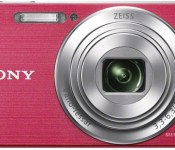
Sony’s Cyber-shot W830 delivers 20 megapixels and 8x zoom for $120

It’s tough to stand out in the realm of budget point-and-shoots, but Sony may rise (slightly) above the crowd with its new Cyber-shot W830. The compact cam refines last year’s W730 with an even sharper 20-megapixel sensor (up from 16) while preserving the 8x, 25-200mm lens you’ll want for those long-distance family reunion shots. Optical stabilization and 720p movie-making also make the cut. The W830 isn’t a revolution, then, but it’ll be hard to object to the camera’s rock-bottom $120 price when it goes on sale in February.
Source: Sony
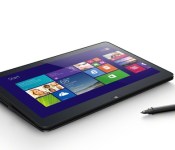
Sony unveils VAIO Flip 11A convertible; arrives in February for $799

It’s almost as if Sony reads our laptop reviews! After testing out the VAIO Flip 15 convertible, we concluded that while the design was innovative, but didn’t quite make sense for a machine that large. At the time, the smallest machine in the line was the 13-inch model, but that came with a different trade-off: At $1,100, it was the most expensive of the bunch. Now, Sony’s going even smaller, and it’s lowering the price of entry too: The company just announced the 11-inch Flip 11A, which starts at a more reasonable $799.
Like its big siblings, the 11A has a 1080p screen that can flip back so that the display is facing away from the keyboard (yep, sort of like the Dell XPS 12). Speaking of the screen, this too uses Sony’s Triluminos color-reproduction technology, which first made its debut on the company’s Bravia televisions. All told, though, it might make more sense to compare the Flip 11 not to the bigger Flips, but to the VAIO Tap 11, Sony’s first Windows 8 tablet. Both have 8-megapixel cameras using Sony’s Exmor imaging technology, and both have an N-trig digitizer allowing for pressure-sensitive pen input. Also, both start around $800, which means you can expect similar specs on the inside, too. In this case, that means a quad-core Bay Trail (Pentium) CPU to start, though if you wanted, you could go all the way up to a Core i7 chip instead.
One other important (but perhaps obvious) difference: Having a built-in keyboard makes the Flip 11 quite a bit heavier (2.82 pounds versus 1.7). Then again, the typing experience will surely be better than what you’d otherwise get on Sony’s flimsy wireless keyboard, so keep that in mind if you plan on using this to get real work done. Look for this guy to ship sometime next month, though odds are, we’ll be getting hands-on before then (read: in a few moments).
Finally, in less headline-grabbing news, Sony also announced that its existing Flip 13, 14 and 15; Tap 11; Tap 21; Duo 13; and Fit 14E and 15E will ship with Windows 8.1, along with Adobe Photoshop Elements 12. Additionally, the Pro 11, Pro 13 and Tap 21 are getting upgraded with faster 802.11ac WiFi. If you’re interested in buying, you’ll want to mark your calendars: The Fit 14E/15E are coming later this month; the Flip laptops, Tap 11 and Tap 21 will ship in February; and the Pro 11, Pro 13 and Duo 13 will go on sale sometime in April.
 AIVAnet