



HDTV deals of the week: 01.29.14

Early in the year is the best time to save your hard-earned cash on a new TV. Whether you’re prepping for the big game this weekend or just looking to upgrade your existing living room display, there are price cuts across the board on 2013 models to make room for this year’s releases. In order to lend a hand with the search, we’ve selected a handful of worthy contenders after the break. With a variety of sizes and price ranges covered, there’s sure to be something for those eyeing a new HDTV this week.
Just window shopping? No worries. Join us and add the gadgets you’re shopping for to your “Want” list; every time there’s a price cut in the future, you’ll get an email alert!
55-inch Sony KDL-55W900A

Price: $1,773.55
Regular Price: $3,300
Buy: Amazon
This 55-inch HDTV from Sony’s 2013 lineup has been touted for its picture quality, which many folks note is right up there with the best models available. In fact, Engadget users have given that stat a perfect 10. When compared with the current top-scoring HDTVs in our product database, the KDL-55W900A stacks up nicely in both ratings and price. Want to see how it stacks up to your current display? Make your own comparison right here after clicking “add to compare” on your HDTV’s product page.

46-inch Samsung F8000 Series

Price: $1,429
Regular Price: $2,449
Engadget Global Score: 87
Buy: Abe’s of Maine
This 46-inch LED HDTV from Samsung has also earned high marks for both picture quality and speedy performance, tallying up an Engadget Global Score of 87. According to our price-tracking tool, this is the lowest price we’ve seen on the unit since mid-November as well. Thinking about holding off a bit? Add the F8000 Series to your “Want” list and we’ll send you alerts as soon as the price tag fluctuates.

50-inch Panasonic Smart VIERA ET60 Series

Price: $841.30
Regular Price: $1,400
Engadget Global Score: 81
Buy: Amazon
Panasonic’s 2013 Smart VIERA ET60 LCD line is getting in on the end-of-the-model-year action as well with savings of around 40 percent off the MSRP. The HDTV has mustered an Engadget Global Score of 81 thanks to sharp picture and accurate color handling. If you’re after a bit more oomph, step up to the Smart VIERA ST60 Series and its 92 Global Score that’s currently priced in the $1,600 range for a 55-incher. To compare the two, mosey right over here for a side-by-side comparison.
32-inch Vizio M-Series Razor LED

Price: $360.04
Regular Price: $399
Buy: Target
Don’t need a massive HDTV to get the job done? Well, Vizio’s M-Series Razor family offers a 32-inch option that’s been discounted $40 from its original price when it arrived back in May. While the stats and picture may not blow you away, the affordable price for a smart TV with Hulu, Netflix and more packed in make this selection worth more than just a passing glance. Right now, it’s also priced the lowest we’ve seen in more than a month, according to the 90-day price history.

Filed under: Home Entertainment, HD
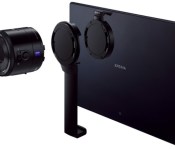
Sony add-on will let you graft a giant camera to your tablet

Whether you like it or not, tablet photography is here to stay — it’s only fair that slate owners get a fair chance at taking nice pictures. Sony certainly thinks so, since it has unveiled a new mount, the SPA-TA1, that attaches its QX lens cameras to tablets. The peripheral isn’t just for small devices, either; it includes six adjustable arms that accommodate larger hardware, like the Xperia Tablet Z and VAIO Tap 11. Sony ships the camera accessory to Japan this April for a suggested price of ¥3,675 ($36). There’s no word of a US release, but we wouldn’t rule out an eventual stateside launch.
Filed under: Cameras, Peripherals, Tablets, Sony
Via: Xperia Blog, Talk Android
Source: Sony (translated)

Playstation Now streaming service sends out invites for beta testing

We hope you’re ready to stream your favorite PS3 games to, well, a lot of things, because Sony is rolling out the private beta testing phase for PlayStation Now, emailing the chosen ones with a confirmation link and instructions on what’ll go down next. Those that sign up will get “exclusive access” to testing the new game streaming service as well as the ability to offer their (occasionally scathing) feedback to the PS Now team behind it all. Requirements are pretty fair too: you’ll beed a PS3 wired to the internet and a 5Mbps or higher broadband connection. In case you forgot to sign up earlier, you can catch up right here. From those we’ve heard that are getting the invites, it might be limited to the LA and DC areas: as mentioned at Neogaf, the site asks for your zip code during the sign-up process.
Source: Neogaf
Sony goes on offensive to fight spec leaks
When it comes to leaks, Sony is not playing. Their prototype devices now have built in traps for apps that are able to leak prototype information such as processor, ram, display resolution, etc. This is not even a warning, the new trap will prevent the app from running all together.
It is kind of disheartening to see this since we love to see what is being created before it even is officially announced, however I am sure our guys will figure out a work around and allow for those leaks to keep on flowing.
Source: XperiaBlog
The post Sony goes on offensive to fight spec leaks appeared first on AndroidGuys.

Weekly Roundup: PlayStation Vita TV review, T-Mo’s ‘Mobile Money’ and more!

You might say the week is never really done in consumer technology news. Your workweek, however, hopefully draws to a close at some point. This is the Weekly Roundup on Engadget, a quick peek back at the top headlines for the past seven days — all handpicked by the editors here at the site. Click on through the break, and enjoy.

The future of Nokia featurephones
Engadget’s Brad Molen discusses Microsoft’s impending acquisition of Nokia and how the deal might change the future of the manufacturer’s once-mighty featurephone linup. Follow the link for more information.

PlayStation Vita TV review
Sony’s PS Vita TV media streamer is cute, quiet and about the size of a deck of cards. You can even pair it with a PS3 DualShock controller and viola, you’ve got games. But would your $96 be better spent on a more portable PS Vita? Click the link for our review and find out.

T-Mo’s ‘Mobile Money’
T-Mobile’s latest endeavor is a personal finance product called “Mobile Money” that combines a smartphone app and branded prepaid Visa card. Best of all: you don’t even have to be a customer to sign up for it. Click on through for details. Click on through for details.

Uber-rare NES game lands on eBay
Back in the 1990′s, the Nintendo World Championship toured the US with 116 custom game cartridges containing special levels from Super Mario Bros., Rad Racer and Tetris. If owning a gem like that makes you flutter on the inside, now might be your chance! Click the link for details.
Filed under: Misc

IRL: Sony Xperia Z1S

CES wrapped just two weeks ago, and already, the gadgets announced there are starting to arrive on our review desk. First up, Sony’s Xperia Z1S, a modified version of the waterproof Z1 we tested last year, complete with a 20.7-megapixel camera. Only this time, the phone’s being sold exclusively on T-Mobile — at least here in the US, anyway. So how does it stack up? Our own Joseph Volpe spent a week with one to find out.

I’d never been a fan of the Xperia Z’s “omnibalance” design; those hard edges and right angles made the phone pretty to behold, but uncomfortable to grip. That is, until I picked up the Xperia Z1S for the first time. The phone carries on that same Sony design sentiment, but with one minor cosmetic addition that has made a world of difference: subtle curves. Yes, that change alone goes a tremendous distance in making this 5-inch device something you’d carry in hand all day. It’s even propelled me from being staunchly against the rectangularity of the Z line to being somewhat smitten.
As odd as it is to admit, I am genuinely surprised and delighted every morning when I first lay eyes on the phone — it’s a stunner — and, yes, that feeling extends to actually using it (more on that in a moment). I guess this is the kando (a Japanese word roughly meaning emotional resonance) CEO Kaz Hirai has been talking about for years, except it’s only now starting to hit home. Sure, the concept of forming a bond with your smartphone may seem like an irrational — if not downright silly — one, but if you’re spending hundreds for new electronics, shouldn’t it have the effect of making you smile? To Sony’s credit, this one does.
Alright, so we’ve established the Xperia Z1S is a beautiful thing. It’s also a waterproof thing, but I haven’t had much opportunity to test that out yet. I mean, sure, I’ve taken it in the shower with me, well, just because… and it performs without a hitch. But I just don’t see myself wanting to plunge into the deep end of a pool or take a dive in the ocean with it in hand. I’d be too worried about losing it to the Atlantic. The truth is that I’ll appreciate the Z1S’ intense waterproofing should I ever have the misfortune of dropping it in a toilet. Don’t judge, we all know someone who’s done that.
I did use the Xperia Z1S’ 20.7-megapixel camera, but mostly to add dinosaurs and exploding volcanos or swarms of butterflies to my shots using AR Effect, one of Sony’s many bundled camera apps. If you’re not a child at heart like me, you’ll probably want to just stick with Superior Auto mode and not worry about the ISO and aperture. Which is fine since the Xperia Z1S does a great job anticipating settings. But at some point, you’re going to play around with the Picture Effects or bokeh-making background defocus apps and be glad you did.
Never once did I find myself chucking the Xperia Z1S to the couch out of frustration. Why should I? It runs on a Snapdragon 800 and has a battery life that lasts well over a day. Which is to say, it runs like butter. No, I actually clung to it and even dabbled with thoughts of making the jump to T-Mobile so I could use it as my daily driver. Turns out, T-Mobile’s LTE speeds are pretty good in New York right now, or at least they’re better than whatever I get with my current provider. I was able to download an 80-song Spotify playlist to the Xperia Z1S in about a minute. That’s impressive.
There’s only one blemish on what would otherwise be a pristine experience, and that’s the 1080p display. I’ve whinged on about this in previous Xperia reviews, but it bears repeating here: Sony desperately needs to adopt IPS panels for its smartphones. It’s no good trying to watch a show on Netflix at the gym and having to constantly adjust the angle you view the screen so as to avoid washout. This is the crux of Sony’s Xperia phone line and I want it to stop. I don’t even mind that the Triluminos display doesn’t have the exaggerated pop of saturation that AMOLED does. It’s refreshing in a way to not be assaulted with color; it’s easier on the eyes. But I want to see the same image quality from any angle I hold or view the phone. Is that too much to ask, Sony?
You see, this is the danger of Sony’s philosophy, of connecting emotionally with our electronics: you expect perfection. Thing is, people are allowed to have flaws, not gadgets. Warts and all isn’t something I’m willing to pay good money for, and because of that, I love the Xperia Z1S a little less than it deserves.
– Joseph Volpe
Filed under: Cellphones, Mobile, Sony

Daily Roundup: PlayStation Vita TV review, the future of Nokia featurephones and more!

You might say the day is never really done in consumer technology news. Your workday, however, hopefully draws to a close at some point. This is the Daily Roundup on Engadget, a quick peek back at the top headlines for the past 24 hours — all handpicked by the editors here at the site. Click on through the break, and enjoy.
The future of Nokia featurephones
Engadget’s Brad Molen discusses Microsoft’s impending acquisition of Nokia and how the deal might change the future of the manufacturer’s once-mighty featurephone linup. Follow the link for more information.
PlayStation Vita TV review
Sony’s PS Vita TV media streamer is cute, quiet and about the size of a deck of cards. You can even pair it with a PS3 DualShock controller and viola, you’ve got games. But would your $96 be better spent on a more portable PS Vita? Click the link for our review and find out.

Apple gushes on 30 years of Mac
It’s the 30th anniversary of the Macintosh computer, and what a ride it’s been. And to commemorate the event, Apple’s put together a video presentation and interactive timeline that’s sure to make many nostalgic. Click the link for details.

Google ad patent arranges shoppers’ transportation
Google was granted the patent for an ad that can arrange transportation for shoppers who want to visit its advertisers’ stores. Why shop online when a chauffeur can take you to a real store, right? Click on through for more information.
Filed under: Misc

Sony teases ‘slimmest’ PlayStation device coming to the UK on January 30th

We’ve had a lucky run with product teasers recently. Instead of being totally vague, they’ve deliberately given us some inkling of what to expect, and we’re hoping that the Sony flyer above — summoning us to a PlayStation event in London — does so too. We’re told the briefing will introduce UK journalists to the “slimmest” PlayStation device, but we’re not told that we’re definitely going to witness the launch of a whole new product, which — to our minds, at least — suggests we might be looking at the UK launch of the PlayStation Vita TV (though it’s probably just a new Vita model). At just 13.6mm thick, the Vita TV is the thinnest PS device that we know of and it’s currently only available in Japan, so a launch in the UK (or anywhere outside of Asia) could potentially be a big deal. We’re gonna go ahead and rule out a super slim PlayStation 4 already, but the other alternative is that this could be the UK launch of the slimmer version of the PlayStation Vita handheld — in other words, the 2013 Japanese model, which has an LCD screen instead of OLED, better battery life and is just 15mm thick (20 percent skinnier than the current UK model). In any case, we’ll be there at the event on January 30th, with a flask of coffee and a pair of calipers.

PlayStation Vita TV review: Sony’s first mini-console has some growing pains

Sony had a tiny surprise to share just ahead of the Tokyo Games Show: the PS Vita TV, appearing from inside SCE President Andrew House’s jacket pocket. Having already announced a new, slender PS Vita handheld less than an hour earlier, Sony showed off this minute console — roughly the same footprint as a smartphone — that plays Vita games, PlayStation games and streams video content, as well as music and video from Sony’s own store. It can also connect with multiple PS3 DualShock controllers, allowing for proper, responsive gaming — something we’re not quite used to getting from something so tiny.
You could see it as a brutal counterstrike from the PlayStation team against the cheap, mini-console likes of OUYA and GameStick, even Huawei. Aside from contemporary Vita titles and indie games, you can also tap into an ever-increasing catalog of hits from yesteryear — something that the Android and iOS platforms also dip their feet into, but with the peace of mind (read: stability) of PlayStation hardware, and the ability to steer the action with a DualShock controller. Sound like something you’d like to try out? Well, unfortunately, unlike the new PS Vita, this is currently a Japan-only deal. What’s more, availability in Nihon is directly tied to compatibility there, too; you’ll need a Japanese PSN account to even use it. We’re still getting a vague line from SCE on whether it will eventually arrive outside of Japan. (It would be a convenient bit of hardware to sell alongside Sony’s PlayStation Now streaming-game service, set to launch in the US later this year, right?)
So, is this just a tenuous experiment or a whole new console line for PlayStation? Or, given that it’s practically got all the same internals, would you be better off just buying a Vita?
Hardware

It’s deck-of-cards small. And stylish. And somehow cute. Sony clearly got the hardware right, with neatly curved sides and all the cable ports relegated to the back. It comes in an off-white finish, which, oddly, is slightly darker than the companion white DualShock controller that came included in the 15,000-yen ($144) value pack we tested for this review. The front panel is glossy, with some Sony branding on the left and a single LED to display when the Vita TV is on. There’s also the 19-year-old PlayStation logo on the top, but that’s about it. It’s an unassuming little console, and we like it for that, though once you’ve got all the necessary cables plugged in (HDMI, power, possibly Ethernet), it loses some of its style points. That can’t really be helped though, can it? Maybe. Sony could have tried powering the whole device through MHL (the same standard that allows smartphones to shift content to HDTVs while charging it at the same time) and that would have wrapped those display and AC adapter ports together. We’re guessing the relatively high level of graphics rendering and processing that the Vita TV has to do might be too much for an MHL port.
Because it isn’t housing bleeding-edge GFX, it’s quiet. So quiet. Sony has told us that it uses the same processor found in its Vita handheld, which makes sense: The mini-console loads and responds to navigation at an identical pace. You will, however, need the aforementioned DualShock controller to do this, which might bump up initial costs if you don’t already have one from a PS3. (As we’ll elaborate on later, a PS4 controller also works.)
The USB port along the back acts as the charging port for controllers, meaning you’ve got yet another cable there to clutter up the design. To the right, there are HDMI and Ethernet ports, while a 5V AC socket for powering everything is on the far edge. On the other side of the USB port, you’ll find the second media slot, alongside another for Vita game carts. This is for your Vita memory card, which could mean another add-on purchase, assuming you didn’t already plump for the value pack. The cards are still overpriced, but at least there’s now a 64GB one — which seems like it could be enough to last the lifetime of one’s Vita TV. If you already own a Vita handheld, you’ll need just the one card. We could eject the Vita game cart and memory card, slot them into our portable Vita and play the same games from the same game saves. Aside from wrestling the memory card out of the slot, it’s a pretty straightforward process, meaning you can continue your portable gaming on a bigger screen, with an arguably more comfortable control setup.
Along the back, on the far left edge, there’s a power button, although with a wireless controller in hand, we tended to power down from inside the menu — it’s one of several software differences between the Vita TV and the handheld that came before it.
Software

The PS Vita TV has the same interface as the Vita handhelds: Games and apps are housed in floating bubbles, and you press the PlayStation button to switch out of games, multitask and get back to the home screen. However, with the Vita TV there’s no touch panel to navigate through those icons and menus, which does fight against how it was originally designed.
Fortunately, its sheer simplicity means we had no real issues making our way through it using a DualShock controller. Yes, typing is more of a chore than with a touchscreen, but because the Vita TV explodes exactly the same view from the Vita handheld to your HDTV, the onscreen keyboard is just as huge and this editor found it easier to use than the one on the PS3. Again, this is a credit to its simplicity. Because of the lack of presses to hold and swipes to delete we were using on the Vita, the Vita TV occasionally throws up subtle reminders for how to do these things — a relief, because we wouldn’t have known how to otherwise.
As a games console, you can play Vita games (on physical media, or downloaded) as well as a back catalog of PSP and PSX titles, both of which are easy to play on a DualShock controller. However, a lack of touch input (the original Vita has both a touchscreen and rear touch panel) does ultimately hamper which games you can actually play. Tearaway, Metal Gear Solid HD Collection, Wipeout, Uncharted and Gravity Rush are all unfortunate casualties of this compatibility oversight, each requiring a degree of touch within gameplay. The TV unit also lacks cameras and a built-in compass — again reducing the list of compatible titles, but this doesn’t seem to preclude any especially notable games.
When a compatible game demands some sort of touch input, Sony’s come through with a system (included within a patch that automatically downloads) that attempts to lash a two-dimensional touch area to the analog sticks. Pressing R3 summons two pointers for the front panel, while L3 does the same for the rear one. Pressing both analog sticks down produces pointers on both. If our description sounds confusing, good — because it’s even more difficult to grasp in use, and it’s only really a workaround for a handful of cases. Those aforementioned titles simply won’t load to start with.
Regardless of which generation of PlayStation gaming you choose to dip your toes into, the Vita TV automatically upscales to 720p — an improvement over the manual process needed on the Vita. Predictably, it’s the Vita games that look the best on an HD screen. Animation is smooth and while upscaling from the handheld means that it doesn’t quite look as sharp as on the original (it’s a pixels-per-inch issue), it still looks good — which surprised us. We’d cite Ultimate Marvel vs. Capcom 3 as one game that handles the big screen particularly well.
The years haven’t been so kind to original PlayStation titles.
Alas, the years haven’t been so kind to original PlayStation titles. To their credit, the likes of Tomb Raider, Final Fantasy and the original Wipeout play just like they used to. The original PlayStation was the first Sony console to use a dual-analog pad, the DualShock 3′s distant ancestor, meaning that if there’s a game available on the PlayStation Store, it’ll work on the Vita TV. (Funnily enough, the Vita iteration of Wipeout doesn’t work.) Despite that, the Vita TV is a wake-up call to middling (cheap) plug-in consoles that haven’t quite made the cut. Regardless of the sluggish launch schedule of Vita games, there’s that huge back catalog of titles to play through, along with all those indie hits. And aside from that touchscreen barrier, they all work; they work well; and there’s no controller lag — it is a PlayStation, after all.
The Vita TV isn’t just gunning for cheaper console challengers, however. Alongside its gaming talents, there’s a handful of video services too, besides Sony’s own Video Unlimited store. Japanese rental chain Tsutaya offers both a video-on-demand store as well as a monthly subscription service for unlimited viewing. Hulu is meant to be here too. As of this writing, however, it still isn’t available at the store.
There are other services you’ve probably never heard of, and they offer a pretty limited selection. Skappa On Demand broadcasts live J-League soccer matches and, at the moment, nothing else. Video output is capped at 720p too, meaning the Vita TV trails the likes of Roku and Apple TV in picture quality. The mini-console’s talents outside of gaming are certainly secondary, which is a shame. It has such a small footprint that it could have been a great choice for making non-smart TVs a little more capable.
Because the Vita TV transposes nearly everything from the hand-held version, some of the apps, like the web browser, are downright diabolical on an HDTV. Due to the resolution limitations, you’ll have to read sites one giant paragraph of text at a time — it’s far from a comfortable experience. Ditto for social networking apps like Twitter and Facebook: the text is huge. We spent most of our time scrolling and scrolling and scrolling.
Wrap-up

More Info
Thanks to a combination of petite, understated hardware and more than a little nostalgia, there’s a lot to like about the Vita TV, especially if you grew up with PlayStation. However, Sony’s littlest console still has some game-support issues it needs to sort out. In particular, it needs to get its entire PS1 back catalog online and work out a better way of bypassing the lack of a touchscreen. Relief could come from the PS4 controller, which already houses a tiny touchpad, although Sony hasn’t said anything to that end and given that the fourth PlayStation hasn’t even launched here in Japan, it’s not something we’ve been able to test out. We’re also thinking this could be the cheapest way to play Sony’s incoming PS Now streaming-game service on your non-Sony TV, if/when PS Now and the Vita TV are both available in the same region.
For now, the PS Vita TV is, at its core, a cheap games machine (10,000 yen, or $96) that we can’t recommend as a media-streaming device — although that’s all icing on the cake anyway. But until Sony reveals global plans for the Vita TV, this mini-console remains a tempting Japan-only curio. That’s a shame, because there’s so much more here to recommend it over those similarly priced, rougher-edged Android consoles.

Kernel code for the T-Mobile Xperia Z1s released by Sony
The kernel source code for a device is a great thing for developers and those that like to tinker with their device. More and more manufacturers are starting to get on the proverbial bandwagon and have been doing a fairly great job at keeping the kernel codes for their devices out and available. Many have even been right on point to have them available right after an update goes out or when a new device is physically available for purchase. Sony has done just that. Just yesterday the Xperia Z1s became available for customers at physical T-Mobile stores. At the same time, Sony released the kernel code for that very device.
 Wahoo! Right? Well, sort of. While the kernel code is key to development and tweaking of your device, it won’t do much good if the bootloader doesn’t get unlocked. That is and still is an issue with the original Xperia Z from T-Mobile. It didn’t gain a large enough following for the devs to spend a lot of free time cracking it open. Which is sad because it really is a great device. Same thing applies to the Xperia Z1s as T-Mobile has requested the bootloader be locked. Not really surprising though. Hopefully the Z1s gains enough of a following that this little issue gets side skirted.
Go get your download on if you would like to though. You can pick up the 347MB file over at Developer.SonyMobile.
Source: Sony Mobile Via Android Police
 AIVAnet