


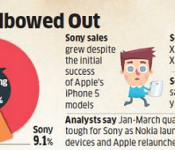
Who is the number two smartphone manufacturer in India? Sony, that’s Who!
 India is one of the largest emerging smartphone markets in recent years (China of course being the other), so it stands to reason that many smartphone manufacturers are vying for the attentions of the Indian population. While the global market distribution of devices seems to be relatively stable in its rankings, the story is not as simple in India; While Samsung is predictably first in market share, if you asked the question ‘who is the number two smartphone manufacturer in India’, you might be surprised to hear the answer is actually Sony.
Driven by sales of the Sony Xperia M Dual and the Sony Xperia C, Sony achieved a market share of 9.1% (by sales) to end 2013, which was particular impressive as they leapfrogged Apple, who had 7% in the same quarter, for second place. Seeing as Sony generally has a lackadaisical showing in Western markets, it is probably Sony’s intention to try and secure their position in this growing and lucrative market before fully committing to the more competitive markets. The road isn’t going to be easy, however, as Apple has re-launched the iPhone 4 at an entry-level price point of $375, and Nokia’s super-budget device, the Nokia X, is likely to make waves in this budget smartphone arena.
What do you think about Sony’s fortunes in India? Let us know your thoughts in the comments below.
Source: XperiaBlog via Phone Arena
//<![CDATA[
ord = window.ord || Math.floor(Math.random()*1E16);
document.write('’);
//]]>
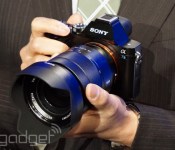
Sony announces full-frame Alpha A7s with 4K video output

It wouldn’t be NAB without a major 4K announcement from Sony, and that’s exactly what we’ve got here. The company introduced the Alpha A7s at its Las Vegas press event today, bringing 4K video to the popular full-frame mirrorless camera line. The “s” in the new camera’s name stands for sensitivity, and to that end it supports an ISO range of 50 to 409,600. The 12.2-megapixel full-frame sensor limits downscaling with 3,840 x 2,160 (QFHD) 4K video, ultimately resulting in higher quality footage. While you can store 1080p video internally, you’ll need to use an external recorder to capture 4K video, which the camera outputs with 4:2:2 color sampling via HDMI.
You can store XAVC S-format video with a class 10 or higher SDXC card. When in 1080p mode, you can also opt to shoot with APS-C cropping, while 120 fps capture is supported when you jump down to 720p. The A7s can snap still images, of course, but it really shines when it comes to capturing 4K and HD video. The camera supports S-Log2 gamma, expanding the dynamic range to 1300 percent, resulting in reduced shadow and highlight clipping.
Physically, the A7s looks identical to its Alpha siblings, with a solid design and feel. It also sports WiFi and NFC, for wireless transfers to a smartphone or tablet. Also, like the other Alpha 7 cams, the A7s includes a Multi Interface Shoe, so you can add in Sony’s XLR mic adapter kit, the XLR-K1M. Pricing has not yet been announced, but Sony executives say to expect it in stores this summer, just a few month’s after Panasonic’s GH4. Check it out in our video below.
Sarah Silbert contributed to this report.
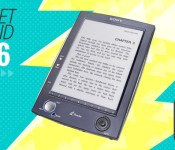
Gadget Rewind 2006: Sony Reader PRS-500
It’s our 10th birthday, and to celebrate we’ll be revisiting some of the key devices of the last decade. So please be kind, rewind.

Sony may not have been at the forefront of the digital music revolution, but when it came to e-books and e-readers, the company was certainly a pioneer. It all started in the ’90s with Sony’s chunky, flip-topped Data Discman. This two-pound, paperback-sized player came bundled with a selection of reference books on disc, each capable of storing up to 100,000 pages of digital text. When that cumbersome early e-book solution failed to gain traction, Sony went right back to the drawing board and returned in 2004 with the Japan-only LIBRIé e-reader. This particular device used an innovative E Ink display and relied on an e-book loan program — a distribution model that proved unpopular with consumers at the time.
By 2006, the company was ready to try again with its Sony Reader PRS-500, a 6-inch device that used the same E ink display as the LIBRIé and boasted 7,500 page-turns worth of battery life. This time, however, consumers could actually purchase e-books to own from Sony’s online store, which held around 10,000 titles at launch. The PRS-500 also shipped with a dock and USB connector in the box since downloads could only be managed by a PC and then transferred to the device.
Sony wasn’t the only company trying to launch the e-reader revolution in 2006. E Ink-style devices like the iRex iLiad and the STAReBOOK were hitting stores around the same time. There were also rumors that Apple would try its hand at the format as well. Of course, the elephant in the room was Amazon’s 2007 Kindle. Where Sony’s initial release date for its Reader was pushed back by several months — disappointing some eager customers — the Kindle arrived on schedule and sold out online in just five and a half hours. Amazon’s customers also had access to 88,000 e-books in the Kindle online store using Sprint’s wireless network.
Although Amazon snagged a top spot in the hearts of e-reading consumers, Sony continued to develop its own hardware line over the years, logging more than 10 iterations and developing a loyal fan base. Despite this consistent effort, however, recent events, like the shuttering of its Reader store, indicate that Sony may be somewhat willing to cede the e-book category to Amazon. It now directs current Reader customers to the Rakuten-owned Kobo platform for e-book purchases.
This isn’t the first time that Sony has pioneered the way into a new market only to lose its edge to a competitor; the same thing happened to its transistor business back in the 1950s.
Did you own a Sony Reader PRS-500? Add it to your Engadget profile as a device you had (or still have) and join the discussion to reminisce or share photos of your device with other like-minded gadget fans.

Sony releases an unlocked Xperia Z1 with US-friendly LTE

Frustrated that you’ve had to sign up to T-Mobile just to pick up an Xperia Z1 variant with completely US-native LTE? That won’t be a problem after this week. Sony has released an unlocked version of the Z1 that can take advantage of 4G speeds on AT&T, T-Mobile and their virtual network partners. The flagship Android phone should also support LTE on bigger Canadian carriers, if you’re inclined to travel. You won’t get anything else special for the $620 you’ll spend on the unlocked model, but it may scratch the itch if you’re unwilling to wait for stateside releases of newer hardware like the Z2 or Z1 Compact.
Filed under: Cellphones, Mobile, Sony, AT&T, T-Mobile
Via: CNET
Source: Sony

Sony’s Xperia Z2 is coming to North America in May

Sony’s Xperia Z2 is already available in a few corners of the world, but North America has so far been left high and dry. That drought will soon come to an end, though, as Bell says that it’s bringing the waterproof Android flagship to Canada this May. While the carrier isn’t divulging pricing at this stage, we’d expect the Z2 to cost $200 Canadian or more on a two-year plan, like most high-end smartphones. As for the good ol’ US of A? Unfortunately, there’s no word on an American launch — for now, you’ll have to make do with the Xperia Z1S if you live stateside.
Filed under: Cellphones, Mobile, Sony

On Xbox One, game broadcasters are quickly catching up to PlayStation 4

Though Xbox One sales may be slightly behind that of the PlayStation 4, it looks like game broadcasting is taking off at a much quicker pace on Microsoft’s new console. In the first week of availability, 108K Xbox One owners took to Twitch to broadcast games; the same number was reached on the PlayStation 4 after 25 days of availability. This is largely due to Twitch broadcasting launching alongside the PS4, whereas broadcasting didn’t function on the Xbox One until early last month — resultantly, millions of Xbox One consoles were already out in the wild, whereas the PS4 had to be physically purchased and brought home before users discovered the glory of … mostly safe for work broadcasts. It also didn’t hurt that the Xbox One had its first major exclusive game, Titanfall, launching alongside game broadcasting (we even got in on the fun ourselves). Regardless, it looks like game broadcasting is proving more than just a passing fad.

April Fools’ 2014 roundup: selfie-taking drones, smartgloves and more

For the last 24 hours (and likely the next 12), excitable company execs have been barraging our inbox,YouTube and your social media networks with their best shenanigans. Love it or loathe it (and you’re probably starting to loathe it by now), the April Fools tradition continues, even stronger, in 2014. Google went a little overboard, but hopefully, after today, selfies will die a death. Hopefully.
Google has too much fun, again
Aside from its Pokemon mapping efforts, Google wants the world to see the web differently… peppered with emoji icons.
Google Japan also has a new “Magic Hand” for touchscreen text input, featuring a very necessary cat paw add-on.
Then there’s Gmail’s shareable selfie, the Shelfie and a new auto-Awesome photobomb feature, ruining your photos with David Hasselhoff.

HTC’s GLUUV lays down the gauntlet to Samsung Fingers

Who was first? We’ll call it an awkward draw, as both Samsung and HTC had largely identical ideas for AF 2014: smartgloves. HTC’s Power Glove knock-off Gluuv promises holo-calls and an 87.2-megapixel camera. Finally. We also like the companion BoomBass speaker though: “durable, humongous, and completely wireless” … and carried on your shoulder.
Samsung Fingers‘ blog post outlines a palm-based flexible screen, another mention of selfies, and in a nod to its own often superfluous software add-ons, an increasingly bizarre list of feature, showcased with sketches like these:

Sony reveals the future of gadget power sources
“Our engineers and culinary technicians have come up with a way to tap into the amazing energy of food,” says the nondescript Sony spokesman. An enzyme that transfers food energy to gadgets and it involves a “voltaic enzyme.” Sony’s planned cereals and protein bars, filled with “protein, fiber and charged lithium.”
Nokia brings the 3310 back from the dead, pumps it full of megapixels

Nokia’s most iconic phone, the 3310 is making a return. Nokia’s best-selling handset returns with Windows Phone OS, a 41-megapixel camera sensor and most importantly, preloaded with Snake 2. We almost wish it was real.
HERE maps goes back to basics (and paper)

Apparently, you can still HERE maps without a smart device. This is HERE Papyrus, and we’re particularly taken with this augmented reality trace sheet.
CERN gets serious, switches to comic sans

Truly, the thinkers’ font.
Nest / Virgin America
Total temperature control for every passenger.
Kodak Picture Kiosk Drone

We can tell it’s a fake because Kodak’s blog post mentions calling and texting a phone number. Oh and hands-free selfies. (Also, how is this any more ridiculous than Kodak’s very real nuclear reactor?)
Samsung’s Fli-Fy

Why not just utilize the rats of the skies to be your drones… and boost your WiFi.
GoPro: #STOKED, the energy drink
Has its own hashtag. Must be legit.
iFixit

iFixit gets an offer it can’t refuse.
Swiftkey Flow Hard for your physical keyboard
No touchscreen needed.
‘Make your own smartphone, piece by piece, with this magazine subscription’
In just 10 years, you can make your very own smartphone, in this tie-up between Japan’s KDDI network and magazine publisher Deagostini.
Sega returns: MEGAne DRIVE, the wearable

That should equal 32-bit gaming.
The Roku Watch

Look at the size of the remote. Coming April 31st.
TechCrunch introduces Crunchcoin

Filed under: Cellphones, Displays, Gaming, Wearables, Science, Internet, Mobile, Alt, Samsung, Sony, HTC, Google
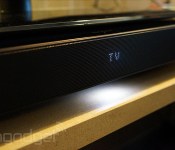
Sony’s latest home audio systems balance looks, price and sound quality

Here’s the thing with soundbars, sound plates and every other gadget that attempts to fill the niche between a full 5.1 home theater system and the tinny speakers built into your TV — they rarely sound great and they usually look even worse. Of course, there are always trade offs to be made, but the question that vexes us is, are they worth it? Sony is hoping that it’s found a proper balance with it’s latest trio of home audio setups and hit certain sweet spots on the bell curve of sound quality and design (and price).
First up are a pair of soundbars, the CT770 and CT370. Physically, both are extremely similar, with two-inch high bodies, angled speaker grills and displays that disappear completely into the front panel when turned off. The slimmer design allows them to be placed in front of a TV with little worry that you’ll be blocking the screen, something you couldn’t guarantee with their oddly octagonal predecessors. Both support 4K and 3D pass-through via a trio of HDMI inputs, along with optical and analog audio connections around back. There’s also Bluetooth under the hood, with NFC points on top for quickly pairing with the Sony SongPal app which acts both as a remote and lets you stream music from any service of your choosing.
The difference between the two boils down to price, power and size. The $449 770 has a total of 330 watts of power. Inside the main unit are four two-way speakers (two tweeters, two mid-range) with diffusers for creating the widest possible sound stage. In addition, a gyroscope inside can switch audio profiles based on the position the bar is in. The “.1″ of the 2.1 equation here is a 120W down-firing wireless subwoofer that, in our short experience, was capable of rumbling the floor without muddying the lows. It’s also designed for larger TVs in the 46-inch and up range. The smaller, $349 CT370 drops to a 100W subwoofer and, while neither is going to stand up next to a $1,000 5.1 home theater system, they definitely deliver clear balanced audio with a consumer-pleasing focus on the higher and lower frequencies.
The $299 XT1 “TV Sound System” is a rather elegantly designed platform with a 170W 2.1 array inside. It has it’s own 100W dual down-firing subwoofers and feet that elevate it off your TV bench (or sturdy crate…) to make sure the bass resonates clearly and as far as possible. The tempered glass top is designed to support the weight of a TV up to 55″ or 66 lbs. Just like its soundbar cousins it has Bluetooth and NFC on board, plus a trio of HDMI inputs. The XT1 didn’t produce quite as wide and even of sound as the CT770, but it was certainly a vast improvement over the speakers built into any mass market television.
All three units will be shipping in April and you’ll be able to pick them up from the usual retailers.
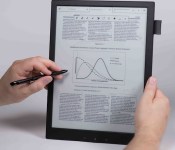
Sony’s 13-inch ‘Digital Paper’ is just like paper, except it costs $1,100

Despite years of development, E Ink’s displays haven’t yet replaced traditional paper everywhere. Sony’s trying to change that with this 13.3-inch Digital Paper device intended for legal, educational and business environments and after we got a brief demo last year it’s finally ready to go on sale in May. The only downside? Its pricetag, currently set at a cool $1,100. To answer the question of who could possibly afford or want such an expensive piece of paper that displays PDFs and accepts handwriting input, Sony is introducing Digital Paper at the American Bar Association Tech Show (which is apparently a thing) in Chicago.
The draw for Digital Paper is that it’s very light at 12.6 oz and has a high resolution (1,200 x 1,600) / 16-level grayscale display with touch controls, stylus input and no backlight. That helps out easy reading in the daytime and no need to scroll or zoom around documents like on smaller tablets. Sony also claims a three week battery life with recharging via AC or USB, while documents can be loaded over WiFi and stored on its 4GB of internal memory or an SD card. It’s still way out of our price range for note taking, but if Mark Zuckerberg comes knocking with a billion dollar deal in hand, it might be good to have around.
Filed under: Peripherals, Sony
Source: Sony, Digital Paper

The Last of Us coming to PS4 this summer with improved graphics

A PlayStation 4 port of highly acclaimed title The Last of Us will launch sometime this summer, a Sony spokesperson has let slip. Talking on CNN Turk’s Multiplayer gaming show, a PlayStation exec claimed the port will have better graphics than the PS3 version, and will be available both digitally and physically. PS4 copies will apparently include the Left Behind single-player DLC, so newcomers get the whole story upfront, and diehards get to replay a prettier rendition. Additional single and multiplayer content is in the works, too, but even a straight port should keep most superfans happy while they wait for the movie.
Source: CNN Turk (Multiplayer)
 AIVAnet