


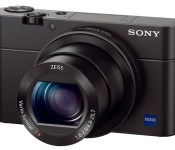
Meet Sony’s RX100 III, a refined edition of its excellent point-and-shoot

Even though Sony has been suffering from financial woes of late, the Japanese company did find some form of success recently thanks to new Xperia smartphones and the PlayStation 4. And let’s not forget another meaningful part of its electronics business: cameras. With the introduction of the Cyber-shot RX100 back in 2012, Sony made a point-and-shoot that most any photography buff could proudly carry around, to use not only as a backup to, say, a DSLR, but even as a main camera. Now, looking to build on the success of the first and second generations, Sony is announcing the RX100 III, bringing with it more bells and whistles than you could ever hope for out of a compact shooter.
On the outside, the new RX100 is quite similar to its predecessors, sporting a sleek, slightly glossy black finish and that 180-degree tilting LCD on the back. It is the inside where most changes have taken place, however. For instance, it now features Sony’s Bionz X image processor (also found on the recently unveiled Alpha A77 II), which is paired alongside the same 20.1-megapixel Exmor R CMOS sensor that’s found on the previous version of the RX100. But while Sony didn’t make any upgrades to the sensor here, the RX100 III does welcome brand new Zeiss glass in the Vario-Sonnar T*, a 24-70mm, f/1.8-f/2.8 lens — Sony says this is perfect for keeping a wide-angle view and should help you take some solid, bokeh-filled pictures.
One of the many things the RX100 does well is video, and Sony wanted that trend to continue with its third-gen model. The pocket-sized shooter now processes video in XAVC S format, which, according to Sony, lets you record 1080p videos at a much faster data rate and with very little compression — in other words, this will make your movies look a lot better and crisper. To go with that, Sony also added a built-in, retractable OLED electronic viewfinder (which wasn’t present on either of the older editions), WiFi/NFC for wireless sharing and the ability to capture 4K still images, making the newest RX100 an even more powerful little camera.
So just how much will you have to pay for all these features? Well, Sony’s pricing the Cyber-shot RX100 III at a reasonable $800 when it arrives next month, which is only $50 more than the RX100 II was when it became available last year.
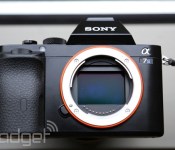
Full-frame and 4K-ready: The Sony Alpha A7s can be yours in July for $2,500

It’s hard to believe that the Alpha A7 is about to have its successor hit the market, especially since a full-frame mirrorless camera from Sony was just a rumor not that long ago. Today, Sony announced that its Alpha A7s, which was revealed at NAB in Las Vegas last month, will be going on sale in July for a cool $2,500 (body-only). Sure, it is a pretty heavy price tag, but the A7s packs enough features inside to make it one of the most exciting shooters to date. Along with the 35mm full-frame, 12.2-megapixel Exmor CMOS sensor, Sony’s newly minted ILC can also take 4K video (though you’ll need an external drive to do so) and has an ISO range of 50 to 409,600. But there’s a lot more where that came from, too — things like built-in WiFi, NFC, a 25-point autofocus system and 4K movie output.
We asked Sony whether the A7s would have a body-plus-lens kit available at the time the camera goes on sale, but the company said it didn’t have any details to share on that at the moment. Still, chances are there will be one — after all, that’s sort of standard with camera sales nowadays. The availability announcement of the Alpha A7s comes alongside the introduction of the Cyber-shot RX100 III, as Sony continues to expand its camera lineup with a little something for everyone. Of course, the A7s is set to face a little more competition than its cousin the RX100, with existing options like Panasonic’s Lumix GH4 and others looking to also get a piece of the 4K pie.
Sony’s $700 4K streaming box gets a much needed pre-order discount

4K TVs are still quite expensive and there’s still not a lot of stuff to watch on ‘em. If neither of those things deterred you from buying one, however, then Sony’s FMP-X10 Ultra HD Media Player is probably a good investment. The Roku-esque hardware lets you pull down 4K content like American Hustle and The Blacklist from Sony’s Video Unlimited store, as well as House of Cards and Breaking Bad from Netflix. Having already launched in Europe, it’ll arrive on these shores in July for $700 — unless, that is, you pre-order between today and July 15th, since Sony is offering a $200 discount for even earlier early adopters.
Filed under: Home Entertainment, HD, Sony

Sony’s finance chief explains why it’s been hemorrhaging cash

Further heavy losses for Sony: electronics sales (minus phones and gaming) stand at half of the peak seven years. The company’s latest financial report is grim reading for its investors — and its fans. So what happened, Sony? It’s new CFO Kenichiro Yoshida gave a starkly honest assessment of his employer’s missteps at a conference late on Wednesday. “2014 is the year to finish off our restructuring measures.” However, it’s not the first time a Sony exec has mentioned rejigging the entire business and that’s been one many issues. Changes apparently never cut deep enough. The company was also sluggish to adjust to trends, resisted major changes, had hulking overhead costs and ever-continuing TV troubles –these were all part of the problem.
According to Yoshida, Sony’s cost cutting up until now focused on manufacturing, but really didn’t affect sales and HQ divisions: tied in with pricey Tokyo real estate and locations. From now, cuts to sales will be around 20 percent, while HQ will see a 30 percent reduction over the next few years. There’s no bonuses for CEO Hirai and other top-level executives, which will apparently translate to a 30-50 percent drop in annual pay totals. (Gotta love those bonuses.)
“Since we’re in a very difficult situation … we must not get the priorities mixed up.”
Sony’s TV arm has apparently totaled losses of around 790 billion yen over the last 10 years, despite annual promises of a profitable turnaround. The head of the arm has changed five years in that time, and the CFO says that steps taken to improve the business simply weren’t consistent. Previous restructuring had also stopped short of selling or terminating significant electronics businesses, like TV and PCs — something that’s certainly changed in 2014.
Perhaps the most damning comment from Yoshia was that the entire company had been slow to respond to consumer trends, as financial and entertainment arms continued to provide stable profits. Restructuring only occurred as electronics sales began to falter. Turning Sony into a more cost-effective company comes first, and only then can the company focus on its smartphone imaging and games strategy, said the CFO. “Since we’re in a very difficult situation … we must not get the priorities mixed up.”
[Image credit: AFP/Getty Images]

Want to be a race car driver? Start playing video games

The Nissan GT Academy is a racing competition that sees winning drivers transition from Gran Turismo‘s digital realm to an honest-to-goodness race car. Lucas Ordóñez was the very first GT Academy winner and he not only went on to race outside the virtual realm, but grabbed some podium finishes, too. Fast forward five competitions (and as many years) and Road & Track reports that four Academy grads will be racing at Le Mans for 2014, proving that this feeder route is the real deal. Nissan’s own entry in the famous 24-hour event, the hybrid electric ZEOD RC, will be driven by Ordóñez and 2012 winner Wolfgang Riep with Satoshi Motoyama as the third in the team. The Lotus entry in the gruelling full-day race will see 2011′s victor Jann Mardenborough — now actually racing in GT3 — and 2012′s Mark Shulzhitskiy competing with F1 commentator and ex-driver Martin Brundle’s son Alex Brundle. So next time your mom gives you grief for wasting all your time and rotting your brain playing video games, let her know you’re training for your future career as a professional race car driver.
[Image credit: Nissan]
Filed under: Gaming, Transportation, Sony
Via: The Checkered Flag
Source: Road & Track

Engadget Daily: futuristic Army helmets, Sony Alpha 6000 review and more!

You might say the day is never really done in consumer technology news. Your workday, however, hopefully draws to a close at some point. This is the Daily Roundup on Engadget, a quick peek back at the top headlines for the past 24 hours — all handpicked by the editors here at the site. Click on through the break, and enjoy.

Future Army helmets make for cooler soldiers, terrified enemies
What you’re looking at is not a mask from Halo, it’s part of the US Army’s new “soldier of the future” concept. As of now, the helmet is just a render, but this design could one day protect our forces from heat, humidity and even chemical agents.

Russia threatens to disrupt GPS navigation in fight over sanctions
Today, the Russian government threatened to end cooperation with America on maintaining the GPS network, unless the US promises to house stations supporting the competing GLONASS. Gee, thanks Putin.

Sony Alpha 6000 review: a do-it-all mirrorless camera that’s worth every penny
Once again, Sony’s hit the nail on the head with its Alpha 6000: a well-rounded camera with speedy performance, fit for the novice and advanced photographer alike. At only $800, it packs the most bang per buck of any mirrorless shooter around.

A PC component maker in a post-PC world
Creative Labs has deep roots in the PC market. But as our world becomes increasing mobile, how does such a company adapt? Well, the audio specialist’s betting on its new $200 Bluetooth speaker, the Sound Blaster Roar.
You also might like:
Filed under: Misc

Bond producers snag film rights to the Snowden story

A secret meeting in Hong Kong, a stunning revelation and a pulitzer prize-winning news story. Sound exciting enough to grace the silver screen? Sony sure thinks so — the company’s film branch just bought up the rights to Glenn Greenwald’s No Place to Hide, the story behind the journalist’s fabled meeting with Edward Snowden. The book covers Greenwald’s early meetings with Snowden and offers no small amount of commentary on the NSA’s surveillance practices, but it could be a difficult story to put to film: Snowden is still in Russia, after all. Still, Sony Pictures is rearing to take a stab at it, and is putting the project in the hands of Michael G. Wilson and Barbara Broccoli, the producers behind James Bond films like Skyfall and Quantum of Solace. Considering the kind of international trouble Bond gets himself into, it could be a good fit — just don’t expect it to be an action film.
Filed under: Misc, Home Entertainment, Sony
Source: New York Times
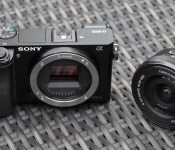
Sony Alpha 6000 review: a do-it-all mirrorless camera that’s worth every penny

By now, you’ve probably had a chance to shoot with a compact interchangeable-lens camera, or you’ve at least caught a whiff of that never-ending mirrorless cam hype. Sure, we’ve run into a few duds, but the last few years have brought a slew of models that exceeded our already lofty expectations, with Sony often leading the pack. Still, $800 (or £669 in the UK) is a lot to spend on any gadget, and while you’d probably be safe making a purchase based on Sony’s reputation in this space, we don’t blame you for wanting a review.
We invite you to stick around even if you’re not thinking about buying a camera today — we’re going to have some fun with this one. Sony’s Alpha 6000 met its match with monkeys in Bali, delicious Hong Kong dim sum and the brilliant skyline of Singapore. Strap in and join us on a wild Southeast Asian adventure, powerful ILC in tow.
Hardware and user interface

The A6000 is one of Sony’s beefiest-looking mirrorless cameras yet. The body is still quite compact, but a high-quality metal build means it should survive minor bumps and tumbles without suffering any dents and scratches. This model replaces Sony’s NEX-6, retaining the OLED electronic viewfinder, full-size hot shoe, dedicated mode dial and pop-up flash. There’s a 3-inch, 921k-dot, tilting LCD, as well as a 24.7-megapixel CMOS sensor, WiFi, 1080/60p video and a top sensitivity of ISO 51,200. It’s clearly not lacking in the spec department.
The A6000 is hardly the most intimidating mirrorless camera, but it does have its fair share of buttons and dials. You can select your shooting mode using a dedicated wheel mounted up top, then make tweaks to aperture and shutter speed with the secondary dial to its right. The bundled 16-50mm f/3.5-5.6 power zoom lens has a toggle on the side for adjusting focal length, or you can zoom in and out by turning the front lens wheel. There are plenty of dedicated and customizable buttons on the back, ranging from exposure compensation to ISO, along with a video record button positioned beside the thumb rest.
The camera’s software interface is identical to what you’ll find with recent NEX and Alpha cameras. While there’s no touchscreen, individual tabs make it easy to click through to the setting you need. You can also make tweaks on the fly using the quick-function menu, and you can fire pics and videos off to a smartphone or computer over WiFi by pressing the clearly marked transfer button.
Performance and battery life

Sony claims that the A6000 sports the “world’s fastest autofocus.” That’s difficult to verify without testing several recent models side by side, but the Alpha is certainly speedy. There are 179 autofocus points, making it easy to get a sharp shot quickly even with complex scenes and the 11 frames-per-second consecutive-shooting mode should serve sports shooters just fine. The only process that remains a bit time-consuming is transferring shots to a connected smartphone. After you pair the two devices, you’ll still need to wait for your phone to connect to the camera’s WiFi network before you can start moving photos over, either one by one or several at a time.
As for battery life, Sony’s managed to make improvements over the years without replacing the 1,080mAh cell. The A6000 comes bundled with Sony’s NP-FW50 battery back, which has been shipping with the company’s mirrorless cameras since the NEX-3, a model that first hit stores just about four years ago. Officially, you can expect to get 360 shots with a full charge, though we got through a full day of shooting, including more than 500 stills and three minutes of HD video, with a nearly 50 percent charge remaining.
Image quality
The A6000 offers fantastic image quality, on par with recent Sony NEX and Alpha cameras. You won’t necessarily notice a tremendous difference if stepping up from the NEX-6 or comparable models, but if you’re moving over to this ILC system, you should be quite pleased with the results. Click through the gallery below for some examples, then scroll down as we evaluate a selection of images.

The A6000′s automatic mode captured this Balinese rice terrace beautifully, with accurate exposure and colors. You can see the sharpness of details in the 100 percent insets above, shot at f/9 with a 1/100-second shutter speed and a sensitivity of ISO 100.

The camera’s speedy focus made it possible to snap this shot on a whim. The Balinese countryside looks vibrant and properly exposed. With more time to prepare, I would have adjusted the aperture from f/11 in order to bump up the shutter speed from 1/125 of a second to something that would have counteracted the movement of our car. Regardless, with a sensitivity of ISO 100, there’s no noise in sight.

A sensitivity of ISO 1250 allowed for a 1/160-second shutter speed with an aperture of f/4.5 in this shady shot, enabling the camera to capture sharp details at Ubud’s Sacred Monkey Forest.

This midday scene at Bali’s Ulun Danu temple is slightly overexposed, though colors are accurate and details are sharp in this 1/125-second, f/10 exposure at ISO 100.

Set at Ubud’s Royal Kirana Spa, this tranquil scene was captured at 1/160 of a second and f/4, with a sensitivity of ISO 200. Details are incredibly sharp, with accurate color and exposure.

Singapore’s skyline shines brightly from the top of the Marina Bay Sands Hotel. Details are sharp, with relatively low noise at ISO 3200, with an exposure of 1/15 of a second at f/3.5.

I bumped the ISO up to 6400 to snap this sharp shot at Singapore’s Flight Experience. Details are crisp and clear in this Boeing 737 simulator, with an exposure of f/3.5 and a 1/40-second shutter speed.
Video quality was also excellent, as you can see in the sample reel above. The camera exposed properly and adjusted quickly, with speedy focus as well. Zoom is also improved over previous models, thanks to the motorized lens and integrated toggle.
The competition

Competition is stiff in the mirrorless camera market, but you can’t do much better than the Alpha 6000 kit for 800 bucks. If you’re willing to spend a bit more, Sony’s A7 full-frame model is a phenomenal option, but that’ll run you $1,700 without a lens. In the 6000′s price range, Samsung’s NX30 is a solid choice — it’s available for $940 with an 18-55mm lens. Photographers also seem to love Panasonic’s GH3, which ships for $1,000 without a lens, and the Olympus E-M1, available for $1,300 body only.
Wrap-up

Sony is continuing its winning streak with the Alpha 6000. This well-rounded camera should last you for several years of top-notch shooting, and at $800 (or £669) with the 16-50mm power zoom lens, your wallet will be in good shape, too. Advanced shooters will find dedicated controls, speedy performance and excellent image quality, while ILC newbies will benefit from accurate full-auto options and a straightforward interface, also making it a solid fit for beginners with the cash to spare. In other words, while the macaques at Bali’s Sacred Monkey Forest will steal any camera, if they’re serious about their photography, they’ll want to opt for Sony’s Alpha 6000.

Sony will give your PlayStation controller a free World Cup makeover

Major sporting events serve as the perfect time for brands to thrust their latest wares in fans’ faces. With only weeks until the start of the 2014 World Cup, Sony is maximising its marketing opportunities as one of only six official FIFA Partners by offering PS3 and PS4 owners the opportunity to give their DualShock controllers a World Cup makeover. Sony will set up Customisation Stations in three UK cities where teams of graffiti artists will adorn the controllers with owners’ favourite players, teams and squad numbers completely free of charge. To take advantage of the offer, make your way to the PlayStation Customisation Stations situated in the Bullring Shopping Centre in Birmingham on May 24th, Piccadilly Gardens in Manchester on May 31st or Westfield Stratford City in London on either the 7th or 8th June. All you’ll need is your PlayStation controller and an idea of what you want done with it.
Via: Pocket-lint

Sony reaps benefit of PS4 and Xperia sales, but forecasts further bleeding

There are few surprises in Sony’s full-year earnings figures, especially since we’ve already covered the huge loss it suffered in pulling out of the PC business. However, although overall profit is heavily in the red, the detailed numbers show healthy gains in precisely the two departments where we’d hope to see them: Gaming-related sales shot up 53 percent on the back of the PS4, while Xperia smartphone sales rose by around 20 percent to just shy of 40 million units for the year ended March 31st. Sony doesn’t specify phone sales by model, but the year-over-year gain strikes us as a fair and just reward for the manufacturer’s excellent Xperia Z1 and Z1 Compact (shown above). Unfortunately, none of this success looks likely to fix Sony’s deeper ailments any time soon, because the company is still forecasting further heavy losses throughout 2014. It predicts a net loss of 50 billion yen over the coming year, whereas most pundits had expected the ship to be righted and profitable by then.
Source: Sony
 AIVAnet