


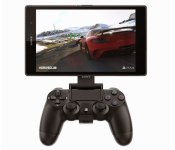
Sony PS4 Remote Play and Game Control Mount coming to Z3 devices

Sony has announced that its new Z3 lineup will exclusively get PS4 Remote Play, a service that has so far only worked with the Vita. The console will detect your Z3 device over WiFi and unlock it, letting you play with a Dualshock4 wireless controller using the new GCM10 Game Control Mount (see the image below). On top of playing games, you’ll also be able to use a Z3 device as a second screen to view livestreams (of games, of course) or chat over the Playstation Network. Sony kept using the word “exclusive” with Remote Play, so if you’re using a non-Z3 handset it seems you’ll be out of luck. The mount and service will likely arrive when the Z3s do, along with the pricing.

Filed under: Gaming, Peripherals, Sony
.CPlase_panel display:none;
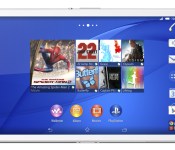
Sony’s Xperia Z3 Tablet Compact stuffs full performance into an 8-inch slate

Sony had a minor hit when it unveiled the Xperia Z1 Compact, which crammed a full-power smartphone into a smaller frame; now, it’s hoping to repeat that success with tablets. Its new Xperia Z3 Tablet Compact is not only one of the thinnest (6.4mm) and lightest (0.6lbs) 8-inch tablets you’ll find, but is actually more powerful than the full-size Z2 Tablet. It still has a 1080p display, 3GB of RAM, waterproofing, an 8.1-megapixel rear camera and a 2.2-megapixel front shooter, but runs a speedier 2.5GHz Snapdragon 801 processor. The Compact should also last for a very healthy 13 hours of non-stop video playback.
There are a few hefty software upgrades, to boot. Besides the audio upscaling also seen in the new Z3 phones, this is Sony’s first tablet with PlayStation 4 Remote Play — you can not only control your game console from the tablet, but use it as a primary screen if someone’s hogging the TV. You can even buy a custom mount for your DualShock 4 controller so that you don’t have to find a safe resting spot for the slate.
Sony expects the Z3 Tablet Compact to hit shelves in the fall. It’s not revealing full launch details at this point, but there will be both WiFi-only and LTE models.
Source: Sony Mobile
.CPlase_panel display:none;
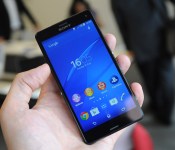
Sony’s Xperia Z3 Compact represents what all ‘mini’ phones should be

Miniature. Every phone maker is trying out the Mini Me approach these days, but most of them don’t do it very well. Sony’s one of the exceptions: Last year the manufacturer came out with the Xperia Z1 Compact, which was a smaller version of the flagship phone with almost the same specs. This is a big deal, because more often than not, “mini” models don’t get the same stellar treatment as their bigger siblings. Fortunately, the first Compact must have done well enough for Sony to give it a second heave-ho; enter the Xperia Z3 Compact, which debuted today at IFA 2014 in Berlin.
To be clear, the Z3 Compact isn’t an exact shrunken-down replica of the Xperia Z3 — also announced at today’s show — but it’s still much closer than any other manufacturer has been. It uses a 4.6-inch 720p screen instead of a 5.2-inch 1080p option; Sony claims that phones this small doesn’t really need such high resolution, so this is clearly an optimal way for them to cut costs. (My first impressions of the screen are quite lovely; the lower resolution didn’t negatively effect my initial experience, albeit it was in a brightly lit press booth.) Additionally, it has a smaller battery as a result of the smaller size, but 2,600mAh is still nothing to balk at — especially given the lower resolution won’t be much of a battery burden.
It also comes lined with a “liquid reflection” frame (which sounds like something you’d get at a bar after a long day at work), which uses translucent plastic on the sides instead of aluminum; and although I’m always a fan of phones that feature metal frames, the plastic feels extremely solid and the translucence simply looks pretty cool.
But those differences aside, the Compact has nearly everything else. It comes with the same IP68 waterproof rating, Snapdragon 801 chipset, 20.7MP ExmorRS camera sensor with 2.2MP front-facing camera, 16GB internal storage and microSD card slot (though the Z3 gets up to 128GB, whereas the Compact is 64GB).
As you might expect, the smaller body and svelte 7.3mm profile makes it quite easy to hold, and the slight curves on the side bubble out to offer a solid grip without the feeling of the corners or edges being too sharp for comfort. It comes with a hardware camera shutter button on the lower right, just below the volume button and power key; the volume is in a rather awkward spot, however, as it’s the exact place I like to keep my grip, so it may likely result in more accidental presses for anyone with similar preferences. Over on the left, you’ll find the nano-SIM slot, microSD reader and micro-USB charger, and the 3.5mm headphone jack is on top.
The Compact will come in several colors when it gets released this fall: White, black, green and orange, with the latter two being much more sporty than the Z3′s options. All told, I’m actually a bit more excited to use this phone than the Z3 itself, though both are rather tempting offerings; but there are still plenty of people who prefer a smaller size but don’t want to sacrifice flagship components to get it. Fortunately, although Sony’s option isn’t a perfect replica of its big brother, it’s at least the best compromise for a “mini” smartphone that we’ve seen so far.
Filed under: Cellphones, Wireless, Mobile
.CPlase_panel display:none;
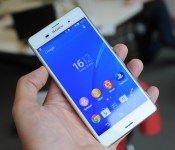
A closer look at Sony’s Xperia Z3 flagship

The Xperia Z2 is just over six months old, but Sony’s intent on staying ahead of the curve with the new Xperia Z3, announced today. With a 2.5GHz quad-core Snapdragon 801 processor, a whopping 3 gigs of RAM and various other high-end components like a 20.7-megapixel camera, we’re talking about serious future-proofing, even if it’s still a relatively incremental upgrade over its predecessor. Sporting more or less the same omnibalance design with aluminum detailing round the perimeter, you’re going to need to be a fan Sony’s previous work to appreciate the Z3. Anyone who may’ve found the Z2 unwieldy, however, might see the more refined, newer flagship as a viable option.
It’s immediately apparent the Xperia Z3 doesn’t carry quite the bulk of the Z2, being both thinner, lighter, and just as simply designed. There’s nothing much to the glass front and back of the device (which comes in white, black, silver-green and copper colors), with camera lenses, bezels and understated logos more of less where you’d expect them. The aluminum power key, volume rockers and dedicated camera shutter button adorn the right edge of the device, alongside the waterproofing flaps that hide the microSD and SIM card slots. One more noticeable difference from the Z2 is the aluminum edges are now broken up at the corners, and replaced with corner caps made out of a type of nylon. These are more resilient than the aluminum, we’re told, and thus won’t ding or deform if you happen to drop the thing.

Otherwise, not much has changed on the design front at all. The Z3 does have a higher water and dustproof rating than the Z2, even if you can’t tell, at IP65/68. Sony has stuck with a 5.2-inch, 1080p display on the Z3 (just like the Z2), although this panel has contrast-enhancing technology for improved sunlight readability. Sony didn’t want to upgrade to a 4K or even 2K display for better a spec sheet if it was going to impact battery life, thus no improvement in resolution. The display also has dedicated memory, so it won’t refresh when it doesn’t have to, saving on battery life further. The more efficient Snapdragon 801 should help on that front, too, and every little helps when you have a 3,100mAh battery (100 mAh less than the Z2) driving such a powerhouse. We’re told that it’ll last for two days without needing to be plugged in, but we’ll have to see what kind of usage conditions that entails.
The camera hasn’t changed in terms of megapixel count from the Z2. The 20.7-megapixel sensor, however, is said to have better low-light performance, a new 25mm wide-angle G-lens, and a new upper limit to the ISO setting of 12,800 (a smartphone first, apparently). A new “Intelligent Active Mode” when shooting video offers improved digital stabilization, which operates on top of the Steadyshot tech Sony already incorporates into its top-end devices. New camera features include live to YouTube streaming and “Face in,” a mode that captures feeds from both the rear and 2-megapixel front-facing camera simultaneously. There’s also “AR fun,” which lets you add 3D AR effects to the frame, and a multi-camera mode that pairs the Z3 with other Sony cameras and smartphones via WiFi Direct, allowing you to see both viewfinders on the screen and dynamically direct video from just the one phone.

The Z3 is also equipped with high-resolution audio playback, and an upscaling engine called DSEE HX that upscaled low-res audio (whether that be from streaming services or files) to near hi-res audio, although you’ll need a high-end set of headphones to feel the benefit. Finally, Sony has equipped the Z3 and others devices in the Z3 family with PlayStation 4 remote play, previously only a feature of the handheld Playstation Vita console. It works best over your home WiFi network (say, if the TV is required for some other purpose), but it can theoretically work anywhere, albeit with terrible lag. A new controller mount that adds a suction cup to the DualShock 4 controller gives you the optimum setup for smartphone gaming. The remote play feature isn’t due to be enabled until November, however, possibly a little later than the Z3′s “fall” release date for an as-yet unknown price.
Filed under: Cellphones, Mobile, Sony
.CPlase_panel display:none;
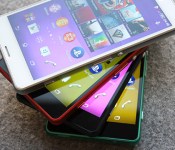
Live from Sony’s IFA 2014 Xperia event!

If you don’t see this message, that’s probably a good sign — it means that the liveblog is going strong and we’re telling you about the latest Sony products as they’re introduced on stage at IFA 2014. If you do see this message, however, it just means that we haven’t been able to get settled into our seats quite yet, but are busily working toward achieving that goal. Keep refreshing this page (or at least hang onto it as a bookmark if you need to come back to it later) and soon you’ll see exactly what we’re seeing: New phones, tablets, smartwatches and who knows what else.
[Image credit: Ausdroid]


Filed under: Announcements, Cellphones, Tablets, Wearables, HD, Mobile, Sony
.CPlase_panel display:none;

Sony’s soundbar combo offers another high-definition audio option

Headphones and music players aren’t all Sony had on tap in the audio department for IFA, as the company has also announced a new soundbar/wireless subwoofer combo. Having already outed two of the devices earlier this year, the HT-ST5 offers the option of 380 watts of 7.1 surround sound across seven digital amps and nine total speakers with support for both Dolby TrueHD and dts-HS formats. There’s a Bluetooth option that touts one-touch NFC connectivity and handles aptX and AAC audio codecs. For hooking up all of those living room gadgets, a trio of HDMI jacks with 4K pass through connects to your TV with a single cable. And a mobile app for both Android and iOS streams music from places like Pandora and Spotify while providing remote control for the system as well. Ready to upgrade your flat’s theater setup? Well, the pair will hit your wallet for $1,000 when it arrives later this month.

Filed under: Home Entertainment, Sony
.CPlase_panel display:none;
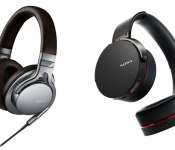
Sony’s latest headphones tackle high-res and bass-heavy listening

While several other audio outfits have already unveiled hi-fi minded and bass heavy options, Sony’s looking to add some more of the same. First, the MDR-1a are a high-res set of on-ear cans aimed at listeners who fancy high-end aesthetics, with a bit more sophisticated look than the MDR-1. There’s silver accents with leather-like material wrapping both the earcups and headband for “long-term” comfort and silent joints keep movement from muddying the tunes. Inside, sound reproduction ticks the meter at up to 100 kHz to keep things clear with 40mm drivers powering beats. Of course, there are two cables included — for those who prefer in-line controls — designed to curb signal loss and a folding design that tucks nicely into that rucksack. Sound too good to pass up? The MDR-1a will arrive later this month with a $300 price tag that matches several other high-end options.
For folks who fancy a wireless set with a heavy dose of bass, Sony is adding to its existing line focuses on those tones with the MDR-XB950BT. This time around, the over-ear unit with built-in electronic bass boost and 40mm drivers cut the tether and go full-on wireless — as the alphanumeric moniker suggests. The Bluetooth connectivity handles streaming with AAC and apt-X support alongside a mic for making calls. What’s more, NFC allows for quick and easy pairing with your smartphone or streaming device of choice. And of course, if you gobble up that 20 hours of advertised battery life, there’s a passive option with a cord so you can still listen while you find an outlet. They have a bit of the leather-esque material of their own too, in case that’s a deal breaker. These are set to arrive mid-September for $200 where Sony’s gadgets are usually sold. For now though, take a look at both sets in the hands-on gallery below.
Filed under: Portable Audio/Video, Sony
.CPlase_panel display:none;
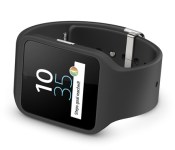
Sony announces the SmartWatch 3 with Android Wear

Sony’s been making smartwatches since before they were cool, and with the advent of Android Wear it was only a matter of time before they made another. Enter the Smartwatch 3, announced at IFA today, running Google’s new platform specifically for wearables. The third member of the family comes with a 1.2GHz quad-core processor, 1.6-inch screen and Sony’s now trademark IP68 waterproofing. Other key features include 4GB of storage, 512MB of memory NFC support, GPS and a 420mAh battery (charged over micro-USB).
Sony has also made it clear that the Smartwatch 3 will make use of the incoming Android Wear features we recently heard about (that make the watch more useful on its own). It’s also promising “better” battery life from that 420mAh cell — suggesting it’ll be good for up to two days of use, or four days on standby. If you’re a believer in “third time lucky,” then you can pick one up for 300 Euros starting this fall.
Filed under: Wearables, Mobile, Sony
.CPlase_panel display:none;
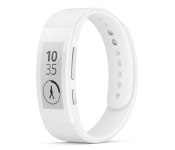
Sony outfits the SmartBand Talk with an e-paper screen and voice calling

When does a fitness band become a smartwatch? We’d argue that an e-paper display is one feature you can use to make that distinction, which is exactly what Sony’s added to its “lifelogging” SmartBand. A display isn’t the only thing new about the SmartBand Talk, because as the name suggests, you can also make/take calls on the wearable thanks to an embedded microphone and loudspeaker. There’s an ARM Cortex-M4 32-bit processor to power the whole thing with 2MB of flash memory and that 1.4-inch black and white display to keep you updated on progress. As you might expect, Sony’s Core is at work here as well with edge-mounted volume and menu buttons to round out the on-board controls. The IP68 waterproof and dustproof wearable connects to an Android 4.4 (and above) device via NFC and Bluetooth to wrangle tasks for up to three days before needing a charge. If you’re looking to get a bit more active, €160 (around $210) will be the cost of admission when the SmartBand Talk arrives this fall in four different color options.
.CPlase_panel display:none;
Wearable and high-res music players added to the Sony Walkman fold

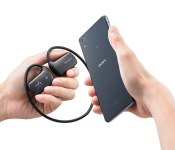
Still opt for a dedicated music player for listening on the go? Sony has two new options in its Walkman line that’ll do just that, and the NWZ-WS613 takes the wearable player and has it double as a Bluetooth headset. Connecting to your smartphone can beam tracks or you can listen to tunes loaded directly on the device with a ring-like controller for controls and calls that won’t break your stride. A smartphone app is also capable of tweaks and skipping around — should you want to limit the number of items in that gym bag. As you might expect, the unit is indeed waterproof to keep the sweat at bay and connects to fitness apps to further enhance those workouts. Does the wrap-around look sound like a solid addition to your exercise attire? Parting with $160 in October will secure one of your very own, but for those who’d rather keep the music player and headphones separate, there’s an option for that, too.

High-resolution audio has been talked about a great deal lately in regards to new gadgets, and Sony’s new Walkman music player continues to take aim there as well. The NWZ-A17 claims its the “world’s smallest and lightest” device to sort such files, with support for WAV, AIFF, ALAC, FLAC and more baked in. For regular ol’ MP3 and WMA files, DSEE HX upscales the tunes for higher quality listening. There’s 64GB of storage on board that’s expandable via a microSD slot, and the gadget allows for up to 50 hours of regular and 30 hours of high-res listening. Bluetooth and NFC connectivity is included too, and the whole lot is accessed via a 2.25-inch QVGA LCD display. So what about loading the thing with music? It appears to be quite easy as drag and drop functions play nice with iTunes on both Mac and Windows. Interested parties can grab one later this month for $300, and to tide you over, there’s a closer look in the gallery that follows.
Filed under: Portable Audio/Video, Sony
.CPlase_panel display:none;
 AIVAnet