


New Sony Xperia smartphone spotted on benchmark sites, sports 5.2-inch display and mid-range specs

A few hours ago we learned that Sony may exit both the smartphone and television markets in a bid to return the Japanese tech company back to profitability. While the Sony CEO, Kazuo Hirai, said that he would not “rule out considering an exit strategy”, this would not be a quick process if Sony were indeed to quit making smartphones. In the meantime though, a new Sony smartphone has been seen being put through its paces at both the GeekBench and GFXBench sites. The details of which are below.

As you can probably tell from browsing the specifications, this newly spotted Sony smartphone with model number E2303 is of the mid-range variety.
- 5.2 Inch display with 720 x 1280 resolution
- Octa-Core Snapdragon 615 clocked at 1.5GHz (64-bit capable)
- Qualcomm Adreno 405 GPU
- 2GB of RAM
- 4GB Internal storage
- 12MP Rear-facing camera
- 5MP Front-facing camera
- Android 5.0 Lollipop
It would be a great loss to the world of Android if Sony left the smartphone business, so here’s hoping that the next batch of Xperia smartphones can do the business and gain Sony some much-needed market share and profits.

Come comment on this article: New Sony Xperia smartphone spotted on benchmark sites, sports 5.2-inch display and mid-range specs

Sony may exit the smartphone and television market to increase profits
 Sony makes some very nice equipment, especially when it comes to smartphones, and I don’t think there are many people that will argue against that. However, the company has struggled to gain much market share and turn a profit in the wireless industry, partly because of intense competition on both the high and low end, and partly because of their inability to make any headway in the lucrative US market.
Sony CEO Kazuo Hirai talked about how Sony plans to get back to profitability by the end of the 2018, and those plans include leveraging Sony’s Playstation business, as well as their camera component sales and access to media like TV shows, movies, and music. However, two of Sony’s current major divisions, televisions and smartphones, are absent from that plan.
Hirai didn’t explicitly say it’s part of the company’s long term plan, but he hasn’t ruled out getting out of the mobile and TV market. Both of those industries are extremely competitive, and even when a company does manage to grab up some market share it can be tough to turn that into profit. Sony has struggled with both of those markets lately, and we’ve already seen them spin off their PC division to cut their losses, so it’s very possible that the mobile and TV sections get the same treatment.
Ultimately, Sony plans to increase it profits to about $4 billion by the end of 2018, and Hirai believes they’re on track to do that with or without those two divisions. It’ll be interesting to see how things play out, but I’d be pretty disappointed to see them leave the mobile industry altogether. There’s always a chance that they sell the division off to a third party, similar to what happened with VAIO, but it’s too early to make any guesses at this point.
source: Reuters
Come comment on this article: Sony may exit the smartphone and television market to increase profits

Android Zodiac: notable Android events
Android has come a long way since its release. From the HTC Dream to the Nexus 6, everything has changed. To come so far, significant things have happened that have changed the Android world. To highlight some of these events that have occurred, I have created an Android Zodiac! Yes, I’m aware this is not the same as the Chinese Zodiac, and this doesn’t really say anything about those born in those years. If you’re looking for something like that, check out our article called “What does your phone say about you“. Anyways, let’s dive in.

2007: Year of the Open Handset Alliance
2007 was a big year in not only the Android world, but the technology world as a whole. This was the year that the first iPhone was announced, and when Google and 47 other firms announced the Open Handset Alliance that would lead to Android. The reason for this was to unite companies to “enable everyone in our industry to innovate more rapidly and respond better to consumers’ demands” by having an open operating system, Android. The SDK is available to everyone, and the goal is to have one standard among mobile phones. If you’re interested, you can even look at the website that was released for this here. Definitely a blast from the past! Anyways, it would be the Open Handset Alliance that would help make Android the most popular OS on the market.

2008: Year of the HTC Dream
In 2008, the very first Android phone was released: the HTC Dream. Also known as the T-Mobile G1, this was the first phone to showcase Android. This smartphone not only had a sliding keyboard, but it had a home screen you could customize, complete with a wallpaper and widgets. There was also a new notification system that displays the icon for an app in the status bar whenever there’s a new notification, and you can slide down from the top to view more details about the notification. There was also integration with Google services allowing access to Gmail, YouTube, and more. On top of all of that, it was backed by the OHA, Google, and a promise to have updates brought to it that would bring new features and bug fixes. This device would change how software is designed and implemented for devices everywhere. Another interesting thing about this is HTC would later be the first for other landmarks in Android. But more on that later…
2009: Year of the Android Wars
2009 was the year that most of the manufacturers we know in Android phones today started to make Android phones. Samsung, Motorola, HTC, Sony, LG, and more all threw their hat into the Android phone ring. HTC released four other smartphones after the HTC Dream; Samsung released the first Galaxy phone, along with three other phones; Motorola released three phones along with their first DROID, Sony released the first Android Ericsson phone, and LG released a phone. Below is a collection of some of the phones along with a link to their specifications.
Note: I may have missed a few devices. Please let me know what I’ve missed!
 Samsung
 Motorola
 HTC
HTC
 Sony
Sony
 LG
LG
2010: Year of the Nexus
In 2010, Google released their first in-house designed smartphone: the Nexus One. Once again, HTC was the first with something in the Android space, as they manufactured the Nexus One. The Nexus One was a phone released with an unlocked bootloader for developers to create and test software on a version of Android that was untouched by manufacturers. It was also designed by Google to provide an example of what it believes other phones should look like in terms of hardware. The phone was sold online by Google, eventually being available through carriers. Little did we know, this would open a world of expectations from Android geeks everywhere as each year we now await eagerly to see what Google will release in the next Nexus. The Nexus One also was the first phone with Android 2.1 Eclair, which is another precedent set by this phone.

2011: Year of the Modern Phone
2011 saw the introduction of a lot of aspects in smartphones that consumers have come to expect of their smartphone. Displays started getting bigger, the bodies started getting thinner, and keyboards started disappearing. Screen resolutions started becoming important, and design started to focus more on looking futuristic. 2011 saw phones such as the Samsung Galaxy S II, the first Samsung Galaxy Note, the first Motorola DROID RAZR, and the Motorola DROID BIONIC. HTC and LG started to up their game too. Companies who were a part of the Android world started releasing more and more devices, and companies that weren’t involved before started to get involved. Users started to expect more out of their devices. A lot of the things you see in your current smartphone likely resembles most of the phones that came out in 2011.
 2012: Year of the Samsung

Let’s be honest, 2012 was all about Samsung. Not only did they have almost 50 different models and refine their Galaxy Note in the much more successful Galaxy Note II, but they released their most successful phone ever: the Samsung Galaxy S III. The S3 turned out to overtake the Apple iPhone 4S and iPhone 5 in sales in Q3 2012, selling over 18 million units in Q3 alone. The design was different, its speed and fluidity was unprecedented, and Samsung had added features to Android through its TouchWiz UI (user-interface) that helped make the OS (operating system) more friendly. Again, the Galaxy Note II also did well, selling over 3 million units in under two months of its release. The Note II had improved on the first generation in almost every way, and can certainly be accredited for the rise in popularity of the “phablet”. Samsung was on fire, and at that time it seemed no other manufacturer could touch them.

2013: Year of the User
2013 was a big year for Android. After Samsung’s huge success in 2012, all the other manufacturers took a step back and realized they needed to change things, and focus on the user. LG released their very different LG G2, where the power and volume buttons were on the back. Sony released the Xperia Z series, where durability became a focus. HTC released the gorgeous HTC One (M7). Google/LG released the Nexus 5, which improved on the widely accepted Nexus 4. Motorola released the Moto X, which focused on genuinely useful features and consumer design, and the Moto G, which brought great functionality and speed to budget phones. In 2013, we saw a huge focus on the end-user, finally bringing Android as an ecosystem to the big leagues.

2014: Year of the Chinese
After all-around positive reception to Android devices in 2013, most manufacturers pretty much just improved on their previous flagships in small ways (which is not a bad thing). However, with little to no innovation, this made way for a new player in the Android space: Chinese manufacturers. Xiaomi especially, but companies like Huawei, Vivo, Oppo, THL, and OnePlus entered the smartphone race with some serious gusto. While most of these companies had already existed, their entries in 2014 gained a lot of attention, and money. OnePlus in particular with their very controversial invitation-only system garnered many headlines. However, Xiaomi was the company that often made a couple of entries onto lists of top-selling smartphones, such as this one. Essentially, manufacturers based in China proved that they were starting to get serious about making Android smartphones.

2015: Year of the Software Design
I know I know: 2015 has just started. So you can take this as my prediction for the big thing in 2015. Some say that it will be all about wearables; others say it will be all about phone displays. In my opinion, wearables still have a ways to go before it becomes mainstream, and curved displays can only do so much at their current state, especially considering how expensive they are to manufacture. With innovation in the hardware space becoming infrequent (except for Project Ara, but that’s not ready yet), there is really only one place left to go: software. And while new features in software are introduced all the time, I think that Android Lollipop has shown us that Android can look good. Pretty soon, iOS will not be the only pretty operating system, as more and more manufacturers adopt Lollipop; with manufacturers having their own UI skin they slap on their phones, they’ll recreate Lollipop a bit, but users are going to want the design to still be there, so there is going to be a lot of creativity in the software. Hopefully.
That wraps up the Android Zodiac! Let me know what you think 2015 will bring. Perhaps in a year, we can dig this post back up and compare and add-on what really happened.
(function() var script = document.createElement(‘script’);script.src = ‘https://stacksocial.com/widget.js?publisher=androidguys&type=editorial_post_widget_preferences’;script.async = true;var entry = document.getElementsByTagName(‘script’)[0];entry.parentNode.insertBefore(script, entry);)();
http://www.androidguys.com/pubgalaxy/728×90.html
The post Android Zodiac: notable Android events appeared first on AndroidGuys.
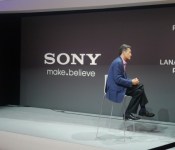
Sony to “explore potential alliances” in “highly volatile” mobile business

Sony revealed its mid-term corporate strategy for the next three years, and mobile is singled out as one of the areas where Sony will focus on minimizing risks, rather than creating growth or profits.
For the fiscal years 2015-2017, Sony wants to return to a healthy profit, by focusing on “growth drivers” including the PlayStation platform, image sensors for mobile devices and cameras, and entertainment. These are all business where Sony will implement “growth measures and engage in aggressive capital investment” with the goal of expanding both revenues and profits.
A second group of activities mentioned in the strategy is “stable profit generators,” businesses where Sony doesn’t foresee growth, but can still deliver “steady profit and positive cash flow.” In other words, these are units that won’t bring Sony a lot of money, but won’t cause losses either.
Finally, Sony mentioned Mobile Communications and TV as “areas focusing on volatility management.” Here, Sony will focus on curtailing risks, cutting costs, and dealing with commoditization in a “challenging competitive landscape.” The company hinted that it will invest more parsimoniously in mobile and TV and that it’s even considering partnerships or spinoffs:
“By carefully selecting the territories and product areas it targets, Sony will seek to limit its capital investment and establish a business structure capable of securing stable profits. The Company will also continue to explore potential alliances with other companies in these areas, in response to changes in the business landscape.”
And
“Sony also intends to move forward with preparations for splitting out other business units thereafter”
The company didn’t specify what business units it considers “splitting,” but the term could mean two things here: Sony could spin out mobile as a wholly owned subsidiary, in order to give it more autonomy and to reduce costs. Or, it could sell it off, like it did with the Vaio laptop business, which it unloaded to a group of investors in 2014.
Over the past couple of years, Sony touted mobile as a pillar of its return to profitability and future growth. In fact, when Vaio was offloaded in February 2014, a better focus on mobile was offered as one of the key reasons for the divestment. But things have changed, and CFO Kenichiro Yoshida has made it clear in the past that Sony has no “sacred cows.” Yoshida has impressed investors with hard, no-nonsense measures, including the write-off of most of the value Sony put in the mobile unit. As such, we shouldn’t really be surprised if Sony decides to take a drastic measure sooner or later.
On the product front, two weeks ahead of MWC, there’s no word of any Sony event at the show, and it’s increasingly clear we won’t see the Xperia Z4 in Barcelona.

Daily Roundup: NSA spyware, Apple’s VR headset and more!

Welcome to the Daily Roundup. Security researchers discovered NSA surveillance software in the firmware of some new hard drives. In other news, a UK company works on a self-driving shuttle for public transit and an Apple patent filed in 2008 shows the company has long been interested in VR displays. Catch up on all of today’s top stories past the break.
The NSA hides surveillance software in hard drives

Security researchers at Kaspersky Lab have discovered apparently state-created spyware buried in the firmware of hard drives from big names like Seagate, Toshiba and Western Digital.
The autonomous shuttle hoping to transform public transport

Public transportation is one particular area that could benefit from self-driving vehicles and a UK company is working toward making it a reality.
Apple explores headsets that turn your iPhone into a VR display

The USPTO has granted Apple a patent (originally filed way back in 2008) for a headset design that uses your iPhone as a virtual reality display. The basic concept bears more than a small resemblance to Samsung’s Gear VR.
Behold: a wristband that replaces your phone with a dumber phone

The folks behind the giant and retro (but not quite useful) Neptune Pine smartwatch are back — and this time they’re aiming to flip technology paradigms. Their new product, the Neptune Duo, is made up of two familiar looking devices that don’t work the way you’d expect.
Any app that works with Android Wear now works on your Pebble

A new update for the Pebble smartwatch adds support for Android 4.0 devices, automatic app and watch face updates and Square Cash payments. You’ll need to update your Pebble smartwatch firmware as well as download the very latest edition of of the companion Android app to get rolling.
Sony’s $840 augmented reality glasses are real, just not pretty

Sony’s SmartEyeGlass SED-E1 Developer Edition is coming to 10 countries next month. The glasses use “holographic waveguide technology” to put information directly in the wearer’s eyeline, with simple green monochrome text and diagrams displayed at up to 15fps. The starting price? $840 USD.
The Big Picture: Rosetta gets up close and personal with a comet

This weekend, the ESA’s Rosetta spacecraft took a close approach past Comet 67P/Churyumov-Gerasimenko and captured this stunning photo taken just 5.5 miles above the comet’s surface.
Sony announces pre-orders for the SmartEyeglass Dev Edition in the UK and Germany
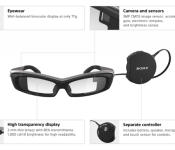
We’ve seen prototypes of Sony‘s answer to Google Glass pop up almost a year ago, and now it’s finally official. Sony will now let you pre-order the Sony SmartEyeglass Developer Edition for $840. Units are available for pre-order from today in Germany and the UK, and will ship in March. US and Japan availability is coming soon, though we don’t have a timeframe for these countries yet. Additionally, the headset will be available for enterprise customers in France, Italy, Spain, Belgium, Netherlands and Sweden when it officially launches. Also upon launch, Sony will release an updated SDK for developers to begin creating SmartEyeglass-compatible applications.

Similar to Google Glass, the SmartEyeglass (SED-E1) dev unit will let you interact with your surroundings, allowing you to take photos, send text messages, and much more. It connects to any Android device running 4.4 KitKat or later, and can easily pair to the device through the SmartEyeglass app which can be found in the Play Store. The headset is controlled by a wired remote used for navigating through the device. The controller houses the battery, microphone, speaker and more. The controller is constantly connected to the headset, and is recommended to clip on either a shirt or jacket. But here’s the thing, having all of that extra space in the remote should warrant better battery life, but Sony is only quoting the battery at 150 minutes of continuous use. Since this is a first generation product, we’ll need to withhold judgement until we see a consumer-ready product.
Here are a few other notable specifications:
- Display: Binocular, see-through (more than 85% transmittance)
- Resolution: 419 × 138
- Max brightness: 1,000 cd/m2
- Camera: 3MP
- Sensors: Accelerometer, gyroscope, electronic compass, brightness sensor, microphone, noise suppression sub microphone
For a more detailed look at the headset’s specs, head to the official product page here. Sony plans to have this ready for the general public sometime in 2016, though the exact timeframe hasn’t been mentioned quite yet. So, if you’re a developer in the UK or Germany, head here to pre-order your new headset.
Sony announces release of SmartEyeglass Developer Edition SED-E1

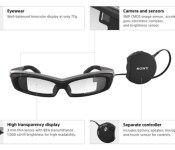
Sony has made it official with their announcement today that they will start selling their SmartEyeglass Developer Edition SED-E1 starting in March in ten countries and they are even taking pre-orders starting today in the U.K. and Germany. Sony is also releasing the official version of the SmartEyeglass SDK so developers can start working on porting their apps over to the device.
Sony indicates several SmartEyeglass apps will be available from Google Play once the devices start to ship. These include the Twitter and Facebook apps we already knew about along with the official SmartEyeglass app used to configure settings on the device. Sony indicates apps for Gmail, reading RSS feeds, calendar, and voice control will also be available.
Sony is hoping the SED-E1 version sets itself apart from a device like Google Glass by providing a binocular display in which information is displayed on top of the lens the user looks through rather than using a dedicated HUD display the user has to glance over to see.
Sony is making this particular model of SmartEyeglass available to developers in Japan, the U.S., the U.K and Germany starting in March. Enterprise customers will have access shortly thereafter, also in March, in France, Italy, Spain, Belgium, Netherlands and Sweden. Sony is pricing the SED-E1 version of their smartglass device at $840 USD.
Anyone out there considering investing in a pair of these?
Click here to view the embedded video.
source: Sony
Come comment on this article: Sony announces release of SmartEyeglass Developer Edition SED-E1

Sony releases official SmartEyeglass app, demo video for SmartEyeglass Attach

The signs that Sony is getting close to releasing their head-mounted wearable devices are starting to add up. Last week we saw an FCC filing surface for the SED-E1 accompanied by the release of official social media apps for Facebook and Twitter intended to operate on SmartEyeglass devices. Now Sony has released their own dedicated app for SmartEyeglass to the Google Play store.
The SmartEyeglass app is intended for the same model, SED-E1, that just passed through the FCC. According to Sony’s description, the app will be used to control different settings of SmartEyeglass and manage the apps the device can access.
Sony has also released a video that demonstrates their SmartEyeglass Attach device, which is supposed to be the version of SmartEyeglass that can be attached to any pair of eyeglass or sunglasses. This contrasts with Google Glass which has a dedicated frame that the unit rides on. The demo video also shows some use cases indicating how Sony sees the device being able to augment reality for the user.
You can check out the video below and the Google Play listing for SmartEyeglass using the links below.
Click here to view the embedded video.


Come comment on this article: Sony releases official SmartEyeglass app, demo video for SmartEyeglass Attach
Sony tests the waters for self-driving cars with a small investment

Apple and Google aren’t the only tech giants exploring the brave new world of self-driving cars. Financial Times tipsters report that Sony has invested roughly $842,000 into ZMP, a Japanese autonomous vehicle startup. While it’s a small start, Sony apparently has big plans — it wants to combine its cameras with ZMP’s robotics to develop “self-driving technologies.” That doesn’t necessarily mean you’ll see a Sony-branded ride, but you could easily find the company’s equipment inside cars from various marques. The move at least makes sense. Sony is already working on automotive cameras, so it’s no big leap to translate that experience to hands-off transportation.
Filed under: Transportation, Sony
Via: CNBC
Source: Financial Times

Android Authority this week

It was a very interesting week in the world of Android. OnePlus caused quite a stir when it announced it hired key Paranoid Android developers to help create Oxygen OS. A mystery Nvidia device was teased for next month. The long awaited Xposed framework update for Lollipop finally landed. We heard several credible reports about the Galaxy S6 and S6 Edge. Sony introduced its low-cost Xperia E4. Lollipop updates hit more devices. Xiaomi introduced itself to the US and said it would open an accessories store later this year. And we heard rumors about Google’s plans with Android One and a new payment service.
Inside AA HQ
A little PSA: by now I probably shouldn’t tell you that online security is important. This week Google launched a little promo where they give you 2GB of free Drive storage (you can’t ever have enough) for doing a little security checkup. Basically, take a look at all the security options that are available (2-step verification is particularly important) and make sure you have them set up properly. I personally did just that, not for the free storage, but because a lot in my life depends on the security of my Google account. Do yourself a favor this weekend and make sure your account is as secure as possible.
With Valentine behind us, you can almost smell spring in the air. For tech geeks, that means… new devices. We just reviewed the amazingly thin Dell Venue 8 7000, the G Flex 2 is in the house, and more great stuff is incoming. For a little teaser, Ash did an epic history of Nexus video – keep an eye out for it this Monday, and trust me, it’s going to be worth it.
If it’s Sunday, it’s a new giveaway! This week we are giving away a Nexus 9 Android tablet.
The Friday Debate Podcast
The stuff you shouldn’t miss
Here are some interesting posts for your Sunday reading:
- Opinion: Mark looks at the factors holding back the smartwatch as a concept
- Review: Josh reviews the affordable and attractive Huawei Honor 6
- Versus: It’s battle of the beasts, in our Nexus 6 vs iPhone 6 Plus comparison
- Feature: Simon weighs in on the state of battery tech in the mobile industry
- Tech talk: Snapdragon 810 benchmarks shed some light on the overheating speculation
- Review: Taylor reviews the intriguing Dell Venue 8 7000

Top news of the week
And here are the top news in the Android world this week:
OnePlus
- OnePlus One will be available without an invite every Tuesday
- OnePlus One OTA update arrives with MaxxAudio and Swiftkey
- OnePlus hired the key people behind Paranoid Android/

New Nvidia device
- Rumor: Tegra X1 powered SHIELD Tablet in the pipeline
- NVIDIA press invitations rolling out, new gaming product coming March 3rd
Xposed is back
- Xposed Framework for Android 5.0 Lollipop coming “soon”
- Xposed Framework for Android 5.0 Lollipop now available

Galaxy S6 rumors and reports
- Alleged Galaxy S6 Edge benchmark shows top of the line specs
- Bloomberg confirms “all-metal” Galaxy S6 and Edge, as more renders and schematics surface
- Samsung promises intelligent Galaxy S6 camera, new details leaked
- Galaxy S6 to have user un-installable bloatware, Material Design improvements, and more
- First video teaser for Galaxy S6 is all about the camera

Lollipop updates
- Android Lollipop arrives for the Samsung Galaxy S4 in India
- LG G3 Lollipop update rolling out for AT&T users
- T-Mobile Lollipop OTA for HTC One M8 landing on Feb. 9 (Update: Feb. 10)
- Lollipop update hitting Galaxy Note 4, starting in Poland
- Galaxy Note 2 to receive Android Lollipop, says Samsung Poland
- Android Lollipop arrives for the Moto Maxx and Moto E, in select markets
- Samsung Galaxy Note 4 (SM-N910F) and Note 3 LTE (SM-N9005) receive Lollipop 5.0.1
Xperia E4

Xiaomi
- Xiaomi plans to launch US e-commerce site this year
- Xiaomi event takeaway – Xiaomi is getting ready to play with the big boys

- Google Helpouts to shut down April 20th
- Helpouts: A dissection – What went wrong?
- Google Maps adds lane guidance for 15 new European countries
- Google is working on a new Bluetooth-based payment service
- Report: Google in talks with developers to subsidize app data costs
Sound off
We always want to hear your feedback. Whether it’s criticism or praise, feel free to tell us what you think about Android Authority’s content, design, and community. Comment here or get in touch with us on our social channels:
Happy Sunday!
 AIVAnet