



Beats Music builds a unique, if messy, listening experience around emotion

The Beats empire has officially expanded beyond its humble headphone roots. In just a few hours Beats Music will officially launch, and become the latest contestant for your streaming music dollar. Of course, the market for such services is already pretty crowded. Between Spotify, Google Play and Rdio (just to name a few) one might wonder “why bother?” Well, the company thinks there’s plenty of fish in the sea who haven’t jumped aboard the music subscription bandwagon just yet. While we’re sure execs are hoping to convert a few listeners along the way, they’re more concerned with broadening the pool of customers. After two years of plugging away, with a little help from Trent Reznor and its MOG acquisition, Beats feels it has something unique to offer; something built around curation, emotion and a personalized user experience. It all sounds good in theory, but the real question is whether or not the reality lives up to the promise. As usual, the answer is complicated and it awaits you after the break.
The initial setup experience, which we’ve already given you a rundown of, is quite different from most services. The app spends a good amount of time getting to know you and your tastes. You’ll tap (like), double tap (love) and long press (hate) your way through bubbles bearing genres and artists. It doesn’t take long, and Beats Music immediately starts serving up musical suggestions based those choices. The first tab you see in the app, Just for You, is populated based on your listening habits. So, on first launch it’s primarily built around your professed preferences from the “on-boarding” process. But over time, thanks to algorithms created with the help of both behavior and data scientists, it should grow smarter. Granted, in our limited time with the app it was hard to spot a difference. A few days didn’t exactly give Beats a chance to figure out the finer details of our tastes (liking Vampire Weekend does not equal liking Fleet Foxes). That said, it quickly learned this editor had an obsession with Bruce Springsteen, and served up a new album from the Boss’ catalog every time it launched.
Swipe to the right of the Just for You tab, and you come face to face with The Sentence. This is one of the interesting and bizarre features of the app. The Sentence is just that, a Madlibs-style fill in the blank statement. Tell it that “I’m at my computer & feel like partying with my inner child to hair metal” and you’ll get an automatically generated playlist of retro rock tunes with big guitars and simplistic lyrics (think girls and partying). Go with “I’m at the gym & feel like running with my pets to vintage soul & funk” and you’ll get a selection of treadmill-worthy gems from Funkadelic, Kool & the Gang and the The Gap Band. Of course, odd things occasionally slip in, like the late-era Marvin Gaye cut Third World Girl, but for the most part it does a decent job of matching up with your mood. Besides, just like its competitors, you can fine tune its selections by taping love it (a heart icon) or hate it (a heart with an X through it). You can even share your sentences on Facebook or Twitter and invite others to give the tailored listening experience a try. All told, Beats claims there are a 1,000,000 possible sentences and we’re sure that will grow over time.

From there, Beats Music turns into a more traditional listening experience. The Highlights tab serves up a curated selection of playlists and albums chosen by taste-makers like former Pitchfork and XXL writers. But there is no personalization to be seen here — Highlights serves up the same exact content to every listener, such as a themed collection of songs dedicated to Martin Luther King Jr. The same is true of Find It, the next and final tab, which allows you to browse playlists, albums and artists based on genre, activities and curators. If you’re planning a summer cook out, the BBQing section under activities has a host of playlists conducive to grilling up some burgers. Wondering what Pitchfork thought the best tracks of 2013 are? You’ll find a playlist dedicated to just that under Curators. If you swipe to the left from most screens you’ll reveal a pop out menu with a search option that lets you pull up a specific artist, album or song. There’s also options here to browse your playlists or your library, the latter of which are songs and albums that you’ve pinned for easy access. (That’s right, no saving albums as playlists here, huzzah!) So long as you’re a paying subscriber, you can download any of this content for listening offline and it will never expire and force you to re-download.
On the whole Beats has succeeded at building a mobile-first service that offers something its competitors don’t. The human-curated playlists are top notch and features like The Sentence allow users to create a more unique listening experience than simply starting a radio station based on a song or artist on Pandora. But there’s still a lot of work to be done. For one, there are some glaring holes in its 20 million song catalog. And those holes go beyond expected omissions like Led Zeppelin. Pull up Black Sabbath and you’ll discover none of their pre-1980 albums are available. Oddly, they’re listed in the artist’s library, but grayed out and tapping play does nothing. We encountered the same phenomena with the Velvet Underground’s White Light/White Heat, a song sitting smack in the middle of one of those much-touted curated playlists.

The other major short-coming (other than some stability issues, which we’re willing to forgive in the beta version of the app we used) is the app’s design. The company says its guiding principle was to focus on function, and build something simple and accessible for those that don’t consider themselves early adopters. But there are plenty of questionable interface decisions. For one, the left-hand slide out menu doesn’t work when viewing a playlist or currently playing track. And, while it will function when you’re browsing around other parts of the app, the visual indicator of its existence disappears the moment you leave the home screen. It’s also far too easy to accidentally open up the right-hand social menu (which is also inconsistently available) when trying to swipe between tabs. If you tap on the track name or album art in a playlist, instead of directly on the play button sitting between those two, you’re taken off to the artist’s profile rather than treated to a tune. And, if you’re already on the artist page, tapping a track title does absolutely nothing. Many of our issues might seem less onerous after getting more familiar with the app, but our initial impression is that the interface is simply too busy and inconsistent.
Despite its problems, Beats Music is still a pretty compelling product. If you’re not yet hooked on Play Music’s ability to plug holes by uploading your own files, or on Spotify’s robust social features it’s certainly worth giving this new comer a look. It has all the basics down pat and at least partially succeeds in its quest to build unique features around the inherently emotional experience of listening to music. Sure, playlists curated by major music publications aren’t quite the same as getting a personal recommendation from a clerk at Other Music, but its a heck of a lot closer than letting Pandora serve up a random series of tracks based on a song’s “musical genome.”
Beats Music will be available on January 21st with subscriptions starting at $10 a month. Those still clinging to their MOG accounts will be migrated to the new service over the next 90 days.
Billy Steele contributed to this report.
Filed under: Home Entertainment, Software, HD, Mobile

Google starts banning Chrome extensions bought by shady ad firms

A brouhaha over adware-laced Chrome extensions has forced Google to remove two from its store and possibly exposed a wider issue. According to the original developer of “Add to Feedly,” the problems happened after he sold his plug-in — created in a few hours — to a party for a too-good-to-be-true “four-figure” sum. As detailed in a blog, he discovered that new code was injecting ads into every page browsed without approval, angering users and lowering its rating. The same thing happened with “Tweet This Page,” another app that served up unwanted ads after being sold. Since other developers were also approached, there’s speculation that it could be a new type of scam: buying perfectly good extensions, altering them and then letting Google slip them to users via automatic updates. After it was contacted by the WSJ, Google pulled the renegade extensions, saying that recently altered terms of service prohibit them. However, that’s only because they didn’t ask user permission; there’s nothing to prevent apps from inserting such ads — something to keep in mind the next time you tweak Chrome.
Via: The Verge
Source: WSJ, Amit Angarwal

Android 4.4 for LG Optimus G and Optimus G Pro spotted in Testing
 After HTC announced that its HTC One X and One X+ would not be moving past Android 4.2.2, many phone owners could be forgiven for thinking that their manufacturer would also be leaving them high and dry without a software update past Jelly Bean. Not so for some LG owners as Android 4.4 for LG Optimus G and LG Optimus G Pro has been spotted in the wild being tested.
The User Agent profiles, first seen on Phone Arena, appear to list quite a few models of both the LG Optimus G and LG Optimus G Pro suggesting that Android 4.4 is being tested for these devices. This is great news for Optimus G owners in particular as many of them have been wondering what’s been taking so long seeing as it is basically the same device as the Nexus 4. All the same, it’s great to know that LG is still support at least some of its devices, even if Android 4.4 for its flagship LG G2 is still no where to be seen. No word on when the update will become available, but we’ll let you know when we do.
 Any owners of an Optimus G or Optimus G Pro excited to hear that Android 4.4 exists for your device and is being tested right now? Let us know how you feel in the comments.
Source: Phone Arena

Android 4.4.2 Update For Galaxy Note 3 Rolls Out, Kernel Source Available Now
 Late last year, an alleged Samsung internal document appeared to suggest that Android KitKat would become available for the Galaxy S4 and Galaxy Note 3 in January 2014, and sure enough, the Android 4.4.2 update for Galaxy Note 3 started rolling out last week. Reportedly starting its roll-out in Poland, the update will be rolling out to all Note 3s with model number SM-N9005 presumably in the near future; sorry Note 3 owners with carrier versions, you’ll have to hold your breath a little longer.
If you do have a SM-N9005 and you can’t wait for the OTA update, you can try your luck by downloading the update files over at SamMobile.
 Accompanying the roll-out of the Android 4.4.2 update, Samsung has made the kernel source files available for all the excited developers out there. The files are available now on Samsung Open Source for download so hit the source link below if you’re interested in tinkering with the newest update.
Let us know if you get the Android 4.4.2 update on your Note 3 and how you find it.
Source: SamMobile, Samsung Open Source via Android Police (1), (2)

Valve: The future of Virtual Reality is just one year away

The most exciting aspect of contemporary virtual reality is its implications. Even using Oculus VR’s early duct taped-prototype, most users immediately “get it.” You’re transported to, say, Tuscany, or an underwater exploration vehicle, or a space fighter, and that experience is enough to trigger a flood of ideas for other potential interactions — interactions that are dramatically heightened by employing a VR headset. How about deep-sea exploration in 4K? Or maybe Mars? And we’re not talking just video games, but experiences. Valve VR lead Michael Abrash detailed that notion in a recent talk:
“Not only could VR rapidly evolve into a major platform, but it could actually tip the balance of the entire industry from traditional media toward computer entertainment.”
Abrash believes that VR headsets so vastly outperform other interaction methods (TV, theaters, etc.) that how folks absorb media in general may be impacted by the coming wave of head-mounted displays. His concept of our potential future may be distant-sounding, but the beginning of consumer-grade, extremely polished VR headsets isn’t far off: 2015. At least that’s what Abrash and Valve are targeting as primetime for VR, and they’re laying the groundwork right now.
 This is a VR prototype headset from Valve
Valve’s first ever game developer conference, dubbed Steam Dev Days in honor of the company’s ubiquitous digital storefront/ongoing socio-economic experiment, took place this week. Abrash gave a talk titled “What VR Could, Should, and Almost Certainly Will Be Within Two Years,” where he detailed the current state of VR, what challenges the technology faces going foward, and when he (and Valve) believe it’ll be ready for primetime. In it, he established a baseline of standards for VR: perfect timing to lay a base given Oculus VR’s own standards for VR game development going live at nearly the same time.
First, any VR headset needs to create “presence” for the person using the headset. Abrash defined presence as such:
“It’s the sense of being someplace else while in virtual reality; many people feel as if they’ve been teleported. Presence is an incredibly powerful sensation, and it’s unique to VR; there’s no way to create it in any other medium.”
Cliché as it is, VR headsets aim to do exactly what their name implies: simulate a new reality for the user, real enough to fool the human brain. Oculus VR CEO Brendan Iribe echoed that sentiment to us earlier this year when he said that the closer the experience is to reality, the better the experience is for the user. Sadly for us writers, “presence” — or rather the experience of using a virtual reality headset and being convinced – is incredibly hard to convey with just words. “Most people find it to be kind of magical, and we think that once people have experienced presence, they’ll want it badly,”Abrash noted during his talk.
Moreover, Abrash thinks that the VR hardware available right now — including the latest Oculus Crystal Cove prototype — is still a step or two away from the specs required for true presence. He even has a list of target specs required for creating presence (which Valve has functioning in an R&D headset right now, and was shown to developers during Steam Dev Days):

The Crystal Cove prototype that Valve provided support for is “a big step in the right direction” Abrash said, but still not enough to create the sense of presence he and Valve are aiming to achieve. While Valve continues R&D on virtual reality hardware — Abrash said “several” companies are working on VR headsets, though we only know of two officially creating consumer products (Oculus and GameFace Labs). The company’s also building out Steam’s VR software support to stay ahead of the curve. That’s why SteamVR just went live (a VR version of Big Picture Mode) in beta; why VR games now have their own category in the Valve’s store; and why the company created the SteamVR API (read: it makes games play nice with the SteamVR platform).
Valve’s yet to give press a chance to try its VR hardware prototype, but developers who tried it at Steam Dev Days are responding positively thus far. It apparently has specs similar to what’s detailed above, and we’re not entirely clear on whether or not it uses a camera in conjunction with the headset for positional tracking (a la the latest Rift prototype). Given Valve’s openness during Dev Days and Abrash’s assertion that Valve is open to working with any partners to push VR forward, we’re certain to hear more in the coming year(s).
Abrash ended his speech with a confident, thrilling statement regarding VR:
“A great VR system at a consumer price in 2015 is more than just possible – it’s sitting there waiting to happen. And it will happen, if not in 2015, then soon after. Virtual reality on the PC over the next few years may be as exciting as anything that’s ever happened in games. We’re sharing what we’ve learned with you, and we’ll continue to do so. There’s a huge amount to be learned and figured out about VR, and we certainly can’t figure it all out by ourselves; I hope that as you dive into VR, you’ll make it a two-way exchange, so together we can make VR one of the great entertainment evolutions.”
Filed under: Gaming, Peripherals, Wearables, Software, HD
Source: Michael Abrash (PDF), Joe Ludwig (PDF)

Android 4.2.2 with Sense 5 Rolling out to AT&T HTC One X+ Devices
 A few days ago we caught a tweet that went out telling everyone that the HTC One X+ would be picking up Android 4.2.2 from AT&T this week. 3 days later, and the update is starting to rollout. That is great news for a good number of you out there. The update Brings in Android 4.2.2 with the Sense 5 UI overlay. WHile it won’t bring in all that is found on the HTC One, it will bring plenty of what is new to your device. Things like the new HTC Gallery, Blinkfeed, updated lockscreen, Daydream and battery percentage notification. It will be missing HTC Zoe and Sense TV.
The update carries a software build of 2.15.502.1 and will be delivered in waves, just like everything else. You can check in settings > AT&T software update > Check for updates > OK. Don’t count on that to pull it any faster for you though. If you do happen to see it pop up, be sure you have asolid Wi-Fi connect and plenty of power handy to download it and get it installed. While you wait, feel free to head over to the HTC One X+ software update page to get the real dirt on what to expect.
Source: HTC Source
Google’s Chrome remote desktop app will come to iOS as well as Android

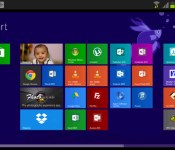
The desktop versions of Chrome make it easy to access remote PCs (and Chromebooks) linked together by your Google account, but this feature hasn’t yet made the trek across to Chrome’s mobile manifestations. We know that an official Android “Chromoting” app (an early build of which is shown in the screenshot above) has been in the works for a while, and now there’s evidence it’ll come to iOS too. Radio chatter between Chromium developers reveals that the iOS version is still at an “unpolished” design stage, but it also suggests that a good few devs have it on their to-do lists — and although we have very little detail about how the final Chromoting app will work, these folks must believe that it’ll do something different (or better, or easier) than the hoards of existing alternatives.
[Image courtesy of Chrome Story]
Filed under: Internet, Software, Mobile, Google
Via: 9to5mac
Source: Chromium

Starbucks plans to secure user information with updated iOS app (update)

Following this week’s revelation that Starbucks’ mobile apps store data such as user names, passwords and even location coordinates in plain text, a company executive announced today that a refreshed application is in the works. Curt Garner, the beverage giant’s chief information officer, says that the new iOS app will “add extra layers of protection” to the “added measures” that he claims already “sufficiently address the concerns” referenced in yesterday’s post. Garner also emphasizes that no information has been compromised using the methods outlined this week. There’s no firm timeline for the updated iOS app, but the company reiterated that the current version offers sufficient protection — and we imagine they’ll be sticking to that story right up until a fix is available.
Update: According to the Starbucks Twitter account, an update is now available. We’re not seeing it via the web, but a check of our iOS device reveals v2.6.2 with “additional performance enhancements and safeguards.” The press release doesn’t go into detail about changes, saying only “As promised, we have released an updated version of Starbucks Mobile App for iOS which adds extra layers of protection. We encourage customers to download the update as an additional safeguard measure.”
Update for Starbucks iOS Mobile App is now available.
– Starbucks Coffee (@Starbucks) January 17, 2014

The Engadget Show 49: CES 2014 wrapup

Grab a wearable, switch on the ‘ole curved TV and fire up your favorite 3D printer. We came, we saw, we conquered and now we’re ready to distill it all for you in the form of some high-quality video content. We’re not going to suggest that it’ll replace the seemingly endless stream of posts we’ve churned out over the past week or so, but if you’ve got a cocktail party full of guests you need to impress tonight, it’ll help you drop some serious CES 2014 tech news knowledge on their collective heads.
We’ve pulled together some top editors to offer up an abbreviated view of tech’s biggest show of the year, charting trends in old standby categories like HDTV, mobile, tablets and cars, to emerging spaces set to define the changing face of the show for years to come. Oh, and we’ve also tossed in some fun video of the show’s gadgets, because, well, it wouldn’t be much of an Engadget Show without that sort of thing, now would it? Toss in a bit of video of your long-time host getting a bit welled up the end, and you’ve got yourself a little thing we like to call The Engadget Show 49.
‘Til we meet again, Engadgeteers.
Filed under: Announcements, Cellphones, Desktops, Cameras, Displays, Misc, Gaming, GPS, Handhelds, Home Entertainment, Household, Laptops, Meta, Peripherals, Podcasts, Portable Audio/Video, Robots, Tablets, Transportation, Wearables, Wireless, Storage, Networking, Science, Internet, Software, HD, Mobile, Alt, Apple, Samsung, Sony, Microsoft, HTC, Nokia, ASUS, Google, Amazon, Verizon, Sprint, AT&T, LG, AMD, Intel, Blackberry, T-Mobile, HP, Dell, Acer, NVIDIA, Nikon, Canon, Facebook, Nintendo

Rdio now lets you listen to tunes for free on the web

Good news, Rdio loyalists: Spotify users aren’t the only ones who are now able to stream music for the unbeatable price of free. Presumably as a result of the Cumulus Media deal revealed earlier this year, Rdio customers can now listen to the entirety of the service’s streaming library via a desktop browser for zero cost, as long as they’re willing to sit through a few ads. According to Rdio, those interstitials will consist of “new feature announcements, messages from partner brands, notifications about exclusive content and other helpful tips.” Of course, if commercials aren’t your thing, you can still cough up $9.99 a month to get rid of them courtesy of Rdio’s Unlimited service. Combined with free mobile stations and lots more supported countries, Rdio is certainly helping to make the streaming music space a whole lot more competitive.
Filed under: Internet, Software
Source: Rdio

